
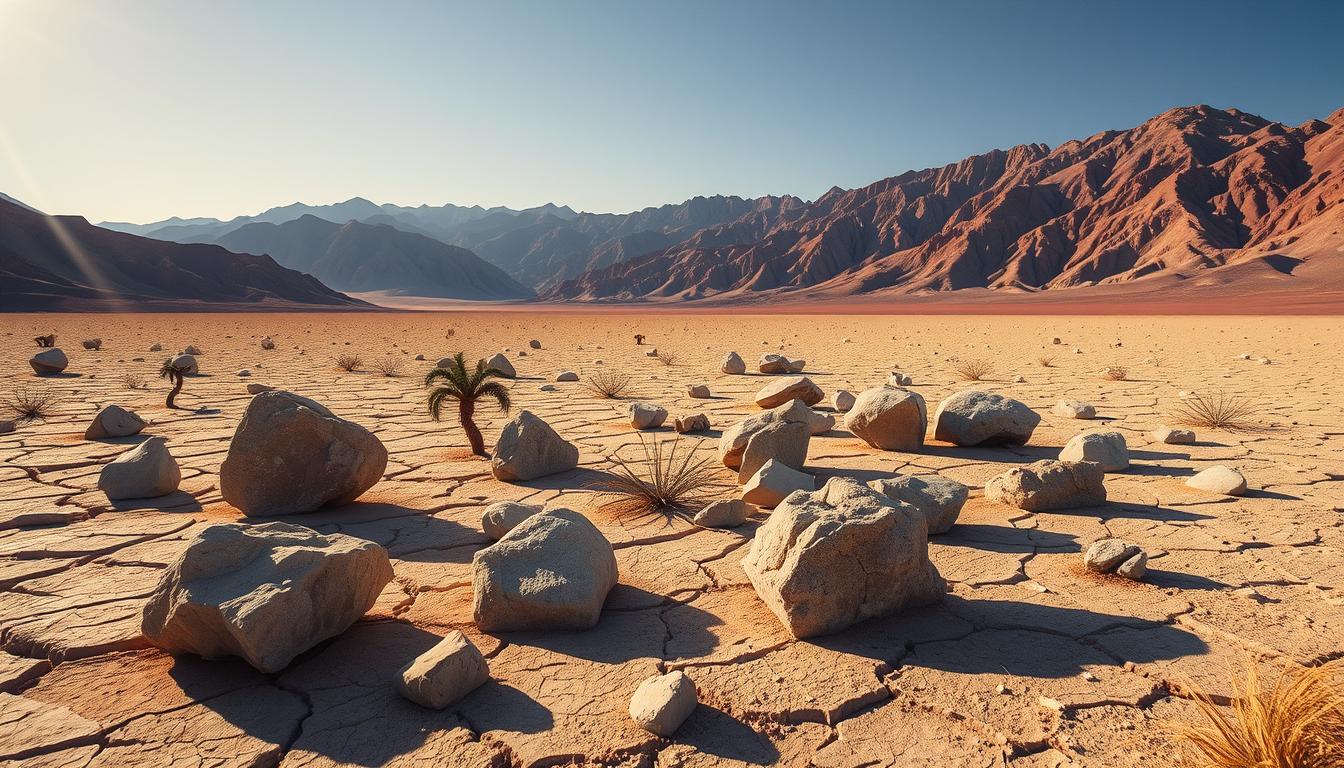
In Death Valley National Park, there’s a place called Racetrack Playa. Here, rocks move on their own, leaving long tracks. These rocks, known as Death Valley rocks, have puzzled scientists and visitors for over a century.
How do these heavy stones glide without any obvious force? Their trails can stretch up to 330 feet. This shows us nature’s hidden forces at work.
Researchers have been studying these sailing stones for over a century. In 2014, a team from Scripps Institution of Oceanography and NASA found a link to winter storms. Thin ice forms on wet lakebeds, breaking into panels that push rocks as winds reach up to 90 mph.
Yet, even today, the full secret of these sliding rocks remains a mystery.
From tiny pebbles to 700-pound boulders like Karen, these stones create tracks that last years. While science explains part of the puzzle, the rare moments when Death Valley rocks shift keep the world wondering.
Introduction to Mysterious Moving Rocks
At Racetrack Playa in Death Valley National Park, a mystery unfolds. Stones, some as heavy as 700 pounds, move across the dry lake bed. These sliding boulders have puzzled people and scientists for over a century.
Tracks in the mud show they travel hundreds of feet. But no one has seen them move. This has left everyone wondering.
Death Valley’s Racetrack Playa is famous for these moving stones. It’s a 3-mile-long, 2-mile-wide dry lake bed. The flat, cracked surface is like a stage for these mysterious wanderers.
Records show some stones, like “Sliding Pete,” moved 15 feet in a minute. But most move slowly, leaving trails over years. The first report was in 1915 by prospector Joseph Crook.
By the 1940s, researchers started tracking the stones’ paths. But they couldn’t find the answers.
Modern studies, like the 2013–2014 project, used GPS and cameras. They found ice sheets thinner than a pencil and winds over 50 mph were important. But these conditions happen very rarely—just 0.0001% of the time.
Even today, visitors are amazed by the tracks left behind. They don’t know about the freezing rain and sun needed to start these journeys.
The Science Behind the Movement
At Racetrack Playa, a unique blend of weather and physics causes rocks to move. The ice sheet theory shows how winter rain freezes into shallow pools overnight. These pools turn into thin ice around rocks, making them float.
When sunlight hits, the ice breaks into panels. Gentle winds, up to 9 mph, then push these ice slabs. This wind-driven movement moves rocks across muddy surfaces, leaving long trails.

“The ice acts like a sail, amplifying wind force,” said researchers tracking the process.
In 2014, scientists from Scripps Institution solved the mystery. They used GPS trackers and cameras to study the movement. Rocks weighing 700 lbs slid at 4 mph during winter storms.
The scientific explanation relies on specific conditions. Ice must be 3–5mm thick, water just inches deep, and winds strong. Rocks moved for seconds to 16 minutes, leaving trails visible for years.
Most movement happens every 2–3 years, with 60+ rocks shifting at once in 2013. This rare combination of rain, cold, and wind creates a brief window for the phenomenon. Modern technology has captured this dance of geology and climate, ending decades of speculation.
Notable Locations of Moving Rocks
Death Valley sailing stones attract adventurers to Racetrack Playa, a unique spot in Death Valley National Park. This area, 3 miles by 2 miles, turns into playa lakes after rain. It’s the perfect setting for its mysterious rock movements.
Visitors must travel 82 miles from Furnace Creek Visitor Center. They face 30 miles of rough, unpaved roads that need 4×4 vehicles. Even when it’s calm, the playa is fascinating. A 2013 study found rocks moved at 2–5 m/min during winter days when ice sheets broke under sunlight.
“The rocks moved in sunlight, defying old theories that needed hurricane-force winds.”
Nearby Little Bonnie Claire Playa in Nevada also has similar phenomena but on a smaller scale. While Death Valley’s rocks leave trails up to 224 meters, Nevada’s stones travel shorter distances. Globally, places like the Uyuni Salt Flats suggest similar mysteries, but none are as famous as Racetrack.
Most visitors see rocks that don’t move, as movements are rare. Over 95% of tracked rocks stayed put for years in the 2011–2013 study. But when ice, wind, and sun meet, the stones glide, leaving paths across the desert. For the brave, Racetrack Playa offers a glimpse into Earth’s quietest enigmas.
Theories That Explain the Movement
For decades, the rock movement theories about Death Valley’s sliding stones varied widely. Early sailing stone explanation ideas included magnetic fields, animal interference, or even aliens. Researchers like Bob Sharp and Dwight Carey tracked rocks in the 1960s, but the Death Valley mystery remained unsolved. Today, scientists focus on natural forces.

In 2013, scientists watched 60 rocks move at 15 feet per minute during a rare rain. The sailing stone explanation became clear: ice sheets. Rain creates thin ice around rocks. When it warms up, wind pushes these ice rafts across wet clay, moving rocks.
This breakthrough came from the Slithering Stones Research Initiative. They placed GPS-equipped stones on Racetrack Playa.
“Ice lubricates the surface, turning wind into motion,” explained researchers studying the 2013 data. Winds at 70 mph, combined with freezing nights and sunny days, create the perfect storm for movement.
Dr. Paula Messina’s GPS mapping of 162 rocks showed trails up to 3,000 feet long. Even small gusts could start motion, disproving earlier theories about extreme weather. While the ice theory is now widely accepted, the Death Valley mystery isn’t fully solved. Some stones move in loops or sudden bursts, hinting at undiscovered factors. Science continues unraveling this iconic natural puzzle—one scientific theories at a time.
The Impact on Local Ecosystems
The movement of rocks in Death Valley’s playa environment leaves marks that show its power. These tracks change the Death Valley ecosystem by eroding the land. They can be 330 feet long and a few inches deep, affecting soil and water.
These changes impact plants and animals living there. They help hardy species survive in this harsh place.
Human actions cause more harm than nature. In 2016, off-road driving damaged 10 miles of the playa. It took 750 gallons of water and a lot of work to fix it.
Now, efforts focus on teaching visitors to stay on trails. This helps protect the area.
Plants like creosote bush and soil microbes need undisturbed surfaces to live. Animals, from insects to lizards, depend on the playa’s changes. But, human carelessness is the biggest danger.
By protecting this ancient dance, we ensure future generations can see its beauty. This way, we keep the Death Valley ecosystem safe and intact.
Cultural Significance of Moving Rocks
Death Valley folklore is rich in stories from Indigenous tribes. The Timbisha Shoshone told of rocks moved by spirits or magic. These tales make Racetrack Playa a sacred place, mixing mystery with cultural heritage.
Moving rocks attract tourists from far and wide. Racetrack Playa is a hotspot for those eager to see “sailing stones.” It’s like Earth’s most magical gallery. Social media and documentaries like Nova have made it a global wonder.
“You have to be kind of a nerd to appreciate what is here… sit in awe of how it all happens!”
Even those who doubt the phenomenon are amazed. In 2014, scientists found ice sheets pushing rocks. Now, tours mix science with stories, respecting both. As more people visit, park rangers work to keep it special for everyone.

Research Efforts and Studies
Death Valley research into its sliding rocks started in 1948. Geologists Jim McAllister and Allen Agnew mapped the Racetrack’s bedrock. Their geological investigations set the stage for decades of curiosity.
By the 1960s, Bob Sharp and Dwight Carey marked 30 rocks with numbered stakes. They tracked their paths for seven years. These early moving rocks studies showed trails hundreds of meters long but left the causes unknown.
In 2011, researchers placed GPS trackers on 15 rocks for scientific monitoring. After two years, data from 2013 gave them clues. Thin ice, light winds, and wet mud were key factors.
The 2014 study in PLOS One confirmed rocks hydroplane on ice-flecked ponds. They move at 2-6 meters per minute. Thin ice (under 5mm) and 3-5 m/s winds were essential. Three scientists even filmed the first-ever video of rocks sliding.
Though the ice sheet theory solved the mystery, questions remain. Climate change might reduce pond formation, slowing movement. The 100-year quest shows patience and tech can unlock nature’s secrets, even in Death Valley’s extreme conditions.
The Role of Technology in Understanding Movement
Technology has solved the mystery of Death Valley’s sliding rocks. Time-lapse photography has changed how we document rock movement. Cameras at Racetrack Playa took pictures every hour from 2011 to 2013. They caught winter storms turning the dry lakebed into a slippery ice stage.

GPS units were placed in 15 rocks to track their movement. They moved up to 15 feet per minute during winter freezes. Thin ice, just 2-4 millimeters thick, acted like a sail, pushed by winds up to 90 mph.
Scientific tools like moisture sensors and wind gauges showed how rain, cold, and wind worked together. A 2013 storm brought 1.5 inches of rain and 7 inches of snow. This created the perfect conditions for the rocks to move.
These tools ended decades of mystery. Time-lapse photography and GPS tracking proved ice rafts, not just wind, moved the rocks. Modern technology turned brief natural events into something we can study. It shows even harsh deserts have a delicate dance of weather and geology.
Common Misconceptions About Moving Rocks
“Various and sometimes idiosyncratic possible explanations have been put forward over the years that have ranged from the supernatural to the complex.”
Moving rocks myths mix truth and fiction. Many believe magnetic fields or aliens cause the stones to move. But, decades of science prove it’s ice, water, and wind that do the trick.
Ice forms on the playa when it floods. Then, as the sun melts it, the ice panels move rocks across the muddy surface. This rare winter event is what makes the stones move.
Some think strong winds alone are responsible. But, wind is just part of the process. It’s not just about wind. It’s about the whole chain of events happening together.
Dust devils or hurricanes aren’t needed. The stones move only after the dry lakebed fills with rain and freezes overnight. Then, when the sun warms it, the ice breaks, and the rocks slide.
Visitors often hope to see rocks moving. But, most movements are unseen. They happen in winter, under specific weather conditions. The average tourist might not see it for years.
The park’s harsh climate changes the landscape. In summer, it’s dry and cracked. In winter, it floods. This makes it hard to see the rocks moving.
Biological soil crusts help hold the ground together. But, they don’t affect the rocks moving. These ancient organisms grow slowly and are easily damaged by foot traffic. It’s important to protect them for the site’s natural balance.
Learning about sailing stones facts helps debunk myths. The 2014 discovery ended years of guessing. But, people are always curious. Explorers can admire the tracks left behind, even if they rarely see the rocks move.
Education helps visitors understand this natural wonder. It shows the science behind the moving stones. This way, they can appreciate it even more.
Conclusion: The Ongoing Fascination
Natural wonders like Death Valley’s sailing stones show Earth’s secrets are not all revealed. Even with science explaining their movement, these mysteries spark endless curiosity. The 2011 footage and 2014 studies on ice’s role in their glide are fascinating.
But, climate change is a threat. Warmer winters might stop these rare movements. Protecting Death Valley ensures future generations can see these wonders.
Environmental conservation is essential for these sites. The 2013 theft of rocks from Racetrack Playa shows we need to care for these places. Visitors must respect these fragile ecosystems.
Exploring these sites with care preserves the landscape and the science behind them. Research on climate’s impact on these movements is growing. By valuing these mysteries, we honor Earth’s hidden stories and our duty to protect them.
The sliding stones of Death Valley are more than a curiosity. They remind us of our responsibility to safeguard our planet’s enigmas.