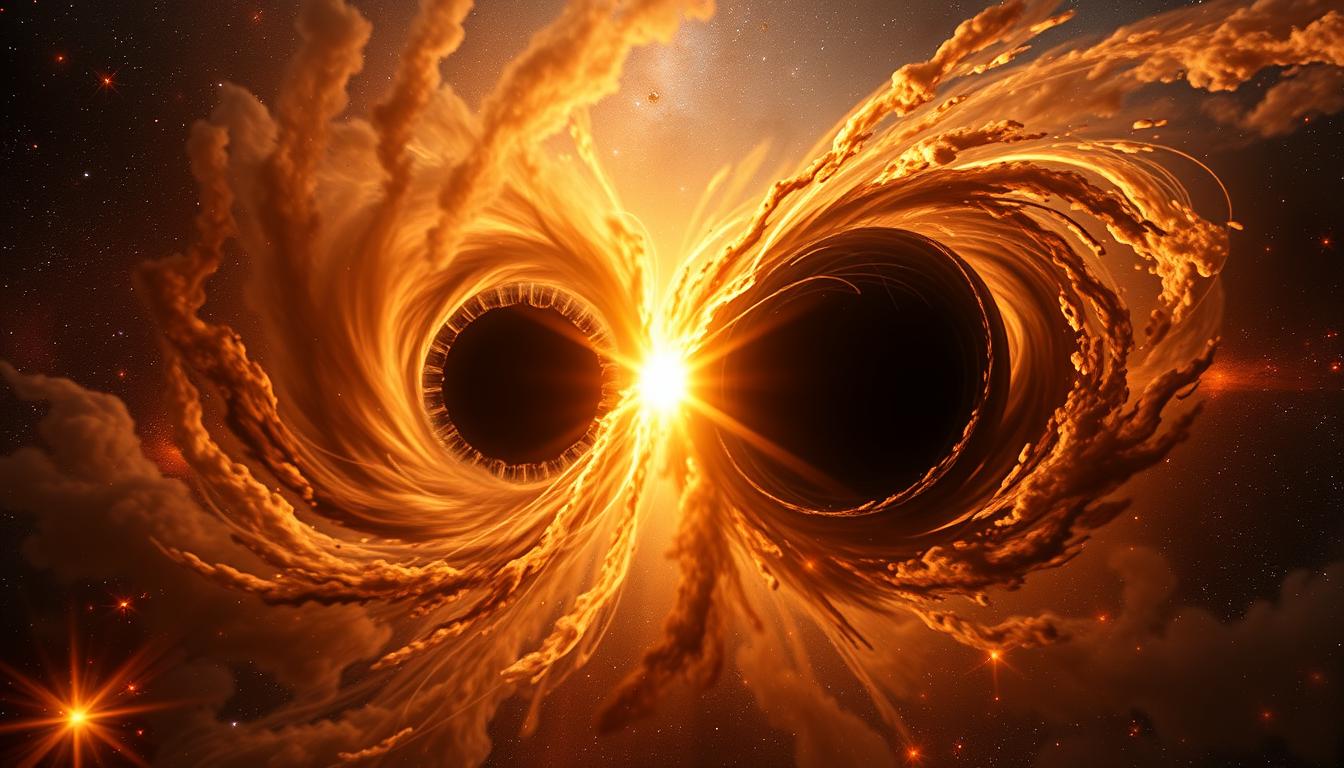
When two black holes collide, they merge into a single, massive black hole. This cosmic event releases more energy than all stars in our universe. The Milky Way and Andromeda galaxies will merge in 4 billion years, pulling their central supermassive black holes into a gravitational dance.
In UGC 4211, a galaxy 500 million light-years away, two supermassive black holes orbit each other. They are separated by 750 light-years and will merge in 200 million years. This merger will create a single giant black hole.
These collisions produce gravitational waves. These waves are invisible ripples that map the universe’s hidden dynamics.
The 2015 discovery of gravitational waves from colliding black holes earned a Nobel Prize. Future telescopes like the Laser Interferometer Space Antenna (LISA) aim to detect waves from supermassive pairs. They will reveal how cosmic collisions shape galaxies and space itself.
Understanding Black Holes
Black holes are created when massive stars collapse or galaxies expand. Stellar black holes come from exploding stars and weigh 5–40 times our sun. On the other hand, supermassive black holes can weigh millions to billions of solar masses and are found at the centers of galaxies.
Our Milky Way has a supermassive black hole at its center. It’s waiting for Andromeda to come closer. This could lead to a merger between the two galaxies.
Black holes have a secret: the singularity. It’s a point where gravity is so strong that it warps space and time. The event horizon is the point of no return for anything caught in its pull.
NASA’s Chandra X-ray Observatory and LIGO’s detectors help scientists study black holes. LIGO has detected nearly 100 black hole mergers, mostly from stellar pairs. These mergers send out gravitational waves that LIGO can detect.
Stellar black holes orbit galaxies like cosmic ghosts. Supermassive black holes, on the other hand, control how galaxies grow and evolve. As telescopes get better, scientists hope to learn more about how these black holes shape the universe.
The Nature of Collisions
Binary black holes come from two massive stars collapsing at once or when galaxies merge. These pairs are held together by gravity, starting a slow dance through space. Over millions of years, they spiral closer, their orbits getting tighter in the inspiral phase.

As they get closer, gravitational waves take away energy, speeding up their black hole orbits. The 2015 LIGO detection showed two black holes, 36 and 29 times the sun’s mass, merging. In just 0.2 seconds, they released energy 100 times brighter than all stars. This leaves behind a single, larger black hole, with some mass turned into spacetime ripples.
We can’t see these collisions directly, but gravitational waves tell us a lot. The Milky Way and Andromeda will merge in the future, their supermassive black holes dancing toward a massive collision billions of years from now.
The Science Behind Black Hole Mergers
Einstein’s theories helped us understand black holes. His general relativity predicted gravitational waves. These are ripples in space-time from massive objects colliding.
LIGO first detected these waves in 2015. In 2019, LIGO and Virgo found GW190412. This event showed two black holes merging, one three times heavier than the other.
Computational astrophysics uses supercomputers to model these events. They show how black holes merge, releasing up to 10% of their mass as energy. This energy is so bright, it outshines galaxies.
But, there’s a catch. Modeling these events is hard. It’s hard to include all the details, like how spin and mass ratios affect the outcome.
GW190412’s mass ratio was unique. It might have come from a previous merger or a dense cluster environment. Scientists use these hints to test Einstein’s theories under extreme gravity.
Even small differences could show us new physics. With tools like NANOGrav, scientists hope to find even bigger mergers. This will help us learn more about black hole physics.
Observing Black Hole Collisions
Gravitational wave detection has changed how we see the universe. Scientists can now “hear” cosmic events that telescopes can’t see. The LIGO observatory and Virgo detector use laser beams to measure tiny changes in space.
When black holes collide, these machines pick up the waves. It’s like listening to the universe’s hidden music.

In May 2019, a big discovery was made. The LIGO and Virgo team found GW190521g, a black hole collision. This event was special because it showed a new way to study the universe.
The Zwicky Transient Facility (ZTF) at Palomar Observatory helped find light signals related to the event. This was a big step forward in astronomy.
“This is the first time we’ve seen hints of black hole mergers and light emissions together,” said a researcher behind the Physical Review Letters study. “It’s like seeing and hearing a cosmic event at the same time.”
These discoveries open new doors for studying the universe. While telescopes can’t see black holes, gravitational waves reveal their mergers. As LIGO and Virgo get better, we’ll learn more about these cosmic giants.
The Impact of Collisions on Space-Time
When black holes collide, they shake the universe’s foundation—its space-time fabric. These cosmic crashes send gravitational wave ripples outward, just as Einstein’s predictions described. In 2016, scientists first captured these waves, confirming how massive objects warp reality itself.
Imagine dropping a stone in water: the waves spread, stretching and squeezing space. Detectors like LIGO spot these space-time distortions smaller than a proton’s width. Future missions like the ESA’s LISA will track even older collisions, revealing how galaxies grow through these cosmic quakes.
Supermassive black holes, millions of suns in mass, spiral closer over millions of years. Their final plunge creates shockwaves felt across galaxies. Each merge tests physics, showing how space-time distortion shapes the cosmos. As they collide, their energy echoes through billions of years, rewriting our grasp of the universe’s hidden architecture.
The Role of Black Hole Collisions in the Universe
Imagine the Milky Way merging with Andromeda in four billion years. This isn’t just a collision—it’s a key step in galaxy evolution. When galaxies collide, their black holes move towards each other, merging into supermassive giants. These events shape cosmic structure, making galaxies denser and forming clusters.
Black hole collisions drive black hole growth, a key part of universe formation. Supermassive black holes like Sagittarius A* (4.3 million solar masses) and the Large Magellanic Cloud’s 600,000 solar mass black hole grow by swallowing gas and merging. This growth builds the universe’s architecture, with small structures merging into larger ones over billions of years.
When two supermassive black holes, like those in UGC 4211 (125 million and 200 million solar masses), spiral together, they release energy. This energy reshapes their host galaxies. Such mergers, expected to finalize in 200 million years, send shockwaves through star-forming regions. These events are part of a cosmic cycle where collisions sculpt galaxies and fuel the universe’s evolution. Every merger is a step in the story of how gravity and chaos sculpted the cosmos into the web-like cosmic structure we observe today.
Theoretical Models of Black Hole Collisions
Black hole collisions are invisible to telescopes. But, theoretical physics helps predict their behavior. Scientists use numerical relativity to create theoretical models of these events.
These black hole simulations run on supercomputers. They solve Einstein’s equations, showing how spacetime warps during mergers.
Simulations break collisions into phases. These include the inspiral (orbiting dance), merger (violent clash), and ringdown (final quakes). By comparing these predictions to real gravitational wave data from LIGO, researchers confirm or refine their models.
For example, LIGO’s 2015 upgrades boosted sensitivity. This let it detect waves matching these theoretical models. Every signal helps test Einstein’s theory under extreme conditions.
Recent studies from Caltech and Johns Hopkins show simulations agree on key details. Like energy released during mergers. Yet, some findings hint at nonlinear effects in gravity.
This means waves might interact in ways current theoretical physics hasn’t fully captured. This suggests models need updates to handle these complexities.
These advances matter because LIGO’s detections rely on matching real wave patterns to simulated ones. By improving numerical relativity methods, scientists sharpen their grasp of spacetime’s behavior. Every breakthrough brings us closer to seeing how black holes shape our universe, one collision at a time.
Famous Black Hole Collision Events
GW150914 was a groundbreaking moment in 2015. It was the first time LIGO detected gravitational wave events. This event showed two black holes, each 29 and 36 times the sun’s mass, merging 1.3 billion light-years away. Their collision was so powerful, it released more energy than all stars combined, proving Einstein right.
UGC 4211 is home to an amazing sight: two supermassive black holes. They have masses of 125 million and 200 million solar masses. They are only 750 light-years apart, making them the closest confirmed pair. Chiara Mingarelli, a study author, says:
“This pair was really exciting because they’re so close and nearby.”
This close proximity allows scientists to study them in many ways. It helps us understand how galaxies change after a merger.

In 2019, GW190521 amazed scientists with a 150-solar-mass black hole. This was much bigger than expected. Such findings help us learn more about black holes. Upcoming projects like the Next Generation Event Horizon Telescope will give us sharper images and more gravitational wave events. This will help us understand these cosmic giants even better.
Implications for Physics and Cosmology
Gravitational waves from black hole collisions are changing what we know about fundamental physics. The 2020 Nobel Prize-winning detection of our galaxy’s central black hole shows how these events test gravity’s limits. When two black holes merge, their ripples in spacetime act like cosmic labs for testing Einstein’s theories under extreme conditions.
These mergers also serve as “standard sirens” to measure the universe’s expansion rate. By analyzing gravitational wave data from events like GW150914, scientists refine estimates of the Hubble constant. Recent studies link black holes to vacuum energy, showing new paths to resolve tensions in cosmological constants. Findings show supermassive black holes’ growth tracks the universe’s expansion, a phenomenon called cosmological coupling.
Confirming Hawking’s area theorem with 95% confidence after 50 years marks a milestone in physics breakthroughs. The 132,000-square kilometer jump in event horizon size during mergers validates theoretical predictions. These insights challenge existing models, revealing gaps in our grasp of how black holes evolve over billions of years. By tracing their growth across nine billion years, researchers now see ties between black hole physics and the 70% dark energy shaping the cosmos.
Future experiments will expand these frontiers, using mergers to map the universe’s architecture. Every collision becomes a clue in solving cosmic puzzles—from dark energy’s nature to the fate of spacetime itself. These discoveries prove black holes are more than celestial oddities—they’re cosmic laboratories revealing the universe’s deepest secrets.
Future of Black Hole Research

Future observatories like the LISA mission will change how we see cosmic events. The LISA mission is a set of space-based detectors orbiting Earth. They will catch gravitational waves from supermassive black hole mergers.
Unlike LIGO, LISA can detect longer wavelengths. This means it can see events that happened billions of years ago.
“Detecting the gravitational wave background would map the entire cosmic history of supermassive black holes,” says astronomer Chiara Mingarelli. This background, a chorus of ripples from countless mergers, holds clues to how galaxies evolved.
New tools will help answer big questions. For example, how did the first supermassive black holes form? Do their collisions warp spacetime differently than smaller pairs?
The LISA mission will watch mergers from when the universe was younger. Next-gen telescopes will search for light flares tied to these events. Simulations of binary star systems will help predict merger rates and black hole numbers.
By 2030, upgraded detectors might find 1,000 mergers a year. Projects like the Einstein Telescope aim to measure black holes’ spins and masses with great detail. These tools make the universe a lab, testing Einstein’s theories under extreme conditions.
Conclusion: The Fascinating Universe of Black Holes
Black hole collisions are changing what we know about the universe. The discovery of GW190521g by LIGO and Virgo shows us how gravitational waves uncover secrets. These waves, once just ideas, now help us see the universe in a new way.
As technology gets better, we can explore even the darkest parts of space. This is exciting for those who study the cosmos.
Our future in space exploration will answer big questions. For example, how do supermassive black holes merge? What causes light signals from invisible collisions? NASA and the National Science Foundation are working on these mysteries.
They use pulsar timing arrays and next-gen telescopes. These tools might find waves from mergers billions of light-years away. This could tell us more about the universe’s structure.
Every new finding, like the 2019 merger and the 2.5-billion-light-year distant supermassive pair, shows how much we don’t know. The final parsec problem and the search for light signals in gas disks keep us curious. As our tools get better, we get closer to solving the universe’s oldest mysteries.