
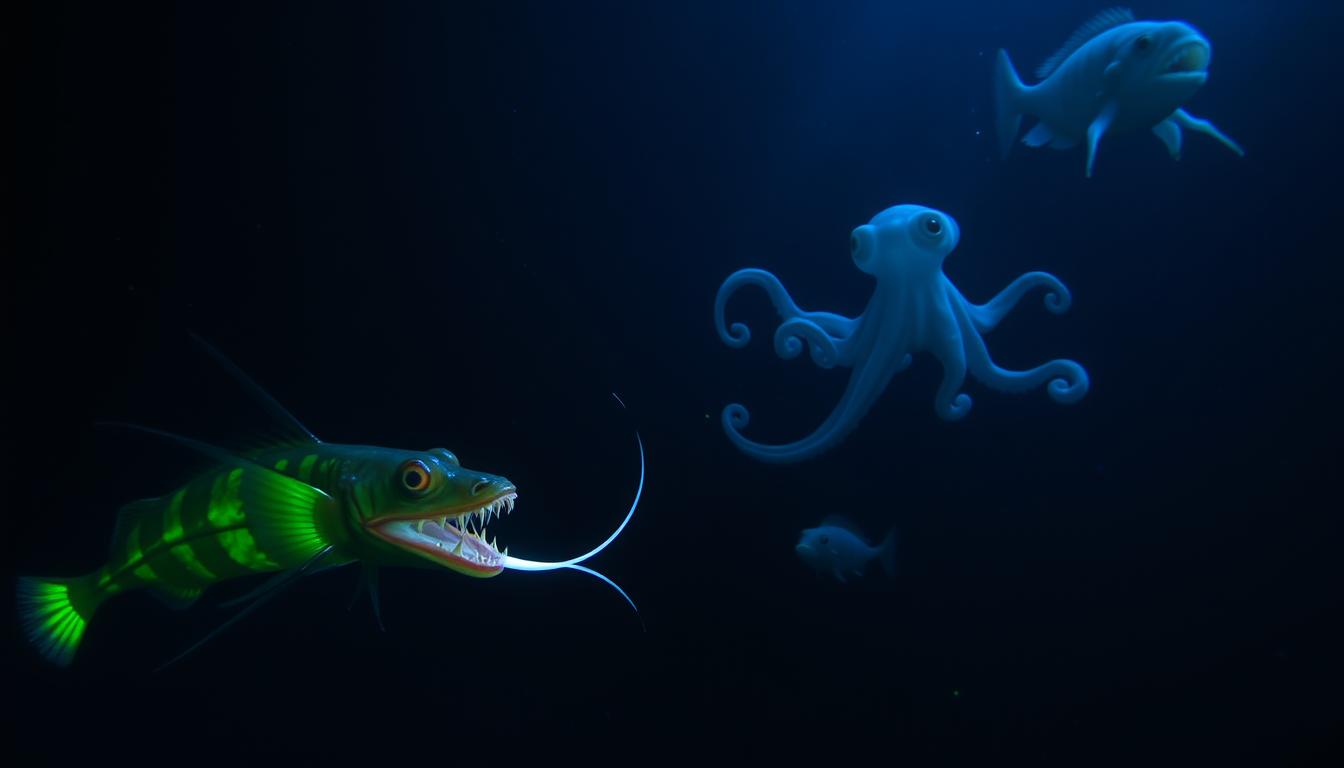
Most people think of dolphins or clownfish when they think of the ocean. But deep down, there are bizarre creatures that live in the dark. The giant oarfish can grow longer than a school bus, and the frilled shark looks like it’s from another time.
These fish glow in the dark and have heads you can see through. They show us that life can be very different under the sea.
Only a small part of the ocean has been explored. This means we’ve seen creatures like the barreleye with a see-through head and the blobfish, which looks like a blob. They live in places where no sunlight can reach.
These fish have evolved to survive in extreme conditions. Every time we find a new species, it reminds us of how much we don’t know about the deep sea.
Introduction to Freaky Fish Species
Life in the ocean’s depths is full of survival tricks that land creatures can’t imagine. In extreme marine environments, where sunlight is gone and pressures are crushing, fish develop deep-sea adaptations to survive. Their strange features are not random—they are survival blueprints.
Imagine fish with teeth like needles or bodies that glow in the dark. These traits help them hunt, mate, and avoid danger in endless blackness.
Pressure at 2,600 meters is enough to crush a human, yet creatures like the knifenose chimaera thrive there. They handle the crushing weight through pressure adaptations like flexible bones or special enzymes. Some, like the knifenose chimaera, have four top teeth and two bottom ones to snap prey in total darkness.
Bioluminescent fish light up their world. They have glands that produce their own glow to find food or mates. These bioluminescent fish turn their bellies into lanterns, creating shimmering displays in eternal night. Even their senses shift—some rely on smell or electric fields instead of sight.
Survival here means weirdness. Expandable stomachs swallow meals whole. Translucent skin or see-through body parts help sense vibrations. These traits aren’t just odd—they’re lifelines in a world where sunlight never reaches.
The Anglerfish: Nature’s Deep-Sea Performer
In 2020, a rare black seadevil anglerfish made headlines after surfacing near Spain’s Canary Islands. These deep sea predators live in depths over 200 meters, where it’s dark. They survive with a glowing angler fish light, as mysterious as the depths they inhabit.

The bioluminescent lure hangs from a fleshy stalk above their mouths. Inside, symbiotic bacteria light up, attracting prey. When prey gets close, the anglerfish’s jaws snap shut fast.
Reproduction is also strange. Tiny parasitic males find females using special senses. When they find a mate, males attach themselves permanently, merging tissues and blood. A female can have many males, ensuring fertilization in the dark.
Recent studies show more surprises. Despite harsh conditions, anglerfish genetics haven’t changed much over millennia. Over 250 research papers from 2013 highlight their slow evolution. They adapt to stability, not rapid change. Even their immune systems allow males to bond with females, a unique connection.
Anglerfish are a marvel, with glowing lures and unique partnerships. They show us the deep sea’s mysteries, one strange discovery at a time.
The Blobfish: A True Face of the Deep
The blobfish was named the world’s ugliest animal in 2013. Its gelatinous body often makes people laugh. But, this “ugly” look is just the surface.
Deep down, 3,000 feet under the ocean, the blobfish thrives. It can float easily because its body is less dense than water. Pictures of its droopy face are from when it’s pulled up too fast from the deep.
At such great depths, the pressure is incredibly high. Yet, the blobfish’s body is perfectly adapted. It doesn’t have a swim bladder, which helps it avoid collapse.
Being called world’s ugliest animal is unfair. They lay 100,000 eggs at a time and eat sinking plankton. Despite their looks, they’re key to deep-sea life.
Found in 2003 off Australia and New Zealand, blobfish face dangers from trawling. Efforts are being made to protect their home. Next time you see a blobfish, think of its amazing adaptation, not just its looks.
The Goblin Shark: The Living Fossil
In the ocean’s darkest depths, the goblin shark (Mitsukurina owstoni) lives as a piece of history. This deep sea shark species has been around for millions of years, connecting us to prehistoric ocean creatures. Its pinkish skin and long snout are unique, but its protrusible jaw is the most striking feature.

When it hunts, the shark’s jaw shoots out fast, catching prey in the dark. It has many teeth to grab onto squid, fish, and crustaceans. This helps it survive in the deep sea.
People rarely see this shark, mostly when it gets caught in nets. Most sightings are near Japan, where 30 are caught each year. Scientists are curious about its long life and how it reproduces. Despite being listed as “Least Concern,” it remains a mystery, living in the dark depths of the ocean.
The Mola Mola: The Ocean Sunfish
The giant ocean sunfish, or mola mola, is the largest bony fish on Earth. It can grow up to 10 feet tall and weigh over two tons. Its unusual fish anatomy has a rounded body and a short tail, making it look like a giant head swimming.
These surface-dwelling giants are found in temperate and tropical waters all over the world. They often float near the ocean’s surface. Here, they bask in sunlight to keep their body temperature stable after diving deep.
Despite their huge size, mola mola mainly eat small prey like jellyfish. They can eat up to 220 pounds of jellyfish daily. Their diet also includes crustaceans and squid, showing their adaptability.
Females release up to 300 million eggs at once, the highest number of any vertebrate. Yet, only a few survive to adulthood. Young mola mola grow fast, gaining hundreds of pounds in just a year.
Mola mola face threats from bycatch in fisheries and plastic ingestion. Over 340,000 are caught annually in South African longline fisheries. Their thick skin often traps parasites. Conservation efforts aim to reduce accidental captures and marine debris.
These mysterious giants remind us of the ocean’s resilience—and fragility.
The Lanternfish: Masters of Bioluminescence
Lanternfish are tiny but very common bioluminescent species in the mesopelagic zone. They light up with photophores, making cool deep-sea light patterns. These mesopelagic fish use light to hide from predators in the dark ocean.

Every day, these fish go on a huge vertical migration. They swim up to eat at night and down to hide by day. This journey is the biggest animal migration on Earth, moving carbon from the surface to the deep. Their lights also help them find mates and confuse enemies.
Some lanternfish, like the stoplight loosejaw, have red light that most can’t see. This red glow helps them sneak up on shrimp. Scientists at places like the Scripps Institution study these tricks, learning how light helps deep-sea creatures survive.
Lanternfish are key to the ocean’s food chain, becoming food for whales, squid, and seabirds. Their glowing bodies show us how much we don’t know about our oceans. As we explore the ocean, these glowing fish teach us about our planet’s health.
The Pufferfish: Toxicity and Beauty
Meet the pufferfish, a creature where danger and artistry collide. When threatened, these puffer fish species deploy their iconic inflation defense. They puff into spiky spheres up to four times their normal size. This dramatic display, fueled by gulped water, leaves predators wary of a mouthful of poison.
Hidden in their tissues lies tetrodotoxin poison, a toxin 1,200 times deadlier than cyanide. No antidote exists, yet Japan’s chefs master its preparation. They serve fugu sushi with precision honed over years of training.
Beyond their deadly reputation, males of some puffer fish species create breathtaking underwater sand patterns. Japanese pufferfish sculpt spirals and ridges in seabed sand. They craft geometric masterpieces up to seven feet wide.
These nests, built over days, signal readiness to mate. Scientists marvel at the precision—tiny fins shaping art rivaling human-made designs. Some nests even incorporate shells and debris, proving beauty isn’t just skin-deep.
Over 120 puffer fish species thrive worldwide, from coral reefs to freshwater rivers. Despite their tiny size—some as small as 1.5 inches—these fish wield survival strategies millennia in the making. Their toxin, gathered from diet, becomes a silent shield.
Yet their artistry, like their poison, cements their place as ocean’s paradox: fragile yet fierce, deadly yet dazzling.
The Leafy Sea Dragon: A Marine Mimic

The leafy sea dragon, a relative of seahorses, floats in Australian coastal waters like a seaweed strand. Its body has leaf-like appendages that confuse predators, making it a master of marine camouflage. Found from Victoria to Western Australia, these creatures live in kelp forests up to 50 meters deep. They grow up to 24 cm and move slowly, relying on their disguise to survive.
“The leafy sea dragon is one of nature’s most exquisite creations.” – David Attenborough
Though not currently endangered, these fish face threats from habitat loss and illegal collecting. Their endangered sea life status in human care shows their fragility. Males carry eggs on their tails, but only 5% of hatchlings survive due to predators and environmental stressors.
Protected in key states, their survival depends on preserving seagrass ecosystems. Public fascination drives conservation efforts, like the 2005 Leafy Sea Dragon Festival, which drew thousands to advocate for their survival.
Beneath their whimsical appearance lies a delicate balance. As climate change impacts Australian coastal waters, their survival depends on balancing tourism, research, and habitat preservation. Their story is a reminder of the ocean’s hidden marvels—and the urgent need to protect them.
The Arapaima: Ancient Freshwater Giant
The Arapaima, or pirarucu, is a true Amazonian megafish. It can grow up to 15 feet long and weigh over 400 pounds. It lives in the Amazon’s murky waters.
This air-breathing fish surfaces every 10–20 minutes to gulp air. It survives where oxygen is scarce. Its armored scales, tougher than steel, protect it from predators like caimans and piranhas.
Scientists classify the Arapaima as an ancient fish species. Fossils show it has changed little in 13 million years. Indigenous tribes have hunted it for millennia.
But modern overfishing and habitat loss pushed it toward collapse. Today, sustainable fishing practices are reversing this trend. Brazil’s protected zones and community-led hatcheries allow stocks to recover.
Conservationists partner with locals to monitor breeding and enforce catch limits. The Smithsonian’s National Zoo even breeds Arapaima to study their survival traits. Their comeback shows that balancing tradition and science can protect these living fossils for future generations.
Conclusion: Celebrating Ocean Diversity
From anglerfish with glowing lures to blobfish with gelatinous grins, the ocean is full of wonders. These creatures show us the ocean’s endless creativity. They remind us that marine life shapes our world.
Yet, 80% of the ocean floor is unexplored. Secrets like self-fertilizing mangrove killifish and new species could change medicine or tech. Protecting these areas is key to finding these breakthroughs.
Ocean conservation is more urgent than ever due to climate threats. Droughts and wildfires in California show how vulnerable coastal areas are. Rising seas threaten Bay Area homes and $750 billion in value.
But there’s hope. Supporting marine protected areas and reducing plastic pollution can help. Every action we take helps protect the 91% of ocean species we don’t know yet.
Future discoveries await in the unexplored ocean depths. Imagine life thriving in hydrothermal vents or adapting to acidifying waters. The mangrove killifish’s ability to survive droughts and breathe air shows life’s incredible adaptability.
Yet, without protection, these wonders face extinction. As temperatures rise and storms intensify, protecting marine life is vital. Let’s explore responsibly and protect the unseen worlds beneath the waves.