
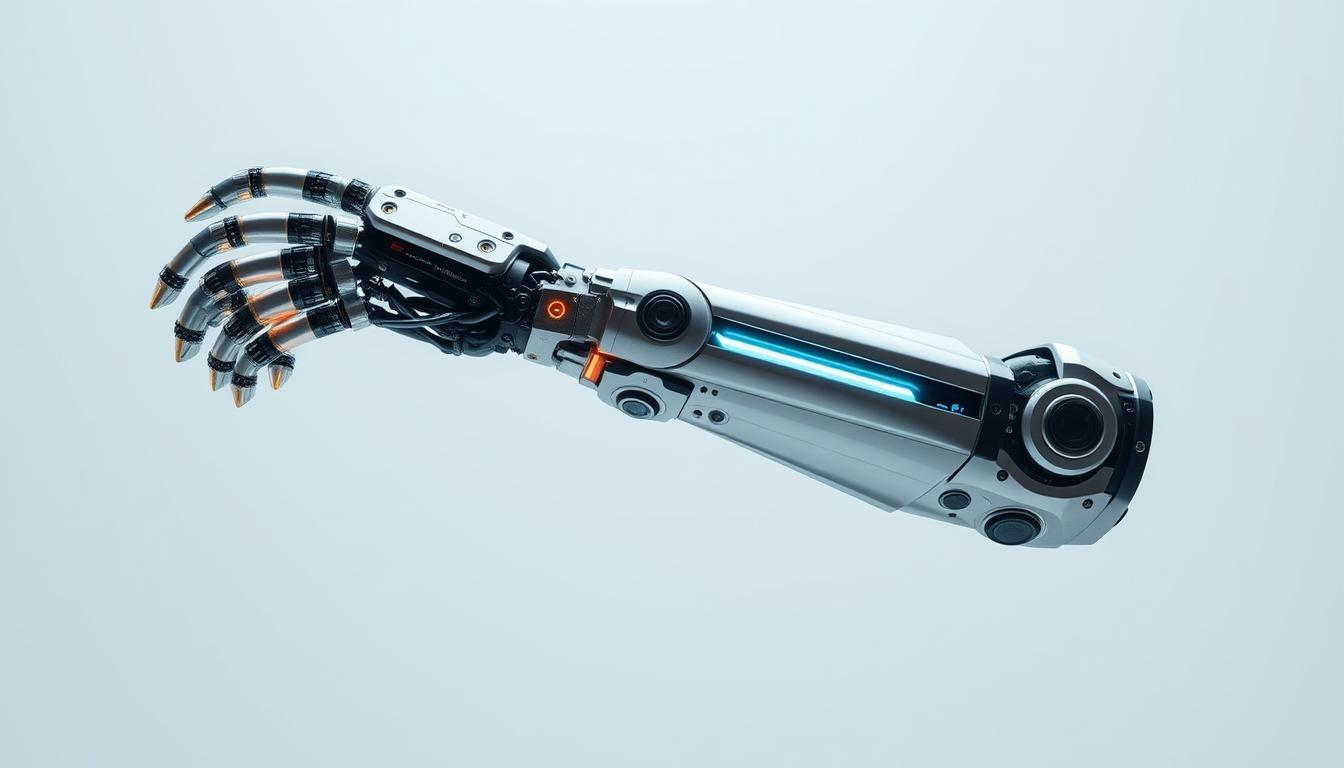
Bionic limbs are no longer just in science fiction. They are changing our world. The term “bionics” came up in the 1960s, mixing biology and electronics. It started with simple artificial limbs from 600 BC and now we have advanced robotic prosthetics.
Devices like the Ability Hand1 use sensors and myoelectric systems. They respond to muscle signals. The Utah Bionic Leg is lighter, using the user’s energy for longer battery life.
Today, bionic limbs like those using osseointegration connect directly to bone. This allows for more intuitive control. But, 44% of users stopped using prostheses because of discomfort.
Innovations like Dr. Marasco’s feedback systems and PSYONIC’s TensorFlow-driven algorithms are trying to solve this problem. Research is growing, from clinical trials to DARPA’s brain-linked hands. These advancements are bringing artificial limbs closer to being part of our bodies, combining science with real-world needs.
Understanding Robotic Prosthetics and Their Evolution
Prosthetic history goes back thousands of years. The oldest known prosthetics were Egyptian artificial toes from around 1000 BC. They show early efforts to help people move again.
By 300 BC, a Roman nobleman used a wooden leg with a movable knee. For a long time, these devices focused on basic function, not comfort. Wars later led to new ideas.
The Civil War era brought the Hanger limb, a wooden prosthetic with rubber for comfort. This was a big step towards making prosthetics more comfortable.

“Leonardo da Vinci’s 1495 sketch of a spring-driven arm hinted at possibilities beyond static limbs, blending art and engineering.”
Now, bionic technology leads the way. New materials like carbon fiber and microprocessors have changed things. Today’s robotic prosthetics, like Vanderbilt University’s powered ankle system, can adjust to different surfaces.
But, there are big challenges. High costs and insurance issues make it hard for people to get these prosthetics. The U.S. Department of Veterans Affairs is working to help. They want to make sure new technology is available to everyone.
This journey shows how robotic prosthetics now combine biology and technology. They are changing what we think is possible for humans.
The Anatomy of Modern Robotic Prosthetics
Modern robotic prosthetics are made with precise engineering to look and act like real limbs. They have carbon fiber frames for strength, titanium joints for lightness, and silicone prosthetic interfaces that fit well. These materials make the prosthetics strong yet light, making them comfortable to wear every day.

Inside, bionic hand technology uses batteries, microprocessors, and sensors. These parts work together to turn body signals into movement. Electronic sensors pick up muscle and nerve signals on the skin, sending them to microprocessors. This lets users move their prosthetics like a real hand, whether it’s picking up objects or typing.
Prosthetic interfaces connect the user to the prosthetic. They use surface electrodes or implanted sensors to translate nerve signals into action. Haptic feedback systems add touch, so users can feel pressure or temperature changes. Each prosthetic is customized to fit the user’s body and activities, from work to sports.
Now, prosthetics have AI that can adjust to the user’s habits. New technologies, like neural-controlled limbs, aim to reduce falls and pain. These advancements offer hope for better mobility and independence to the over 2 million U.S. amputees.
Types of Robotic Prosthetics Available Today
Today, we have myoelectric prosthetics, osseointegrated implants, and exoskeletons. Myoelectric systems use sensors to detect muscle signals. They turn these signals into motion. For example, the Esper Hand gets better at gripping over time.
Osseointegrated implants attach directly to bone. They offer stability and help reduce pain from phantom limbs. These implants work well with prosthetic limbs, seen in over 60 cases worldwide.

Exoskeletons help people with paralysis by supporting walking or standing. New breakthroughs include brain-controlled exoskeletons. But, they face challenges like battery life and weight.
Upper limb robotic prosthetics like myoelectric arms are making progress. But, lower limb options are limited, with only a few ankle systems available. Researchers are working on neural interfaces to improve control and natural movements.
Each type meets different needs. Myoelectric hands are great for daily tasks. Osseointegrated implants help with long-term mobility. Exoskeletons offer hope for those with spinal injuries, with ongoing improvements in power and design.
As technology advances, these innovations open up new possibilities for users around the world.
Benefits of Using Robotic Prosthetics
Robotic prosthetics bring big changes, giving users back their independence. They help those with upper limb amputations do things like cook and groom. David Brockman, a retired firefighter, recounts how his myoelectric hand lets him grip a fishing rod again.
Research shows 70% of users find myoelectric prosthetics easier to use than older models. Hybrid prosthetics improve task efficiency by 30%. They help with both small and big tasks.
Psychological benefits are also huge: 50% of users say they feel better mentally after getting prosthetics. TMR surgery reduces phantom pain and improves control.
Advanced tech like the FDA-approved Integrum OPRA implant and AI-driven sensors make these devices smarter. Dr. Nick Langhals says the goal is to restore capability, not just replace limbs. With training, 90% of users adapt well.
For many, these prosthetics mean a new chance at life. Whether fishing, working, or just feeling whole again, they make a big difference.
Overcoming Challenges in Robotic Prosthetics
Robotic prosthetics have made great strides, but they face robotic prosthetics challenges that slow their adoption. A study found that 44% of arm amputees stop using their prosthetics. This is because of issues like short battery life, heavy weight, and limited feedback.
“The gap between tech and usability remains,” says researcher Jonathon Schofield. Even advanced prosthetics struggle to accurately read the user’s intentions. This makes controlling them feel unnatural.

Cost is another big obstacle. Prices for prosthetics range from $20,000 to $100,000. Many people can’t afford them because of insurance gaps. This forces them to pay out-of-pocket, making prosthetics less accessible.
Learning to use prosthetics is also a challenge. Users need to spend hours practicing to get the hang of it. This includes relearning basic tasks, which can be tough both mentally and physically.
Researchers are working hard to solve these problems. They’re using lighter materials and 3D printing to make prosthetics more affordable and customizable. Training programs are also improving, thanks to VR simulations that help users learn faster.
There’s hope for better prosthetics in the future. As technology advances, the goal is to make prosthetics feel as natural as the body they replace.
The Role of Artificial Intelligence in Bionics
Robotic prosthetics AI is changing how bionic limbs work with our bodies. Dr. Thomas Schofield at UC Davis uses EMG sensors to catch muscle signals. He trains algorithms to make these signals into exact movements.
“The system learns patterns from residual muscles, turning subtle contractions into actions like pinching or gripping,” Schofield says. This makes prosthetics easier to control, cutting down on the mental work needed for simple tasks.
Devices like the LUKE Arm by DEKA Research and the Utah Bionic Leg use neural networks bionics to guess what the user wants. They look at sensor data in real time, adjusting things like grip strength or walking patterns. For example, the artificial intelligence prosthetics in the LUKE Arm can tell when you’re holding something fragile, so it grips more gently.
Machine learning prosthetics also get better at adapting. The Atom Limbs bionic arm uses AI to understand brain signals without surgery, making it affordable under $20,000. The Össur Proprio Foot uses AI to adjust to different terrains, mimicking natural walking.
Even feeling textures is getting better. The e-dermis system from University of Chicago researchers lets users feel textures through AI-processed sensory data.
“AI isn’t just improving function—it’s making prosthetics feel like extensions of the body,” says Dr. Robert Armiger, a bionics researcher at Johns Hopkins University.
But there are hurdles to overcome. Dealing with neural signal noise and the need for more computing power is a big challenge. Yet, advances like generative adversarial networks (GANs) are helping. They create fake training data to make prosthetics more accurate. As AI keeps getting better, prosthetics might soon feel almost like a part of us.
Future Innovations in Robotic Prosthetics
Imagine a prosthetic limb that feels touch as naturally as your own hand. DARPA’s 2015 experiment showed a paralyzed man felt sensations through a brain-linked hand. This is a glimpse into the robotic prosthetics future.
Today, neural interfaces are getting better. In 2018, researchers made an electronic “skin” with three layers of sensors. It sends touch signals directly to the brain. Soon, users might grip objects as easily as blinking.
3D printed prosthetics are changing how we access prosthetics. The Utah Bionic Leg uses AI to adapt to users’ movements. FDA-approved devices like the DEKA Arm also allow for complex motions.
Companies like Synchron and Xilloc Medical are working to make prosthetics more affordable. By 2050, 3.6 million Americans may need prosthetics. This growth is driving innovations like self-healing materials and lightweight composites.
“The digital twin of the residuum could prevent 25% of prosthesis abandonment by monitoring health in real time.”
Hybrid designs are combining rigid and soft robotics. They’ve created hands that can grip fragile objects with 99.69% success in lab tests. But, there are challenges like infections and high costs.
Despite these, progress continues. The OPRA implant, with its 2044 patent, promises better stability. As markets grow, the focus is on combining advanced technology with affordability. This will help millions gain not just function—but freedom.
Inspiring Stories of Prosthetics Use
David Brockman’s story is common for robotic prosthetics users. He lost his arm and had trouble with a myoelectric hand. Now, he builds decks with a harness system. His journey shows the importance of trying different prosthetics.
“It looks nice, but it doesn’t work for a physical lifestyle,”
Brockman said of his early prosthetics. Athletes like Sarah Reinertsen and Bethany Hamilton also inspire. They race and surf despite losing limbs, showing what’s possible with technology.
For bionic limb children, prosthetics are more than tools. They wear superhero prosthetics, embracing their devices. Amy Remer, a cancer survivor, got a custom arm through Arms for All. Her story shows how prosthetics can be tailored to fit each person’s needs.
These stories show the strength of people with prosthetics. Heather Mills and Casey Pieretti are examples. They live full lives with prosthetics, proving technology can empower us.
Advancements in Research and Development
Research on robotic prosthetics is moving quickly. At UC Davis, scientists are making TMR better for controlling prosthetics. They aim to let users move their prosthetics like real limbs, thanks to funding from DARPA.
Modern prosthetics focus on what users need. For example, 44% of users stop using advanced prosthetics because they’re uncomfortable or don’t work well. Researchers are working on haptic systems to make prosthetics feel more real.
Teams are now working together to create better prosthetics. This includes surgeons, engineers, and patients. Medicare has started to cover more prosthetic devices, showing they’re valuable. But, there’s a need for more studies that include diverse populations.
The number of people losing limbs in the U.S. is expected to grow. This means more people will need affordable, easy-to-use prosthetics. Advances in 3D printing and AI are making prosthetics cheaper and more customized. The goal is to make sure everyone can benefit from these advancements.