
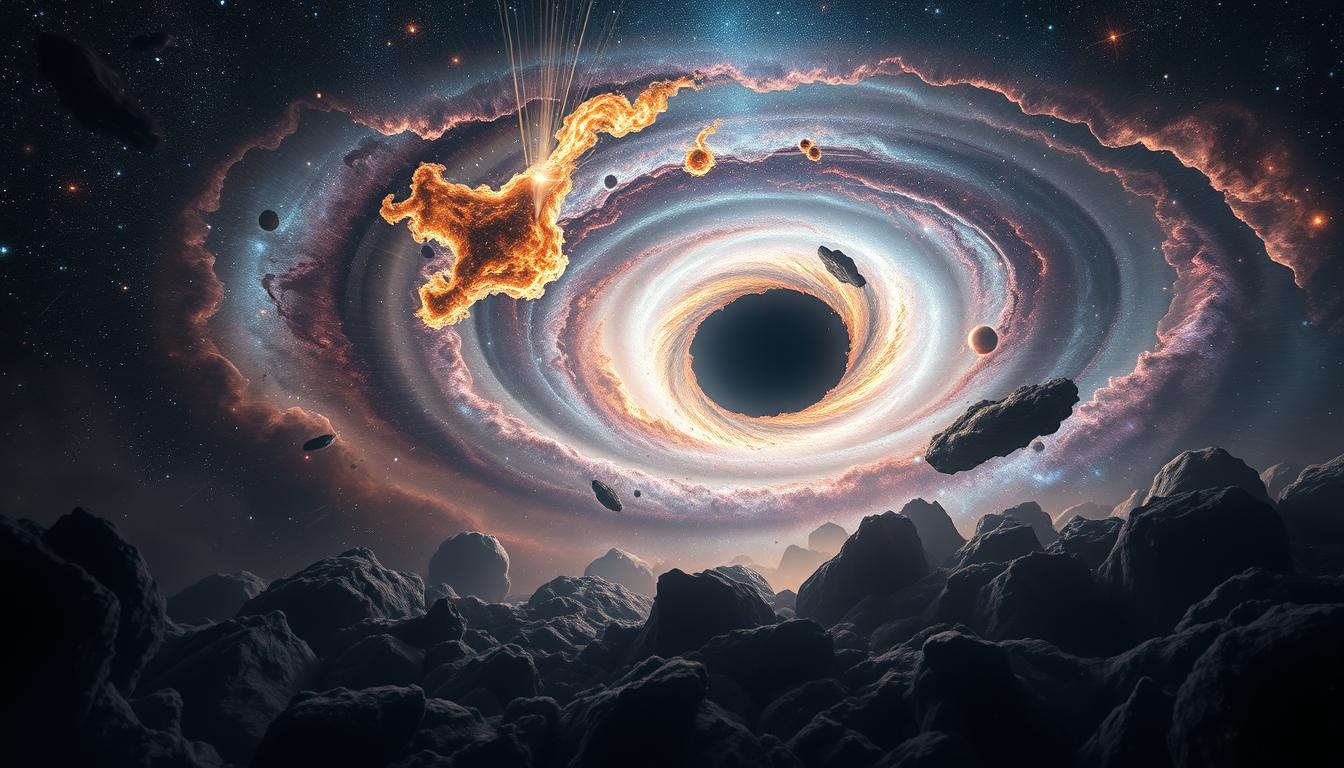
Cosmic mysteries surround us. They stretch from our backyard to the edge of the universe, where 2 trillion galaxies live. Despite advanced telescopes, 95% of the universe is hidden. Dark energy, making up 69% of the cosmos, drives its expansion.
Ordinary matter, like stars and planets, is just 4.5%. This leaves many questions about what else is out there.
Dark matter’s invisible grip on galaxies is a big mystery. The Fermi Paradox also puzzles us: if billions of planets exist, why do we see no alien life? The universe’s birth is also shrouded in mystery.
The Big Bang’s rapid inflation and dark energy’s role are debated. So is the fate of stars in distant galaxies. These enigmas remind us of how much we don’t know, sparking curiosity and discovery.
Introduction to Unsolved Space Mysteries
Our quest to understand the unexplained universe has led to more astronomical mysteries than solutions. Despite telescopes showing us galaxies far away, we’re left with big cosmic questions. For example, why can’t we see dark matter, which makes up 27% of the universe?
And how does dark energy, which is speeding up the universe’s expansion, work? These scientific puzzles show how much we’re missing.
Every new discovery, like the Bullet Cluster’s dark matter find, brings more space phenomena. The Wow! Signal’s 1977 radio burst and the Fermi Paradox, with billions of planets and no alien signals, highlight our knowledge gaps. Even the Sun’s superhot corona challenges basic physics.
These mysteries aren’t just for scientists to ponder—they push science to grow. Tools like the Event Horizon Telescope and the James Webb Space Telescope try to solve these riddles. But often, they lead to even more questions.
Each cosmic question brings us closer to understanding existence. As we explore, the universe keeps us curious, inviting us to discover more.
The Fermi Paradox: Where Is Everybody?
Imagine a universe full of alien civilizations. If life started here, why haven’t we seen extraterrestrial intelligence elsewhere? This question is at the heart of the Fermi Paradox. Physicist Enrico Fermi once asked, “Where is everybody?”
“If they exist, why haven’t they visited us?”

Frank Drake’s Drake equation tries to figure out how many civilizations might send signals. It looks at things like how many stars form and the chance of life evolving. Even with the most optimistic guesses, millions of civilizations could exist. So, why haven’t we heard from them?
One idea is the great filter theory. Maybe civilizations destroy themselves before they can reach space. Or maybe the vast distances make interstellar communication too hard. Signals could get lost over light-years, or advanced beings might choose not to contact us. Scientists keep arguing, showing the Fermi Paradox is more than just a mystery—it’s a reason to keep listening.
SETi scans the sky every day, looking for radio waves or laser pulses. But the silence remains. Are we truly alone, or just early to the cosmic party? The search goes on, driven by curiosity and a desire to answer the ultimate question: are we really alone in the stars?
Dark Matter: The Invisible Universe
Dark matter is the universe’s invisible matter, seen only through its pull on things. It was first spotted by how stars move in galaxies. Stars on the edges move too fast, showing there’s more than meets the eye.
This hidden stuff makes up 27% of the universe, more than all stars and planets. It’s a big part of what holds our universe together.
Gravitational lensing and the 2007 Bullet Cluster collision gave us clues. The Chandra telescope showed dark matter’s mass moved apart from gas in the crash. This proves it’s not just hidden black holes or gas.
These gravitational effects show dark matter’s role in forming galaxies. But, we can’t see its particles.
Scientists think WIMPs (Weakly Interacting Massive Particles) might be dark matter. They’re particles that barely touch normal matter. But, we haven’t found them yet.
Underground labs try to find these particles by blocking out cosmic noise. But, we’re not there yet.
Dark matter’s gravity holds galaxies together, but we don’t know what it is. Finding out could change how we see the world. For now, it’s a mystery waiting to be solved.
Dark Energy: The Universe’s Expansion Mystery
In 1998, scientists found that the universe is not slowing down. Instead, it’s speeding up. This change, caused by dark energy, has changed how we see the universe. It’s believed that dark energy makes up 70% of the universe’s energy, pushing it apart.
Studies of distant supernovae showed galaxies moving away faster than gravity alone could explain. The Hubble constant, which measures how fast the universe is expanding, shows a 9% difference. This “Hubble tension” suggests we need new physics to understand it.
Scientists think dark energy might be vacuum energy or quintessence. Both are trying to explain how dark energy’s push can counteract gravity’s pull. The James Webb Space Telescope’s findings support early dark energy models. But, there’s ongoing debate.
What dark energy is could decide the universe’s future. If its density increases, it could cause a Big Rip, tearing galaxies apart. To find out, scientists are using the Dark Energy Survey and Euclid satellite. They’re studying supernovae and galaxy distributions to learn more. Understanding dark energy could change how we see space, time, and the expanding universe.
Strange Signals: The Wow! Signal Mystery
“Wow!”
— Jerry Ehman’s handwritten note on the data sheet. This 72-second radio burst was detected in 1977 by Ohio State University’s telescope. It is known as theWow!signal. The signal’s 1,420 MHz frequency matches hydrogen’s natural emission, a key target inSETI findingsfor possibleinterstellar messages.
At 30 times louder than cosmic background noise, it seemed like analien transmission. But, it disappeared without being repeated.
The signal’s origin is a topic of debate. In 2016, researcher Antonio Paris suggested it might come from comets 266P/Christensen and Gibbs. These comets emit hydrogen clouds. Yet, they were too far away in 1977 to match the signal’s timing.
In 2020, the Arecibo Observatory found eight weakerextraterrestrial signals near the same frequency. This raised both hopes and doubts.
SETI researchers urge caution. While theWow!signal’s narrow bandwidth fits artificialradio astronomypatterns, there’s no solid proof of alien intent. Each unexplained signal brings us closer to knowing if we’re alone—or if we’re just not listening hard enough.
The Great Attractor: A Cosmic Gravitational Force
In the southern sky, a huge gravitational anomaly pulls our galaxy and thousands more. The Great Attractor was found in the 1970s. It pulls the Milky Way at 600 kilometers per second.
This force is 150–250 million light-years away. It’s hidden by the Milky Way’s dense dust in the Zone of Avoidance. Despite its name, we don’t really know what it is.

Astronomers connect it to the Laniakea supercluster. This is a huge structure 500 million light-years wide. It includes the Norma Cluster with massive galaxy clusters like Abell 3558 and 3565.
But, it’s not just visible matter that pulls. Dark matter is thought to be the main force. Yet, we don’t know where it is exactly. Recent studies have even cut down its mass estimates, making it even more of a mystery.
Some galaxies near the Great Attractor move at millions of miles per hour. Radio telescopes first found these cosmic flow patterns. But, dust blocks our direct view.
Future studies hope to map this gravitational web. They want to show how dark matter and energy shape the universe’s biggest structures. For now, the Great Attractor’s gravity-driven dance of galaxies shows us how much we don’t know.
The Cosmic Microwave Background: Anomalies Explained
The CMB cold spot and the axis of evil cosmology are mysteries in the Big Bang afterglow. This faint glow is leftover radiation from the universe’s start. It shows tiny temperature changes caused by quantum fluctuations right after the universe began.
Scientists thought these changes would spread out evenly. But, CMB maps show strange patterns. The CMB cold spot is a huge 1.8-billion-light-year area that’s much colder than expected. It doesn’t have a clear reason like a huge void.
The axis of evil is a line of temperature differences that matches our solar system’s plane. It suggests the universe might not be perfectly symmetrical. No theory fully explains this.
Some theories say these oddities could be signs of collisions with other universes. They might leave marks in the primordial universe. Others think they might be due to mistakes in data analysis or dust from galaxies.
Researchers keep studying these features to find new physics. The quantum fluctuations that shaped galaxies might also tell us about the universe’s first moments. They might show if inflation really smoothed out the universe as thought.
As telescopes like Planck improve CMB maps, debates grow. Are these just flaws in our models or signs of something beyond? The answers could change how we see the universe’s start—and its possible hidden neighbors.
Rotating Galaxies: Missing Mass Problem
In the 1970s, astronomer Vera Rubin found a big puzzle. Her galaxy rotation curves showed stars at the edges moved faster than thought. Newton’s laws said they should slow down far from the center. But stars moved at almost the same speed, a mystery.
This mystery led to the idea of dark matter. It’s a hidden mass that affects galaxies but can’t be seen.

Galaxies seem to rotate as if they have a galactic halo of invisible stuff. This mass is 5-10 times more than what we can see. It bends light and holds galaxies together with gravity.
But scientists can’t find dark matter particles like WIMPs or axions. Some think modified gravity theories might explain it. These theories say gravity changes over huge distances.
Experiments like the Dark Energy Survey are trying to figure it out. They map 100 million galaxies to test these ideas.
By 2025, the Vera Rubin Observatory will search the skies for answers. It will track how dark matter affects galaxies. This could change our understanding of physics or show we need to rethink gravity.
Alien Life: Are We Alone?
Over 5,000 exoplanets orbit distant stars, with some in exoplanet habitable zones where water could flow. Astronomers look for biosignatures—like oxygen or methane—to find life. The James Webb Space Telescope searches these worlds, looking for signs in their atmospheres.
Earth’s extremophiles live in volcanic vents and deep mines. This shows life could exist in Europa’s seas or Venus’ clouds. The panspermia theory says microbes might travel between planets on asteroids, spreading life.
Scientists also look for technosignatures: radio signals or megastructures that show advanced civilizations. Discoveries like synthetic DNA in 2019 or Mars’ ancient organic molecules give us hope. Missions like Perseverance and ExoMars explore Mars’ soil, while Hubble and JWST study far-off planets.
With trillions of stars and uncharted worlds, the search is vast. But every rock sample and spectral scan brings us closer to finding out if we’re alone.
Voyager Probes: What Lies Beyond?
Launched in 1977, the Voyager probes have changed how we see the edge of our solar system. They crossed the heliosphere, the sun’s magnetic area, and entered interstellar space in 2012 (Voyager 1) and 2018 (Voyager 2). Their journey showed us a solar system boundary much more complex than we thought.
They found magnetic bubbles, plasma changes, and a “magnetic highway” where solar and interstellar fields meet.

The Voyager mission discoveries also showed us the interstellar medium is not as expected. The boundary area is full of charged particles and magnetic chaos. Scientists now know the heliopause moves with the sun’s 11-year cycle.
Voyager 1, about 15 billion miles away, and Voyager 2, over 13 billion miles away, keep sending us information. Their power is fading, but they keep studying the interstellar medium. They might stop sending data by the late 2020s, ending their groundbreaking work.
Even with old systems, the probes’ impact is huge. Their discoveries challenge our understanding of star interactions with space. They show us there are gaps in our theories about the interstellar medium. Future missions like the Interstellar Probe could follow their lead, but funding is a big question. For now, the Voyagers are our only look into the unknown beyond our solar system.
Conclusion: The Future of Space Mysteries
Future telescopes and gravitational wave astronomy will change how we solve cosmic mysteries. The Extremely Large Telescope will see light from the universe’s first galaxies. The Square Kilometre Array will map dark matter’s effects.
These tools might explain why galaxies spin faster than their mass and why the universe expands. Multi-messenger astronomy combines signals from black holes and stars to give us a clearer view. Quantum cosmology could show how space-time works near singularities.
Theorists aim to merge relativity and quantum mechanics. They want to solve the Fermi Paradox, why we haven’t heard from aliens. Future technology, like James Webb’s infrared vision, might find dark energy’s source or signs of life on other planets.
Even the 85% dark matter mystery might be solved soon. Particle detectors and supercomputers are working on it. With each discovery, we get closer to understanding the universe’s birth and future.
Our journey to understand the universe continues. Every answer brings new questions. The next decade will bring new tools and theories to explore.
We’re on the verge of unlocking secrets from the Big Bang to parallel universes. The universe’s story is ongoing, and our curiosity will keep us exploring.