
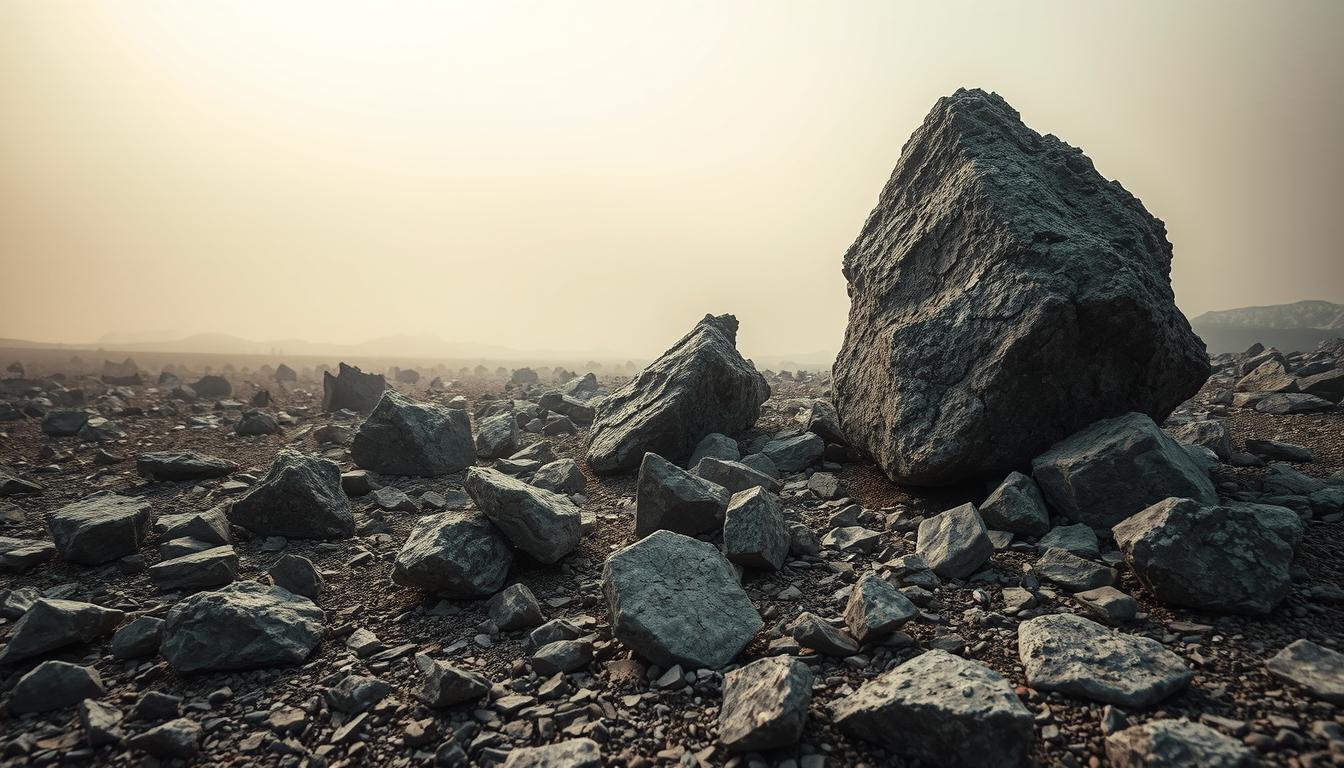
Every year, 1,800 space rocks fall to Earth. They bring gifts like the Edmore meteorite, a 22-pound rock sold for $75,000. The Maryborough meteorite, a 37.5-pound chunk, is the second-largest chondrite found. The Winchcombe is a 4.5-billion-year-old relic, older than Earth itself.
Some meteorite finds change history. The Mörigen Arrowhead’s iron came from a 1500 BC meteorite strike. The Allan Hills 84001, a 13,000-year-old Mars fragment, suggests interplanetary travel. Even Earth sent back the Northwest Africa 13188, the only known rock flung into space and returned.
These cosmic rocks are more than just oddities. The 2013 Chelyabinsk meteor injured over 1,000 people with its shockwave. Scientist Dermot Henry says studying them is like getting a free ticket to the cosmos. Let’s dive into how these space rocks, from small invaders to 16.5-ton giants, reveal secrets of life, time, and our planet’s connection to the stars.
Introduction to Meteorite Mysteries
Meteorites are more than just space rocks. They are cosmic time capsules. Scientists sort them into three main types: stony meteorites, iron meteorites, and stony-iron meteorites. Each type holds secrets about the solar system’s birth, 4.6 billion years ago. Meteorite classification shows how rocky material formed planets. These ancient fragments often survive fiery entry into our atmosphere, keeping clues about our cosmic origins.
Stony meteorites make up most of the space debris that reaches Earth. They are filled with minerals like olivine. Iron meteorites, rare and magnetic, reveal details of celestial bodies’ cores. Stony-iron meteorites mix rock and metal, showing how materials mixed in early collisions. NASA studies these samples to map planetary formation, tracing how leftover space debris shaped our world.
Every fragment has a story to tell. Iron meteorites hint at long-lost asteroid cores. Researchers analyze these relics to understand how dust and gas formed planets. Their study bridges gaps in solar system history, turning fallen space rocks into textbooks for cosmic archaeology.
The Allure of Extraterrestrial Rocks
Meteorite collecting is a global adventure that mixes science with the thrill of the hunt. The market for space rocks is booming, thanks to rare finds like the Edmore specimen. This meteorite, once a simple doorstop, is now worth $75,000. Each meteorite tells a story that’s older than human history.

Rare meteorites are sought after for their beauty and scientific importance. The Brenham meteorite, found in Kansas, covers acres and is highly prized by collectors. Meteorite hunting requires both luck and skill. In 2005, a piece of the Brenham meteorite sold for $1,000 per gram, showing its high value.
Humans have valued these rocks for thousands of years. The Hopewell culture made beads from meteoric iron, and King Tut’s dagger was made from space metal. Today, museums like the Field Museum in Chicago protect treasures like the 15-ton Willamette meteorite. It’s a sacred object for local tribes.
Modern laws, like New Zealand’s Protected Objects Act, help ensure scientists can study these rocks. Yet, private collectors continue to seek them out. From ancient Egyptian beads to massive meteorites found on farms, these rocks connect us to the cosmos. Their worth goes beyond money; they bridge ancient skies with today’s curiosity.
Noteworthy Meteorites in History
Famous meteorites have greatly influenced human history. They have changed cultures and advanced science. Events like the Tunguska event and the Chelyabinsk meteorite show their big impact.
Ancient cultures worshipped meteorites. In Australia, the Indigenous people celebrated the Cranbourne Meteorite. They valued its metallic sounds.
In 1908, the Tunguska event in Siberia flattened 80 million trees. No crater was found, making it a big mystery. Its power was as strong as 1,000 Hiroshima bombs, changing how we see cosmic threats.
The Chelyabinsk meteorite hit Russia in 2013. It shattered windows and hurt over 1,000 people. Footage of the fireball helped scientists learn more about these events.
From ancient rituals to today’s science, meteorites connect us to the universe. They mix mystery and discovery, inspiring us all.
Fossils Among the Stars: The Allende Meteorite
Carbonaceous chondrites, like the Allende and Murchison meteorite, are key to understanding life’s origins. The Murchison meteorite, which fell in Australia in 1969, revealed amino acids in meteorites. These are the building blocks of proteins. Professor John Lovering called it “almost as exciting as Moon dust,” showing its rarity. 
These space rocks carry organic compounds in meteorites that challenge our views on life’s beginnings. Murchison’s amino acids in meteorites include glycine and alanine, not found on Earth. The rock even smells like methylated spirits, hinting at its volatile organic makeup. Over 100 amino acids have been found, sparking origin of life theories about cosmic delivery of life’s ingredients.
“The molecules inside are older than Earth itself,” noted researchers studying its 7-billion-year-old presolar grains.
Carbonaceous chondrites like Allende and Murchison are like time capsules. Their chemistry matches early Earth’s conditions, sparking debates on whether organic compounds in meteorites seeded our planet. Every fragment studied adds to the puzzle of where space and life meet.
The Mysterious Tunguska Event
On June 30, 1908, a huge Tunguska explosion hit central Siberia. At 7:17 AM, a 130-foot-wide asteroid entered Earth’s atmosphere at 98,000 mph. The meteorite airburst went off 3–6 miles above ground, releasing energy 1,000 times more than Hiroshima’s bomb.
Over 80 million trees fell across 830 square miles. Yet, no crater was left behind—only flattened forests and a silent Siberia impact. The asteroid explosion released 15 megatons, causing seismic shocks like a 5.0 earthquake. This cosmic mystery remains science’s most debated enigma.
Early searches found no crater, only charred trees and strange “pothole” bogs. Theories vary from comets to alien tech, but most agree it was an airburst. In 1927, explorer Leonid Kulik’s team documented the destruction, but no meteorite fragments were found.
Modern studies suggest the space rock vaporized before hitting the ground. This left only tree patterns and soil traces.
Today, Tunguska shapes our planetary defense. NASA’s Planetary Defense Coordination Office tracks near-Earth objects, inspired by this 1908 warning. The 2013 Chelyabinsk meteor, a 150-kiloton airburst, showed such events aren’t rare.
Over 1,000 studies are analyzing this blast, seeking clues to protect Earth from future threats. The cosmic mystery reminds us space’s dangers demand constant vigilance.
The Unusual Composition of Meteorites
Some meteorites hold secrets from space that scientists are just starting to understand. The El Ali meteorite, found in Somalia in 2020, is a great example. It contains two unknown minerals: elaliite and elkinstantonite. These minerals don’t exist on Earth, giving us clues about other worlds.

The Wedderburn Meteorite in Victoria, Australia, also has secrets. It has rare space elements like Edscottite (Fe₅C₂). This iron carbide was only seen in labs before, making this meteorite unique. Meteorite analysis shows how these elements form in ways Earth can’t.
The Murchison Meteorite, studied for over 50 years, is another surprise. It has organic compounds and water, suggesting how life might have started here. Each meteorite composition is like a time capsule, showing what our solar system was like long ago.
Studying these space rocks is more than just finding oddities. The rare minerals in them, like in the Bendoc stony-iron meteorite, help us understand how planets and asteroids formed. Every discovery opens up new stories about the universe, showing even small rocks can hold big secrets.
Meteorites and Planetary Science
Imagine holding a piece of Mars or the Moon. Mars meteorites and Moon meteorites like those at Museums Victoria are like time capsules. They give us clues about planetary formation and the solar system history.
A lunar meteorite there shows little weathering despite being 3.3 billion years old. This proves it survived space’s harshness until Earth’s gravity pulled it down. These rocks didn’t just fall here randomly; asteroid impacts on their home worlds hurled them free of gravity, a journey lasting millions of years.
Studying Mars meteorites like the volcanic nakhlites—formed 1.4 billion years ago and ejected by two impacts—shows how planetary surfaces evolve. Carbonaceous chondrites like the Winchcombe meteorite, rich in water and organics, hint at how Earth might have inherited its water. Their isotopic signatures, like iron-60 decay patterns, even trace ancient supernovas’ role in solar system history.
Advanced techniques like atom probe tomography uncover how early planetesimals formed. Research in Science Advances shows that collisions vaporized rock, altering origin of planets theories. By analyzing these space-born gifts, scientists rewrite stories of how Earth and Mars lost volatile elements, piecing together the solar system’s first chapters—one meteorite at a time.
The Role of Meteorites in Understanding Life
Scientists study meteorites to learn about Earth’s early days. The panspermia theory suggests that meteorite organic compounds could have started life. The Murchison meteorite, which fell in 1969, has over 70 amino acids.
This shows that space chemistry can create life’s building blocks. Such discoveries spark debates about where life first began.

Exogenesis, or life starting elsewhere, is linked to findings like organic molecules on Mars. Meteorites might have brought carbon-rich compounds to Earth. Impacts, like the one that killed dinosaurs, could have helped new species evolve.
Even today, meteorite impact biology research looks into how crashes shaped life’s habitats.
Carbonaceous chondrites, like the Murchison sample, hold prebiotic chemicals. A 2017 Springer publication (pages 283–325) shows these space rocks preserve compounds formed at -223°C. This suggests organic chemistry can happen far from Earth.
By studying these relics, researchers follow the path from stardust to life’s first cells. Every meteorite landing offers clues to our cosmic ancestry.
The Cultural Impact of Meteorites
Ancient civilizations believed meteorites were messages from the sky. The Black Stone in Mecca’s Kaaba, a key site in Islam, might be a meteorite worship object. Meteorites have shaped myths and traditions across the world, showing their cultural significance of meteorites for thousands of years.
King Tutankhamun’s dagger is a prime example. Scientists found its iron came from a meteorite. This 3,300-year-old blade, made from a rare octahedrite, shows ancient smiths valued cosmic materials. Its lime adhesive also suggests long-distance trade, linking meteorites in mythology to global networks.
“The dagger’s celestial origins challenge views of ancient technology,” noted researchers in 2022.
Indigenous Australians danced near the Cranbourne Meteorite, seeing its metallic ring as divine power. Such rituals echo Norse tales of Thor’s hammer or Inuit legends of sky stones. Today, meteorite jewelry turns cosmic debris into pendants and rings, blending tradition with modern style.
Meteorites have moved from sacred relics to trendy accessories. Their stories connect our past to today’s museums, labs, and fashion boutiques. They remind us of our ancestors’ wonder for the sky.
How Meteorites are Collected and Studied
Meteorite hunting is not just about luck. People like David Hole found the Maryborough meteorite while looking for gold. David Mazurek found a space rock used as a doorstop. Science turns these finds into real discoveries.
Experts use meteorite authentication to confirm finds. They check for fusion crust, magnetism, and density. This helps tell real meteorites from fake ones.
After verification, meteorite analysis techniques uncover their secrets. Scientists use CT scans to look inside without harming the sample. They also use mass spectrometers and ion exchange chromatography for age dating.
The Winchcombe meteorite, found in 2021, is a great example. It was collected quickly, which helped preserve its organic compounds. Its makeup gives us clues about the solar system’s origins.
Scientific classification depends on detailed records. Every year, 40,000 tons of space material hit Earth. But only rare finds like the Murchison meteorite, which has amino acids, help advance astrobiology.
Missions like OSIRIS-REx aim to collect samples from asteroids. This expands our meteorite collection for lab study. These efforts help us understand cosmic history, one rock at a time.
Caring for Meteorite Collections
Meteorite preservation is a big task. Museums like the Smithsonian Institution have over 60,000 specimens. They keep these cosmic treasures safe by controlling the environment. Meteorite storage involves sealed containers with low humidity to stop iron from rusting.
For those who collect meteorites, handling them right is essential. Wearing clean gloves and storing them in airtight containers prevents damage. Some collectors use silica gel packets to keep things dry, like space.
Iron meteorites, like the 60-ton Hoba meteorite in Namibia, need extra care. Museums use special coatings to protect them from oxygen. Private collectors must also take steps to conserve their finds, like documenting them. This helps scientists learn more about these rare pieces.
Whether in a lab or a home, the first step is education. Simple actions, like not touching meteorites with bare hands, can make a big difference. By following best practices, both museums and collectors ensure meteorites are preserved for the future.
Conclusion: The Enduring Mystery of Meteorites
Meteorite research keeps changing our view of the universe. Questions about life’s beginnings and how chondrules formed are key. Recent finds of ribose in meteorites suggest life’s ingredients might exist elsewhere.
Studies like those in the Proceedings of the National Academy of Sciences show 13C enrichment. This proves the extraterrestrial origin of these compounds. Gas chromatography mass spectrometry helped uncover this.
Theories like the grand tack hypothesis and the role of HMT in amino acid creation excite scientists. Missions like Hayabusa2, which survived extreme heat, bring back samples. These samples could reveal much about asteroid chemistry.
Planetary protection is now more important as we consider mining asteroids or deflecting threats. The Barratta meteorite, weighing 203 kg, is an example of how common rocks can hold secrets.
Meteorites are like time capsules, each one a window into the past. With over 60,000 documented falls, they challenge our understanding. Labs are working to understand how HMT might have played a role in life’s creation.
Studying meteorites takes us back to the dawn of time. They are not just rocks but clues to our origins. Holding a piece of Murchison or Ryugu is to hold a piece of the universe’s history.