
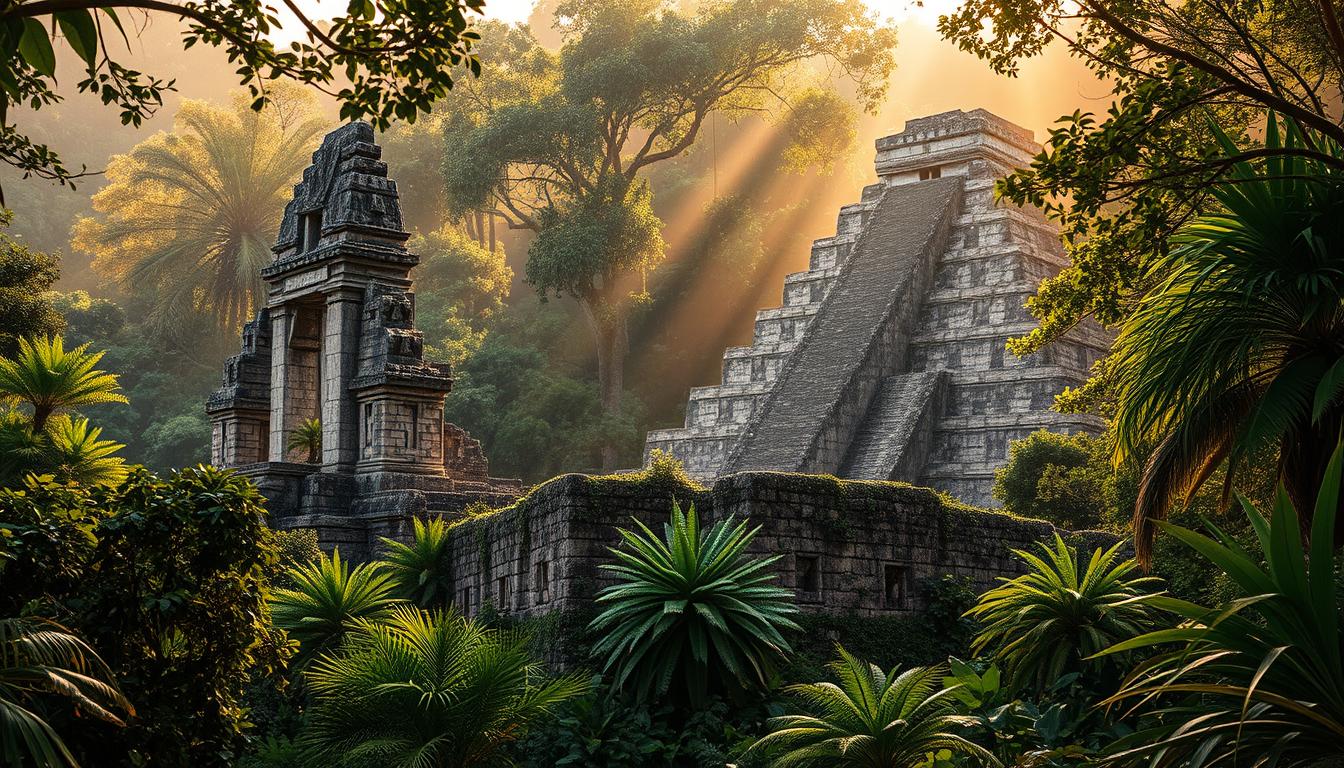
Lost civilizations like the Maya, Easter Island, and Cahokia once shaped history but vanished, leaving behind only ruins and questions. Ancient societies such as the Indus Valley, with five million people, or Angkor’s million-strong capital, now stand as riddles. How could such advanced cultures simply disappear?
Angkor’s grandeur faded 300 years before the Khmer Empire’s end. Cahokia’s 100 earthen mounds near St. Louis were abandoned after floods, while Easter Island’s statues hint at a society that overharvested its forests. These disappeared civilizations’ stories reveal how environmental crises or social collapse could erase entire cultures.
From the Maya’s Yucatan decline to the Indus Valley’s 3,000-year-old mystery, these archaeological mysteries invite us to explore their vanishings. Why did Cahokia’s 40,000 residents leave? What caused the Ancestral Puebloans to abandon their cliff dwellings? This article delves into these enigmas, uncovering the clues left behind by vanished cultures.
A Brief Introduction to Lost Civilizations
Abandoned cities and forgotten cultures hold secrets waiting to be uncovered. Places like the Maya pyramids or the Indus Valley’s advanced drainage systems show us what once was. These historical mysteries make us wonder: Why did such advanced civilizations disappear? Their falls tell us about patterns that experts are trying to understand.

“Every broken pot or buried stone is a clue in the story of humanity’s journey.”
Now, with tools like LiDAR and satellite imaging, we find ancient ruins hidden under forests or deserts. These archaeological discoveries show how forgotten cultures tried to survive. For instance, the Indus Valley’s 3000 B.C. cities had sewage systems that European capitals wouldn’t have for thousands of years.
War, disease, and environmental changes often led to their downfall. Yet, their legacies live on in the historical mysteries we solve today. By studying these vanished societies, we learn about the fragility or resilience of human progress.
The Indus Valley Civilization: A Park of Wonders
Over 5,000 years ago, the Harappan civilization flourished in ancient India. It left behind clues to a society far ahead of its time. Cities like Mohenjo-daro showed early urban planning unlike anywhere else.
Streets were laid out in perfect grids, and homes had advanced drainage systems. This was over 3,000 years before Rome’s plumbing. Standardized bricks and public baths showed a society organized on a massive scale.

At Mohenjo-daro, archaeologists found the Great Bath, a ritual pool, and granaries. These suggested centralized governance. Yet, the Indus script etched on seals remains a mystery.
Over 400 symbols, found on terracotta tablets, puzzle scholars. Why did this tech-savvy culture vanish? Droughts and floods may have forced people to scatter.
Today, excavations uncover new clues. Buildings raised repeatedly after floods show resilience. Yet, the civilization faded by 1500 BCE. Every broken pottery shard or seal offers a clue to a world where early urban planning met an unknown fate—a puzzle waiting to be solved.
The Mysterious Elamite Culture
The Elam kingdom was a Bronze Age society on the Iranian plateau. It thrived for over two millennia. Their capital, Susa, was a crossroads between Mesopotamia and ancient Persia.
From 3200 BCE, Elamite rulers created a unique identity. They left behind clues of a civilization that stood out.

The Susa civilization was skilled in bronze and goldwork. They made artifacts as impressive as Babylon’s. Their language, not related to any known family, was written on clay tablets using cuneiform.
Monuments like the ziggurat at Chogha Zanbil show their architectural skill. This stepped pyramid, with thousands of inscriptions, reflects their spiritual and political goals.
Elam’s story is one of resilience. They fought empires like Assyria and Babylonia for 2,661 years. When Cyrus the Great’s Achaemenid Empire rose in 539 BCE, Elamite practices shaped Persian governance.
Though forgotten by many, their legacy lives on in art, writing, and cities. They helped shape ancient Persia.
The Ancestral Puebloans: Enigmatic Builders
Today, the descendants of the Ancestral Puebloans prefer the name Ancestral Puebloans over Anasazi. This name change is due to historical sensitivity. Their legacy is seen in the cliff dwellings of Mesa Verde and the Four Corners region. They built cities into canyon walls.
Places like Cliff Palace, with 150 rooms, show their skill in masonry and astronomy. These American Southwest archaeology sites have cliff dwellings with precise solar alignments. This suggests they had advanced knowledge.

They built roads that spanned 400 miles, connecting Mesa Verde to Mexico. But by 1300 CE, their communities disappeared. Droughts reduced rainfall to just 8 inches a year, straining their water systems.
Granaries filled with corn, left untouched, suggest they left suddenly. Signs of violence and resource scarcity hint at collapse due to environmental pressure.
Modern tribes like the Hopi trace their heritage to these enigmatic ancestors. Their cliff dwellings, standing for 700 years, raise more questions than answers. Why did they leave such marvels behind? The mystery remains, preserved in the silent canyons of the American Southwest.
The Hohokam: Masters of Irrigation
In the heart of the Sonoran Desert, the Hohokam thrived through desert agriculture. They mastered canal systems that defied the arid landscape. Their prehistoric engineering turned Arizona’s dry valleys into fertile fields.
Over 700 miles of canals, some 30 feet wide, carried water from the Salt and Gila rivers. They were built without metal tools yet were as precise as Roman aqueducts. This ingenuity supported communities for over 1,500 years, with villages of hundreds and even thousands.
These Arizona archaeology sites show a society that adapted constantly. By the 1100s, they grew maize, squash, and beans. Later, they grew tepary beans and amaranth during harsh droughts.
The iconic Casa Grande, a 35-foot-tall structure, stood as a celestial observatory. Its windows aligned with solstices. Yet, their brilliance couldn’t prevent collapse. By 1450, prolonged droughts and soil salinization strained their canal systems, forcing abandonment of core settlements.
Modern Arizona’s irrigation networks trace paths first carved by the Hohokam. Their legacy endures in today’s farms and in the O’odham people, descendants who honor this ancient engineering. From pottery shards to sprawling canals, their story is etched into the desert—a testament to resilience in one of Earth’s toughest environments.
The Maya Civilization: Splendor and Collapse
The Maya civilization thrived in the Yucatan Peninsula and Mesoamerican cultures for over two millennia. They created the Mayan calendar and developed precise hieroglyphic writing. They also built monumental cities like Chichen Itza and Palenque.
These achievements helped their city-states dominate trade and agriculture in Central America. Their innovations were key to their success.
At its peak, the Maya’s territory covered 125,000 square miles. It had 40 major cities. Tikal, for example, had a population of 50,000, thanks to terraced farming and irrigation.
But by 800 CE, troubles began. Droughts hit hard, affecting farming. Wars also increased, with 38 victims found in a Tikal tomb. Temples like Aguateca’s were left unfinished.
The Classic Period collapse made cities like Yaxchilan silent by 808 CE. Environmental stress, political issues, and overpopulation were major factors. Yet, the Maya people survived.
Today, their descendants keep traditions alive. This shows their legacy lived on, even after their cities fell.
Lost Cities of the Amazon Rainforest
For centuries, people thought the Amazon rainforest was too wild for big settlements. But Amazon archaeology has changed this view. LiDAR technology has uncovered pre-Columbian settlements hidden by thick foliage.
In Ecuador’s Upano Valley, archaeologists found 6,000 earthen platforms. Some are as large as football fields. These platforms show that thousands lived in rainforest civilizations much bigger than we thought.
LiDAR scans have revealed roads up to 16 miles long. They also found fortified towns like Kuhikugu, as big as ancient Egyptian structures. The terra preta soil, made from charcoal and bone, shows how these people farmed for thousands of years.
These societies were once thought to be small. But, they managed forests well, creating fertile soil that’s lasted to this day. Over 154,000 sq km of this soil suggests a population boom, with up to 100,000 people in some areas.
These societies thrived until Europeans arrived. Diseases like smallpox, brought after 1492, may have killed 95% of the indigenous people. But their impact on the landscape lives on, challenging old myths. Archaeologists have found cities older than Machu Picchu, showing the Amazon had complex urban life before Europeans saw it.
The Olmec: The Mother Culture of Mesoamerica
Along Mexico’s Gulf Coast, the pre-Mayan civilization of the Olmec left a lasting mark. Their most famous legacy is the colossal stone heads. These massive sculptures, some over 10 feet tall, were carved from basalt. It took thousands of workers to move and shape these 40-ton blocks.
The mystery of how they moved these massive blocks is fascinating. It shows their advanced organization and creativity.
At the center of their culture was La Venta, a ceremonial site. It had the Great Pyramid, a 112-foot earthen structure. This pyramid was covered in jade and ceramics, showing their spiritual practices.
Their rituals influenced the Maya’s ballgame and bloodletting ceremonies. The Olmec also started early Mesoamerican writing. This writing system was used by the Maya later on.
Their 260-day calendar and trade networks reached far, spreading ideas like jaguar symbolism and jade craftsmanship.
Despite their achievements, the Olmec civilization declined around 400 BCE. This might have been due to environmental changes affecting their agriculture. Yet, their innovations lived on.
Later civilizations like the Maya adopted their religious practices and urban layouts. They even adopted their cosmic worldview. The Olmec’s influence is clear in Mesoamerica’s history. They were the foundation of a cultural dynasty that lasted long after their cities were gone.
Lessons from Lost Civilizations
The rise and fall of ancient societies teach us about the dangers of collapse. The Maya lost 90% of their population due to droughts. The Sumerians thrived for 3,000 years before disappearing. Both show the importance of environmental sustainability.
Archaeological sites like Cahokia, once home to 20,000 people, show how innovation can lead to success. But, societies can decline under pressure. This teaches us about the importance of adapting to change.
Historical patterns show that resilience comes from adapting. The Hohokam’s irrigation systems helped them survive longer. But, even advanced civilizations like the Indus Valley, with 5 million people, faced major challenges.
Today, we face similar environmental and social challenges. Studying these collapses teaches us about the fragility of progress. The Maya’s fate warns us against ignoring climate signals. The Sumerians’ legacy teaches us about the dangers of mismanaging resources.
By learning from the past, we can make better choices for the future. The past is not just history; it’s a guide to survival.