
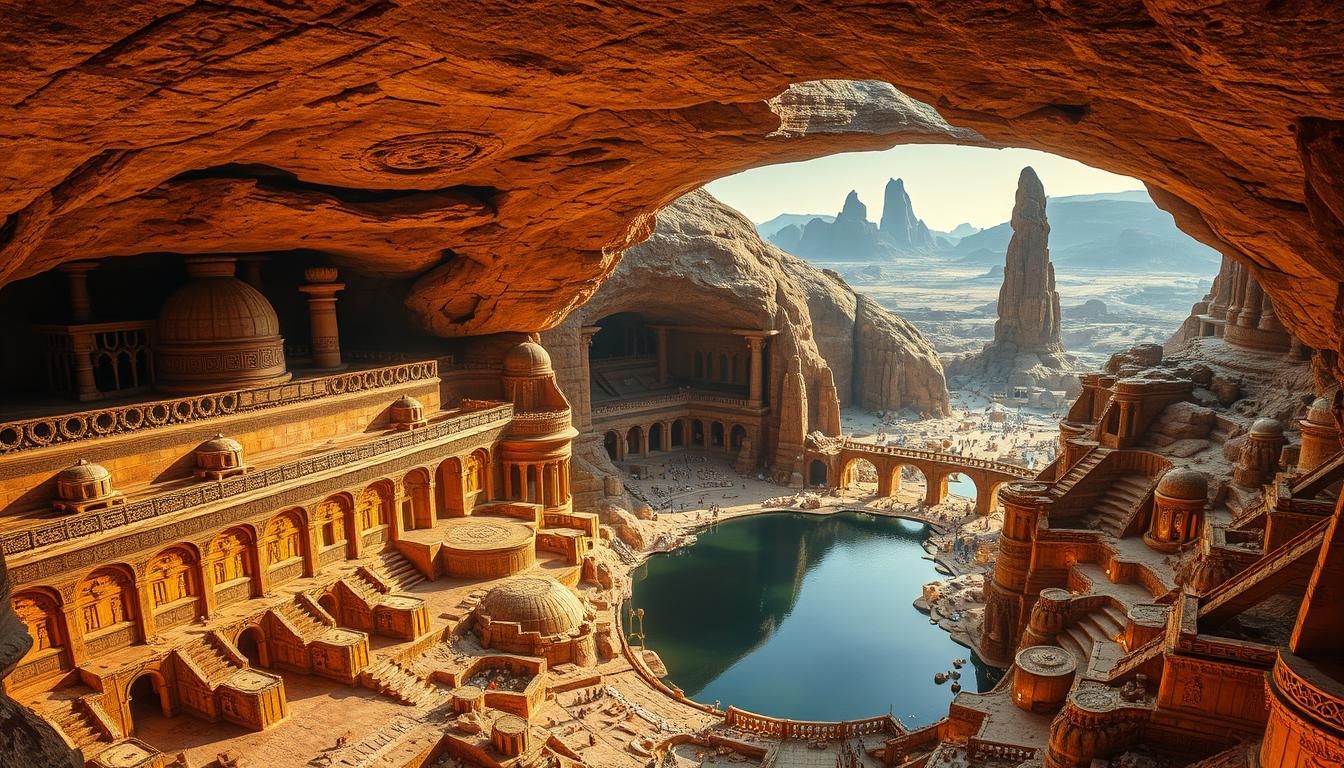
Across the globe, subterranean worlds hide in plain sight. Places like Oak Ridge and Hanford have hidden bunkers. Derinkuyu has ancient tunnels. These secret underground structures challenge what we know about human habitation.
The Manhattan Project’s hidden cities once sheltered 125,000 workers. Wünsdorf’s Soviet-era site stored 98,300 rounds of ammunition. Modern cities like Coober Pedy show underground living is not just history—it’s a survival strategy.
Today, over 1,500 people live in Las Vegas’ tunnels. Montreal’s RÉSO spans 32 kilometers. These hidden cities aren’t just relics; they’re living proof of humanity’s ingenuity.
Some, like Beijing’s Dixia Cheng, were built to withstand nuclear threats. Others, such as Naples’ Napoli Sotterranea, evolved over millennia. Even New York’s subway shelters over 2,000 residents.
These secret underground structures aren’t just forgotten spaces. They’re networks of survival, innovation, and mystery waiting to be explored. Whether carved by hand or engineered with steel, each subterranean world tells a story of resilience beneath our feet.
Introduction to Underground Worlds
For thousands of years, humans have sought shelter in the earth. Ancient places like Cappadocia’s below-ground cities protected people from war and harsh weather. These early subterranean living areas grew into vast networks, combining survival with community.
Today, architects are rethinking underground architecture to tackle issues like climate change and overcrowding.
“Underneath the surface, there’s an entire world of homes, businesses, stores, churches, even sports complexes hidden out of sight. And it’s nothing new – humans have been living underground from the beginning of civilization. And with the weather becoming more extreme, it could be our future.”
Shelters from the Cold War and William Lyttle’s 30-foot-deep labyrinth near his home show underground habitation evolving. Scientists in South Dakota explore microbes a mile underground, searching for life that might exist on Mars. Military history also highlights 3,000 years of tunnel warfare, used in over 300 sieges.
Earl Hess’s book War Underground explores this history, showing ancient Greeks and Romans also used these tactics.
From ancient survival to modern innovation, these hidden spaces suggest a future where living underground is not just a refuge. It could be a blueprint for thriving beneath the surface.
Montreal’s RESO: The Largest Underground Complex
Montreal’s La Ville Souterraine, or the RESO network, is a huge Montreal underground wonder. It covers 32 kilometers, connecting 41 city blocks. It welcomes over 500,000 people every day.
It was built in 1962 to fight harsh winters. Now, it links hotels, offices, and places like the Place Bonaventure and Palais des Congrès.

Walking through the RESO network is like entering a city within a city. You can find 2,000 stores, including big names like Complexe Desjardins and Centre Eaton. There’s also Le Cathcart’s food hall.
More than 200 restaurants and 40 cinemas are part of the network. It even has universities, banks, and art exhibits during the Art Souterrain festival.
The network is easy to use, connecting to metro stations and outdoor spots like Place des Festivals. You can walk 3 kilometers inside without going outside. You can also store bags at Centre Eaton.
From its start at Place Ville Marie to its current 20-mile size, the Montreal underground is a mix of useful and cultural. It has everything from Time Out Market food to Olympic venues, all under one roof.
The Underground City of Coober Pedy, Australia
In the heart of the outback lies Australian underground city Coober Pedy, a opal mining town born from necessity. In 1915, a boy found opals, starting a rush. By 1916, miners dug deep to avoid the extreme heat.
Today, 80% of its 2,500 residents live underground. This is where they find comfort and safety.
The subterranean living Australia spaces are more than just homes. They have kitchens, Wi-Fi, and even a church 55 feet below. The temperature stays around 73°F all year, a welcome respite from the surface’s extremes.
Hotels like the Desert Cave offer rooms for $150 a night. This is a steal compared to Adelaide’s $700,000 homes.
Life in Coober Pedy combines old traditions with new innovations. Solar and wind power meet 70% of the town’s energy needs. Shops, galleries, and a museum line the underground tunnels, carved from the same red rock that yields opals.
Visitors come to see its unique architecture and learn about the miners’ hard work. They see how harsh land became a thriving oasis.
Cappadocia: Turkey’s Underground Cities

Deep beneath Turkey’s Cappadocia region lie historical underground dwellings that defy time. The Cappadocian underground networks span 200+ cities, with Derinkuyu standing as the deepest, stretching 85 meters below ground. Built by ancient civilizations like the Hittites and Phrygians, these Turkish underground cities served as shelters during invasions and religious persecution. Their ancient subterranean networks include 18 levels, ventilation shafts, and stone doors weighing 1,000 pounds. Derinkuyu’s 55-meter well provided water, while 50+ air shafts kept the air fresh.
Today, visitors can explore 4 of Derinkuyu’s 18 levels. They find wine cellars, chapels, and stables carved into soft volcanic rock. Over 600 hidden entrances dot the region, linking cities like Derinkuyu and Kaymaklı via 9-km tunnels. UNESCO recognized these sites in 1985, preserving their legacy as masterpieces of survival engineering. Modern tourists marvel at how 20,000 people once lived here, with schools and kitchens sustaining communities for months.
These historical underground dwellings were rediscovered in 1963 when a homeowner unearthed a hidden room. Now, guides explain how rolling stone doors sealed off invaders, and ventilation shafts maintained stable temperatures. From 3,000-year-old origins to their abandonment in 1923, Cappadocia’s subterranean marvels remain a testament to human ingenuity. Explore their tunnels and imagine life in Earth’s shadowy depths—where history echoes through every carved stone.
Seattle’s Underground: A Window to the Past
Visitors to the historic underground Seattle enter a secret world. Here, 1880s storefronts are hidden beneath today’s streets. The Great Seattle Fire of 1889 led to the rebuilding of Pioneer Square. Streets were raised up to 30 feet to fight flooding, leaving the original floors buried.
This created a network of buried Seattle streets. Now, these hidden areas are open to the public through guided tours.
The Pioneer Square subterranean tunnels are like a time capsule. They were once home to saloons and brothels. But in 1907, they were shut down due to health concerns.
Bill Speidel’s 1965 Seattle underground tour uncovered this forgotten history. Today, tours like Beneath the Streets share stories of resilience and rebirth. They explore themes from the Red Light District to queer history.
Guided paths take visitors through cellars where wooden sidewalks creak above. They see where buildings were raised on stilts after the fire. The 1907 plague scare and the first 500-person tour in 1965 show how this underground space became a celebrated relic.
Every brick in this subterranean world tells a story of Seattle’s rebirth—twice.
The Catacombs of Paris
The French catacombs are a part of the vast Paris underground tunnels. They tell a spooky story beneath the city’s streets. These tunnels were once limestone quarries. Later, they became an underground ossuary due to crowded cemeteries causing diseases in the 18th century.
By 1810, they held over six million people. Their bones were arranged into walls and sculptures.

Now, the subterranean Paris attraction offers a 1-mile tour. It’s just a small part of its 200-mile network. Visitors go down 130 steps to see bones arranged in patterns.
There are also skulls lining the corridors. In 2015, a quirky Airbnb promotion offered a stay for €350,000. But it was just for show.
Some brave souls, called “cataphiles,” sneak into forbidden areas. They avoid a special police unit. History fans might know about the 1788 mass transfers from cemeteries like Saints-Innocents, which had 2 million burials.
In 2017, thieves stole €250,000 worth of wine from a connected cellar.
After a pandemic pause, the catacombs reopened in 2020. They are both a dark historical site and a popular tourist spot. The walls tell stories of Paris’s past, mixing horror with legend.
The Womb of the City: New York City’s Abandoned Subway Stations
Under New York’s busy streets, a maze of NYC underground stations and abandoned subway tunnels exists. Forgotten places like City Hall Station, closed in 1945, hold secrets. Tracks from the Second Avenue “Phantom” line and Track 61, hidden beneath the Waldorf Astoria, tell stories of the past.
These hidden subway stops were shelters during the Great Depression. Today, they are homes for about 2,000 people.
Life in subterranean New York is dangerous. Homeless people face violence, like stabbings and arson threats. They are often called “mole people,” facing stigma despite their strong social bonds.
Police now recognize their presence, even though they were once denied. These areas show the city’s deep social divides. Movies like *Death Wish* (1974) reflect these fears of urban decay.
But these abandoned stations also inspire creativity and myths. Graffiti and underground theaters show the community’s spirit. Yet, the dangers remain, as seen in a 1975 pamphlet, *Welcome to Fear City*. Despite the risks, these tunnels continue to be a symbol of resilience and a reminder of the city’s neglect.
The Underground City of Beijing
Deep beneath China’s capital lies the Beijing underground complex. It’s a massive Cold War shelter called Dixia Cheng. Built in the 1960s and 1970s, it covers 33 square miles. Tunnels stretch 60 feet underground.
Over 300,000 volunteers, including kids, dug these tunnels. They used simple tools. Their hard work turned fear into a huge defense project.

“China and Russia had been having border spats going back hundreds of years but during the Cold War, Chairman Mao wasn’t taking any chances.”
The Cold War underground shelter was meant for all of Beijing’s people. It had theaters, schools, and even skating rinks. It had 2,300 sealed vents to block gas and 90 hidden entrances.
It opened to tourists in 2000. But today, most areas are abandoned. Some are even used as hostels. After the 2008 Olympics, many parts closed forever. Now, the tunnels tell stories of a forgotten era.
Derinkuyu: An Ancient Marvel in Turkey
Beneath Cappadocia’s soil lies the Derinkuyu complex, a remarkable ancient underground city. It stretches 85 meters deep with 18 levels, sheltering up to 20,000 people. This Turkish subterranean wonder shows a historical underground community that thrived with ingenuity.
Carved into soft volcanic rock, the complex has ventilation shafts for air. Massive stone doors sealed from inside kept invaders out. It had kitchens, stables, and storage, allowing life to go on. A 55-meter-deep well provided clean water, isolated from contamination.
Rediscovered in 1963, Derinkuyu’s layout shows communal life: chapels, schools, and a wine press. Families could stay safe for months underground during wars. Today, visitors see its lower eight levels, amazed by the precision.
The Underground River: Puerto Princesa, Philippines
Deep in Palawan, the Puerto Princesa Subterranean River National Park is a natural underground wonder. Water carves through stone, creating an awe-inspiring underground river system. The Cabayugan River flows over 8.2 kilometers underground, meeting the South China Sea.
This Filipino cave network includes the vast Italian’s Chamber. Sunlight shines through openings, lighting up stalactites and stalagmites. These formations took two million years to shape.
The park was named a UNESCO World Heritage Site in 1999 and a Ramsar Wetland in 2012. It protects over 800 plant species and 165 bird species, including 15 unique ones. Rangers lead small boat tours into the Puerto Princesa subterranean passages.
Daily tours allow 1,200 guests to explore. Visitors wait 1–2 hours for a 30-minute boat ride through stunning caves. This journey earned it the 2012 New7Wonders of Nature title after 1 billion votes.
Tours start at 2,500 pesos, with private options up to 15,000 pesos. Over 99% of tourists say it’s unforgettable. This subterranean marvel shows us Earth’s hidden depths are as amazing as any human-made wonder.
Conclusion: The Allure of Underground Worlds
Subterranean spaces show humanity’s endless creativity. Places like Cappadocia’s Derinkuyu and Singapore’s Underground Science City are examples. These areas are key to solving modern challenges.
Projects like Mexico’s 65-story Earthscraper and Singapore’s research hub are underway. They aim to make cities more sustainable. These spaces use natural insulation to save energy and protect against harsh weather.
Underground tourism is on the rise. Sites like Petra’s caves and Coober Pedy’s tunnels attract visitors. They want to see the hidden histories of these places.
But preserving these sites is a delicate task. Places like Derinkuyu and Naours need careful protection. Modern issues like ventilation and fire safety must be solved without losing their historical value.
Sustainable underground spaces offer a green way to grow cities. Montreal’s RESO complex and Beijing’s subway networks are examples. They show how to build eco-friendly cities.
Innovation often hides beneath the surface. Underground spaces have always been key to solving problems. As cities grow and face climate changes, the earth itself may hold the future.