
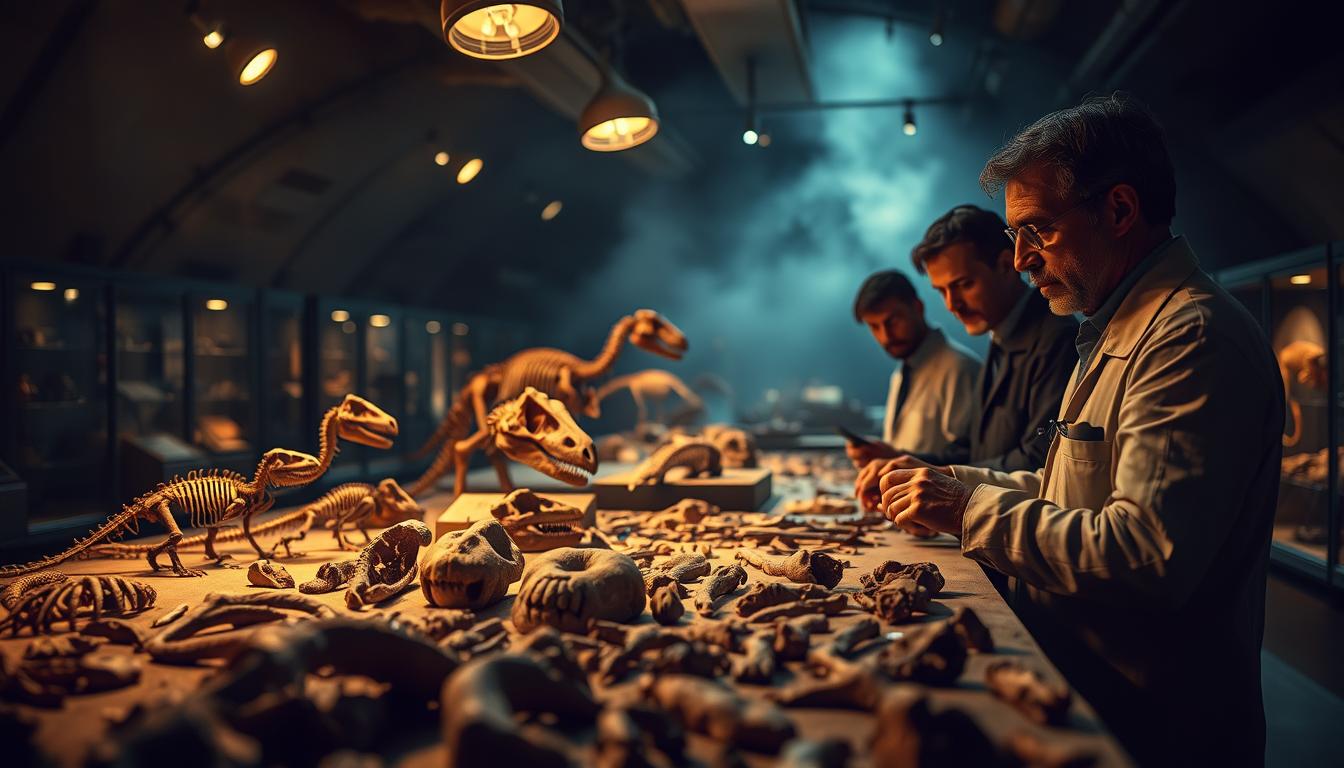
Revolutionary dinosaur discoveries are changing what we know about Earth’s past. The Ahvaytum bahndooiveche, a 230-million-year-old fossil from Wyoming, is the oldest known equatorial dinosaur. This discovery challenges old theories about early dinosaurs.
Footprints from the Early Cretaceous period have been found on opposite sides of the Atlantic. This suggests there were once land connections between these areas. Computer models also suggest that Tyrannosaurus rex could have grown up to 70% larger than previously thought.
In the UK, a fossil of a dinosaur with a dinner-plate-sized pubic bone was found. In Zimbabwe, the Musankwa sanyatiensis was discovered, marking only the fourth named species from the region. These discoveries highlight the diversity of dinosaurs worldwide.
The Middle Jurassic Ceoptera evansae, found in Scotland, is another groundbreaking find. It shows that pterosaurs evolved flight earlier than we thought. They lived alongside the ancestors of birds.
Paleontology breakthroughs keep reshaping our understanding of science. The 166-million-year-old Ceoptera skeleton, digitally prepared, reveals Darwinoptera existed 25 million years longer than thought. These discoveries show that fossils are full of secrets, challenging our old assumptions.
Introduction to Dinosaur Fossil Discoveries
The paleontology history started with the first dinosaur fossils. In 1824, Megalosaurus was named the first dinosaur. Then, Iguanodon was named in 1825. It took 18 years for Richard Owen to call them “dinosaur,” meaning “fearfully great lizards.”
These early dinosaur discoveries made people curious about life before us.
By the 1870s, the dinosaur fossil record grew fast. O.C. Marsh and E.D. Cope found 136 species in their Bone Wars. Their rivalry showed how diverse dinosaurs were, revealing Stegosaurus and Diplodocus.
Early scientists often made mistakes about dinosaurs. For example, Iguanodon was first thought to look like a giant iguana. But later finds changed these views.
In 1923, fossil eggs in the Gobi Desert showed dinosaurs might have nested. By 1964, Deinonychus’s sharp claws proved dinosaurs were active hunters, not slow reptiles. The 1990s discovery of Sinosauropteryx with feather-like fibers showed birds are dinosaurs.
Every discovery has changed science. From 19th-century bones to 21st-century DNA studies, early dinosaur discoveries have shaped our understanding. Today, research continues to uncover new secrets from old fossils.
Significant Discoveries of the 21st Century
In 2013, a big find in Wyoming changed how we think about dinosaurs. The Ahvaytum bahndooiveche was small, like a chicken, but lived long ago. It showed dinosaurs were in northern lands before we thought.
These show how our understanding of dinosaurs is changing. They prove that the 21st century is rewriting history.
Scientists found footprints on both sides of the Atlantic Ocean. These show ancient shores that are now oceans. It shows dinosaurs could travel long distances.
In China, the Liaoning Province keeps giving up fossils with feathers. A 2018 find showed a dinosaur’s tail was feathered. Even Borealopelta, with its full armor, is helping scientists learn about defense.
Argentina’s Patagotitan weighed 80 tons, and a fossil in Montana cost \$4 million. Deinocheirus, once a mystery, now has two complete skeletons. Scientists name a almost every two weeks. They’ve found over a dozen new horned species this century.
Feathers let us see dinosaurs in colors like black, rust, and shimmer. From ancient vomit to battle fossils, each find adds to our knowledge. With new tech, the next decade will bring even more surprises.
The Role of Technology in Fossil Discovery
CT scanning fossils is key to uncovering ancient secrets. The Wankel T. rex skeleton at the National Museum of Natural History was scanned. These scans showed the dinosaur had better vision and smell than thought.
Using digital tools, scientists can now model how T. rex moved. They even guess its top speed at 25 mph. This tech also shows how dinosaurs grew, like Apatosaurus reaching full size in 30 years.
Modern tools like RFID tags track fossils from the field to museums. Tom Hebert’s team uses these tags on tribal lands. They keep detailed records.
Digitizing these records with ArcGIS tools replaces old logs. AI analyzes fossil distributions, predicting new sites and classifying fragments quickly.
3D imaging shows dinosaurs like Sinosauropteryx had feathers, linking them to birds. By combining CT scans and digital tools, scientists recreate ancient life. As tech improves, we learn more about life long ago.
How Fossils Change Our Understanding of Evolution
Fossils are more than just old bones—they’re like ancient textbooks. The finding of feathered dinosaurs in China’s Liaoning Province changed our views on the dinosaur-bird relationship. These fossils showed dinosaur evolution evidence with scales and feathers together, proving a link between reptiles and birds.

Today, evolutionary paleontology uses these clues to challenge old ideas. Feathers, once seen only in birds, now show up in dinosaurs like Yutyrannus. Their feathers suggest they needed warmth long before they could fly. Even dinosaur wrists, once stiff, became flexible, helping them fly.
Nesting sites of Oviraptor fossils also show that dinosaurs cared for their young. This care was similar to that of true birds. It shows that dinosaurs and birds are more connected than we thought.
Cladistic analysis now uses these clues to create detailed family trees. Each fossil fills in the gaps, like Archaeopteryx, once seen as a lone link, now has many feathered relatives. These finds prove that life’s variety comes from small, testable changes preserved in stone.
Dinosaur Fossils Around the World
From Zimbabwe’s Musankwa sanyatiensis to New Zealand’s oldest Southern Hemisphere nothosaur, international fossil sites are changing our view of global dinosaur distribution. These finds show how regional dinosaur species lived in places we didn’t expect. They challenge old ideas about where dinosaurs lived.
In Wales, the “Welsh dragons” tell a new story of dinosaurs in Western Europe. Norway’s 150-million-year-old “Monster” pliosaur, found in the Arctic, shows marine reptiles were far north. China’s 2011 ichthyosaur fossil showed live births 248 million years ago.
Mongolia’s Protoceratops nests show dinosaurs cared for their young. Australia’s Australotitan is one of the biggest dinosaurs, and Japan’s mosasaur links Pacific and Middle Eastern ecosystems. These discoveries add to our understanding of dinosaurs worldwide.
These clues from international fossil sites help scientists understand how species adapted and moved with continents. From Africa’s spinosaurids to South America’s titanosaurs, each regional dinosaur species adds to Earth’s ancient story. As we find more, we learn more about their diversity.
The Impact of Climate Change on Fossil Discovery
Climate changes have always influenced life’s history. The Carnian Pluvial Episode 230 million years ago changed deserts into wetter places. This allowed dinosaurs to adapt and diversify, as seen in fossils like Ahvaytum bahndooiveche.
Now, modern fossil exposure climate changes are changing how we find fossils. Warming is melting permafrost and glaciers, revealing fossils that were once hidden. In 2012, an 11-year-old found a mammoth in thawing Siberian ground, part of a boom in Arctic fossil finds linked to rising global temperatures.

U.S. parks like Dinosaur National Monument have seen temperatures rise by 3.6°F per century. By 2050, they could be up to 8.5°F hotter. This faster erosion uncovers fossils but also risks their decay.
Melting ice has also revealed lost whaling ships in Alaska’s Arctic waters. This shows how environmental changes affect where we find fossils. Researchers say that while climate changes offer new data, fossils are deteriorating quickly if not protected.
Studies of ancient plankton fossils show some species thrived in past warmings. This gives clues for today’s ecosystems. Yet, today’s changes are happening too fast, making conservation urgent. Scientists are racing to document fossils exposed by climate shifts, linking ancient adaptations to today’s environmental challenges.
The Process of Excavating Dinosaur Fossils
Fossil excavation starts with patience. Paleontology fieldwork involves mapping a site first. Scientists use a grid to sketch every bone detail.
They use brushes, picks, and tiny tools to remove rock. A 2012 dig took three days of jackhammering to start. Then, a week was spent uncovering the skeleton.
Keeping fossils safe during transport is key. Teams wrap bones in plaster jackets. This protects them from damage during transport.
At Utah’s Dinosaur National Monument, a 2017 dig found 800+ microfossils. A custom sieving machine helped sift through sediment.
Working in hot sun and rocky terrain is tough. In Wyoming, a 2021 dig faced triple-digit temperatures. Teams use GPS and 3D scanning to document sites.
Even small mistakes can damage fossils. Chiseling too hard can break a 70-million-year-old tooth. Every fossil has a story to tell.
A 2020 study in Nature found 98% of Jurassic-era fossils in riverbeds. Water action helped preserve bones. Researchers debate how often new sites are exposed by storms or erosion.
Education and Fossil Discoveries
Dinosaur museum exhibits now mix the latest science with hands-on learning. The American Museum of Natural History’s “Dinosaur Discoveries: Ancient Fossils, New Ideas”
Paleontology education now includes virtual labs and 3D scans of fossils. For example, Australotitan’s massive leg bones or Spicomellus’s unique spiked ribs are studied. Schools and museums work together, like an Australian school that saved a boulder with 66 Jurassic footprints from mining.
Online dinosaur learning resources include platforms for citizen science. Students help classify fossils. Universities offer free courses on interpreting tracks or analyzing bone structures. Digital tools let users rotate 3D models of Stegouros’ tail clubs or Tlatolophus’ skull features.
These resources inspire future scientists. When kids study the 26-foot-long Ceratosuchops or reconstruct Australotitan’s 82-ton body, they engage directly with discoveries. By merging fossils with education, museums turn classrooms into gateways to understanding Earth’s ancient past—and its future.
Community Involvement in Fossil Discoveries
Garrett Johnson, an undergraduate field assistant, found the site of Ahvaytum bahndooiveche, called “Garrett’s Surprise.” This shows how citizen paleontology changes science. Amateur fossil hunters, like farmers, students, and hikers, often find fossils first.
Their work includes the 2023 discovery of a 38-foot theropod in Maryland—the largest in Eastern North America. This was found by a team with local volunteers.
Community dinosaur discoveries thrive through teamwork. Maryland’s Laurel site, 115 million years old, holds fossils of 14 species. It’s now seen as the most important east of the Mississippi River.
Volunteers helped uncover teeth, bones, and plant material. This proves how groups unlock ancient secrets.
Citizen science programs connect global participants. Online platforms like Zooniverse let anyone help classify fossils from home. These projects turn hobbyists into partners, speeding research and making paleontology accessible.
Indigenous knowledge guides many finds. Tribal communities often share land stories that lead to new sites. For example, partnerships with Navajo groups in the Southwest revealed fossils tied to cultural histories.
Ethical collecting keeps science accurate. Amateur hunters must record find locations and share data with researchers. Training programs teach proper methods, ensuring fossils stay protected for future study.
Challenges in Dinosaur Fossil Research
Paleontology faces many challenges due to the fossil record’s limitations. For example, large bone fragments found in Europe for over a century remain unclear. Are they from giant ichthyosaurs or something new? These debates show how much we don’t know.
Do Some Mysterious Bones Belong to Gigantic Ichthyosaurs?

Scientists struggle with incomplete preservation. Taphonomic processes like decay and erosion often destroy soft tissues, leaving only bones. Dating these bones is also hard, even with advanced tools. This makes it hard to understand when dinosaurs lived and went extinct.
Modern labs, like Mary Schweitzer’s, also face challenges. Her work shows that organic materials degrade quickly. Yet, fossils over a million years old rarely have intact cells. Budget cuts have also reduced paleontology programs. Schools like Ivy League institutions have cut staff, limiting fieldwork and analysis.
Despite these challenges, public interest in dinosaurs remains high, thanks to movies like Jurassic Park. But funding is decreasing. Taxonomic disputes, like mistaking young species for new ones, also slow progress. Yet, these challenges drive innovation. New imaging technologies and global collaborations are working to uncover more about dinosaurs.
Future Directions in Dinosaur Fossil Research
Future paleontology is set to make big strides with new fossil techniques. Studies like the Edmontosaurus collagen discovery show the power of advanced methods. A 50-pound hip bone from South Dakota’s Hell Creek Formation had collagen, found by the University of Liverpool and UCLA. This discovery changes how we think about fossilization.
New tools like AI are changing dinosaur research. They help analyze fossil patterns and growth. Expeditions to Antarctica and central Asia are also underway. These places were once hard to explore.
“These molecular signatures could rewrite dinosaur metabolism theories,” said researchers behind the Edmontosaurus study, highlighting how collagen fragments link dinosaurs to modern birds.
Scientists are now combining paleohistology with climate science. This helps understand how dinosaurs adapted to their environments. For example, Maiasaura grew up fast, in just 8 years. This shows dinosaurs might have been more active than thought.
Future research will use advanced tech to study museum fossils. Isotope analysis and 3D imaging will reveal new details. This could help us understand how dinosaurs evolved into birds.
Conclusion: The Ongoing Importance of Dinosaur Fossil Research
Dinosaur research is as vital as ever, with new finds changing how we see ancient life. From the 1990s discovery of feathered dinosaurs like Sinosauropteryx to the 2018 find of a dinosaur tail in amber, the field is booming. Each new discovery, from Utah’s horned dinosaurs to Patagotitan’s massive skeleton, shows how ancient history meets today’s challenges.
Looking into extinction events like the Permian’s “Great Dying” helps us understand climate change today. The study of Borealopelta’s armor in 2023 and Deinonychus in 1964 shows how past research shapes today’s theories. Even the 1824 naming of Megalosaurus laid the groundwork for DNA and protein studies in ancient fossils.
Every week, new dinosaur species are found, showing the importance of dinosaur research goes beyond schools. The 1923 Gobi Desert egg finds and 1980s Montana nests tell us about dinosaur behavior. Melanosomes even reveal dinosaur colors. These discoveries help advance technology, medicine, and environmental science, showing the wide reach of fossil science.
As climate models warn of warming near Permian levels by 2300, studying past extinctions becomes critical. Dinosaur research isn’t just about the past; it helps solve today’s problems. With breakthroughs like Anchiornis’s feather patterns or 2023 collagen studies, this field keeps sparking curiosity and innovation. From 1842’s “dinosaur” term to today’s 3D scanning, there’s always more to learn. Every fossil has a story that links ancient worlds to our future.