
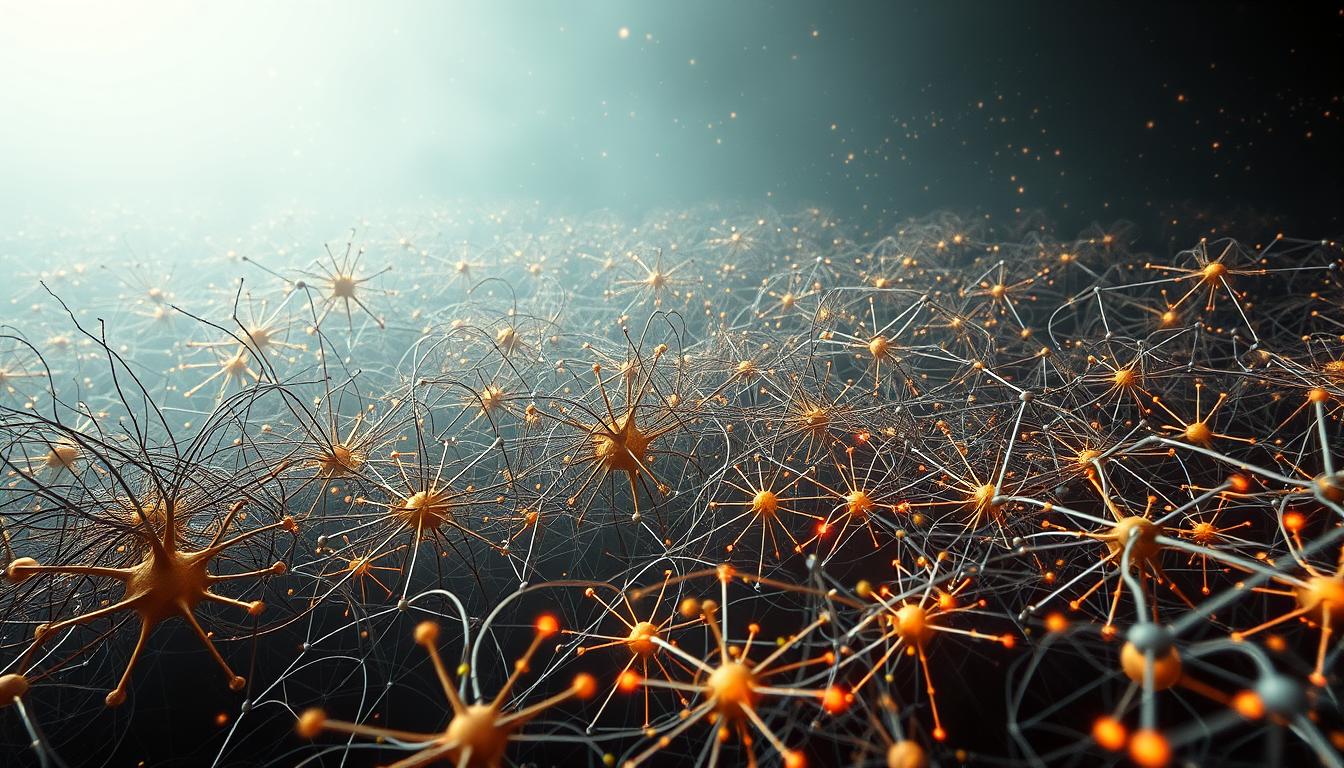
Artificial intelligence (AI) is changing how machines handle information. Neural networks, modeled after the human brain, allow systems to learn from data. They can automate tasks and make decisions without strict rules.
Today, AI can spot patterns, predict trends, and even beat humans in certain areas. This is thanks to recent advancements in machine learning.
The first ideas about neural networks came out in 1944. By 1965, early deep learning algorithms could train complex networks. Big steps forward included LeNet in 1989 and AlexNet in 2012, showing AI could outdo humans in image recognition.
Now, systems like ChatGPT use transformers. These are built on years of research into layers, activation functions, and backpropagation.
Today’s neural networks handle huge amounts of data to automate tasks and cut down on mistakes. They provide insights quicker than ever before. From protein research in the 1980s to 2022’s generative models like DALL·E 2, these systems learn through experience, just like humans.
The 2010s saw the rise of GPUs, which allowed for deeper networks. This led to big leaps in language processing and medical imaging.
Introduction to Neural Networks
Artificial neural networks (ANN) are systems that mimic the human brain’s ability to recognize patterns. They are made up of interconnected nodes, which are the heart of deep learning. This technology powers things like facial recognition and medical diagnostics.
These networks learn from data by going through layers of nodes. They don’t need step-by-step instructions like traditional code does.

The first computational neuron model was created in 1943 by Warren S. McCulloch and Walter Pitts. Frank Rosenblatt’s 1958 perceptron was a big step forward. Then, Paul Werbos introduced backpropagation in 1974, making deeper networks possible.
By the 2010s, Yann LeCun’s 1989 handwriting recognition system showed how far they had come. It proved their value in real-world tasks.
Now, deep learning systems use layered networks to find complex patterns in data. They’re used in everything from MRI scans to language translation. Their ability to uncover hidden data relationships is changing many fields, from healthcare to finance.
How Neural Networks Work
Neural networks are like tiny brains, using neural network architecture. Each node makes decisions. Data goes in, through hidden layers, and comes out as an answer.
These layers are key to deep neural networks. They help solve tough tasks, like identifying objects in photos.
“Deep learning models, known as neural networks, are inspired by the structure and function of the human brain.”

Training starts with data, like pictures of cats. The network guesses, checks its answer, and tweaks its “weights” with AI algorithms. This process, called backpropagation, happens thousands of times to get better.
Google’s image search uses this to quickly find objects. It’s a great example of how neural networks work.
Neural networks learn in three ways. Supervised learning uses labeled data, like teaching a child with flashcards. Unsupervised learning finds patterns without labels, like sorting toys by color.
Reinforcement learning is trial and error, like mastering a video game. DeepMind’s AlphaGo used this to beat human Go champions.
Each layer has a special job. In medical scans, early layers spot edges, middle layers form shapes, and final layers make the diagnosis. This lets systems like self-driving cars recognize and stop for pedestrians and signs.
The more layers, the deeper the network. And the more it can understand subtle details.
Types of Neural Networks
Neural networks come in many forms to tackle various tasks. Convolutional neural networks (CNNs) shine in image tasks. They can find patterns in pictures or scans, helping with tasks like tumor diagnosis and license plate recognition.
Medical AI models use CNNs to quickly analyze X-rays. Self-driving cars also depend on them to spot obstacles.

Recurrent neural networks (RNNs) are great for sequences like speech or text. They remember past data, making chatbots and translation tools possible. Advanced types like LSTMs help in stock market analysis and speech apps.
These networks keep conversations smooth in virtual assistants.
Other types open up new possibilities. Generative adversarial networks (GANs) create realistic images or videos. Transformers, like those behind ChatGPT, handle huge text data.
Aerospace engineers use AI models for flight simulations, making aircraft safer. Military systems use them for drone control and threat detection, combining speed and accuracy.
These networks are not just theories; they’re changing the world. They help find cancer cells and predict storms, solving problems traditional code can’t. Their adaptability drives innovation in healthcare, finance, and climate science.
Applications of Neural Networks
Neural networks are changing industries by solving tough problems. They use computer vision and natural language processing. For example, Facebook suggests friends through facial recognition. Amazon’s recommendation engines guess what you might buy.
These technologies help with photo tagging and medical checks. They make our lives easier.

The melanoma detection app has a specificity of 80% and sensitivity of 94%, surpassing dermatologists’ rates.
In healthcare, neural networks look at medical images to find cancer. They also help in emergency diagnoses. Companies like untapt use 16-layer networks to improve hiring.
OKRA’s AI uses deep learning for predictive analytics. Banks use them to spot fraud. Airlines plan routes with real-time data.
Drones in oil and gas exploration use neural networks. Voice assistants like Alexa understand spoken commands. Airlines use them for flight simulations.
Manufacturers predict equipment failures. Even Walmart uses them to manage inventory and customer service.
Telecommunications use neural networks for language translation and network optimization. Educational tools adjust lessons based on student progress. These innovations are real and making a difference.
They improve everything from airport security to online shopping. The future is vast, thanks to the data these networks process.
Training Neural Networks
Neural network training uses two main methods: supervised learning and unsupervised learning. Supervised learning teaches models with labeled examples. For example, it might show a system 12,000 images of handwritten digits with correct answers. Unsupervised learning finds hidden patterns in data without labels. It groups customer preferences without predefined categories.
Backpropagation is key in this process. It adjusts connections after each guess. If a model mistakes a cat for a dog, backpropagation tweaks the weights to improve accuracy. But, too-large updates can cause problems, so techniques like lowering the learning rate help.
Even small changes matter. Imagine optimizing 11,935 dimensions where each adjustment brings the model closer to accuracy.
Dropout regularization randomly disables neurons during training. This prevents overreliance on specific paths. A 0.02 mean squared error shows better performance than 0.17, proving fine-tuning works. Finding the right balance between speed and accuracy often requires trial and error.
Engineers use tools like mini-batch gradient descent to navigate this complex landscape. They turn chaotic data into organized knowledge.
Challenges in Neural Network Development
Training neural networks needs a lot of computing power. Even simple models require high-performance GPUs or TPUs. AI research teams struggle to scale up to complex systems like reinforcement learning. Training large language models can take weeks, using as much energy as hundreds of homes in a month.
Data quality is a big problem. Neural networks need thousands of labeled examples. For example, medical imaging projects face issues with inconsistent patient records. Biased datasets in predictive analytics have led to flawed tools, like hiring algorithms that unfairly reject female candidates.
Technical hurdles are also there. Vanishing gradients slow down training in deep networks. Exploding gradients need manual fixes, like gradient clipping. Also, 3nm transistors face quantum tunneling issues, making hardware design hard. Optical neural networks are fast and cool, but not as flexible as electronic systems.
Explainability is key in finance and healthcare. Banks need clear credit scoring models, but most neural networks are “black boxes.” Researchers are working on techniques like attention visualization to understand decision-making. Hybrid systems combining optical and electronic layers could cut power use by 90%, according to MIT.
The Future of Neural Networks
Imagine a world where is pushing boundaries. Neuromorphic chips are being developed to work like the brain, making things more efficient. Quantum computing might soon team up with deep learning to solve big problems like climate change or finding new medicines.
Capsule networks, inspired by Geoffrey Hinton’s work, aim to get better at recognizing images. They focus on how things are arranged in space. Self-supervised learning is also making progress, needing less data to learn and get smarter.
Pulsed neural networks are all about timing signals. They could change how we make decisions in real-time, in fields like healthcare or robotics.
The EU is planning to introduce AI laws soon. This shows how important it is to have rules as neural networks become more important in areas like medicine. In the U.S., over 18,000 startups are using deep learning to come up with new ideas. But, there are challenges too. We need better hardware to handle complex networks, and we must understand how these systems work.
By 2027, jobs in machine learning will grow by 40%. This shows how big the field is getting. The future is about making systems that learn and work like us. We’re on the verge of big breakthroughs, but we need to be careful not to overstep.
Neural Networks vs. Traditional Programming
Traditional programming uses clear instructions. Programmers write code to tell machines what to do. This works well for tasks like calculating taxes or sorting data. But, when problems are not clear, AI algorithms come in.
Neural networks, a part of machine learning, learn from examples. They are great at tasks like recognizing faces or translating languages. These tasks require human intuition.
Take 3D printing optimization as an example. A study compared artificial intelligence with traditional methods. Deep learning models cut errors in printed exoskeleton parts by analyzing parameters like layer height and temperature.
Unlike older artificial neural networks (ANN), DL’s layered architecture processed data faster. This reduced error rates. Traditional ANN methods needed manual tweaking, while DL machine learning adjusted automatically.
But traditional code is better for predictable tasks. Financial systems need precise logic to avoid errors. Neural networks, though powerful, sometimes lack transparency in their decisions.
Today, businesses use both approaches. For example, e-commerce platforms use AI algorithms to suggest products. But they rely on traditional code for secure payments. This mix of both worlds is effective.
Real-World Examples of Neural Networks
Neural networks are not just ideas; they’re changing our lives. In healthcare, computer vision systems like KodaCloud’s AI can spot skin cancer with 94% accuracy. This beats human doctors. OKRA’s tech also scans medical images quicker than doctors, giving instant results 24/7.
IBM Watson changes entertainment by making sports event highlights just for you. It uses natural language processing to get what you like. Meta’s AI catches 97% of content that breaks Facebook rules before anyone reports it. BMW and General Motors use neural networks to make their cars better.
Businesses also use neural networks to make smart choices. FedEx and Cisco use them to predict when things might go wrong. Talla’s AI helps new employees get up to speed fast by answering questions right away. Ed Donner’s AI finds the perfect job for people in seconds, looking through millions of pieces of data.
From NASA’s work on aircraft safety to Google’s instant translations, these systems are always at work. Neural networks are not just ideas; they’re the heart of many solutions we use every day. They make things faster, smarter, and more available than ever.
Conclusion: The Road Ahead for Neural Networks
Neural networks have come a long way from the 1940s. Today, they are key players in artificial intelligence. The 1000-layer model from 2016 shows how deep learning is breaking new ground. These AI models can now diagnose diseases, analyze climate data, and understand language. But their journey is just starting.
In healthcare, ANNs are changing radiology and gastroenterology. They help find diseases early. But their use goes beyond medicine. As deep learning gets better, neural networks could solve climate modeling or find new drugs. But we must be careful and make sure they are used right.
Future breakthroughs will come from working together. Scientists, ethicists, and users need to guide how these systems grow. Neural networks promise a future where humans and machines work together. Stay curious, keep asking questions, and join the conversation about how these tools can help society.