
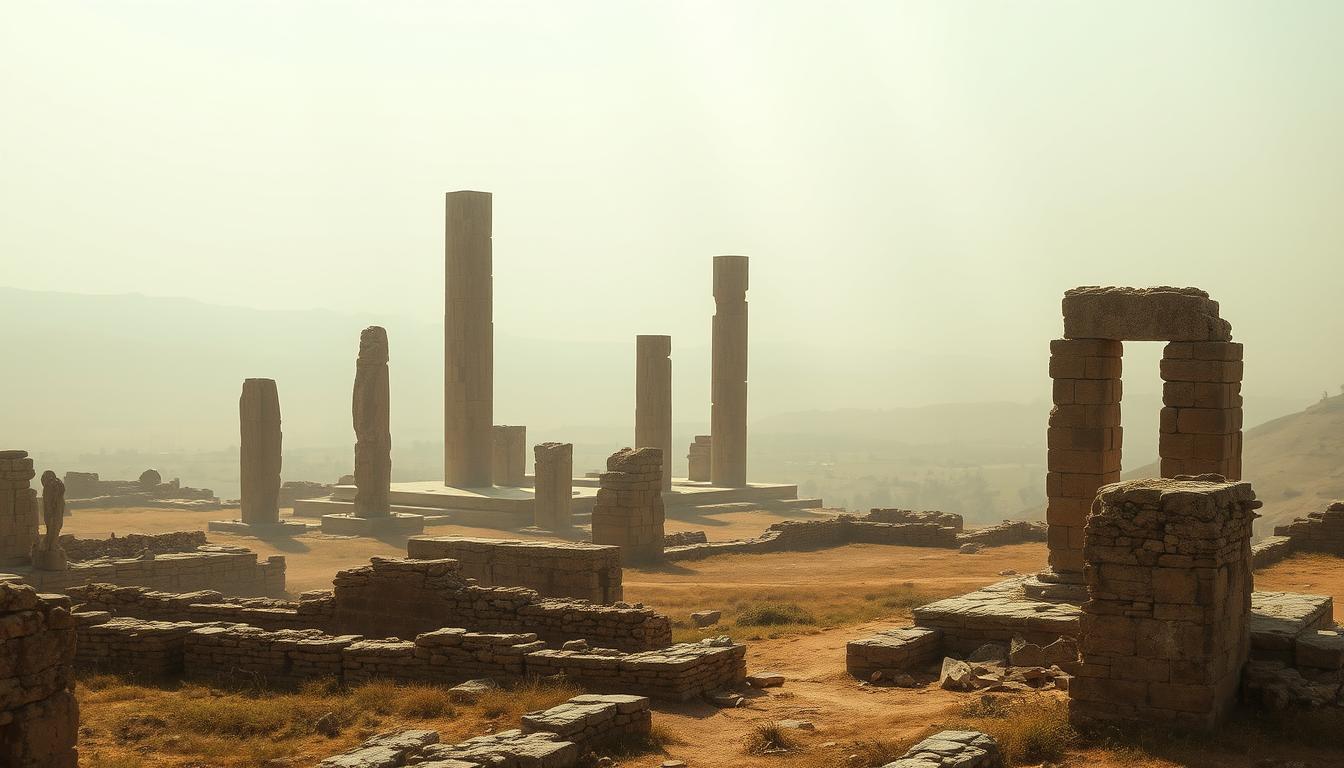
Archaeology has always fascinated us with its secrets. Places like Stonehenge and the Nazca Lines are full of mysteries. The Antikythera Mechanism and the Baghdad Battery also puzzle us.
These ancient wonders make us wonder: What inspired ancient people to create them?
Even famous discoveries like King Tut’s tomb are full of questions. The Diquís Spheres and Scotland’s Towie Ball are also enigmas. Despite our technology, we can’t figure out their purposes.
Artifacts like the Piri Reis Map and Roman dodecahedra show us how much history is unknown. The Towie Ball and Antikythera Mechanism are just as puzzling. The Diquís civilization’s stone spheres are a complete mystery.
Every discovery, like the Moai statues, makes us question what ancient civilizations could do.
The Enigma of the Stonehenge Stones
Stonehenge has puzzled people for thousands of years. This ancient site in England is a huge mystery. Its massive stones, up to 20 tons, stand tall on Salisbury Plain.
The question is, how did the Neolithic builders move these stones from up to 140 miles away? It’s one of history’s biggest puzzles.
In 2020, archaeologists found a hidden stone circle with 25 pits. This suggests there was a bigger ancient complex. Laser scans in 2012 showed damage from souvenir hunters. Excavations in 2013 found marks that suggest some stones are missing.
But what was Stonehenge’s purpose? Was it a temple, calendar, or healing site? We just don’t know.
Science has made new discoveries. In 2020, X-ray scans of 52 stones showed 50 came from the same place in Wiltshire. The Altar Stone came from Scotland, showing ancient trade networks. But two stones’ origins are a mystery.
Research funded by the British Academy found some stones came from one quarry. But why they were placed there is a secret.
Every new find raises more questions. Did the builders choose the site for its sound properties? Why were some stones damaged? The story of Stonehenge is ongoing, showing our endless curiosity about the past.
The Disappearance of the Maya Civilization
The Maya civilization was once known for its grand pyramids, detailed calendars, and many abandoned Maya cities across Mesoamerica. By 900 A.D., these lost Mesoamerican civilization centers were suddenly left empty. The Maya collapse left behind empty spaces and overgrown temples, sparking ongoing debates. What led to this ancient Maya disappearance?

Studies show that the Yucatán faced long droughts between 800 and 1000 A.D., drying up places like Tikal’s water system. Tree ring data and sediment cores confirm a sharp drop in rainfall, making farming hard. Overfarming also led to deforestation and soil erosion. At the same time, political conflicts and power struggles broke city-states, disrupting trade.
By 900 A.D., cities like Palenque and Copán were left empty. This left behind a pre-Columbian mystery in stone ruins.
Modern lidar scans have uncovered hidden settlements, showing people moved to rural areas. Today, over seven million Maya descendants keep their languages and traditions alive. Their story is not an end but a transformation. Researchers are piecing together the past with ancient pollen records and satellite data, showing the Maya’s legacy lives on.
The Secrets of the Egyptian Pyramids
For over 4,500 years, the Great Pyramids of Giza have amazed us. How did ancient Egyptians move 2.3 million stone blocks, each up to 15 tons? The pyramid construction techniques used are a pyramid building mystery that puzzles experts. Recent scans have found hidden chambers, like a void the size of a basketball court, using cosmic ray particles.
These discoveries spark debates about their purpose beyond Egyptian tomb architecture.
Modern scans show a buried river branch near Giza helped move stones. Scholars think 20,000 workers, using copper tools and wooden sledges, built the pyramids under Pharaoh Khufu. But, how did they align blocks so precisely with stars?
Some believe in advanced ancient Egyptian engineering methods. Others suggest unrecorded innovations. The Great Pyramid’s core temperature changes with the seasons, leading to theories of intentional thermal design.
Recent studies found 31 pyramids along an ancient river, suggesting organized logistics. The Great Pyramids of Giza’s base aligns with Earth’s cardinal points with near-perfect accuracy. Theories range from cosmic energy maps to star maps, but the truth is hidden.
Each new discovery, like the 17-acre worker city with bakeries, adds to the puzzle. It’s a mystery waiting to be solved.
The Nazca Lines: Ancient Art or Astronomical Calendar?
The Nazca Lines Peru desert is home to mysterious desert markings. These markings cover 50 square kilometers and are over 700 in number. They were made by removing dark stones to show lighter earth.
Images like a 134-meter condor and a 46-meter spider show the ancient people’s skill. But, what they meant is a mystery. In 2024, 303 new geoglyphs were found using AI, showing there’s more to learn.

Were these pre-Columbian earth art used as cosmic calendars? Some think they match constellations, guiding rituals. Others believe they were connected to water worship, vital in the desert.
Johan Reinhard found paths leading to sacred springs. This links the ancient ground drawings to survival rituals. But, why do these mysterious desert markings need an aerial view to be seen?
Despite being a UNESCO site, the Nazca Lines face threats. Tourism and climate change harm these designs made over 2,000 years ago. Their survival shows ancient engineering skills, but their purpose remains a mystery.
Easter Island’s Moai Statues: Questions Unanswered
The Moai statues on Easter Island are a big mystery. These stone figures, up to 33 feet tall, stand out on the island. They were carved from volcanic rock, showing the skill of the Rapa Nui people. But, we don’t know why they were made or how they were built.
People wonder what the Moai statues mean. Were they for honoring ancestors, showing clan power, or guiding sailors? Their huge size, with some statues weighing 82 tons, shows a lot of work went into them. The red hats on top, weighing 13 tons, add to the mystery of how they were placed.
Moving these huge statues was a big challenge. Recent tests showed that ropes could help move them upright. This shows the Polynesian people had advanced engineering skills. But, why were nearly half of the 900 statues left unfinished in the quarry?
Studies suggest the Rapa Nui people cut down too many trees to move the statues. This led to environmental disaster and the downfall of their society. The Moai statues now stand as silent witnesses to a story that is not yet fully told.
Göbekli Tepe: The World’s Oldest Temple
In southeastern Turkey, Göbekli Tepe is a prehistoric temple Turkey that changes our view of history. This ancient ceremonial site started around 9500 BCE, before Stonehenge. Its huge T-shaped pillars, up to 5 meters tall and 50 tons heavy, are carved with animals and symbols.
How did hunter-gatherers build this Neolithic religious complex without farming or homes?

Excavations started in 1995 and have only uncovered 5% of the site. The oldest known megaliths here challenge old ideas about society. Scholars thought complex religion came after farming, but Göbekli Tepe shows rituals came first.
Carvings suggest spiritual meaning: vultures might symbolize death, and animal reliefs could mark seasons. The site’s decline around 8000 BCE matches the rise of farming, sparking questions. Today, the Göbekli Tepe excavation finds new structures each year, with 20 confirmed and 16 more hidden.
UNESCO named it a World Heritage Site in 2018. Yet, many mysteries remain. What made these nomadic groups build this Neolithic religious complex? Göbekli Tepe’s story is unfolding, layer by layer.
The Voynich Manuscript: An Archaeological Mystery
The Voynich Manuscript is a medieval book that has puzzled scholars for over a century. Its pages are filled with an unknown script and strange drawings. These include pictures of 113 plants that no one can identify, star charts, and enigmatic female figures.
Despite being dated to the 15th century and confirmed to be written in medieval ink, its meaning remains a mystery. Its cryptic alphabet has kept its purpose hidden.
For centuries, people have tried to crack the code of the Voynich Manuscript. Emperor Rudolph II once paid 600 gold ducats for it. In World War II, codebreakers like Alan Turing also worked on it.
In 2019, researchers thought they found a breakthrough. They believed AI had uncovered 10% of the text as Hebrew and Aramaic. But this finding was later withdrawn after more review.
The Beinecke Library has digitized the manuscript, but it has not revealed its secrets. The botanical sections show over 100 plants that no one can identify. The cosmological diagrams suggest knowledge of astrology. Yet, no one has proven what the manuscript is about.
Experts are divided on what the Voynich Manuscript is. Some think it’s a cipher, others a mystical guide, or even a linguistic puzzle. Its 240 pages, made from 14 calfskins, are a challenge to modern technology and human ingenuity. Each page invites new attempts to solve its mysteries, showing that the quest to decode the Voynich Manuscript is ongoing.
The Lost City of Atlantis: Myth or Reality?
For over two millennia, the Atlantis legend archaeology has sparked debates. Plato’s Timaeus described an advanced ancient lost civilization that vanished in a single day. He said Atlantis was 9,600 years before his time—around 9600 B.C.—a date far older than any known civilization. Yet, its sunken city theories endure.
Modern underwater archaeology sites like Thonis-Heracleion and Pavlopetri prove cities can sink. Thonis-Heracleion, submerged near Egypt, vanished 1,800 years ago due to earthquakes. Santorini’s 1600 B.C. volcanic eruption destroyed Minoan settlements, inspiring theories linking it to Plato’s tale. Some scholars suggest this disaster shaped the Plato’s Atlantis myth, blending real events into allegory.

Ignatius Donnelly’s 1882 book revived Atlantis legend archaeology, suggesting a mid-Atlantic continent. Yet geology disproves this—no such landmass exists. But the myth persists, fueling searches from Bimini Road to the Caribbean. Today, archaeologists focus on tangible finds, like Pavlopetri’s 5,000-year-old streets, proving ancient cities could vanish underwater.
While no evidence confirms Atlantis itself, its story reminds us that real disasters—earthquakes, floods—shaped history. The line between myth and reality? A mystery as deep as the ocean itself.
The Mysterious Taman Shud Case
In December 1948, an unidentified body Australia was found on Somerton Beach. This led to the famous Somerton Man case. A piece of paper with “Tamám Shud” (Persian for “ended”) was found. It was from a rare copy of Omar Khayyám’s Rubaiyat.
This Taman Shud mystery has puzzled people for over 75 years. It has elements of a historical forensic puzzle, like an undeciphered code and a strange spleen.
In 2022, cold case archaeology brought new hope. DNA linked the man to WWII veteran Carl Webb. But many questions remain: Why were his clothes without tags? What caused his spleen to grow?
The coded message—five lines of letters—remains a mystery. Despite connections to a local woman named Jessica Thomson and wartime secrets, the case is not solved.
Experts are now studying the Rubaiyat’s pages and Webb’s possible motives. DNA suggests his identity, but the Taman Shud mystery continues to challenge forensic science. Each clue, from coded letters to wartime secrets, keeps this 1948 enigma alive. It shows that even recent history can hold secrets older than archaeology itself.
The Sphinx’s Hidden Chambers
The Great Sphinx of Giza stands tall at 73 meters long and 20 meters high. It has secrets that have sparked many theories about hidden rooms and underground passages. Scans from the 1987 Japanese seismic survey showed possible cavities beneath the statue, suggesting hidden spaces. But, these cavities have not been confirmed.
The “Hall of Records,” a legendary chamber said to hold ancient texts, has been the focus of many expeditions. These searches started in the 1930s. Despite using thermal imaging and radar, no solid proof of such chambers has been found.
Edgar Cayce predicted in the 1930s that the Hall of Records was near the Sphinx’s paws. In 1978, the Association for Research and Enlightenment scanned the area. They found only natural fissures when they drilled.
Geologist Robert Schoch suggested the Sphinx might be 7,000 years old, based on erosion patterns. This is much older than the accepted 2500 BCE. But, mainstream archaeologists stick to the traditional dating, saying there’s no solid proof for secret rooms or an ancient origin.
Recently, Zahi Hawass and others have kept searching, using non-invasive tech like ground-penetrating radar. They found anomalies, but many could be natural cavities from erosion. Egyptian authorities focus on preserving the Sphinx, making deep explorations rare.
The Sphinx’s mystery continues, blending science and myth. Until advanced tech proves or disproves theories, its secrets will remain a mystery. The search for Sphinx archaeological discoveries goes on, balancing curiosity with respect for this ancient icon.