
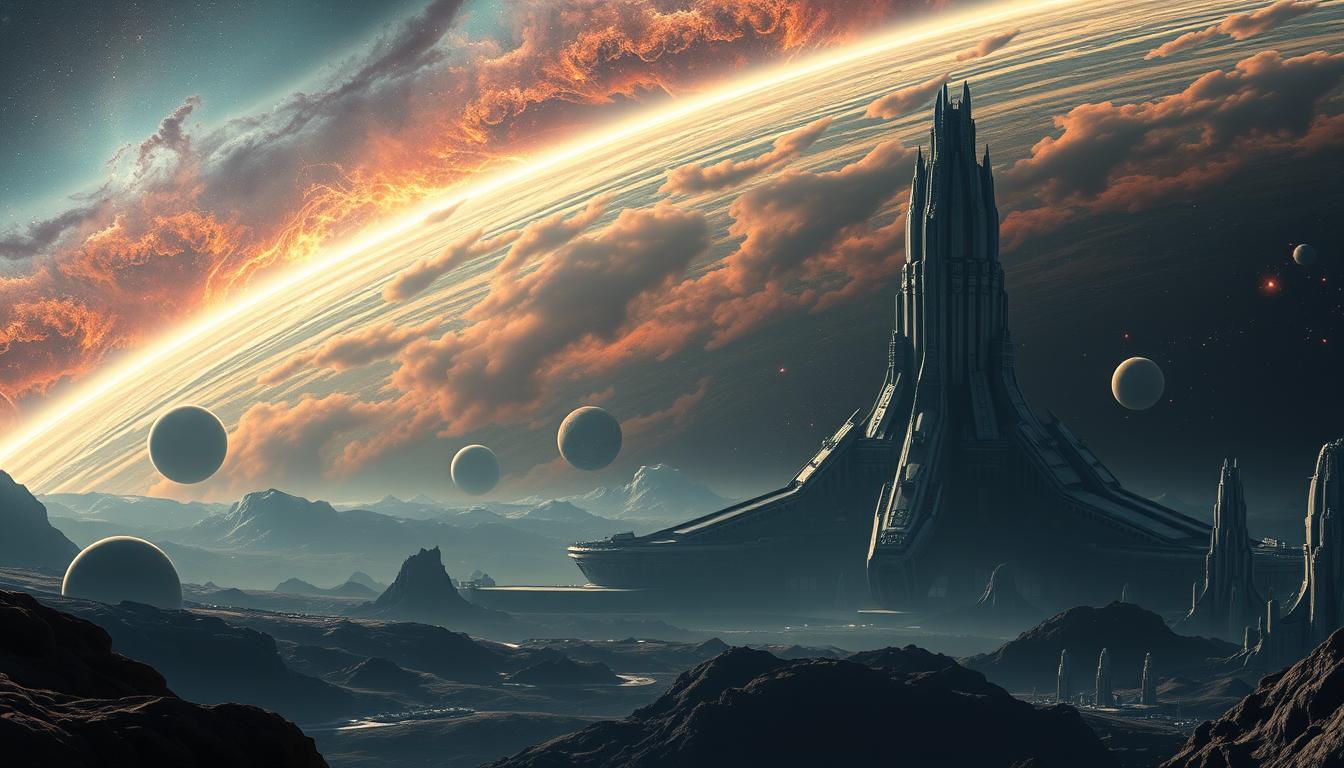
The Kardashev Scale ranks civilizations by their energy use. It was first proposed by Soviet astronomer Nikolai Kardashev in 1964. This scale measures how advanced a civilization is by how much energy it uses.
Earth is currently ranked at 0.7276, far from the Type 1 level of 1.0. This level requires controlling all the energy on a planet. The scale focuses on energy use as a way to compare civilizations, ignoring cultural differences.
Carl Sagan later updated the scale, placing humanity at 0.72. It divides civilizations into three types. Type 1 uses all the solar energy hitting Earth. Type 2 uses energy from a star, and Type 3 uses energy from a galaxy.
These levels show how energy use grows exponentially. They reflect humanity’s progress toward more advanced technology.
By 2060, Earth’s Kardashev score could reach 0.7449. This is due to a 0.042% yearly increase in energy use. This shows how our energy use is linked to our civilization’s ranking.
Innovations like fusion could help us advance faster. The scale is important for tracking our progress toward Type 1. It also helps us understand the impact of our growing energy use on the climate.
Understanding the Kardashev Scale
In 1964, Soviet scientist Nikolai Kardashev introduced the Kardashev Scale at the Byurakan Conference. His energy classification system ranks civilizations by their energy use. It goes from planetary to galactic scales. The framework assumes reflect their , with energy mastery as a universal indicator of progress. Kardashev’s work emerged from Soviet space research, aiming to identify through detectable energy signatures.
Type I civilizations harness all energy available on their planet, like solar and geothermal sources. Humanity currently ranks at 0.7, with estimates suggesting a Type I status in 100–200 years. A Type II civilization could control its star’s energy, using structures like Dyson spheres. Type III civilizations would command across entire galaxies, a leap requiring technologies far beyond current capabilities. Later scholars expanded the scale to seven tiers, but the core idea remains: energy use defines advancement.
Astronomers search for clues like unusual infrared emissions or high-energy neutrinos, which might signal advanced . In 2015, 93 galaxies showed odd heat patterns, possibly hinting at megastructures. Such cosmic energy footprints could help locate . The scale bridges theory and practice, guiding searches for signals of energy use that outstrip Earth’s current .
Type I Civilization: Planetary Mastery
Reaching Type I civilization means mastering planetary energy and global energy control. This level of society would use 10¹⁶ watts, enough to tap into all energy on Earth. Today, we only use 0.001% of that, mostly from fossil fuels.
But, we’re seeing progress. The internet and global trade networks show us the way to connect. These are steps toward becoming a Type I civilization.

Freeman Dyson believes we could reach Type I in 200 years. China’s artificial sun is a big step toward clean energy. A Type I civilization could control the weather, prevent disasters, and even build cities under the sea.
But, there are big challenges ahead. We need global cooperation, to adopt sustainable energy, and to share resources fairly. It’s like Earth growing up.
Reaching Type I could solve energy problems, fuel space travel, and bring humanity together. The journey depends on innovation and working together. Let’s turn today’s small steps into a big change for our planet.
Type II Civilization: Harnessing Stellar Power
Type II civilizations are experts at using stellar energy. They capture a star’s full power. This lets them go beyond what planets can offer, tapping into star power that matches their sun’s output. It’s like having energy that’s billions of times more than what we use today with our advanced technology.
To get this energy, they might build a Dyson Sphere. This is a huge structure that goes around a star. It catches sunlight, allowing them to do amazing things like moving asteroids or changing planets. With this power, traveling between stars and changing planets becomes easy.
A civilization capable of this scale would leave detectable traces. Infrared radiation from energy waste might signal their presence.
Kardashev thought a Type I civilization could become Type II in about 3,200 years. This jump needs advanced technology to handle stellar energy well. Even though it’s a big idea, it’s based on real physics. So, it’s something we can aim for in our research.
These advanced societies wouldn’t just survive; they’d change what it means to survive. They could even make a star last longer or power colonies in other stars. The Dyson Sphere idea is more than just science fiction. It’s a plan for a future where our energy needs meet the vastness of space.
Type III Civilization: Galactic Domination
A Type III civilization goes beyond using star energy. It controls its entire galaxy. This galactic civilization gathers energy from stars, black holes, and cosmic events. They build megastructures like Dyson networks.
Kardashev’s model says moving from Type II to III could take 5,800 years. But, light-speed limits might make this journey much longer.
Picture advanced aliens building planets across star systems. They might even warp spacetime. Terraforming galaxies or using quantum energy from galactic cores fuels their growth.
Finding these civilizations could involve looking for infrared shadows or gravitational distortions. These signs would show
Technologies like self-replicating probes or warp drives could help travel between stars. Their energy output would be much greater than Type II. Today, astronomers look for signs of Type III civilization in distant galaxies.
The Role of Energy in Civilization Development
Today, Earth’s energy use is just 0.16% of what a Type I civilization would need, based on the Kardashev Scale. We only use about one millionth of the sunlight that hits our planet, as Berkeley astronomer Don Goldsmith points out. This
Technological progress relies on using resources more efficiently. We are currently at a 0.7276 Kardashev index, far from mastering our planet. Michio Kaku’s models suggest we could reach Type I in 100–200 years if energy use grows at 3% annually. Reaching Type II, a stellar civilization that uses a star’s full energy, would take even longer.
By 2060, the Kardashev index is expected to rise to 0.7449. This depends on major breakthroughs, like nuclear fusion.
“The Sun is the biggest source of energy, overshadowing all other sources,” Elon Musk emphasizes. Using solar energy could change how we think about energy efficiency. But reaching Type I means capturing all global energy flows, from geothermal to wind. This is a big leap from our current 887 exajoules of annual use. Sustainable technological advancement must balance growth with the limits of our planet.
Civilization’s growth depends on using energy more wisely, not just more of it. Even with fusion power, we might only reach a Kardashev score of 0.7719 by 2100. This highlights the importance of energy efficiency innovations alongside raw energy extraction. Without major breakthroughs, our path is uncertain. But the scale shows that energy is the true measure of our progress.
Measuring Progress on the Kardashev Scale
The Kardashev Scale is a tool for scientists to measure how advanced a civilization is. Carl Sagan made it more precise by adding partial values. This lets us measure progress between whole numbers.
For example, Earth scores around ~0.7 on this scale. This shows we’ve made progress in energy use but highlights areas where we need to improve.
Just measuring energy isn’t enough. Now, we also look at things like how much information we can process or if we can colonize space. A Type I civilization uses 1016 watts, which is 400 times more than Earth’s current energy use.
Reaching this goal might be possible with new energy technologies. But, we also face big challenges like climate change.

Some scientists dream of even higher levels, like Type IV and Type V civilizations. These would use energy on a universe or multiverse scale. But these ideas are just ideas for now.
There’s a debate about what else we should measure. For example, should we count how efficient we are with energy or how well we recycle materials? For now, tracking partial Kardashev values helps us see where we are.
Michio Kaku thinks we might reach Type I status in 100–200 years. This depends on making big scientific breakthroughs.
Studies like the Penn State University galaxy survey show we have a lot to learn. Searching for Yotta-eV neutrinos could tell us if there are Type III civilizations out there. But, our current technology isn’t good enough to confirm this.
These challenges remind us that the Kardashev Scale is not just a goal. It also shows us where we stand compared to our own possibilities.
The Intersection of the Kardashev Scale and Climate Change
Humanity is working towards sustainable advancement. The Kardashev Scale shows us that we need to grow our energy use and protect the environment. Our use of fossil fuels is a major obstacle. To become Type I, we must use renewable energy like solar and geothermal power.
This shift from finite to renewable energy is not just a choice; it’s essential for survival. It’s the only way to avoid harming our planet.
Type I civilizations must also find ways to protect themselves from asteroids and control the weather. This is because even a single asteroid could wipe out all our progress. The dinosaurs’ extinction 66 million years ago is a reminder of how fragile our achievements are.
Today, achieving carbon neutrality is just as urgent. It’s about preventing disasters caused by ourselves while increasing our energy use.
“Surviving technological adolescence is the first step toward becoming a Type I civilization.”
Our current solar and wind technologies are just the beginning. New ideas like carbon capture or space-based solar arrays could help us reach Type I. But, we need global cooperation to make progress.
The Kardashev Scale warns us: growing our energy without being sustainable risks repeating past mistakes on a cosmic scale.
Earth’s timeline is pressing. In 1-2 billion years, the sun will expand, making our planet uninhabitable. For now, we must find a balance between growth and responsibility.
The Kardashev Scale is more than a measure of energy use. It’s a guide to carbon neutrality and survival. Without it, even the most advanced civilizations could become fossils in the universe’s history.
The Kardashev Scale in Popular Culture
Science fiction often uses the Kardashev Scale to dream up advanced civilizations. Movies and books use it to show what future societies might look like. Stanley Kubrick’s 2001: A Space Odyssey had scenes about advanced probes and alien artifacts, like the monoliths. These ideas, even though cut from the final film, are now famous references.

TV shows like Star Trek and Doctor Who show Dyson Spheres to represent Type II civilizations. The Halo series shows the Forerunners as a Type II+ society that can control planets. These examples mix real science with storytelling, making complex ideas like energy mastery easy to understand.
Novels also use the Kardashev Scale. Liu Cixin’s Three-Body Problem talks about civilizations at different Kardashev levels. Arthur C. Clarke’s works hint at cosmic powers. Even video games like Mass Effect use energy-based hierarchies to build alien societies, showing the scale’s influence on storytelling.
These stories spark our curiosity. For example, the Avatar universe has a Kardashev number of 1.3, showing a vision of sustainable energy mastery. Movies like Interstellar or Arrival use science to show space civilizations, blending fact and fiction.
These stories do more than entertain; they shape our view of humanity’s future. By showing energy-driven progress, they highlight the scale’s role in science and imagination. This proves its lasting cultural impact.
Critiques of the Kardashev Scale
The Kardashev Scale focuses too much on power use, leading to energy focus criticism. Critics say it overlooks other ways civilizations can advance. For example, a society might use quantum computing or sustainable tech, showing scale limitations.
New ideas suggest looking at progress differently. Astrophysicist Adam Frank thinks we should value ecological balance more than energy use. This challenges the scale’s classification problems. Also, Lacki’s “smart dust” idea questions the need for big, centralized structures.
“Our search for alien signals is like studying an ocean by dipping a cup,” warns Jason Wright, referencing humanity’s limited galactic exploration. “The Kardashev Scale’s theoretical weaknesses become stark when considering how few stars we’ve truly examined.”
There are also issues with how we categorize energy use. The Club of Rome’s 1972 report warned about the dangers of unchecked energy growth. It suggested that sustainability, not just growth, might be key to progress.
Critics also point out the scale’s human bias. It might overlook civilizations that choose not to build megastructures for ethical or practical reasons. As discussions go on, researchers like Lacki believe we need new ways to think about our search for life beyond Earth and our own future.
The Future of Energy: Beyond the Kardashev Scale
Future technologies could change how we use energy, going beyond the Kardashev Scale. Theoretical physics looks into quantum energy, which might let us control space-time. Physicist Alan Guth’s work suggests we could even create “baby universes” under extreme conditions.

Advanced energy systems might use vacuum energy or dark matter, changing our future. Imagine machines reaching Planck energy levels (10¹⁹ GeV), controlling cosmic events like wormholes. These discoveries could lead to civilizations that control entire universes or shape multiverses.
“Reaching Type I is within reach, but the path to higher tiers demands rethinking our grasp of reality itself.”
Research in quantum energy and theoretical physics could find new energy sources. Civilizations might shape galaxies or control dark energy, changing their cosmic destiny. While these ideas are speculative, they show humanity’s journey on the Kardashev Scale is just the beginning.
Conclusion: The Strategic Importance of the Kardashev Scale
The Kardashev Scale is a roadmap for human progress, giving us a cosmic view of our journey. Today, we use only 0.2% of Earth’s energy. To reach Type I by 2371, we need to focus on renewable energy by the 2030s.
This plan matches with the UNFCCC and IEA’s climate goals. It shows that our energy choices today shape our future.
To move to Type I, we need big breakthroughs in solar, wind, and energy storage. Even if we don’t reach Type I, the scale helps us focus on long-term survival. Carl Sagan’s question about civilizations ahead of us reminds us of our possibilities and duties.
Developing technology like AI and space energy systems responsibly is key. It ensures our progress fits within cosmic possibilities without harming the environment.
Some argue about the scale’s limits, but its main value is in inspiring us to act. It makes us see climate action as part of a bigger cosmic journey. The scale’s vision is not just about stars and galaxies. It’s a call to make our energy choices today part of a legacy beyond our solar system.