
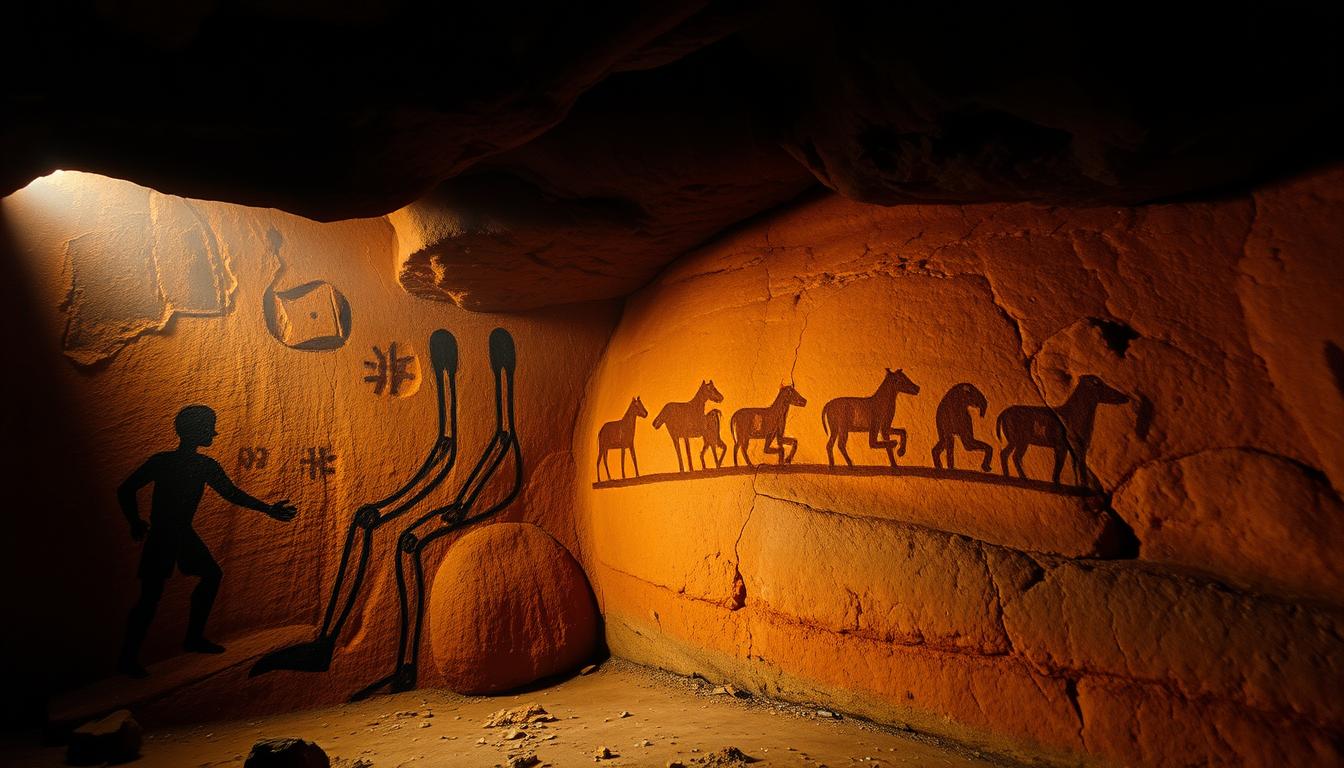
Imagine finding a masterpiece hidden for 51,200 years. In a limestone cave called Leang Karampuang in Indonesia’s Maros-Pangkep region, scientists uncovered the world’s oldest figurative cave art. This 51,200 years old painting of a Sulawesi warty pig and three human-like figures rewrites history. Before this, the oldest known prehistoric cave paintings were in France and Spain, like the Chauvet caves’ 37,000-year-old art.
Researchers used a new laser technique to date the Sulawesi cave art, cutting tiny calcium deposits covering the drawings. These layers trap uranium, which decays at a steady rate—helping pinpoint the pig painting’s age. The discovery pushes back the timeline for human creativity by thousands of years, showing ancient art didn’t start in Europe as once thought.
Why does this matter? This oldest figurative art challenges old theories about when and where humans began expressing ideas through visuals. It’s not just a pretty picture—it’s proof that storytelling and art were part of our ancestors’ lives far earlier than we knew. Every stroke of ochre hints at a shared human urge to create, bridging 50 millennia between then and now.
What Are Prehistoric Cave Paintings?
Cave paintings are a type of parietal art, which includes engravings and carvings on cave walls and ceilings. These ancient artworks, part of the paleolithic art tradition, used natural pigments like ochre and charcoal. They depicted animals, symbols, and abstract forms. Found in sites from Spain’s Altamira to Tennessee’s Mud Glyph Cave, they are some of the earliest known forms of ancient human expression.
Unlike open-air rock art, cave drawings were often created in deep, secluded chambers. Recent studies show Neanderthals and Denisovans also made these artworks. This challenges earlier beliefs that only Homo sapiens had advanced creativity.
Tennessee’s 3rd Unnamed Cave holds art 4,000 years old. Chauvet Cave’s 32,000-year-old horses and bison show sophisticated techniques. These images weren’t just decoration. Scenes of hunting and spiritual symbols suggest storytelling and ritual practices.
In Spain’s Lascaux, vibrant bulls and horses painted 17,000 years ago hint at shared cultural knowledge. Bhimbetka’s 12,000-year-old Indian art and Kakadu’s 20,000-year-old Australian ochre figures reveal how cave drawings evolved across continents. Each stroke and symbol offers clues to early humans’ ability to visualize ideas beyond survival.
The Most Famous Cave Paintings
France’s Lascaux caves are among the world’s most famous famous cave art locations. They feature 17,000-year-old images of bulls and horses, including a massive “Great Black Bull.” By 2000, too many visitors caused mold, leading to a replica to save the originals.

Spain’s Altamira cave was discovered in 1879. People doubted its 15,500-year-old bison ceiling was real. But science later proved it, showing early humans’ artistic talent. Now, it’s a key part of European cave paintings.
France’s Chauvet Cave is home to 35,000-year-old paintings of rhinos and lions. These were made over thousands of years in two phases. The cave also has fossils of cave bears, blending art with ancient history. These places show humanity’s ancient creativity.
Preserving these sites has been a challenge, from Lascaux’s mold to Altamira’s fight for recognition. But their survival lets us appreciate the creativity of those who painted them. It shows art’s enduring role in human expression.
The Age of the Cave Art
Cave paintings’ ages are found through dating techniques like carbon dating and uranium-thorium dating. Early methods had problems: contamination and mixed layers made results hard to trust. Now, scientists use pigments or calcite to date the art.
The oldest cave paintings are a Neanderthal hand stencil in Spain’s Maltravieso cave. It’s over 64,000 years old, thanks to uranium-thorium analysis. This shows human creativity was much earlier than we thought.
Radiocarbon dating only works on organic materials like charcoal. But it can only go back 50,000 years. Uranium-thorium dating, on the other hand, can date mineral deposits, giving a minimum age for the art.
Chauvet Cave in France was once thought to be 15,000 years old. But it’s actually 33,000 years old, thanks to uranium-thorium dating. A painting in Sulawesi was dated to 51,200 years using laser-scanning calcite layers.
These discoveries change our view of human history. Art spans 28,000 years, from 40,000 to 12,000 years ago. Styles evolved over millennia. Even Lascaux’s 18,000-year-old bulls fit into this timeline.
As dating techniques get better, we learn more about early humans. Every new find helps us understand when and how they expressed themselves.
Themes and Subjects in Cave Art
Cave paintings show a common visual language among ancient cultures. Animal paintings are most common, with bison, horses, and deer being favorites. Lascaux Cave has over 600 animals, with 364 of them being horses.
But, there’s a twist. Despite finding reindeer bones, none are painted in the animal paintings. This suggests the art had symbolic meanings, not just depicting reality.
Hand stencils and geometric patterns are found everywhere, from Europe to Australia. Cosquer Cave has 55 hand stencils and complex symbols, hinting at rituals or messages. Chauvet Cave’s 33,000-year-old walls feature abstract designs that might track the moon or early writing. 
Humans are rarely shown, and when they are, they’re simple. But, predators like lions in Chauvet stand out, possibly symbolizing power or myths. Studies now suggest that people with autistic traits might have helped create these precise patterns, leading to cultural breakthroughs.
This reveals a world where art was a mix of storytelling, spirituality, and shared knowledge.
Cultural Insights from Cave Paintings
Cave paintings show how prehistoric human culture used art to share stories. The Sulawesi panel shows humans and a pig, revealing early human behavior. These images were not random but told stories, showing abstract thinking before writing.
The way figures are arranged suggests social roles and rituals. This shows how early humans connected through art.
In France’s Font-de-Gaume, artists used cave bumps for 3D animals. This shows paleolithic life valued creativity. The 14,000-year-old paintings used red and black to share hunting knowledge.
Dr. Victor Shamas found that ancient art was for its own sake, not for money. Even small handprints in caves like Gargas show group identity. They marked belonging in ancient society.
Hunter-gatherer art also showed survival strategies. Scenes of spears and herds reflect hunting plans. Deep-cave locations were likely sacred spaces.
The 400-hour carved Lion-man statue shows deep spiritual dedication. It might link to shamanic practices. These clues reveal early humans’ complex lives, showing more than we thought.
Discovery of New Cave Art Sites
Recent archaeological discoveries in Indonesia have changed our view of early human creativity. In 2021, researchers found 45,500-year-old paintings in Leang Tedongnge cave. This discovery is as old as the 40,000-year-old animal figures in Borneo’s Lubang Jeriji Saléh. Thanks to laser dating and modern technology, these Indonesia cave art sites are now on par with Europe’s famous caves.
Uranium-thorium tests showed a hand stencil in Leang Tedongnge cave is 39,900 years old. This proves ancient artists worked across continents at the same time.

Archaeological exploration teams now use drones and laser scanners to explore caves. In Spain’s Cova Dones, they found clay handprints and animal motifs. These were preserved by the cave’s humidity.
Over 100 figures, including deer and horses, were discovered. They show techniques not seen in northern Spain. Nearby European sites like Atxurra also have similar art. Drones have greatly reduced survey time, allowing experts to reach areas once thought unreachable.
These finds challenge the old belief that art started in Europe. From Sulawesi’s ancient stencils to Borneo’s wild buffalo paintings, the archaeological discoveries show human creativity spread worldwide. As technology improves, more caves in Indonesia and Spain’s Mediterranean coasts will reveal their secrets. The journey continues, one scan, one pigment sample at a time.
Preservation of Cave Paintings
Climate change and tourism threaten ancient cave deterioration of global cultural heritage. Rising temperatures and humidity harm the stable conditions that kept pigments fresh for thousands of years. Sites like Borneo’s 40,000-year-old art show cracks and mold, while Lascaux’s CO2 levels once reached dangerous peaks due to visitor exhalations.
Advanced preservation techniques fight these threats. Lascaux uses Vaisala sensors to track CO2 and humidity, keeping a 12°C environment. Digital 3D scans create permanent records, ensuring art conservation even if originals fade. UNESCO’s World Heritage program safeguards 350+ sites, balancing public access with protection. The Lascaux II replica now welcomes visitors, reducing strain on fragile originals.
Scientists warn that unchecked tourism speeds up decay. At Font de Gaume, CO2 monitors block entry if levels spike. These systems protect pigments made from ochre and charcoal, materials that lasted millennia but now face new stressors. Collaborations between France, Spain, and Australia share innovations like mineral sealants to halt erosion.
Preservation isn’t just technical—it’s about valuing humanity’s earliest stories. By merging cutting-edge tech with strict visitor controls, these masterpieces may endure another 15,000 years. Every scan, sensor, and replica helps safeguard a legacy older than writing itself.
Mysteries Surrounding Cave Art
For over a century, scholars have wondered about prehistoric cave art. Early theories like hunting magic suggested paintings helped hunters. Later, David Lewis-Williams proposed shamanic rituals theory, saying artists were in trances, showing visions of ancient spirituality.
These debates on prehistoric symbolism continue, with no clear archaeological interpretation winning.
The Lascaux caves, found in 1940, show vivid animals but few humans. Why did they avoid showing themselves? Hand stencils in Cosquer cave, hidden for 18,000 years, suggest communal rituals. But, why paint in dark places needing torches? And why focus on extinct animals like megaloceros?

Modern tech like 3D scans of Cosquer’s 230 animal engravings show detailed work. But, the big questions remain. Were these places for stories, spiritual journeys, or maps of ancient spirituality? With new finds like Borneo’s 2018 discoveries, theories keep changing. Each idea adds depth, but the main mystery is: who were these artists, and what did they aim to show?
Exploration and Tourism of Cave Art
Today, cave tourism brings ancient history to life without risking damage to fragile prehistoric art sites. Replicas like Lascaux IV in Montignac and the Pont d’Arc Cavern (Chauvet’s replica) offer immersive experiences. These replica caves use cutting-edge tech to recreate every brushstroke, allowing visitors to walk through exact copies of 20,000-year-old masterpieces.
Modern visitor centers like Lascaux IV’s Espace International de l’Art pariétal combine education with innovation. Interactive tablets guide tours, while climate-controlled environments keep temperatures at 13°C—matching the original caves. Guided tours in multiple languages, including English, make these sites accessible to global audiences. Nearby cultural tourism hubs like the Vézère Valley’s 14 UNESCO sites provide week-long adventures, blending history with outdoor exploration.
Digital tools like virtual reality now let travelers “enter” closed caves like the original Lascaux. At Font de Gaume, which has been open to visitors for 70 years, guided tours highlight 230 vivid animal paintings. Visitor centers like the Musée National de la Préhistoire in Les Eyzies educate on techniques used by artists 36,000 years ago.
Replica caves ensure preservation while sharing these wonders. Lascaux IV’s 50-artist team used laser scans to replicate every detail. Prices start at €10 for children, making history affordable. Sustainable practices, like limiting group sizes to 30 people per tour, protect both art and visitor experience.
The Future of Cave Art Research
New technologies are changing how we study ancient art. Tools like multispectral imaging and AI have found amazing pieces, like the 43,900-year-old Bulu’ Sipong 4 in Sulawesi. These methods show us hidden details and when art was made.
But, there’s a big problem. Salt and mining are harming over 300 caves in Indonesia. Places like Semen Tonasa’s site are causing damage. Now, we use spectroscopy and satellite data to watch for dangers like CO2 and erosion.
AI is also helping us understand cave art worldwide. But, we must find a balance between exploring and protecting these sites. Every month, 1 inch of art is lost at some places.
Teams of experts, including climate scientists and local people, are working together. They want to save these ancient treasures. With the right funding and technology, we could learn more in the next decade.
But, we must act quickly. Salt decay, mining, and climate changes are all threats. We need to protect these sites before it’s too late.