
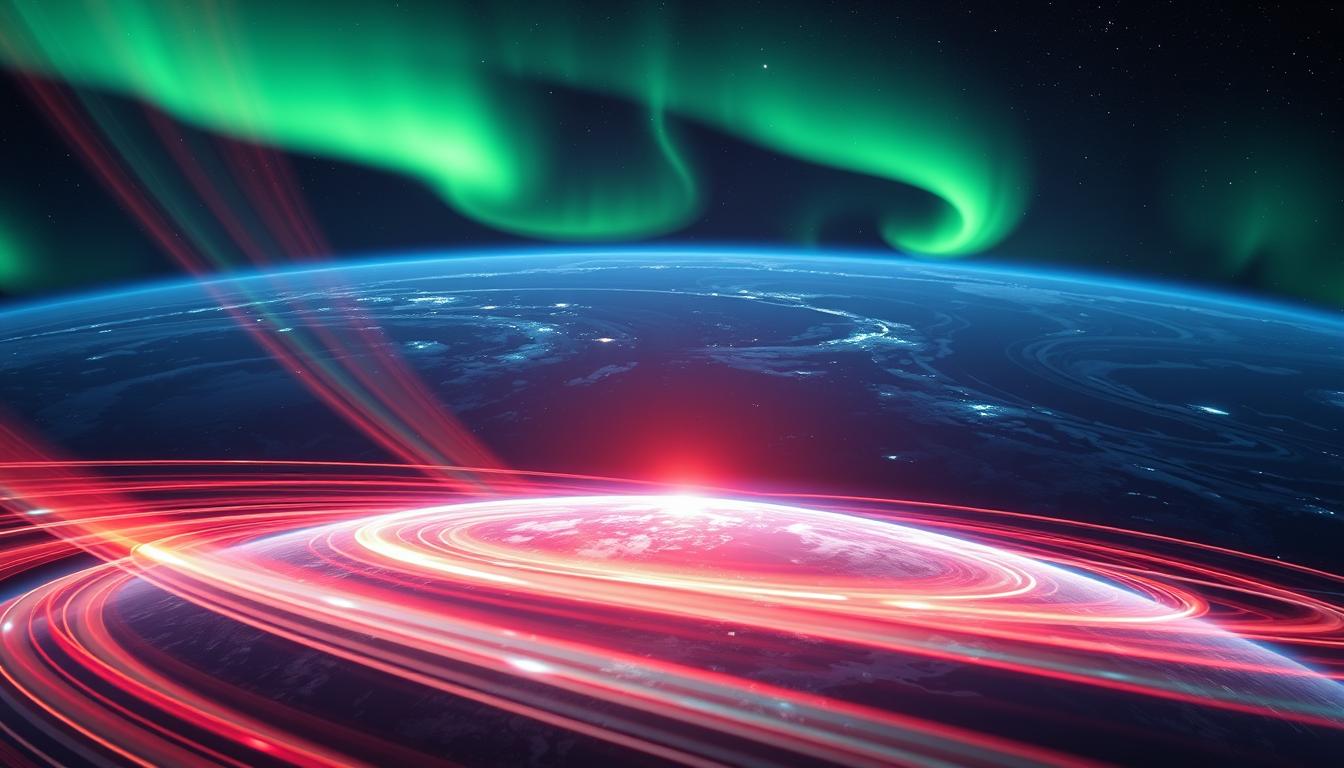
Earth’s magnetic field creates a protective bubble called the magnetosphere. This shield blocks deadly solar wind and space radiation. Without it, our planet would face the same fate as Mars, where a weak magnetic field let solar particles strip its atmosphere.
The magnetosphere stretches tens of thousands of kilometers into space, deflecting charged particles from the Sun. Solar wind and cosmic rays crash into this barrier daily. This invisible force field protects life on Earth by stopping harmful radiation from reaching the surface.
Over the past 200 years, Earth’s magnetic field has weakened by 9%. Today, the South Atlantic Anomaly—a weak spot in the field—exposes satellites to extra radiation. These changes remind us how vital the magnetosphere is for life’s survival.
Understanding Earth’s Magnetic Field
Deep beneath our feet, Earth’s magnetic field starts its journey. The Earth’s core is the source. It’s filled with a swirling ocean of molten iron and nickel. Here, the geodynamo creates our planet’s protective shield.
This process, called magnetic field generation, begins with heat from Earth’s interior. It’s like boiling water in a pot. Hot material rises, cools, and sinks, creating currents.

Earth’s rotation adds spin to this motion. It twists currents into a natural generator. Moving metals in the core cut through Earth’s magnetic field, producing electric currents.
These currents, in turn, create new magnetic fields. This self-sustaining loop is the geodynamo—the engine behind our planet’s shield.
Magnetic north isn’t fixed. It drifts, currently moving toward Siberia at 25 miles yearly. This shift happens because the field’s source is fluid, not solid.
Scientists track changes using satellites like Swarm. They measure subtle shifts in field strength and direction. The core’s activity isn’t static, and neither is our magnetic compass.
Every year, the dipole part of Earth’s field weakens slightly. Over centuries, this gradual decline hints at larger cycles. The core’s fluid motion also causes the magnetic field to reverse polarity, though such flips are rare and take thousands of years.
These changes remind us the field is alive. It’s shaped by forces we’re learning to understand.
The Role of the Magnetosphere
Earth’s magnetosphere is like an invisible magnetic shield, stretching thousands of miles into space. It deflects deadly solar particles, creating a protective bubble around our planet. At its heart are the Van Allen Belts, two radiation belts shaped like giant donuts.
These belts trap charged particles from the sun, keeping them from reaching Earth’s surface.

The magnetosphere is compressed by solar wind on the sun-facing side. It stretches into a long tail called the magnetotail. This dance with solar energy makes the barrier flexible.
The Van Allen Belts move based on solar activity. They swell during storms to protect satellites and astronauts.
Without this magnetic shield, life as we know it might not exist. The belts act like cosmic filters, letting harmless particles pass but blocking dangerous ones. Scientists study these zones to improve space weather forecasts.
This helps protect satellites and power grids from solar storms.
Earth’s magnetic field strength has weakened over centuries. But the magnetosphere remains our frontline defense. Understanding its behavior helps us prepare for space weather events.
This ensures technology and life stay safe under its silent guard.
The Impact of Solar Radiation
The Sun constantly sends out solar wind and sometimes big coronal mass ejections (CMEs). These tests Earth’s magnetic defenses. In 2005 and 2006, solar flares made the solar wind speeds over 900 km/s, much denser than usual.
These events push the magnetosphere’s dayside boundary inward by 35,000 km. Such space weather can harm satellites by exposing them to damaging radiation. For example, GPS signals failed during the 2006 flare.

Geomagnetic storms caused by CMEs bring both beauty and chaos. They create stunning auroras in the sky. But they also disrupt power grids and damage spacecraft electronics.
The Double Star satellites tracked these particles hours after eruptions. This shows how solar radiation can breach Earth’s shield temporarily. Though brief, these moments are critical—2006’s storm showed the risks satellites and astronauts face during peak solar activity.
Scientists keep an eye on this space weather with observatories like the Boulder facility. By studying solar cycles, they can predict storms. This helps protect our technology. Earth’s shield usually holds strong, but the Sun’s whims remind us of its fragile balance between beauty and danger.
Protecting Life on Earth
Earth’s magnetic field is like a silent protector against cosmic rays and solar winds. Without it, radiation protection would fail, putting life at risk. The magnetosphere keeps our atmosphere safe by blocking solar wind from taking away gases like oxygen.
Recent studies suggest a weak field could increase UV radiation by 20% in polar areas. This could harm living things.

Earth’s layered atmosphere is key for life evolution. It depends on this shield. Mars, without a strong field, lost most of its atmosphere.
In 2008, scientists saw Earth’s magnetosphere deflect solar wind 10 times better than Mars. This shows Earth’s field helps life by keeping the atmosphere in place.
Scientists believe the geodynamo started 4.2 billion years ago, making Earth habitable. The core’s silicon-iron alloy creates the field, protecting us from harmful radiation. A weak field could lead to ozone layer depletion, harming ecosystems.
Research shows a weaker field might increase oxygen loss by 1,000 times. This could threaten life-supporting conditions.
Human technology also depends on this shield. Geomagnetic storms could cause trillions of dollars in losses by damaging satellites and power grids. Studying the core’s evolution helps us understand how Earth’s magnetic field allowed complex life to emerge and adapt over billions of years.
The Effects of Magnetic Field Strength
Earth’s magnetic field has weakened by nearly 9% globally, starting in the 1830s. This weakening is less than its peak in the last 100,000 years. Scientists use data from places like Boulder to track these changes, starting in 1963.
The South Atlantic Anomaly is a key area above South America. Here, the magnetic field is much weaker.
“The South Atlantic Anomaly is a natural hotspot for studying how magnetic field fluctuations affect satellites,” explain NASA researchers, noting frequent system reboots by spacecraft passing through this weak zone.
This anomaly allows solar particles to reach as low as 550 kilometers above Earth. This is closer than in other areas. Despite the challenges, there’s no sign of a sudden collapse in the field.
Researchers say magnetic changes are part of Earth’s natural cycles. They are not a guaranteed threat to life. Now, satellites have radiation shields to safely navigate these dips in magnetic field strength.
Human Exploration and Technology
As humans explore space, space technology must keep up with Earth’s changing magnetic field. satellite protection is key—geomagnetic storms can harm satellites with radiation. Engineers use materials like tantalum and niobium to shield them. They also switch to safe modes during solar flares.
On Earth, power grid disruptions are a big concern. The 1989 Quebec blackout was caused by a geomagnetic storm. Modern grids use sensors to spot current surges, but they’re not foolproof.
Astronauts face even bigger challenges. astronaut safety depends on shielding and monitoring radiation in real-time. NASA tracks bone loss and radiation exposure in long missions, like Scott Kelly’s year on the International Space Station.
Future Mars missions need better radiation protection. NASA’s HRP is working on new detectors for deep-space travel. satellite protection is also getting a boost from AI systems that predict solar storms. As Earth’s magnetic field weakens, these advancements are essential for space exploration.
Scientific Research on the Magnetic Field
Scientists study Earth’s magnetic field by looking at paleomagnetism. They analyze ancient rocks and minerals to see how the field has changed over billions of years. Volcanic rocks, sediment layers, and tiny zircon crystals give clues about the field’s past.
Recently, 3,754 zircon grains from Canada were studied. They were 3.7 billion years old and showed a magnetic field strength of at least 15 microteslas. This is half of today’s strength, proving the field existed much earlier than thought.
Today, magnetic field research uses both old geology and new technology. The ESA’s Swarm satellites, launched in 2013, map the field’s changes. Ground stations and lab tools also track and analyze the field.
Researchers are now studying areas like Greenland’s Isua Supracrustal Belt. This is where Earth’s oldest intact rocks are found. They want to know how the field protected early life from the sun.
Future studies will help us understand the field’s history better. By looking at ancient rocks in Australia, South Africa, and Canada, scientists aim to learn more. These findings will help us predict Earth’s future.
Myths and Misconceptions
Let’s clear up magnetic field myths. Earth’s poles have flipped about 100 times in 3 billion years. Each flip took thousands of years. During a flip, the field gets weaker but doesn’t disappear.
The magnetosphere and atmosphere keep protecting life, even with temporary poles. Past flips didn’t cause mass extinctions. This shows Earth can adapt well.
Some say magnetic pole reversal causes climate disasters. But, this is a climate misconception. Magnetic field changes don’t cause global warming or extreme weather. Instead, it’s due to greenhouse gases.
There’s no proof that pole shifts harm human health. Scientists say there’s no sign of an imminent reversal. So, we don’t need to worry.
Modern technology might face some risks during weak field phases. But, these changes happen slowly, allowing us to adapt. Knowing the truth helps us understand Earth’s magnetic shield without fear.
Conclusion: The Lifeline from Space
Earth’s magnetic field acts as a silent protector, deflecting solar storms that could harm our atmosphere. This field is so important that even a small drop in intensity over two centuries shows its weakness. From the core to the magnetosphere, it keeps life going and protects satellites.
The South Atlantic Anomaly has weakened by 2,000 nanotesla over 50 years. The north magnetic pole is moving fast, at 31 miles a year. NASA and SpaceX are working on a $70 million project to protect satellites from space weather. But with over 9,000 satellites in space, we must be careful.
A full magnetic reversal might take thousands of years, but today’s changes are important. The weakening edge of the field makes low-orbit satellites more vulnerable. Researchers are tracking these changes to prepare for a future with more satellites.
This invisible force is not just physics; it’s what makes life possible. Protecting it means keeping our atmosphere and technology safe. As solar wind hits our shield, scientists are ready to adapt to the magnetic core’s next move.