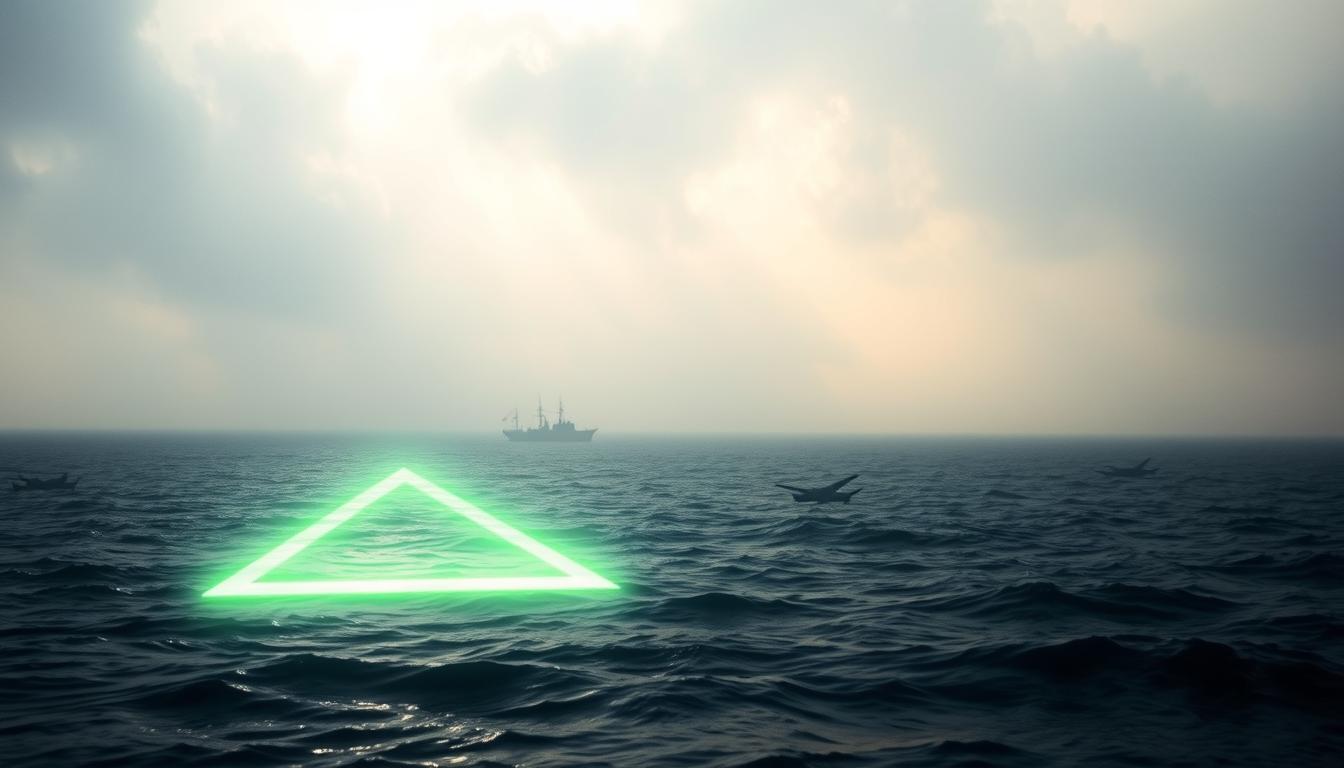
The Bermuda Triangle is a part of the North Atlantic Ocean. It’s near Florida, Bermuda, and Puerto Rico. It got famous in 1964 when Vincent Gaddis named it in a magazine. But, the truth is not as mysterious as people think.
Official data from Lloyd’s of London shows it’s not more dangerous than other ocean areas. It covers nearly 270,000 square miles.
Flight 19 vanished in 1945, with five US Navy planes and 14 crew members. A rescue plane also went missing. This made the legend grow. But, the US Coast Guard says most disappearances are due to human mistakes or storms.
For example, the 2015 SS El Faro sinking happened during Hurricane Joaquin. Yet, some mysteries remain. But, discoveries like the SS Cotopaxxi’s 2020 recovery near Florida’s coast show there are real answers. Most of the time, it’s human or environmental factors, not ghosts or aliens.
An Overview of the Bermuda Triangle
The Bermuda Triangle location covers the western Atlantic Ocean. It’s roughly between Florida, Bermuda, and Puerto Rico. The triangle boundaries are not set, making its edges a topic of debate. It’s also known as the Devil’s Triangle and spans about 1.5 million square miles.
Even though it’s not officially recognized, its fame as a place of Atlantic Ocean mysteries is strong.
The area includes the Puerto Rico Trench, the Atlantic’s deepest spot at nearly 8,400 meters. The Gulf Stream’s strong currents and unpredictable weather make it complex. The U.S. National Oceanic and Atmospheric Administration (NOAA) says there’s no higher disappearance rate here than other busy shipping lanes.
Over 50 ships and 20 aircraft are listed as missing, but many lack confirmed wreckage.
As a major shipping route, its dangers are often overstated. A 2013 study by the World Wildlife Fund ranked it outside the top 10 most dangerous waters. Rogue waves up to 30 meters high might explain some incidents. Yet, the Devil’s Triangle’s mystique remains, blending fact and myth in the Atlantic.
The Myths and Legends
Stories of the Bermuda Triangle disappearances started in 1950. Edward Van Winkle Jones first noticed strange happenings. But Vincent Gaddis made the myth famous in his 1964 Argosy article, calling it the “Deadly Bermuda Triangle.”
“Ships and planes vanish there as if they had touched the ghostly hem of space.”

The USS Cyclops disappeared in 1918, taking 306 crew with it. This was a key part of the legend. Then, in 1945, five Navy bombers vanished during training, known as Flight 19. The 1948 disappearance of a DC-3 plane 50 miles from Miami also sparked theories of supernatural forces or aliens.
Charles Berlitz’s 1974 book The Bermuda Triangle made these mysterious vanishings famous worldwide, selling millions. But today, experts say most incidents are due to human mistakes, storms, or the Gulf Stream’s currents. Despite this, the mystery of the Bermuda Triangle continues to fascinate us. Agencies like NOAA say there’s no higher accident rate here than elsewhere.
Scientific Explanations
Scientists look into the Bermuda Triangle scientific explanations to find natural reasons for its myths. The Gulf Stream effects play a big role. This fast current can quickly move debris away from where accidents happen.
This makes it hard to find lost ships or planes. It leaves few clues behind.
There are also compass variations to deal with. The area’s magnetic field is different from true north. This can confuse people using old charts.
This difference adds to the mystery of the Bermuda Triangle.
The methane hydrates theory says gas bubbles under the water might cause ships to sink. But, USGS research shows no big gas releases in 15,000 years. Most incidents are just regular risks like hurricanes and mistakes.
“Incident rates here match other busy shipping lanes when traffic volume is considered.”
Recent studies, like one from 2013, found the Triangle isn’t more deadly than other sea areas. Rogue waves and storms might explain some disappearances. But, there’s no proof of supernatural forces. Science keeps working to solve the Triangle’s mysteries.
The Role of Human Error
Human error plays a big role in accidents in the Bermuda Triangle. Before GPS, sailors and pilots faced many challenges. They had to deal with faulty compasses, old charts, and unreliable radio signals.
For example, businessman Harvey Conover’s yacht, Revonoc, sank in 1958. He ignored storm warnings, showing how navigation mistakes can be deadly.
Flight 19’s disappearance in 1945 is another example of pilot error. Lieutenant Charles Taylor, the leader, had a history of getting lost. He made mistakes during the flight, ignoring his crew’s advice and not following emergency procedures.
His errors highlight how even experienced pilots can make mistakes under pressure. The U.S. Navy found that Taylor’s navigational mistakes were the main reason for the disappearance, not supernatural forces.

NOAA’s data shows the Bermuda Triangle’s disappearance rate is similar to other busy shipping lanes. The Gulf Stream’s fast currents and unpredictable weather add to the risks. Near the area, compass confusion due to magnetic variations also makes navigation harder, leading to maritime accidents.
Weather like sudden squalls and human mistakes often lead to tragic outcomes. The U.S. Coast Guard calls the Bermuda Triangle a “mythical hazard.” Despite the myths, over 50 ships and 20 planes have gone missing there.
But, the Coast Guard says these incidents are not unique to the Bermuda Triangle. They are more common than people think. Dr. Karl Kruszelnicki says survival depends on preparation, not on supernatural forces.
Military Activity in the Area
The military presence Bermuda Triangle has long been tied to its mystery. Naval exercises and military tests have raised many questions. The 1918 disappearance of the USS Cyclops is a big part of this.
This 542-foot ship vanished without sending an SOS. It had 306 crew members and 10,800 tons of manganese ore. Its disappearance is one of the Triangle’s oldest unsolved mysteries.
The USS Cyclops mystery grew when its sister ships, Proteus and Nereus, also disappeared in the 1940s. Some think it might have been wartime sabotage or experimental weapons. The U.S. Navy says the ship last contacted them near Barbados, heading to Baltimore.
Its cargo of manganese ore has led to theories about chemical accidents.
“They vanished as if they had flown to Mars.”
The Puerto Rico Trench, with depths of 27,500 feet, has also been of interest for military tests. The Coast Guard doesn’t believe in supernatural causes. But strong currents and storms make rescue hard.
Modern sonar and satellite gaps make even routine military testing seem mysterious.
Over 100 vessels and aircraft have gone missing here, including Flight 19 in 1945. The Navy’s secrecy about classified missions adds to the mystery. Yet, the area’s busy shipping and storms offer practical reasons for many disappearances.
Modern-Day Research Efforts
Today, scientists use advanced tools like sonar and submersibles to study the Bermuda Triangle. They explore depths up to 30,000 feet, finding shipwrecks and underwater features. This technology helps them understand the area’s environment better than ever before.

In 1975, Larry Kusche pointed out mistakes in earlier research. He showed that many incidents were caused by storms or human mistakes. Scientist Karl Kruszelnicki said,
“The Bermuda Triangle’s loss rate equals other busy shipping lanes.”
Lloyd’s of London and NOAA agree, finding no unusual accident rates. They say it’s just as safe as other busy areas.
Now, researchers use AI and drones to track methane bubbles or ocean currents. Despite the challenges, they keep exploring. Each new find helps separate fact from fiction, rewriting the Bermuda Triangle’s story.
The Impact of Weather on the Triangle
The Bermuda Triangle’s dangers are linked to its weather. Hurricanes, fueled by warm Gulf Stream waters, form here often. These storms, like the 1986 sinking of the Pride of Baltimore, can hit without warning.
Winds can jump from 20 mph to 90 mph in just minutes. This can turn calm seas into chaos, capsizing ships.
Rogue waves, over 45 feet tall, and sudden storms make it even more dangerous. Hexagonal clouds above the region can create winds over 170 mph. These clouds stir massive waves that even strong ships find hard to survive.
Before satellites, sailors faced these storms blindly. For example, in 1945, 13 planes vanished during a storm.
Modern tracking tools have helped reduce disasters. But the Triangle’s sudden storms are a constant challenge to vessels.
“White squalls” with zero warning and waterspouts make navigation even harder.
Compass errors and shifting currents add to the risks. This makes the Bermuda Triangle a true test of nature’s power.
Theories Surrounding the Triangle
Bermuda Triangle theories often point to the supernatural. Some believe portals to other dimensions or time warps cause disappearances. These supernatural explanations suggest a place where reality warps, trapping vessels in unseen realms.

Alien theories are also popular. UFO sightings and lost technology from aliens are common topics. Charles Berlitz’s 1974 book, The Bermuda Triangle, sold 20 million copies worldwide. He linked disappearances to mysterious forces like advanced Atlantean tech or interstellar interference.
Lost technology claims focus on the Bimini Road, a rock structure near the Bahamas. Some believe it’s proof of Atlantis’ advanced engineering, though scientists say it’s natural. Proponents suggest ancient tech could disrupt navigation systems today.
Despite supernatural explanations, the U.S. Coast Guard doesn’t believe in them. They say human error, storms, and equipment failures are the main causes. Yet, the mystery of alien theories and lost civilizations continues to fascinate in books and films.
While no proof confirms these ideas, the Triangle’s stories live on. Each theory, from time warps to extraterrestrial tech, shows humanity’s interest in the unknown.
Cultural References in Media
The Bermuda Triangle in popular culture has inspired many stories. From books on Bermuda Triangle to movies about Bermuda Triangle, it’s everywhere. Charles Berlitz’s 1974 book, for example, sold millions, sparking curiosity about unexplained disappearances.
John Wallace Spencer’s 1969 *Limbo of the Lost* and Richard Winer’s 1974 *The Devil’s Triangle* also added to the mystery. These works helped make the Bermuda Triangle a place of eerie fascination.
TV and film brought the mystery to life. The 1975 ABC movie *Satan’s Triangle* and *Airport ’77* (1977) both featured plots tied to the Triangle. Even Triangle documentaries like Leonard Nimoy’s 1977 *In Search Of… The Bermuda Triangle* kept the myth alive.
The 1976 Milton Bradley board game, with its tagline “Sinister Mystery Cloud Swallows Ships,” turned the legend into a game. It was a fun way to explore the mystery.
“Sinister Mystery Cloud Swallows Ships.”
Music and games also added to the lore. Fleetwood Mac’s 1974 song and Barry Manilow’s 1980 hit made the mystery a part of pop culture. Atari’s 1982 game *Bermuda Triangle* challenged players to dodge underwater hazards.
Even *Scooby-Doo* and *Wonder Woman* episodes used the Triangle as a plot device. They mixed adventure with the supernatural, making the Triangle a staple of entertainment.
These stories, while entertaining, often focused on drama over facts. Yet, they’ve kept the Triangle’s mystery alive. Its grip on the public imagination remains strong.
The Economic Impact on Tourism
Florida Triangle tours and mystery tourism are big because of the Bermuda Triangle’s legend. Cruise ships and charter boats take people into the area’s waters. They promise to find the unknown.
Hotels and tour operators tell scary stories to attract visitors. This turns myths into money. In 2019, Bermuda welcomed 235,000 air travelers, many because of its spooky stories.
Bermuda’s tourism depends a lot on the Triangle’s fame. In 2018, visitors spent over $1,400 each, staying almost a week. But, a tourism tax adds 28% to their bills.
Cruise lines like Royal Caribbean offer themed voyages. They use the area’s mystique to make money.
But, science tells a different story. A 2013 World Wildlife Fund study found the Triangle isn’t very dangerous. Yet, marketing focuses on ghost stories. This keeps the legend alive and profits flowing.
Florida’s coastal areas also benefit, with “mystery tours” and conferences about the Triangle. Insurers charge more for vessels passing through, even though it’s not that risky. The paradox is that thrill-seekers keep coming, boosting economies while scientists say the dangers are exaggerated.
Debunking the Myths
Myth busting the Bermuda Triangle starts with cold, hard facts. Larry Kusche’s 1975 book Bermuda Triangle Mystery: Solved exposed gaps in sensational stories. Many “mysterious” disappearances were later found to have mundane causes like storms or navigation errors.
Statistical analysis shows incidents here match other busy shipping routes. Lloyd’s of London confirms insurance rates aren’t higher for the area, proving it’s no deadlier than elsewhere.
“Most disappearances are weather-related,” says Norman Hooke of Lloyd’s Maritime Information Services. “The Triangle’s reputation isn’t backed by evidence.”
Flight 19’s 1945 vanishing—a staple of myth—was later linked to poor weather and pilot disorientation. Even methane gas theories, though popular, lack proof. Methane hydrates exist globally and don’t uniquely plague the area.
Meanwile, the US Coast Guard notes most accidents stem from human error or extreme storms common in hurricane alley.
Scientific explanations reveal the truth: the Triangle’s high traffic and natural hazards like rogue waves and magnetic anomalies make it statistically average. Over 50,000 ships sail through yearly, yet only 0.02% report issues—a rate consistent with global averages. The mystery unravels under scrutiny, leaving no room for supernatural tales.
Conclusion: What We Know Today
Today, we know a lot about the Bermuda Triangle. Agencies like NOAA and the U.S. Navy say there’s no proof of supernatural events. Most disappearances are due to human mistakes, bad weather, or equipment failures.
Over 75 aircraft and hundreds of ships have gone missing. But, when we look at the number of accidents per ship, it’s not much different from other busy seas. This shows the Bermuda Triangle isn’t uniquely dangerous.
Some people talk about rogue waves, sudden storms, and methane gas from the seabed. But, there’s no solid proof for these claims. The mystery of the 1918 USS Cyclops and the 2015 El Faro incident is intriguing. Yet, experts say the area is not more dangerous than others.
The U.S. Coast Guard says the loss rates here are the same as worldwide averages. This means the Bermuda Triangle is not special in terms of danger.
Even though science has explained many things, the Bermuda Triangle’s legend lives on. Stories about hexagonal clouds and methane bubbles keep the mystery alive. But, with new technology like sonar and satellites, we might find answers soon.
As we keep researching, the Bermuda Triangle reminds us of nature’s power. It also shows our fascination with the unknown.