
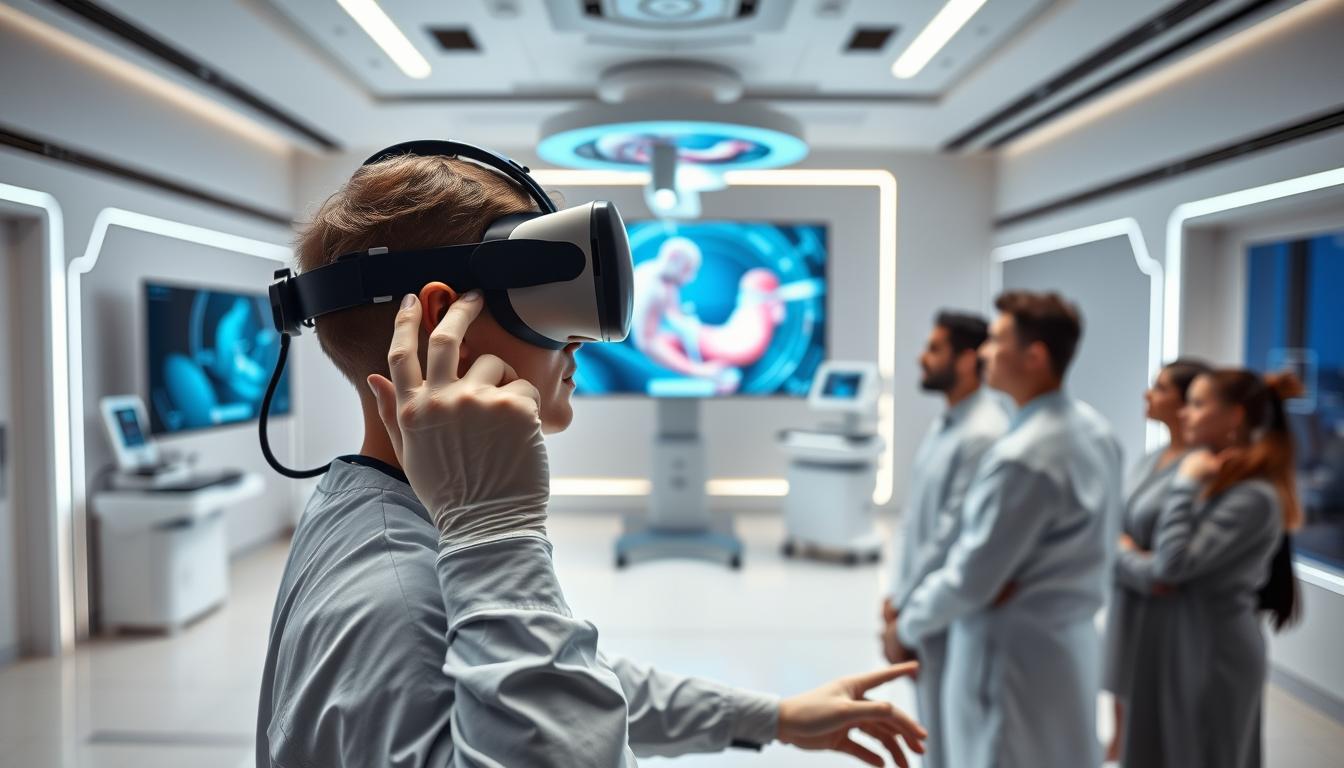
Virtual reality (VR) technology lets users dive into 3D worlds through headsets or screens. It’s changing fields like medicine, gaming, and education. VR is making learning and training more engaging and innovative.
In medicine, VR is making training cheaper and more effective. Medical schools and 18 NHS trusts are now using it. VR setups cost £3,000, much less than £876,485 for real-life simulations.
VR cuts training time to just 5 minutes. It also reduces human error by nearly 50% in aviation. This shows VR’s reliability and effectiveness.
VR’s effects aren’t limited to healthcare. Educational tools like Floreo help with autism therapy. Gaming apps, like InMotion’s Corpus VR, boost patient involvement by 30%.
Universities and telemedicine programs use VR for global education. This makes learning accessible worldwide.
Even though VR is powerful, only 5% of its capabilities are used. Innovations like Surgical Theater’s 3D planning and SyncThink’s Eye-Sync platform show its benefits. As VR becomes more popular, its role in healthcare, learning, and fun will grow.
Introduction to Virtual Reality Science
Virtual reality (VR) science started in the mid-20th century. In 1987, Jaron Lanier named it, aiming to create 3D environments with technology. Early systems, like Morton Heilig’s 1962 virtual simulations in the Sensorama, tried to engage all senses.
Today, VR headsets use head-mounted displays (HMDs) to track head movements. This makes the digital world feel real.
Non-immersive VR uses screens for digital worlds. Immersive systems, like Meta’s Quest 3, wrap users in 360-degree digital spaces. Sensors in VR headsets adjust visuals quickly, making the brain think it sees depth and motion.
This is different from augmented reality, which adds digital elements to the real world.
From the U.S. Navy’s Project Whirlwind in the 1940s to Ivan Sutherland’s 1963 Sketchpad, each step led to today’s VR. Modern VR combines head tracking, 3D audio, and haptic feedback for realistic experiences. As the market grows to $313.5 billion by 2032, knowing its history shows its wide range of uses.
The Role of VR in Medical Training
Medical simulations are changing healthcare education. They provide realistic settings for training in surgery and clinical skills. Programs like Johns Hopkins School of Nursing use VR for all levels, from prelicensure to doctoral.
Surgeons at Massachusetts General Hospital practice complex procedures with PrecisionOS. They work on virtual 3D models made from patient scans. This lets them practice endlessly, building confidence without risking patient safety.
Nursing students at the University of Central Florida use Microsoft HoloLens and Oculus headsets. They simulate high-stakes scenarios like maternity emergencies. VR lets instructors see what trainees see in real time, helping them improve quickly.
Taipei Medical University uses 360° videos to immerse junior students in emergency room settings. Studies show VR anatomy training improves sonography skills. Now, VR systems are more affordable, making them accessible to more schools.
A 2022 review of 37 studies found VR/AR boosts surgical precision and accuracy. Over 149 global studies show its benefits. As tech firms and medical schools work together, VR becomes key for training the next generation of clinicians.
Enhancing Patient Care Through VR
Virtual Reality (VR) is changing how healthcare treats patients. It helps with pain, anxiety, and mobility issues. Hospitals use VR to reduce the need for medication.
For example, 88% of cardiac surgery patients needed less pain relief after VR. This made their recovery smoother without extra drugs.
In exposure therapy, VR creates safe spaces for facing fears. Burn victims in a study felt less pain during care in virtual settings. For anxiety, XRHealth offers virtual spaces for gradual therapy.
“VR’s impact on stress reduction is measurable—ICU patients using synthetic motion pictures saw a 30% drop in discomfort.”
VR is also changing physical therapy. The Jintronix system helps stroke survivors practice in games. This boosts their motivation.
Over 86% of users wanted to keep practicing at home. Doctors can track progress and adjust exercises for better results.
By adding rehabilitation VR to care plans, hospitals save money and make therapy more accessible. Remote therapy helps rural patients without needing to travel. Gamified exercises also improve treatment adherence.
As VR technology improves, it’s becoming key in making patient treatment more effective and caring for everyone.
Virtual Reality in the Gaming Industry
VR gaming has changed how we play games. Platforms like Oculus Quest, PlayStation VR, and Valve Index bring games to life. The global market for VR entertainment reached $1.1 billion in 2020, showing the industry’s growth.
Games like “Half-Life: Alyx” and “Beat Saber” turn homes into action zones or dance floors. This shows how VR gaming can transform any space into a new world.

VR gaming is special because it involves our bodies. Players move and interact with virtual worlds. This makes gaming more than just watching.
Many in the U.S. have tried VR, with 63% thinking it will lead the future of gaming. But, 35% face motion sickness. Luckily, systems like Meta’s Quest 2 help reduce this problem.
Behind the scenes, immersive gameplay drives tech innovation. New systems improve controls and create more realistic games. These advancements also help in fields like medicine.
As VR gaming grows, it’s not just a trend. It’s changing how we play, learn, and connect. By 2024, the market is expected to hit $12.19 billion, showing VR’s impact.
The Impact of VR on Education
Educational VR is changing how we learn in schools. It offers students a chance to dive into learning in ways that go beyond books. Now, over 15% of U.S. schools use VR tools like Nearpod VR or Microsoft HoloLens.
Students can explore ancient ruins or see virtual cells up close. This makes learning feel real and hands-on. Instead of just reading about it, students get to interact with the content.
Research shows VR makes learning more engaging. A 2019 EdTech report found students in VR classrooms did better on biology tests. VR field trips, like visiting the Statue of Liberty through Nearpod, make lessons stick in your mind.
VR also boosts memory retention. A study found a 9% increase in memory when using VR. This shows how VR can improve learning results.
Tools like the Oculus Quest 2 let students practice history or language in 3D. Universities like the University of Michigan and Singapore Polytechnic use HoloLens for medical training. This shows VR’s wide range of uses.
But, there are challenges. The cost of VR gear and training teachers can be a problem. Schools need to weigh these costs against the benefits of deeper learning through VR.
As educational VR becomes more affordable, it will play a bigger role in schools. Schools are already mixing VR with traditional teaching. This creates a new kind of learning experience. With prices falling and more content available, VR could soon be a key part of learning everywhere.
VR for Skill Development and Training
Virtual reality is changing professional training by creating simulation-based learning spaces. These are safe for practicing high-risk or complex tasks. For example, pilots train in emergency scenarios, and manufacturing workers learn assembly lines virtually. This way, they gain confidence and skills without real-world risks.

Studies show VR training boosts practical skills a lot. A meta-analysis of 37 studies found a moderate effect size of 0.477. Medical students showed the most improvement. Programs like VirtualSpeech help users practice public speaking, getting instant feedback on their performance.
Even soft skills like leadership and conflict resolution are now trained in VR. This fills gaps in traditional workforce development methods.
VR also saves money. Firefighters or first responders can train in virtual disasters without the usual logistical challenges. Companies like Boeing have cut training costs by 30% using VR. Platforms like Golf Scope analyze athletic movements in real time.
As VR headsets like the Oculus Rift become cheaper, more people can use them. This includes small businesses. Future advancements will add AI for personalized learning and virtual spaces for global teams.
The Intersection of VR and Social Interaction
Platforms like VRChat and Rec Room change how we socialize online. They let users interact with customizable avatars in virtual spaces. This creates a place for everything from casual chats to serious brainstorming, all from different places.
Virtual communication in these spaces feels more real than video calls. It’s great for those who find it hard to connect in person, like those with social anxiety or mobility issues.
“Virtual reality enhances ecological validity in research without sacrificing experimental control,” allowing scientists to study interpersonal dynamics in lifelike scenarios. This tech also aids therapy: studies show VR exposure therapy cuts anxiety levels, with large effect sizes reported in over 800 participants across 18 studies.
Healthcare uses social VR for telemedicine, like testing senses for stroke patients or guiding therapy. Companies like Meta’s Horizon Worlds and Google’s Daydream help with virtual teamwork. Research shows VR can even boost confidence in real-life situations, like job interviews.
As headset prices fall, more people can join in. This opens up new ways to connect, breaking down barriers of distance or disability.
Challenges Facing Virtual Reality Adoption
VR has great promise, but VR limitations and technology barriers slow its adoption. High costs, with some headsets over $2,000, make it hard for many to access. Issues like the “screen door effect” and limited field of view also reduce immersion.
Devices are often tethered, limiting movement. Even with 5G’s faster speeds, the hardware is bulky and consumes a lot of power.

Motion sickness affects up to 40% of users, causing nausea and dizziness. Older adults are at higher risk, as VR systems mainly target younger users. Experts say 99% of the industry faces tech hurdles, and 61% believe innovation is key for widespread use.
Clinical trials face challenges too. Many are small and results are hard to compare. This makes it tough to measure VR’s effectiveness.
Designing better hardware is essential. We need lower costs and designs that fit everyone’s needs. Only then can VR fulfill its promise in medicine, gaming, and education.
The Future of VR Technology
Emerging VR tech is changing how we interact with digital worlds. Next-generation headsets are getting sleeker, lighter, and more powerful. They have sharper displays and wider fields of view.
Companies like Meta and Sony are working on headsets that don’t need external sensors. They use advanced inside-out tracking instead.
Haptic feedback systems are getting better than handheld controllers. Full-body suits like the Teslasuit are used in NASA training. They track biometrics and provide tactile sensations.
Wireless VR setups are removing cords, giving users more freedom. This is important for things like surgical simulations or classroom activities.
By 2030, Ericsson predicts digital environments could engage all five senses, blurring lines between virtual and real.
Artificial intelligence will make VR environments more dynamic. It will create scenarios for medical training or team-building exercises. Wireless VR is becoming more portable and affordable.
This could make it available to small businesses and schools. The education VR market is expected to hit $13B by 2025.
Imagine a classroom where students dissect virtual specimens with gloves that feel real. Or surgeons practicing delicate procedures with resistance that feels like real tissue. VR tech is evolving into a key tool for learning, collaboration, and innovation.
Case Studies of VR in Action
VR is making a big impact in education and healthcare. At the University of Northampton, nursing students use VR headsets to practice in a virtual ward. They can handle emergency scenarios safely, with their peers watching and discussing.
This approach has cut down on mistakes and improved teamwork. It shows how VR can help build skills without putting patients at risk.

Walmart has also seen benefits from VR. They use it for Black Friday simulations, saving money and time. Employees learn to handle crowds in virtual stores, cutting down onboarding time by 30%.
Games like Beat Saber have also been a hit. It combines rhythm with VR motion controls. Over 2 million copies sold show it appeals to more than just gamers.
Google Expeditions have been a hit in schools, used in over 11,000 schools. Virtual field trips to places like ancient Rome or coral reefs have boosted learning by 20%. Surgeons trained with VR at medical centers saw a 83% improvement in task completion compared to those who learned from textbooks.
These examples show VR’s wide range of uses. Metrics show VR’s effectiveness: 85% of technicians prefer it over lectures. VR-trained soldiers were 2.7 times more successful in their missions.
VR is no longer just a novelty. It’s becoming a key tool in many fields. It mirrors reality without the risks, leading to better training and engagement.
Conclusion: The Transformative Power of VR
Virtual reality has grown a lot from its gaming roots. Now, it’s used in medicine, education, and training. It helps students learn science better and remember more, thanks to VR.
Medical students practice surgeries safely in digital spaces. Art students get creative in 3D worlds, boosting their ideas by 65%. These changes show VR’s big impact on our world.
VR is getting easier to use thanks to new tech. Devices like the Oculus Quest 2 and Microsoft HoloLens 2 make it more accessible. With 5G and cloud computing, VR is spreading fast.
Companies like ARuVR and PBC Linear show VR can cut training time by 80%. Teachers feel more confident using VR, showing its growing role in schools.
Despite some challenges, VR is making fast progress. The VR training market is expected to hit $142.1 billion by 2030. Schools see a 45% increase in student success with VR.
VR is changing how we learn and work. It’s being used for everything from studying molecules to practicing surgeries. VR experiences are more engaging and effective than old methods.
As VR gets better with AI and cloud tech, its impact will grow. We need to make sure it’s affordable and used ethically. But the future looks bright.
Imagine classrooms where students can explore virtual worlds. Engineers can practice in 3D spaces. VR is more than a tool; it’s a way to make learning and care better for everyone.
VR helps us build a better future. It’s not just about technology; it’s about changing how we interact and learn. Together, we’re creating a reality that’s more inclusive and effective.