
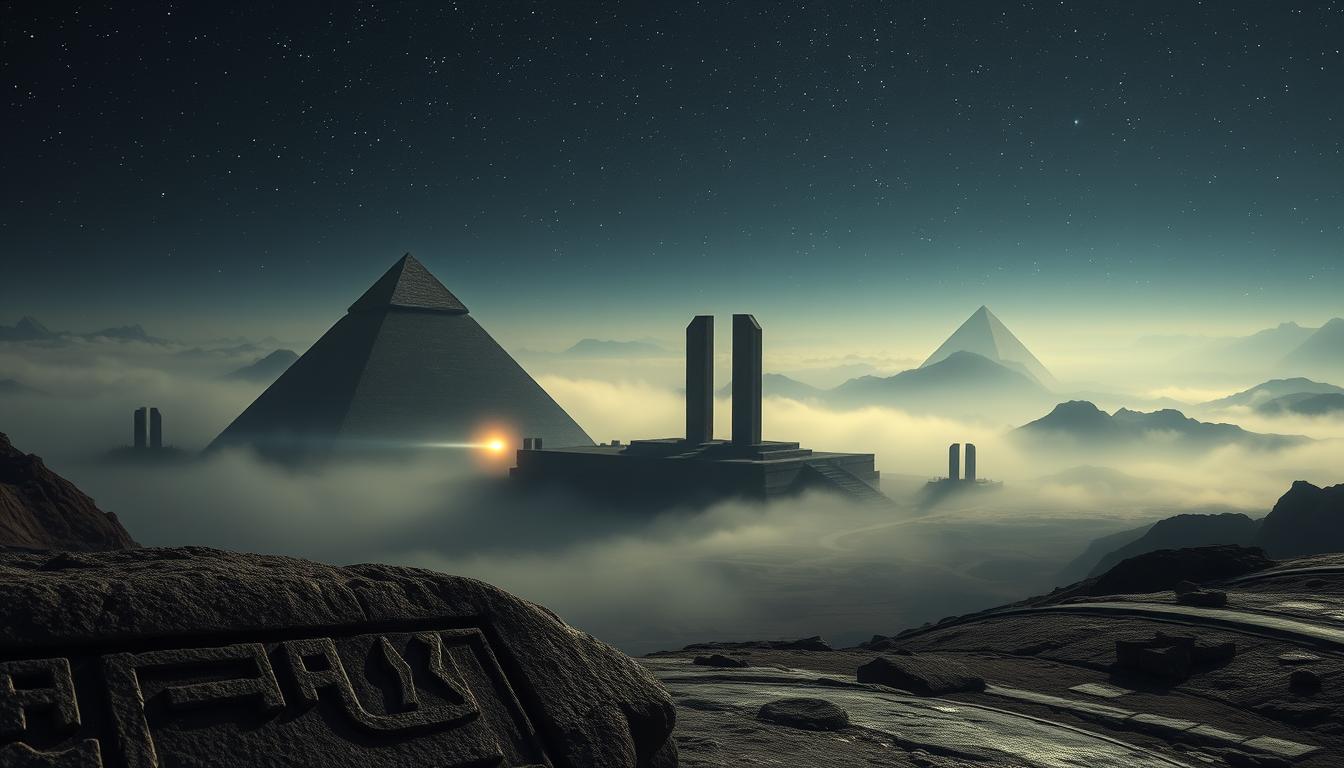
The ancient astronauts theory suggests that aliens visited Earth long ago. They claim these advanced beings influenced human history. The Orion Correlation Theory links the Giza pyramids to Orion’s Belt stars, showing a perfect alignment.
These theories, known as ancient alien evidence, try to explain mysteries like ancient structures or sudden cultural changes. They propose that aliens could have been behind these enigmas.
The History Channel’s Ancient Aliens has been exploring these ideas for 17 seasons. It connects events like the Rendlesham Forest incident of 1980 to ancient stories. This includes UFO sightings and cattle mutilations, as well as ancient gold rituals.
Supporters say ancient art and cave drawings show insect-like aliens or portals to other worlds. Even famous figures like Buzz Aldrin and Paul Hellyer have suggested life beyond Earth. Yet, mainstream science calls these ideas pseudoscience.
Despite this, the theories continue to spark curiosity. They make us wonder if ancient texts or lost civilizations hold secrets of the cosmos.
Ancient Alien Theories: An Overview
In the 1960s, Erich von Däniken changed pop culture with Chariots of the Gods?. He said ancient sites like Egypt’s pyramids were built with alien help. His book sold millions, starting debates about “ancient astronauts” and “astronaut gods.”

Years later, Zecharia Sitchin took these ideas further. He said the Anunnaki—aliens from Nibiru—created humans. Scholars call this pseudoarchaeology, but TV brought it back to life. The History Channel’s “Ancient Aliens” series, now in its 21st season, has attracted millions. Critics say it spreads unproven claims.
Terms like “paleocontact” and “Nibiru” are big online. But experts say no. Despite this, 57% of Americans believe in ancient advanced civilizations. This mix of curiosity and doubt keeps the mystery alive.
Key Civilizations and Their Alien Connections
The Sumerian tablets speak of the Anunnaki, beings who supposedly created human labor to mine gold. These ancient texts, from 4500 BCE, describe Enki and Enlil as creators of human civilization. Some say these stories are myths, not about aliens, but others believe in their extraterrestrial origins.
The ancient Egypt pyramids are truly amazing. The Great Pyramid’s alignment with true north is incredibly precise. This has led to debates about whether humans could have done it alone. The Step Pyramid and the Sphinx’s erosion patterns also spark theories of outside help.
In Mesoamerica, the Mayan alien connections focus on their 260-day calendar and star maps. Alignments in places like Chichen Itza’s El Castillo mirror celestial events. This has led some to believe in guidance from advanced beings. The Nazca Lines, with their hundreds of geoglyphs, also suggest extraterrestrial landing zones. Yet, critics point out that pre-Columbian cultures didn’t have flight.

Mainstream archaeology says these achievements are thanks to human ingenuity and astronomy. But, the mystery of ancient astronaut theories keeps these sites in the spotlight. Whether it was divine, alien, or purely human, their legacy is a topic of ongoing debate.
Biblical Reference: Are Angels Aliens?
Debates over biblical aliens often focus on Ezekiel’s wheel. It’s described as a glowing craft with spinning rings. Erich von Däniken thinks this vision is about advanced technology, not divine signs.
The Nephilim—giant beings in Genesis 6:4—are also a topic of interest. They are linked to religious alien references through texts like the Book of Enoch. This book tells of 200 “Watchers,” celestial beings who shared forbidden knowledge with humans.

Seeing ancient scripture as about aliens challenges traditional beliefs. For example, the Ark of the Covenant’s glow in Exodus is seen as early technology by some. But critics like Dr. Mark Giszczak say these views ignore centuries of scholarly work.
Shows like Ancient Aliens keep these ideas popular. They point out similarities between biblical “angels” and beings with advanced abilities.
Modern polls show over half of U.S. Christians believe in aliens. This mix of faith and curiosity about space keeps the debate going. Whether divine or alien, these stories show humanity’s eternal search for answers.
Stonehenge and Other Megalithic Structures
Stonehenge’s stones line up with the sun during solstices, showing they were built with care. The mystery is how they moved 25-ton stones 200 miles from Wales. Did they use sledges and ropes, or was it something more?

Puma Punku in Bolivia is amazing, with stones that fit together perfectly. It’s hard to believe they did this with ancient tools. Some say advanced techniques, like bronze tools, were used, but many questions remain.
Easter Island’s Moai and Peru’s Sacsayhuamán are also full of mystery. Sacsayhuamán’s walls have 200-ton stones that fit together without mortar. Erich von Däniken thinks aliens helped, but many believe in human ingenuity. Wally Wallington moved a 1-ton block with simple tools, showing what humans can do.
Building Stonehenge took 1,500 years. Recent tests show 10 people could move a ton of stone each day. But moving 225km of bluestones is a big mystery. Some think glaciers moved the stones, while others believe it was for rituals.
There’s a big debate about who built these wonders. Was it ancient engineering or aliens? Sites like Puma Punku and Sacsayhuamán make us wonder about our past. They show what humans could do without modern technology.
Ancient Artifacts: Evidence of Extraterrestrial Life
Some ancient objects and images puzzle scientists today. The Antikythera mechanism, a 2,000-year-old Greek bronze device, could calculate eclipses and star positions with great accuracy. Found in a shipwreck, its complex gears and dials suggest ancient technology beyond its time. Could it be an out-of-place artifact from a forgotten era?
In Charama, India, 10,000-year-old cave paintings of aliens depict human-like figures in metallic suits. Some believe these images show encounters with beings from beyond Earth. The Baghdad Battery—a clay jar with copper and iron rods—might have created weak electricity centuries before Volta’s battery. The Saqqara Bird, a 2,000-year-old Egyptian gold artifact, has wings shaped like planes, sparking debates about its purpose.
Experts have different views on these unexplained artifacts. Were they tools of advanced ancient cultures—or clues left by visitors from space? NASA now funds studies searching for technosignatures in space, showing even scientists wonder about such possibilities. Whether human ingenuity or alien gifts, these relics remind us history holds secrets waiting to be solved.
The Role of Religion in Ancient Alien Theories
Thirty-five percent of Americans think ancient aliens visited Earth. This idea links religious origins to space contact, causing a lot of debate. People who believe in ancient astronauts say these beings were seen as divine beings by early humans.
They point to things like the flying Vimanas in Hindu texts or the Ark of the Covenant’s strange effects. These could be examples of misinterpreted technology.
Critics say there are similarities to cargo cults. These are 20th-century Pacific cultures that worshipped WWII planes as gifts from gods. It’s like how ancient humans might have seen alien technology as sacred.
Erich von Däniken’s Chariots of the Gods? book made these ideas popular. He suggested that gods like Thor’s hammer were actually advanced tools.
Supporters like Zecharia Sitchin say Sumerian texts talk about aliens called the Anunnaki. They mix spiritual alien connections with myths of creation. But skeptics call this pseudoarchaeology, saying it ignores real cultural achievements.
Shows like Ancient Aliens keep the idea alive. They attract people who doubt traditional stories.
Even though scientists don’t believe it, the idea persists. It shows how our search for meaning can mix faith and cosmic curiosity.
Modern Interpretations: Ancient Aliens in Pop Culture
The History Channel made ancient alien theories popular with Ancient Aliens show. It started in 2010 and has grown to 17 seasons and over 200 episodes. The show links ancient artifacts to aliens, thanks to co-host Giorgio Tsoukalos.
His unique hairstyle and arguments made him famous. The show mixes real history with speculative ideas to start debates.
Science fiction influence from the show is seen in movies like Stargate and games like Assassin’s Creed. Critics say it’s a mix of myth and reality. Yet, it has made alien pop culture a big part of how we see ancient history.
Historians may question its facts, but Ancient Aliens show makes us curious about the past. It’s meant to entertain while keeping facts separate. The show shows how stories can turn theories into cultural hits.
The Scientific Community’s Stance
Mainstream archaeology doesn’t buy into ancient astronaut theories. They use scientific criticism to debunk claims without solid archaeological evidence. Experts say the Egyptian pyramids were built with ramps and human effort, not alien technology.
Over 65 million copies of Erich von Däniken’s Chariots of the Gods? have sparked public interest. But, experts label these ideas as pseudoscience. Theories like the Nazca Lines being “runways” fall apart when looked at closely—they’re better seen from the ground, not from the sky.
“Ancient mysteries have reasonable explanations,” wrote astronomer Carl Sagan, highlighting flaws in linking myths to aliens. His words echo modern debates about whether cultures like Great Zimbabwe’s builders needed outsiders to construct their cities.
Researchers emphasize critical thinking when examining claims. The 2014 vandalism of Khufu’s cartouche in the Great Pyramid by pseudoscientists shows how myths can distort history. Shows like Ancient Aliens are popular, but peer-reviewed studies reject their ideas. Scholars like John Colavito point out these theories often belittle indigenous achievements, suggesting they couldn’t have built monumental sites without outside help.
While theories continue, archaeologists encourage skepticism. The Babylonian text Enuma Elish tells of temple-building without aliens, and carbon dating confirms human timelines. Science values evidence—like tools and labor systems—over speculation. As Scientific American noted in 2017, believing in ancient aliens might reflect cultural desires, not proof. The lesson? Be cautious of myths, but trust the science behind human creativity.
The Future of Ancient Alien Theories
Modern technology is changing how we see ancient mysteries. SETI research and missions like Breakthrough Listen look for alien signals. Sites like Göbekli Tepe’s 12,000-year-old structures spark debate.
These new ideas make us question where we come from. They mix science and imagination. This blend challenges our understanding of human origins.
Our search for cosmic connections is growing. Tools like AI and satellite imaging help us. NASA’s Exoplanet Program shows us planets that could support life.
But, there’s a debate: most ancient artifacts have simple explanations. Yet, theories like Sitchin’s Anunnaki ideas are widely rejected. Pop culture, like books and documentaries, keeps these ideas alive.
Many people are curious about aliens: 55% of Americans believe in them. Globally, 40% think we might have met ancient aliens. This curiosity has led to over 200 books and studies.
Even if these ideas are not proven, they spark our curiosity. The Kardashev Scale and Drake Equation show our place in the universe. As we learn more about space, our theories will evolve based on evidence.
Yet, the search for answers keeps us looking up at the stars. It’s a journey that inspires us to explore and discover.