
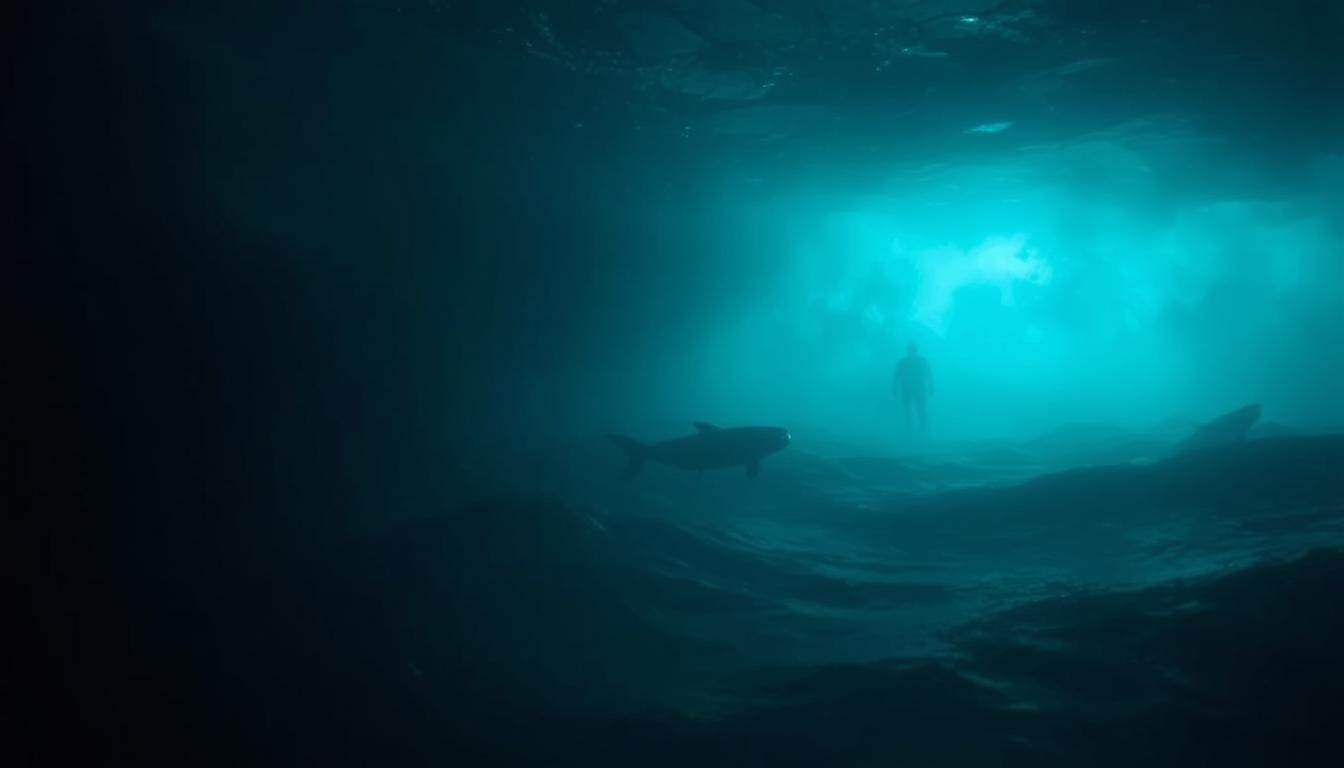
Deep in the ocean, strange sounds echo through the water. Scientists in Monterey Bay, California, have recorded sperm whale clicks at 891 meters. These sounds are as loud as a jet engine, reaching over 200 decibels.
These deep sea sounds were tracked for 1,242 days over seven years. They show patterns that suggest hidden migration routes. This is just one of the many mysteries of the ocean.
Hydrophones, like those used by researcher Will Oestreich, capture sound waves 256,000 times per second. They can detect clicks from 100 miles away. But, even with these tools, many ocean acoustics puzzles remain unsolved.
Sperm whale calls, lasting just fractions of a second, help scientists identify adults and juveniles. But their sudden appearances in unexpected regions raise more questions. Their mysterious sounds remind us of how much the ocean is yet to reveal.
Understanding Ocean Sounds: What Are They?
Ocean depths are filled with a hidden symphony of underwater acoustics. These types of ocean sounds include biological calls from marine life, natural forces like storms, and human-made noises. Scientists use hydrophone recordings to study these waves. These recordings capture sound frequencies beyond what humans can hear.
Sound travels much faster underwater than in air. This allows marine sound propagation to travel thousands of miles. Channels like the SOFAR layer help in this journey.
Hydrophones show amazing details. Blue whales’ moans can reach 190 dB, while pistol shrimp snaps can hit 218 dB. Rainstorms can add 35 dB to surface noise.
These hydrophone recordings reveal how underwater acoustics affect marine life. For example, oyster toadfish use deep calls to attract mates. Plainfin midshipman fish adjust their hearing with seasonal changes.
Human activities like shipping add 10 dB to low-frequency zones. Navy sonars can reach 235 dB. Yet, this world holds clues to climate shifts and animal behavior.
By decoding these soundscapes, researchers learn how marine life adapts. They find out how it thrives or struggles in Earth’s liquid realm.
The Most Mysterious Ocean Sounds
The the bloop phenomenon is one of the most famous unexplained sounds. It was detected in 1997 by NOAA’s sensors near Antarctica. This sound was so low it was beyond any known animal’s voice.
Many theories try to explain it, from giant sea creatures to geological events. It’s a mystery that has sparked a lot of debate.
In 1999, another strange sound was recorded, called Julia. It was a slow descending tone heard off the Pacific coast. It vanished as quickly as it started.
The 1997 Slow Down sound was even more mysterious. It ended with the words “Slow Down” in its final moments. It’s like a message from the deep that we can’t understand.
Recently, scientists found a connection between the biotwang and Bryde’s whales. It was first heard near the Mariana Trench in 2014. Researchers found that 9 out of 10 times it was heard with these whales.
But what it means is not clear. The bio-duck, a quacking sound, was linked to Antarctic minke whales in 2014. It was first heard in 1960, leaving scientists puzzled for decades.
These sounds are a big mystery to scientists. NOAA has over 200,000 hours of audio that holds many secrets. Technology like AI helps analyze these sounds, but many are not understood.
Each new discovery, like the 2016 increase in biotwang recordings during El Niño, shows how much we don’t know. The ocean is full of mysteries waiting to be solved.
Possible Causes of Strange Ocean Noises
Many ocean sound sources come from underwater geological activity. Volcanoes, hydrothermal vents, and gas releases make rumbling or whistling sounds. Cryoseisms, or frost quakes, happen when ice cracks or icebergs scrape the ocean floor, creating low-frequency booms.
The “Bloop” detected in 1997 was thought to be from a monster. But it was actually from Antarctic ice shelves, not a creature.
Biological factors also play a role. Marine creature vocalizations from whales, dolphins, and unknown species can sound eerie. The “Bio-duck” noise was once a mystery until it was linked to Antarctic minke whales.
Whales use these calls to talk to each other over long distances. Mysterious whistles might be from new species we haven’t found yet.
Human-made noise from ships, sonar, and drilling adds to the mix. NOAA uses hydrophones to track these sounds. They help understand the balance between natural ocean sound sources and human impacts.
The Role of Marine Life in Creating Sounds
Whales are experts in making sounds underwater. Sperm whales, for example, make whale vocalizations that are louder than jet engines, reaching 200 decibels. These clicks help them find prey in the dark by bouncing sound waves off it. Scientists can even tell what species and size a whale is by listening to these sounds.

Humpback whales sing complex melodies during mating seasons. They use marine mammal communication to connect with others. Their songs range from 300 Hz to 10 kHz, with the loudest parts at night. Nearby fish like toadfish and damselfish also make sounds, like grunting or grinding teeth, to mark their territory.
Snapping shrimp make crackling underwater biological noises by snapping their claws. This creates a constant “chorus” in shallow waters. These small crustaceans make up to 70% of the background noise in tropical bays. Even belugas and narwhals use high-pitched clicks for echolocation, helping them navigate Arctic waters under ice.
Researchers track these sounds to study ocean ecosystems. Changes in whale calls or shrimp activity can signal changes in ocean health. But there are many mysteries, like why humpbacks sing differently each year and how fish coordinate their sounds. As technology gets better, every sound becomes a clue to life under the waves.
Technology Used to Detect Ocean Sounds
Underwater microphones called hydrophones are the ears of the deep. They capture vibrations at 256,000 samples per second. This lets them pick up noises from over 100 miles away. Modern systems like NOAA’s Pacific Marine Environmental Laboratory use them to map whale calls and volcanic rumblings.
Sonar technology like the U.S. Navy’s SOSUS network, once used to track submarines, now aids civilian research. Deployed in the 1960s, its $16 billion system detected Japanese volcanic tremors from Oregon. Today, it monitors blue whale migrations and underwater eruptions.
Portable hydrophone arrays now operate in key zones like the Gulf of Alaska and North Atlantic. The Pioneer Seamount Acoustic Observatory uses four hydrophones on a 100-km cable. It captures long-term ocean acoustic monitoring data. Researchers like Will Oestreich use these tools to decode whale behavior, revealing migration routes hidden for decades.
“Hydrophones are rewriting our understanding of ocean life,” says marine scientist Dr. Lena Torres, referencing recent discoveries of deep-sea seismic activity.
Sonobuoys launched from ships gather data but last only hours, limiting their use. Future upgrades promise real-time streaming via improved cellular links. This will enable cheaper, instant analysis. These advances turn sound detection equipment into windows into Earth’s most mysterious environments.
Notable Research on Ocean Sounds
Marine acoustic research has led to amazing discoveries about ocean sounds. In the 1950s, William Schevill and William Watkins at Woods Hole Oceanographic Institution started it all. They recorded whale calls, opening up a world of research.
Today, Will Oestreich at MBARI studies sperm whale echolocation. He shows how these whales can find their way in the deep ocean.
Projects like NOAA’s SoundMap and DOSITS (Discovery of Sound in the Sea) have changed how scientists see underwater sounds. These ocean sound studies show how fish change their sounds at night.
“fish sounds increase by 70% at night after parks close,”
They found this out at Mexico’s Punta Nizuc station. It recorded 22,500 soundscapes in just a year.

Now, underwater research uses advanced tools. NASA’s Goddard team turned satellite data into music. They used free tools at Spektune to do it.
The International Quiet Ocean Experiment also shows the impact of human noise. It says reducing noise can help marine animals communicate better.
Citizen scientists help too. They work with places like Scripps and Woods Hole. They tag animals or use PAM devices. This teamwork is important for saving our oceans and discovering their sounds.
The Impact of Climate Change on Ocean Sounds
Climate change is changing the sounds we hear under the sea. More CO2 in the air makes oceans more acidic and changes how sound moves. This means sounds can travel further, affecting marine life.
Whales, once heard from far away, now struggle to communicate as the water warms. Scientists are tracking these changes with acoustic monitoring. They find trends that are very concerning.
Warmer water makes sound travel faster. By 2100, some areas like the Greenland Sea might see a 1.5% increase in sound speed. This could change where animals live and how they find food.
In the Pacific, sperm whales have to make louder sounds to be heard. In the North Atlantic, right whales’ calls are now heard further, making it harder for them to communicate. This could lead to more ship collisions and mating problems.
Tools for monitoring ocean sounds show how animals are adapting or struggling. Some whales change how they sound to be heard better. But, by 2100, the Barents Sea and Arctic Ocean might see sound speeds increase by 15 meters/second. This could make it harder for marine mammals to find their place.
Even the melting of the Greenland ice sheet is a concern. It changes the underwater landscape and how sounds echo. Researchers say these changes could harm biodiversity.
By 2100, 70% of the ocean might have different soundscapes. To protect marine life, we need to keep track of these changes. We must act before the oceans become too quiet.
The Influence of Noise Pollution in Oceans
Human activities fill ocean ecosystems with underwater noise pollution. Anthropogenic ocean sounds from ships, sonar, and construction harm habitats. Over 250,000 vessels make loud noises, with cargo ships reaching 190 decibels—louder than a jet engine.

Bottlenose dolphins now make simpler vocal calls due to shipping noise. Military sonar effects on marine life are worse. Beaked whales exposed to sonar panic, surfacing too quickly and suffering fatal gas bubble lesions. A 2020 study found blue whales stop feeding when sonar activates, changing their migration patterns.
“Quieter ships could save marine life,” says the International Fund for Animal Welfare, citing their petition signed by over 100,000 supporters urging reduced ship speeds.
Seismic surveys and naval exercises cause long-term harm. Zooplankton die-offs within 1.2km of airgun blasts disrupt food chains. Regulations like the IMO’s noise-reduction guidelines aim to curb impacts, but adoption remains low. The EU’s mandatory noise caps face enforcement gaps.
Progress includes quieter propellers and bubble curtains muffling construction noise. Research shows slowing ships by 10% cuts acoustic stress. Balancing economic needs with conservation requires global cooperation to restore ocean soundscapes.
How Ocean Sounds Affect Humans
Humans have always been drawn to the ocean’s sounds. Ancient Greek historian Pausanias wrote about the Aegean Sea’s “tuneful waves” in the 2nd century AD. Today, science shows that ocean sounds have deep benefits.
Studies reveal that listening to ocean sounds can lower stress hormones and improve sleep. The rhythmic sounds of waves and tides can calm the brain. This helps ease anxiety and promotes relaxation.
“The sea’s music is a melody of life itself.”
From Debussy’s La Mer to today’s meditation apps, ocean sounds inspire art and health practices. Researchers at Scripps Institution found that natural soundscapes boost mental focus. But, human-made noise from shipping and energy projects threatens these benefits.
The UN warns that rising underwater noise harms both wildlife and human well-being. Protecting marine soundscapes is not just for marine life. It’s also vital for our mental health.
As technology advances, recordings of underwater sounds help create therapies for anxiety and insomnia. Saving the ocean’s acoustic environment ensures future generations can enjoy the same calming effects. These effects inspired ancient poets and modern minds alike.
Famous Ocean Sounds Documentaries
Documentaries have long brought the hidden world of ocean sounds to life. Films like *Sonic Sea* (2016), winner of two Emmy Awards, expose how human-made noise disrupts marine life. This ocean documentary films reveal both beauty and crisis beneath the waves.

“The ocean’s sounds are a lifeline for species we’ve yet to discover.”
Early underwater sound documentaries include Jacques Cousteau’s pioneering work and a 1978 CBC film by Rick Seaward. They explored a mysterious explosion near Newfoundland. These sea sound productions sparked global curiosity about unexplained noises like the “Bloop” and “Upsweep.”
Modern marine acoustics media platforms like MBARI’s YouTube channel share real-time hydrophone recordings. The Blue Planet series used advanced tech to capture whale calls. *The Loneliest Whale: The Search for 52* focuses on a unique 52-hertz baleen whale. NOAA’s acoustic projects and Cornell’s Macaulay Library offer free access to these ocean documentary films and raw data.
Recent releases like the 2016 Mariana Trench recordings feature a 3.5-second baleen whale call. These films don’t just entertain; they drive conservation efforts. They highlight how noise pollution silences marine life.
How to Harness Ocean Sounds for Relaxation
Nature’s soundtrack is full of healing power. Studies show that ocean sounds help you sleep better by acting like pink noise. This noise slows down your brainwaves. A 2014 study in the Journal of Sleep Research found these sounds can cut sleep time in half.
To start, pick high-quality ocean sound recordings. Apps like Calm or Noisli have playlists made for relaxation. For better focus, try apps that mix waves with breathing exercises.
Science backs up the benefits of ocean sounds. Wallace J. Nichols’ “blue mind” theory shows they calm the brain. Use a sound machine like Marpac Dohm or Bose Sleepbuds II to block out noise. Pairing audio with deep breathing can help even more.
A 2016 study in Frontiers in Neuroscience found rhythmic wave sounds reduce stress hormones.
For a full experience, try resorts like Excellence Punta Cana. They offer direct ocean access and sunny climates. Even at home, combining white noise with beach visuals can help.
Online courses like Mindful Waves ($55, with pay-what-you-can options) teach 7-day programs. They mix breathwork with nature sounds. Their 5–20 minute lessons make it easy to use marine audio therapy every day.
Real recordings are better than fake ones. YouTube’s “Nature Sounds Relax” channel has verified field recordings. Whether using apps, sound machines, or guided sessions, ocean rhythms can lower anxiety and improve sleep. Start with just 10 minutes a day to feel the benefits.
The Future of Ocean Sound Research
Scientists are exploring the depths with future acoustic research and marine sound technology advances. New tools like drones and AI are changing how we study whales and underwater sounds. Imagine tiny sensors on sharks and dolphins sending live data to researchers.
These underwater audio innovations could show how climate change affects marine life’s communication. It’s a fascinating area of study.
Protecting marine life is a top priority. Sound conservation efforts are shaping policies to safeguard species like sperm whales. Their calls are often lost to ship noise.
NOAA’s 2021 Ocean Noise Strategy aims to lessen human-made noise. Projects like CetSound provide vital data. Even a small increase in ocean noise over 30 years highlights the importance of this work.
New tools like MARU devices in Stellwagen Bank are mapping how ship traffic affects fish. It’s a big challenge.
Everyone can contribute. Groups like Ocean Sounds invite people to join in citizen science projects. From Norway to Indonesia, communities can track changes in marine life by monitoring sounds.
As shipping grows, so does the need for quieter ships and protected areas. The ocean’s sounds hold secrets to survival. Every discovery leads to more questions. Stay curious, and you might help uncover the next big breakthrough.