
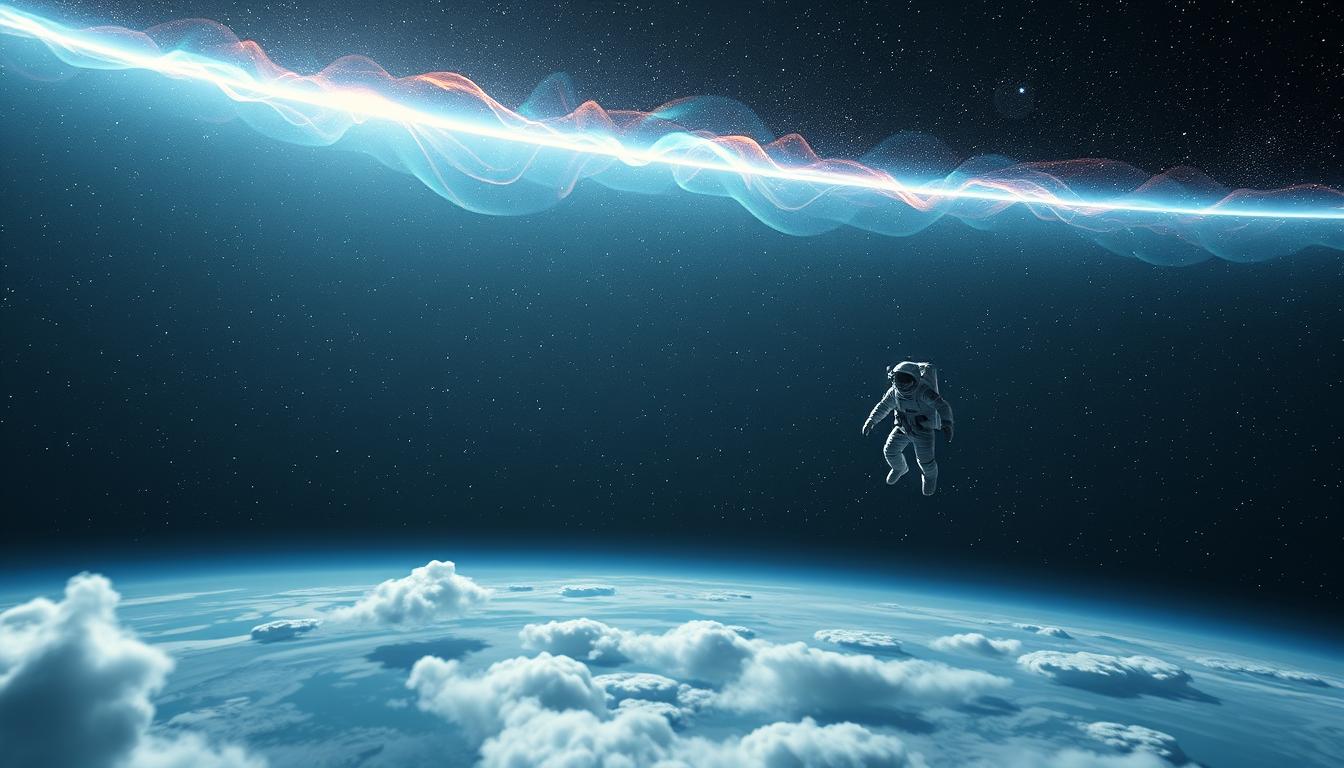
Time dilation is a key part of Einstein’s relativity. It changes how we see time and space. Astronauts on the International Space Station (ISS) see this effect. After six months, their clocks are 0.005 seconds slower than Earth’s.
Cosmonauts like Sergei Krikalev and Sergey Avdeev also noticed this. They found their clocks were 20 milliseconds behind Earth’s. This shows how time can be flexible.
According to relativity, time can be affected by how fast you move and the gravity around you. On the ISS, moving at 7,700 m/s, the time difference is small. But near a black hole, time moves much slower. For example, 1 hour could feel like 7 years on Earth.
GPS satellites need to adjust for time dilation every day. At high speeds, like 98% of light, particles like muons live longer. CERN experiments have confirmed this.
Even on Earth, time is affected by gravity. The Earth’s core is 2.5 years younger than the crust because of gravity. As speeds increase, time differences become more noticeable. For example, the Twin Paradox shows that 8 years in space can feel like 50 years on Earth.
Time isn’t fixed; it bends with motion and gravity. This changes how we understand the space-time continuum.
Understanding Time Dilation: The Basics
Time isn’t the same for everyone—thanks to Einstein’s theory of special relativity. Imagine two clocks: one on Earth and one on a speeding spacecraft. The faster you move, the slower time ticks for you.
This isn’t sci-fi; it’s physics. For example, muons—tiny particles from space—survive longer when zipping through Earth’s atmosphere at 95% the speed of light. From our perspective, their “half-life” stretches from 1.52 microseconds to over 7 microseconds. That’s time dilation in action.
Now add gravity to the mix. General relativity explains how heavy objects like Earth warp spacetime itself. Just like a trampoline sags under weight, planets bend time. Satellites orbiting Earth experience this too: GPS systems must adjust their clocks daily because gravity slows their time flow slightly compared to Earth’s surface. Without these corrections, navigation errors would pile up fast.
Real experiments back this up. In 1971, scientists flew atomic clocks on planes and saw them drift out of sync with ground clocks. Even today, NIST research shows time dilation happens over just millimeters. It’s not just about astronauts—it’s in our daily tech, proving Einstein’s ideas aren’t just abstract. Next time you check a map, remember: time is a flexible partner in space’s dance.
The Science Behind Time Dilation
Time dilation comes from special and general relativity. Albert Einstein’s special theory, from 1905, linked time to motion with the Lorentz factor. This formula, γ = 1/√(1 − v²/c²), shows time slows as objects get close to the speed of light.
British physicist Joseph Larmor hinted at this idea in 1897. He noticed moving electrons experienced time differently, scaled by √(1-v²/c²). A century later, his work helped build modern relativity.
“The contraction of time intervals… depends on velocity relative to light’s speed.”

General relativity linked time to gravity. Massive objects warp spacetime curvature, making time slower. Earth’s gravity makes a clock at sea level run slower than one in orbit.
Even small differences in altitude matter. A clock on a mountain runs faster than one in a valley. This isn’t just theory—GPS satellites adjust for both speed and gravity time dilation to work right.
While Einstein’s equations might seem complex, their effects are real. Particle accelerators show unstable particles live longer when moving fast, just as predicted. These ideas aren’t just cosmic curiosities—they’re key to many technologies we use every day.
Experiments That Prove Time Dilation
Time dilation isn’t just a theory—it’s been tested many times. The atomic clocks in the 1971 Hafele-Keating experiment showed clear differences after circling Earth. Jets carrying these clocks proved that speed changes time, just as Einstein said.
Muon decay experiments give even stronger proof. Cosmic rays create muons high above Earth, which should quickly disappear. But those moving near light speed last longer, thanks to time dilation.
The Frisch-Smith experiment found 412 muons per hour at 1,917 meters—much more than the 27 without dilation. At CERN, muons in storage rings lived 64.378 microseconds, exactly as predicted.
Today, experiments keep testing time dilation. The 2014 Bailey experiment tracked muons in circular paths, showing time dilation works even with acceleration. GPS systems also use relativistic corrections to avoid errors. Even the European Space Agency’s ACES project plans to test time dilation in space.
Recent studies, like the 2014 lithium-ion experiment, measured dilation at 1/3 light speed. They achieved 50x better accuracy than older methods. These findings show time dilation is real, guiding technology and space exploration.
How Time Dilation Affects Space Travel
Astronauts on the International Space Station (ISS) show how time dilation works. After six months, they return 0.005 seconds younger than Earth folks. This is because their speed makes time slow down, while Earth’s gravity speeds it up.
Though the difference is small now, it grows with speed. Imagine the twin paradox: one twin orbits Earth at 17,500 mph for years. They return decades younger than their sibling on Earth. This extreme example shows physics in action.

Space travel needs precise timing. GPS satellites also adjust for time dilation. Their clocks drift 38 microseconds daily because they orbit at 17,000 mph. Engineers fix this to keep maps right.
Future missions to Mars or beyond will face bigger challenges. A trip to Proxima Centauri at near-light speeds could make astronauts age slower. For now, these effects are milliseconds. But as we explore more space, understanding these rules is key. Time isn’t just a number—it’s a traveler’s compass.
Time Dilation: Real-World Applications
Everyday technology relies on Einstein’s theories of relativity. GPS systems need GPS time correction to work. Satellites orbiting Earth move faster and feel weaker gravity than those on the ground.
Without adjusting for these differences, GPS locations would drift by 10+ kilometers daily. Engineers program satellites to slow their atomic clocks by fractions of a second. This aligns them with Earth-bound systems.
High-speed networks and financial markets also use clock synchronization. Stock trades need precise timestamps—nanosecond delays can cost millions. Even a 33-centimeter height difference between two clocks causes measurable time drift.
Scientists use cesium-133 atoms to measure these shifts. This ensures global communication systems stay in sync.
Modern relativity in technology impacts more than space travel. Particle accelerators and medical imaging devices depend on precise timing. The 2014 particle accelerator experiment proved moving clocks run slower, confirming Einstein’s predictions.
Even smartphones use these principles. Without relativity, maps and internet connections wouldn’t work as we know them.
Time Dilation in Pop Culture
Science fiction stories make complex physics exciting. The Interstellar movie shows how time stretches near a black hole. One hour on a planet can feel like seven years on Earth.
These stories reflect Einstein’s theories but make them more dramatic. Films like Planet of the Apes and books like Ender’s Game also play with time in space. They mix science with imagination.

Shows like Stargate SG-1 use time dilation for plot twists. Soldiers might age faster than Earth. Video games and novels like The Forever War explore similar themes.
These stories make abstract concepts like gravity’s effects on time relatable. They spark curiosity about real physics.
While these tales inspire, they sometimes bend facts. In reality, time changes subtly, except at near-light speeds or near black holes. Yet, the Interstellar movie’s visuals of orbiting black holes actually used real NASA data.
This mix of accuracy and creativity helps audiences understand time isn’t the same everywhere in the cosmos.
Common Misconceptions About Time Dilation
Time dilation isn’t time travel, despite what movies suggest. It changes how time passes, but doesn’t let us reverse or jump through time. Astronauts orbiting Earth don’t notice their own clocks slowing. They only see differences when comparing with clocks on Earth’s surface.
The observer perspective often causes confusion. For example, two spaceships moving past each other both see the other’s clocks ticking slower. This isn’t a paradox because each perspective relies on different reference points. Like how two people far apart both appear small to each other—distance changes appearance, but math resolves the “contradiction.”
Some think time dilation is just abstract math, but experiments prove it real. Atomic clocks flown on planes run slower than ground clocks, matching predictions. Even unstable particles like muons, surviving longer in Earth’s atmosphere due to high speed, show these effects are real, not theoretical.
Another myth? Astronauts return decades younger. In reality, time differences are tiny—cosmonauts gain fractions of a second over years. The relativistic effects grow extreme only at near-light speeds, far beyond current spacecraft capabilities.
The Future of Time Dilation Research
Research into time dilation is changing how we think about future space travel and physics. Scientists are looking into how relativistic velocity could help us reach distant stars. A spacecraft moving at 1 g could travel so fast that time seems to slow down.
This lets astronauts explore galaxies in their lifetime. These studies use equations to show how time changes at high speeds.

Advances in quantum gravity aim to combine general relativity and quantum mechanics. These breakthroughs could change how we calculate time near black holes or on interstellar missions. Particle accelerators like CERN test high-energy environments where time dilation effects are measurable.
These tests give us clues about space-time’s fabric. Engineers are creating clocks that can track tiny time differences caused by Earth’s gravity. These tools could guide spacecraft moving at relativistic speeds in the future.
Proposals for deep-space missions aim to test how time dilation affects human biology over long periods. As technology improves, understanding time dilation is essential for long-duration missions. Every discovery brings us closer to using relativistic velocity for exploration.
Quantum gravity research may also reveal new dimensions of space-time. The next decade could redefine humanity’s place in the cosmos.
Everyday Examples of Time Dilation
Time dilation isn’t just a mystery of the universe. It’s part of our everyday lives, thanks to altitude effects and Earth time differences. For example, a clock on your wrist might tick a bit faster than one on your ankle. This is because your head is higher than your feet, creating a small time difference.
Over time, this difference adds up. But you wouldn’t notice it unless you had atomic clocks to measure it.
Gravity also plays a role in everyday relativity. The Earth’s core is actually 2.5 years younger than its surface. This is because of gravitational time dilation.
Being at higher altitudes means time passes faster. A 2010 experiment in Colorado showed this by lifting a clock 33 centimeters. Over 79 years, it would be 90 billionths of a second slower.
Even a hot-air balloon ride makes you age faster than someone on the ground.
GPS systems use these principles to work correctly. Satellites orbiting Earth experience time passing faster than ground stations. Without adjustments for Earth time differences, navigation errors would grow by 10 km daily.
Scientists at Harvard tested relativity in a six-story building. They showed that time slows down near Earth’s surface.
Though we can’t see these effects, they show that relativity is real. Every step and every flight subtly changes our personal time. Relativity is all around us, shaping our world in ways we’re only starting to understand.
Why Understanding Time Dilation Matters
Time dilation is more than just a theory; it’s a real phenomenon that will shape our future. NASA’s missions and experiments, like the atomic clock orbiting Earth, show how time changes with gravity and speed. Astronauts on the ISS age a tiny bit slower, about 0.005 seconds less after six months.
This small difference is important. As we plan for interstellar travel, understanding these effects will be key. A trip to another star could make time pass much slower for the crew, changing how we plan and think about life.
Time perception is also changing in our daily tech, like GPS. Satellites adjust for Earth’s gravity to avoid navigation errors. This shows Einstein’s theories are not just abstract; they’re practical.
The twin paradox, where spacefaring twins age less, is not just a thought experiment. Particle accelerators like CERN confirm it with muons living longer at near-light speeds.
Understanding these effects helps us grasp reality better. The Earth’s core is younger than its surface by 2.5 years due to gravity. This shows time is a flexible dimension.
As we explore further, mastering these effects could change space exploration. It could enable faster-than-light travel or safer deep-space missions. Time dilation is not just science; it’s a way to see the universe’s hidden order, sparking our curiosity about what’s beyond our everyday world.