
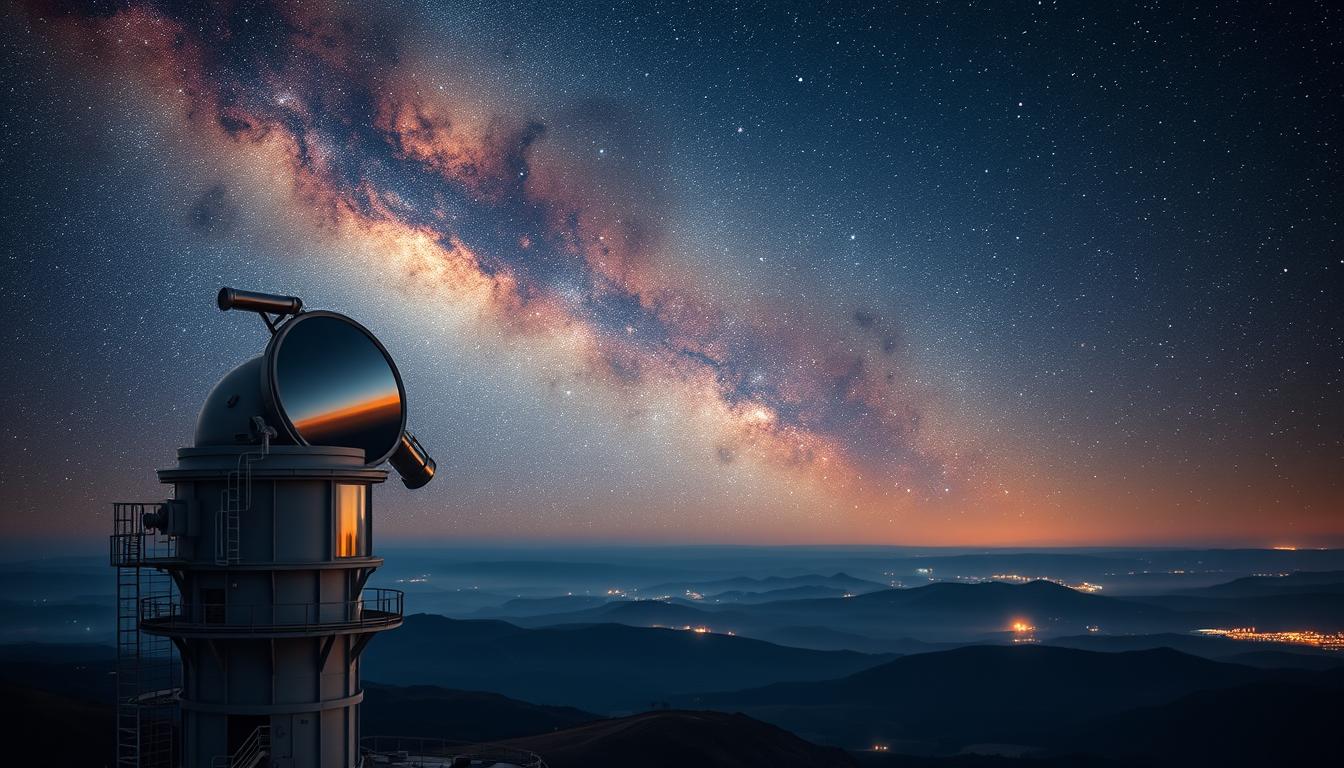
The James Webb Space Telescope (JWST) was launched in December 2021. It is the most powerful telescope NASA has ever built. It can see light from galaxies that were born just after the Big Bang.
This telescope has a field of view 15 times wider than Hubble’s. It captures light from galaxies born just after the Big Bang. This breakthrough in space observation reveals cosmic secrets, like the first stars and planets outside our solar system.
Deep space telescopes act as time machines, showing galaxies as they appeared billions of years ago. The JWST’s infrared sensors detect light stretched by the universe’s expansion. They reveal mysteries like unexplained hydrocarbons in distant brown dwarfs.
These astronomical discoveries are rewriting our grasp of how stars form and planets evolve. This article explores how these powerful telescopes are unlocking the universe’s past. They trace dark matter’s influence, map exoplanets, and peer into the first moments after the Big Bang.
Every discovery brings us closer to answering humanity’s oldest questions about our place in the cosmos.
Introduction to Deep Space Telescopes
Deep space telescopes are space observatories that look far beyond our solar system. They capture light and radiation from distant galaxies and cosmic events. These astronomical instruments use advanced telescope technology to see past Earth’s atmosphere.
By floating in space, they show us things we can’t see from Earth. This includes the birth of stars and the structure of ancient galaxies.
Early telescopes used mirrors and lenses to gather light. But today’s telescope technology can detect X-rays, infrared, and radio waves. The James Webb Space Telescope, for example, has a 6.6-meter mirror.
This is three times larger than Hubble’s. Its gold-coated mirrors reflect infrared light. This lets it see through dust clouds to capture the universe’s earliest stars.
These instruments are like cosmic time machines. Light from the farthest galaxies takes billions of years to reach us. When the Webb observes a galaxy 13 billion light-years away, it’s seeing it as it was just 800 million years after the Big Bang.
This shows how galaxies formed and evolved over time. Ground-based telescopes struggle with atmospheric interference. So, space observatories like Webb or Hubble give us clearer images.
Their astronomical instruments also split light into spectra. This reveals a star’s composition or motion.
From the 1990 Hubble launch to today’s cutting-edge designs, these tools continue to redefine our cosmic understanding. Each new telescope technology pushes the boundaries of what we can see. It turns the vast darkness of space into a storybook of the universe’s history.
The Hubble Space Telescope
Launched in 1990, the Hubble Space Telescope changed astronomy, despite early issues. Its flawed mirror was fixed by astronauts in 1993. Now, it captures light from across the universe.
Orbiting Earth for over 30 years, this 13-meter-long observatory uses a 2.4-meter mirror. It looks deep into space, uncovering cosmic secrets. It has made over 1.6 million observations and 21,000 scientific papers.

The Hubble Deep Field changed astronomy in 1995. It stared at a “blank” patch for 10 days, revealing 3,000 galaxies. Some of these galaxies are 13 billion light-years away.
Later images, like the Ultra Deep Field, added 10,000 galaxies. They showed us the universe 400 million years after the Big Bang. These Hubble discoveries have changed our understanding of dark energy, galaxy formation, and the universe’s age.
Over three decades, Hubble’s space telescope history includes 5 servicing missions and 95-minute orbits. Its data confirmed the universe’s accelerating expansion and revealed exoplanet atmospheres. With missions into the 2030s, Hubble continues to explore the cosmos, preparing the way for the James Webb Space Telescope.
The James Webb Space Telescope
Launched on Christmas Day 2021, the James Webb Space Telescope (JWST) orbits the Sun 1.5 million kilometers from Earth. This $10 billion observatory, a partnership between NASA, ESA, and CSA, took over two decades to build. Its 6.5-meter golden mirror—six times larger than Hubble’s—captures light invisible to human eyes, unlocking cosmic secrets hidden in infrared wavelengths.
The JWST’s tennis-court-sized sunshield blocks solar heat, keeping instruments near -267°C. This extreme cold lets it detect faint infrared signals from 13.1 billion years ago. By peering through cosmic dust clouds, its infrared astronomy reveals newborn stars and galaxies Hubble couldn’t see. The first deep field image, capturing a sand-grain-sized patch of sky, exposed thousands of galaxies forming during the universe’s first billion years.
“Webb’s infrared vision lets us witness the universe’s first light,” said NASA scientists. “This is our clearest window into the cosmic dawn—the era when stars first ignited.”
Webb’s NIRCam and MIRI instruments dissect light from galaxies 180 million years post-Big Bang. Observing the HR 8799 exoplanet system 130 light-years away, it mapped atmospheres with 10-nanometer precision. Over 2,000 engineers contributed to this marvel, designed to operate for a decade but expected to last twice as long. With its 25.4m² light-collecting surface, Webb continues humanity’s quest to trace the origins of light itself.
The Chandra X-ray Observatory
Launched in 1999, the Chandra Observatory is a key part of X-ray astronomy. It studies high-energy events that optical instruments can’t see. This telescope shows us secrets in supernova remnants and galaxy clusters.
Its mirrors are polished to a few atoms’ thickness. This allows it to see details as small as 0.5 arcseconds.
Chandra looks at high-energy astrophysics, like explosions and black holes. It has seen X-rays from Pluto, the first from a Kuiper belt object. It also watched a huge brightness increase from Sagittarius A*, our galaxy’s black hole.
By studying supernova remnants, Chandra shows how these explosions spread heavy elements in space.
Chandra orbits far from Earth in a special path. It can watch targets for over 50 hours without interruption. Its four instruments analyze X-ray spectra to understand cosmic events.
This data helps us see the universe in many colors, thanks to Hubble and Webb. Chandra was meant to last five years but has been working for over 25.
Chandra can see very faint X-ray signals, 20 times dimmer than before. It helps us learn about dark matter and neutron star collisions. Its work shows how X-ray astronomy lets us see the invisible universe.
The Spitzer Space Telescope
Launched in 2003, the Spitzer Space Telescope changed the game in infrared astronomy. This infrared telescope explored the universe for over 16 years, way beyond its 2.5-year goal. Its 34-inch mirror could see wavelengths from 3 to 180 microns, showing us cool objects like brown dwarfs and exoplanets hidden by dust.
Spitzer could see through clouds of gas and dust, revealing where stars are born and how galaxies formed in the early universe. In 2005, it made the first heat map of an exoplanet. In 2017, it found the Trappist-1 system with seven Earth-sized planets. Even when it lost its coolant in 2009, Spitzer kept going for another decade.
Its three tools—IRAC, IRS, and MIPS—could see light from galaxies 13 billion light-years away. This helped us understand the universe’s history. Over 8,700 studies used its data, showing how valuable infrared astronomy is. Spitzer retired in 2020, but its discoveries will guide the James Webb Space Telescope. Its work showed us that infrared telescopes can reveal secrets even dust can’t hide.
The Atacama Large Millimeter/submillimeter Array (ALMA)
The ALMA observatory changes radio astronomy by looking at the universe with millimeter wavelength light. It sits 16,500 feet high in Chile’s Atacama Desert. The dry air lets signals get to Earth without being blocked.
It has 66 antennas, 54 at 12 meters and 12 at 7 meters. Together, they act as one huge telescope. They can see details as small as 10 milliarcseconds. 
Millimeter wavelength observations show where stars are born. ALMA finds gaps in disks that suggest new planets. It also finds organic molecules in places where stars are born.
By combining signals from antennas up to 16 kilometers apart, ALMA gets 10 times sharper than the Hubble. This sharpness lets scientists see gas swirling around black holes or the birth of new stars.
ALMA started in 2011 and has done over 1,000 studies. Its $1.4 billion cost shows its advanced technology. In 2019, it worked with the Event Horizon Telescope to map a black hole’s shadow. ALMA keeps uncovering secrets of star formation that optical telescopes can’t see.
The Very Large Array (VLA)
“And as light travels through space from those distant galaxies, the light is literally stretched by the expansion of space.”
The VLA is in New Mexico, on the Plains of San Agustin. It has 27 giant dishes in a Y shape. Each dish is 82 feet tall and weighs 209 tons.
These dishes move along tracks to change their position. This makes the VLA act like a single dish up to 22 miles wide. It can see details that smaller telescopes can’t.
The VLA uses radio astronomy technology to find radio waves from space. It looks at things like supernovas and star nurseries hidden by dust. A big upgrade in 2011 made it 10,000 times more sensitive.
Now, scientists can study radio galaxies in great detail. The VLA recently found a blazar 13 billion light-years away. This gives us clues about the early universe.
Visitors can check out the VLA’s visitor center. It has exhibits on its role in movies like Contact. Soon, the ngVLA project will add 260 antennas. This will let it study black holes and how planets form with 10x better detail.
The Kepler Space Telescope
Launched in 2009, NASA’s Kepler mission changed how we look for life outside Earth. It focused on finding exoplanet discovery by scanning distant stars. Over 2,700 confirmed worlds were found, many in habitable planets zones where water might exist.
“We all want to find another Earth, don’t we?” Dr. James Stevenson noted, highlighting Kepler’s legacy in reshaping astronomy.
Kepler used the transit method to find planets by looking for dips in starlight. Its 0.95-meter telescope watched 150,000 stars at once. Even after mechanical failures in 2013, it was repurposed for the K2 mission, adding 350+ new exoplanets.

Kepler showed our galaxy has billions of small, rocky planets. Over 30 of these could be in habitable zones, like our Sun. In 2016, it announced 1,284 verified planets at once, doubling known exoplanets. It surveyed over 530,000 stars and found 40 billion Earth-sized worlds in the Milky Way.
Even though it ended in 2018, Kepler’s data is a goldmine. It sets the stage for missions like James Webb, which will study these worlds up close. Kepler didn’t just count planets—it made us wonder how special our corner of the cosmos is.
Ground-Based Telescopes vs. Space Telescopes
“Space is the ultimate mountaintop.” — NASA
Ground-based telescopes, like the Very Large Telescope in Chile and Hawaii’s Keck Observatory, face challenges. Atmospheric interference blurs starlight and blocks some light. Adaptive optics help by bending mirrors in real time. But, clouds or light pollution can stop observations at night.
Space telescopes, like the Hubble and James Webb, don’t face these issues. They capture infrared and ultraviolet light not seen from Earth. They work 24/7 without weather delays. Yet, their high costs and limited upgrades mean fixes are risky.
Working together, like the Chandra X-ray Observatory with ground-based radio telescopes, reveals more. Ground-based arrays track cosmic events spotted by space instruments. They combine data for 3D maps of galaxies. While ground telescopes grow, space-based models explore new cosmic areas.
Both systems are essential. Ground-based telescopes offer flexibility and scale. Space telescopes reveal hidden light. Together, they uncover secrets from exoplanets to dark matter.
The Future of Deep Space Telescopes
Future telescopes will change how we explore space. The 39-meter Extremely Large Telescope (ELT) and the Thirty Meter Telescope (TMT) will improve images. They will use advanced technology to see details that were once hidden.
The Habitable Worlds Observatory (HWO), set for the 2040s, will search for planets like Earth. It will have a 6–8-meter mirror and special tools to block starlight. This will help us see more about these planets.
Space is also getting new tools, like the Nancy Grace Roman Space Telescope (launching 2027). It will study dark matter and how the universe expands. NASA’s HWO will be able to see very small details, thanks to advanced technology.
Telescope technology is getting better, thanks to AI and new ways to combine images. This will give us clearer views of space.
“What Webb will do is take that field and go even further,” says University of Texas’s Casey. “HWO will turn those specks into galaxies and planets.”

These new tools will help solve big mysteries. They will study dark energy, the first galaxies, and if there’s life elsewhere. With new rockets, like SpaceX’s Starship, we can send bigger missions. The 2037 Laser Interferometer Space Antenna (LISA) will even detect gravitational waves.
The future of astronomy depends on these new observatories. They will help us make new discoveries and understand the universe better.
The Challenges of Space Observation
Building telescopes for space is a huge challenge. They must handle extreme environments unlike those on Earth. Space telescopes face freezing cold and hot sun, needing special cooling systems.
The James Webb Space Telescope (JWST) has a huge sunshield to stay cool. It’s as big as a tennis court. A small mistake during launch could ruin the whole mission.
“Anything warm glows in infrared light,” explains NASA scientist Dr. Straughn. This truth drives the Webb’s observatory maintenance demands: its instruments must stay below -233°C to avoid self-glare.
Launching a telescope is also tough. The shake during takeoff can damage its parts. The Hubble Space Telescope had a problem with its mirror in 1990, showing how small errors can be big issues.
Space is full of dangers like radiation and tiny rocks. Even simple tasks, like moving the telescope, need careful planning. But these challenges lead to new ideas and discoveries. They help us keep looking up at the stars.
Conclusion: The Ongoing Journey of Discovery
Humanity’s quest to understand the universe has reached new heights. Telescopes like the James Webb have already changed how we see the universe. With 18 gold-coated mirrors and a 1-million-mile orbit, it has made groundbreaking discoveries.
In its first year, Webb revealed 45,000 galaxies in one image. Some of these galaxies are just 320 million years old. It has also found carbon dioxide and sulfur in exoplanet atmospheres, showing its ability to study Earth-like worlds.
This journey started with Galileo’s simple lens. Now, it involves global teamwork. NASA, ESA, and Canada worked together to build Webb. It’s a tool that sees deeper than ever before.
Its $10 billion mission is about unlocking mysteries. Scientists are studying light older than Earth itself. Every discovery leads to new questions.
Future missions will continue to explore the universe. Telescopes will search for life, map galaxy evolution, and challenge old theories. The cosmos is a frontier where curiosity drives progress.
These tools remind us we’re all stardust seeking answers. The next generation of telescopes will transform how we see our place in the universe. They will make new discoveries and change our understanding of the cosmos.