
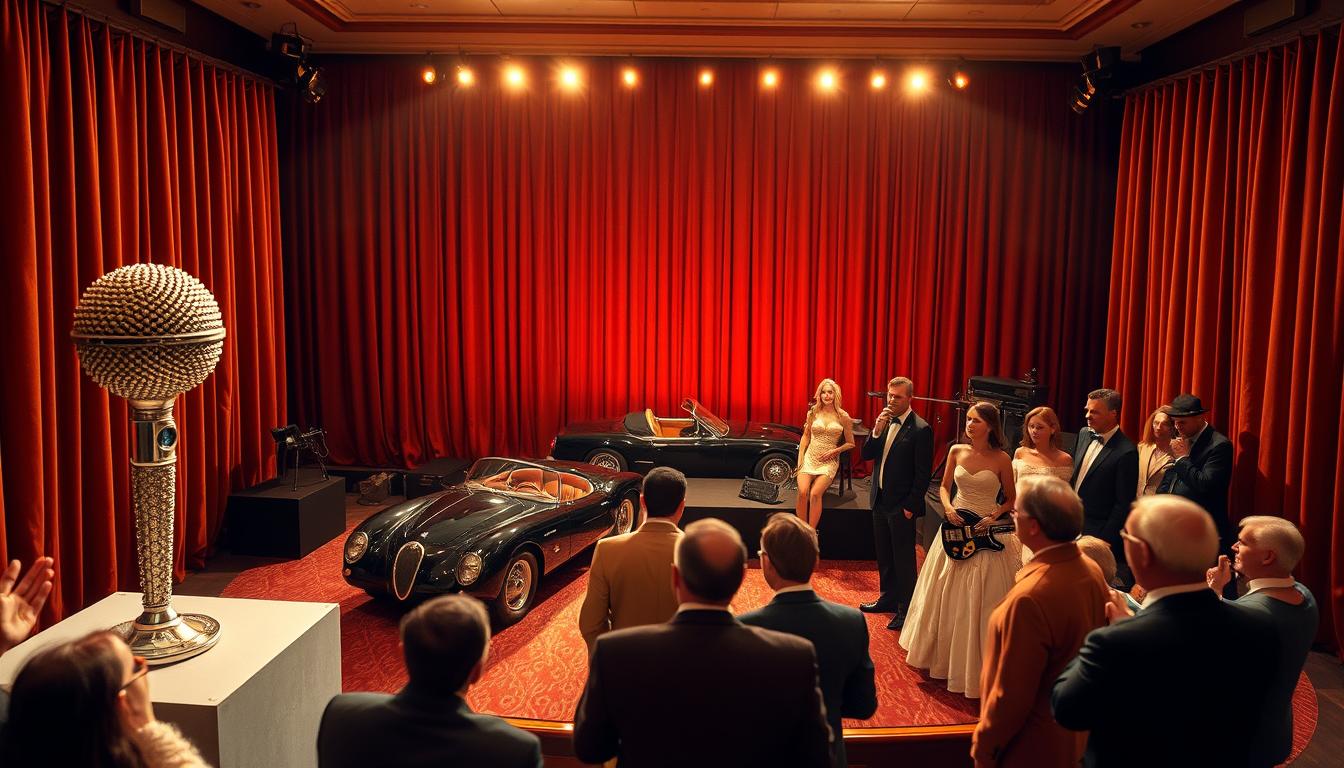
Winston Churchill’s dentures sold for £18,000, and Truman Capote’s ashes went for $43,750. The world of oddest things auctioned is full of surprises. Auction houses often feature weird auction items like a ceramic goat made by King Charles or John Lennon’s toilet, which sold for £9,500.
These bizarre collectibles include historical artifacts, celebrity memorabilia, and even whole towns. Buford, Wyoming, for example, sold for $900,000. Each item has a unique story behind it.
A jar of Elvis Presley’s hair sold for $115,000, and Napoleon’s tooth went for £13,000. Even a slice of Prince Charles and Princess Diana’s wedding cake sold for £1,850 years later. People collect these items for their rarity, history, or just because they’re unusual.
Collectors are drawn to anything rare or unique. This includes a space diamond valued at £3.16 million and Michael Jordan’s $2.2 million NBA sneakers. The auction world turns the unexpected into headlines. Get ready to see how the ordinary becomes extraordinary in the world of oddest things auctioned.
Introduction to Odd Auctions
Online platforms and changing tastes have changed the auction world. What was once for fine art and antiques now includes unusual auction items like a virus-infected laptop or a bust of King Tut. Big names like Sotheby’s see more interest in strange collectibles market items, showing that odd things sell well.
So, what makes something an odd collector item? It could be rare, have a rich history, or just be shocking. For example, Queen Victoria’s 44-inch waist bloomers sold for £1,000, or a Nazi-era Donald Duck toy that went for $2,500. These weird auction trends show how people worldwide are drawn to the unusual.
Why do people buy these odd items? They want stories behind them, like a haunted Titanic captain’s mirror or Elvis Presley’s TV with a bullet scar. Online bidding has made these auctions more accessible. Now, items like rhino horns or haunted artifacts can fetch millions, rewriting the rules of value every day.
Iconic Celebrity Memorabilia
Celebrity auction items often blur the line between bizarre and beloved. Fans worldwide bid on famous memorabilia sold, turning everyday objects into star collectibles. Take Elvis Presley’s hair, which fetched $115,000 in 2002. A decade later, another lock sold for $18,300, proving even iconic celebrity possessions hold enduring appeal.
John Lennon’s tooth drew $31,200, while Freddie Mercury’s Tiffany moustache comb soared past estimates to $152,400. Even health-related items make headlines: William Shatner’s kidney stone raised $25,000 for charity, and Russell Crowe’s jockstrap fetched $6,500. Celebrities like Justin Bieber saw his hair sell for over $40,000, while Lady Gaga’s fake fingernail reached $12,000.
X-rays of Marilyn Monroe’s chest sold for $45,000—15 times their $3,000 estimate. Britney Spears’ alleged pregnancy test hit $5,001, and Scarlett Johansson’s used tissue went for $5,300. These sales show how personal artifacts gain value when linked to fame.
David Bowie’s hair sold for $18,750, and Joan Rivers’ Tiffany dog bowl sold for 30x its price tag. Even food items, like Justin Timberlake’s half-eaten French toast, hit $1,025. These auctions reveal how fans connect with stars through tangible mementos, no matter how odd.
Unusual Works of Art
Strange artwork auctions often feature weird art pieces sold for high prices. For example, the “World’s Largest Cat Painting,” a 227-pound masterpiece, sold for $826,000 in 2022. This shows how the bizarre art market keeps surprising us.
Art collectibles like Banksy’s Love is in the Bin are also big hits. This shredded painting sold for $25.4 million in 2018, even after it self-destructed during the auction.
Invisible sculptures also grab attention. One such piece, described as a “blank” canvas, sold at auction, despite having no visible elements. This challenges our traditional views of art value.
Christie’s made headlines in 2018 with an AI-generated portrait, Portrait of Edmond Belamy, which sold for $432,500. Today, collectors bid on everything from meteorite fragments to a biscuit from the Titanic. This shows how curiosity and storytelling drive the bizarre art market.
Art pieces like Caleb Larsen’s A Tool to Deceive and Slaughter, sold for $6,350 in 2010, highlight the power of storytelling. Whether it’s a malware-infected laptop sold for $1.3 million or a ghost-in-a-jar, buyers seek something unique. These sales show that weird art pieces sold at high prices often rely on intrigue over tradition.
Weird and Wacky Antiques
Strangest antique auctions often show items that are both odd and intriguing. For example, a 200-year-old condom made from sheep intestines sold for $556. This unusual vintage item gives us a peek into early birth control methods.
Even more astonishing are items once owned by royalty. Queen Victoria’s embroidered underwear, for instance, sold for $16,300 in 2015. It had been kept in perfect condition for over a century.

Collectors love these bizarre collectible antiques for their unique stories. Elvis Presley’s hair lock, sold for $115,000 in 2002, is a prime example. John Lennon’s porcelain toilet, listed at $15,000, also grabs attention.
These weird historical objects are more than just relics. They spark conversations that connect the past to today. They make history come alive in a way that’s both fascinating and unexpected.
Items like a 19th-century undergarment or an ancient contraceptive are not just oddities. They serve as bridges to times we can barely imagine. For those who love them, these strange antique auctions turn forgotten pieces into treasured keepsakes of humanity’s quirky path.
Quirky Animal Artifacts
Collectors love unusual animal artifacts for their uniqueness. Taxidermy has evolved, featuring creatures in odd poses. A ceramic goat made by King Charles sold for £8,500, showing even inanimate animals can spark interest.
These collectibles span from Victorian-era displays to today’s oddities. They capture the imagination of many.
A Triceratops skull sold for over $270,000, showing nature’s oddities. Fabergé started in 1900, creating animals from agate and nephrite for royalty. Three “mystic monkey” carvings are in London’s Victoria and Albert Museum, highlighting their beauty.
Exotic birds and Fabergé’s hens and bulls mix history with the unusual. Even a plaster cast of Lincoln’s head sold for thousands. But animal-focused items often get the most attention. From a pink quartz monkey to dinosaur fossils, these items make auctions exciting.
Infamous Historical Items
The Roman Empire was once sold in a controversial historical auction by the Praetorian Guard in 193 AD. Bidders paid 6,250 drachmas for the title of emperor, but they were later executed. These infamous artifacts sold show the darkest parts of history.
Winston Churchill’s dentures, for example, sold for £18,000. These dentures were often broken during his angry outbursts. They turned a legendary leader into a more relatable figure.

Napoleon Bonaparte’s tooth, taken during his exile, sold for £13,000 in 2011. Adolf Hitler’s reading glasses were sold for $7,500. Leonardo da Vinci’s Codex Leicester manuscript went for $30.8 million.
These bizarre historical memorabilia make historical figures into collectibles. They raise questions about ethics and value. These auctions turn violence and power into physical reminders.
Each item, from a leader’s tooth to a wartime relic, connects buyers to key moments. They show that history isn’t just in books. It’s in the broken dentures of statesmen or the glasses of dictators, showing the past’s lasting impact.
Bizarre Food Items
Strange food auctions turn weird edible collectibles into prized possessions. Century eggs, preserved in clay and ash, or the Philippines’ balut (duck embryo meals), draw bidders. These unusual food memorabilia include Taiwan’s pig’s blood tofu or Indonesia’s durian fruit, whose pungent aroma doesn’t deter fans.
Bizarre food artifacts like Iceland’s fermented shark or Japan’s fugu (pufferfish) highlight global culinary extremes. Bird’s nest soup, made from swiftlet nests, costs up to HKD500 per gram. Even dishes like Ecuador’s roasted guinea pig or Bhutan’s fried tarantulas become cultural relics, preserved for their rarity.
Collectors items range from Vietnam’s snake wine to Kenya’s blood-milk mixtures. A slice of Prince Charles’ 1981 wedding cake sold for £1,850, proving how preserved foods become memorabilia. From Estonia’s blood sausage to Mongolia’s mare’s milk beer, these items transcend dining, becoming edible history.
Peculiar Sports Memorabilia
Strange sports auctions make odd items into treasures. Fans bid on Lionel Messi’s £300,000 napkin contract and Curt Schilling’s blood-stained socks for $92,613. Even simple things like Babe Ruth’s chewed gum ($10k) or a $10,000 BBQ sauce named after a player become valuable.
Collectibles like Ty Cobb’s wooden dentures ($18,840) and Nolan Ryan’s jockstrap ($25,000) are sought after. Barry Sanders’ signed urinal sold for $3,000, and a $75,000 love note from Babe Ruth to his mistress is also a hit. Items like Klay Thompson’s toaster (est. $9k) and Steph Curry’s mouth guard ($3,190) also draw interest.
In these auctions, the value of memorabilia comes from its story, not its use. Fans pay for a $3k photo of Ruth’s “called shot” and Joe Montana’s $3k love letters. Items like a $451k T206 Honus Wagner card or Thurman Munson’s $1,500 pilot license show the power of devotion.
Strange Technology and Gadgets
At weird technology auctions, you see tech’s wild side. Paul Allen’s computer collection is a prime example. It includes rare items like the original Apple I and early gaming consoles. These strange tech collectibles sell for millions, mixing old with new.
The 2022 sale of the 555.55-carat “Enigma” black diamond is another highlight. It looks like a palm symbol and sold for £3.16 million. Its unique shape and story made it a hit at auction. At CES 2025, gadgets like the Dyson Zone Air-Purifying Headphones and the Pepe Pet Dryer also caught attention.
Even gadgets that didn’t make it can find a new home. The HapiFork tracks how fast you eat, and the Xybernaut Poma is a wearable PC from 1998. The Denso Vacuum Shoes and the Taser MP3 Holster show tech’s creative side.
“These items aren’t just obsolete—they’re time capsules of human ingenuity.”
Items like the Electric Salt Spoon and the Kosé Mixed Reality Makeup system show tech’s possibilities. Auctions keep evolving, and collectors seek out the unusual. Even failed ideas have stories worth keeping.
Unexpected Personal Items
Strange personal auctions turn everyday things into weird items sold for surprising prices. A grilled cheese sandwich supposedly showing the Virgin Mary’s face sold for $28,000. A jar called “ghost in a bottle” almost sold for $56,000 before the deal fell through. Even a haunted rubber ducky sold for over $100, showing how stories make items valuable.

Britney Spears’ chewed gum and Justin Timberlake’s half-eaten French toast have sold for thousands. A Dorito shaped like the Pope’s hat sold for $1,209 after 34 bids. Ian Usher even auctioned his future children for £192,000, mixing humor with high stakes.
eBay started with oddities like Pierre Omidyar’s broken laser pointer selling for $14.83. Today, you can find things like a ghost-themed fish ornament or custom guinea pig armor (sold for $24k). These auctions show that stories can make items more valuable than their worth.
Outrageous Funeral Artifacts
Some of the most bizarre funeral auctions feature items that blur the line between respect and exploitation. Truman Capote’s cremated remains were sold for $43,750 in 2016 at Julien’s Auctions. This was much higher than the $6,000 estimate. These unusual memorial items sparked debate over privacy and ownership, as the ashes had been stored by his friend Joanne Carson until her death.
Strange death artifacts like Ronald Reagan’s blood vial—sold for $3,550 in 2012—show how weird posthumous collectibles captivate buyers. After public outcry, the blood was withdrawn from later sales. Even George Washington’s hair sold for $30,000 at Sotheby’s, proving history’s macabre appeal.
Victorian-era strange death artifacts include human hair jewelry and death masks, now displayed in museums or private collections. Items like Winston Churchill’s false teeth ($18,400 at Bonhams) or Queen Victoria’s underwear ($14,600) mix historical value with discomfort.
Modern bizarre funeral auctions stir controversy. Items like John Lennon’s school detention slip ($2,500) or Britney Spears’ gum ($14,000) highlight how memorabilia spans lifetimes. Collectors prize these relics for their stories, even when ethics clash with curiosity.
Whether it’s Elvis Presley’s medicine bottle ($8,000) or Lee Harvey Oswald’s coffin ($87,000), 2010), these auctions reflect humanity’s fascination with mortality. They remind us that death, even in weird posthumous collectibles, can become a spectacle—or a silent tribute.
Conclusion: The Allure of the Unusual
Strange collectibles have a special place in our culture. They surprise and engage us. Items like a Pope-shaped Dorito or historic artifacts spark curiosity and tell unique stories.
Collecting weird items can be a journey into history or a personal passion. It turns oddities into cherished pieces. For many, it’s a way to share a story.
The value of unusual auctions comes from turning rare objects into treasures. Online platforms and social media make these sales global. This boosts prices and connects collectors worldwide.
Even quirky items like vintage taxidermy or antique medical tools find devoted fans. This shows that there’s always a market for the unusual.
The future of bizarre auctions looks bright with digital innovation. More people will explore collecting as a way to express themselves or learn about history. From sugar packets to rare celebrity relics, these collections show our fascination with the unexpected.
Technology will keep linking buyers and sellers. This means the market for the unusual will grow. It proves there’s always a place for the weird in collecting.