
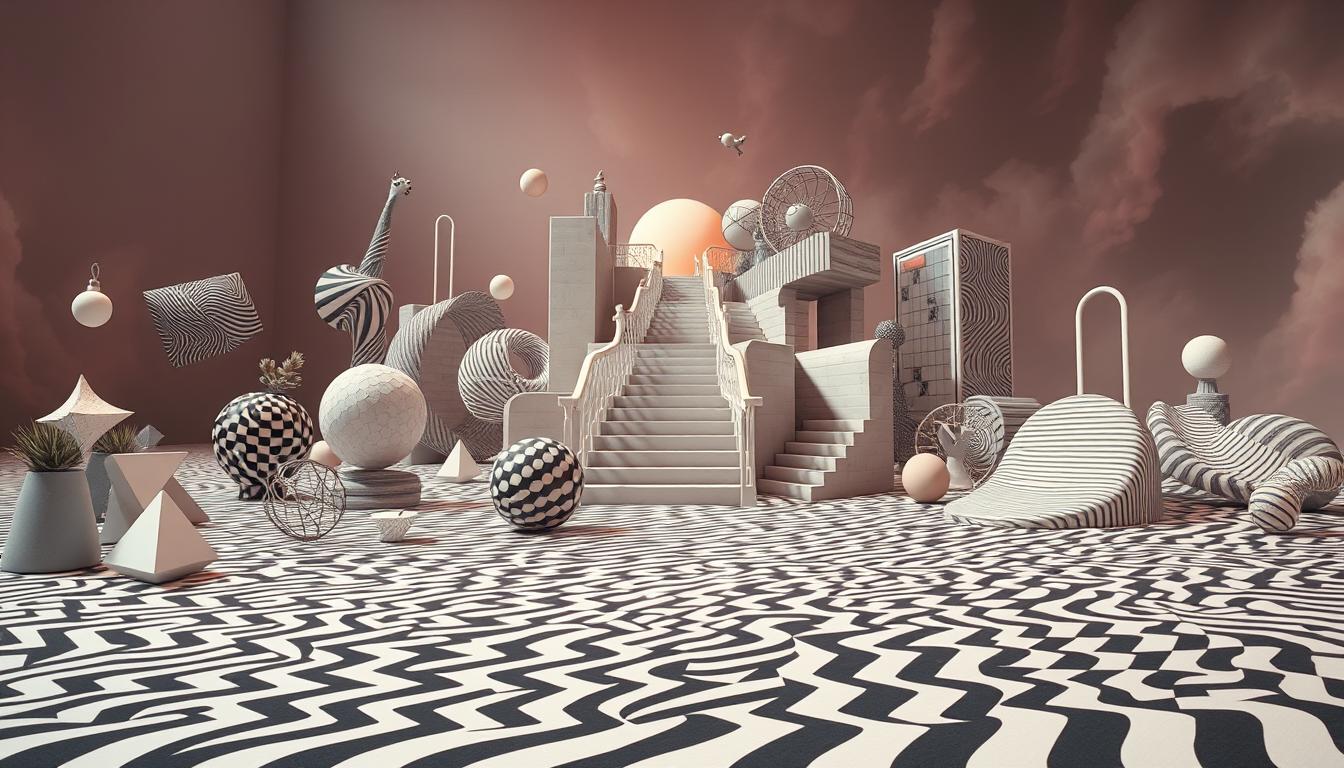
Our eyes and brain work together to build the world we see—but sometimes they disagree. The human eye processes an image in just 13 milliseconds. Yet, the brain keeps editing that snapshot long after. This disconnect creates mind-bending optical illusions that fool us into seeing what isn’t there.
Ancient Greek thinkers like Aristotle marveled at these tricks over 2,500 years ago. They showed our long-standing fascination with
Think of your brain as a detective. It fills gaps in what your eyes send it, making brain tricks like the Hermann grid or the Müller-Lyer illusion possible. Even identical lines can look longer or shorter based on nearby shapes.
These visual illusions reveal how our minds guess at reality, not just record it. This article explores how these tricks work, why they matter, and what they teach us about how we see—and sometimes missee—the world.
Understanding Optical Illusions: A Brief Overview
Optical illusions play tricks on our brains through visual deception. Light enters our eyes, but our brain’s interpretation can lead to errors. These errors are at the heart of optical illusions. They have fascinated people for centuries, from ancient buildings to modern art.

There are three main types of optical illusions: physiological, cognitive, and literal. Physiological illusions happen when our senses are overstimulated. For example, looking at a bright light can leave spots in our vision. The Hermann Grid illusion shows how our retinas process contrast, creating ghostly dots at intersections.
Cognitive illusions play on our brain’s assumptions. Rubin’s vase, where we see two faces or a goblet, is a clear example. M.C. Escher’s impossible staircases, like in Waterfall, make us see 3D in flat art. The Jastrow illusion, where identical shapes look different, shows how context can deceive us.
These illusions show how our brains shape our view of reality. By studying their cognitive and physiological aspects, we understand why some images confuse us. They remind us that sight is more than just what’s in front of us.
How Your Brain Perceives Reality
Every moment, your eyes capture light and send signals to your brain. Your brain then turns those signals into the world you see. This visual processing isn’t a direct snapshot. Your brain actively reality interpretation by piecing together sensory information and filling in blanks.
For instance, your brain ignores your blind spot, where no light-detecting cells exist. It guesses what should be there based on surrounding details.

Studies show this system isn’t flawless. A 2019 experiment by Patrick Cavanagh revealed the visual cortex treats identical illusions differently. This proves brain perception varies even within the same person.
Cultural differences also play a role. The Müller-Lyer illusion, with its arrow-like lines, tricks Westerners more than some African tribes. This highlights how upbringing shapes vision.
Recent research adds more layers. A study of 13,000 people by Pascal Wallisch found night owls and morning larks saw the viral “blue and black vs. white and gold” dress differently. This ties to how light exposure history alters color sensory information processing.
Even small rewards can sway perception. Emily Balcetis showed people saw a photo as a horse or seal based on incentives.
Your brain prioritizes speed over accuracy, creating a delayed visual processing system. Signals take 100 milliseconds to reach your brain, yet you perceive motion in real time. This mix of speed, bias, and guesswork makes every moment a unique reality interpretation. Proving sight is as much a mental puzzle as it is a sensory one.
The Psychology Behind Optical Illusions
Visual psychology shows how our minds build reality using Gestalt principles. These rules help us see parts as a whole. For example, the Kanizsa triangle looks like a triangle, even though it’s not. Our brains fill in the gaps.
This quick trick helps us understand scenes fast, like spotting a friend. It’s like recognizing a face from afar.
Context also plays a big role. The “Einstein or Marilyn?” illusion changes based on what we think. Blurred details can change how we see things, thanks to our past experiences.
The Necker Cube switches between views because our brains can’t decide on depth. Even dots can seem to move because of how our eyes work.

“85% of participants reported shifting perceptions when exposed to illusions,” highlighting how context drives sight. Artists like Escher used these principles to create mind-bending masterpieces, challenging viewers to question reality. The Ambiguous Cylinder Illusion by Dr. Kokichi Sugihara went viral, proving how brains misread 2D lines as 3D shapes.
These illusions show how our brains rely on patterns and guesses. They teach us that seeing isn’t just passive—it’s active and personal. Next, we’ll look at famous illusions that amazed the world.
Famous Mind-Bending Optical Illusions
Classic visual illusions like the Rubin vase amaze us today. This image makes us see either two faces or a vase. It shows how our brain plays tricks on us, making us question reality.
The Müller-Lyer illusion tricks us with arrow-like ends, making lines seem unequal. The Ponzo illusion creates depth, making lines look different lengths. M.C. Escher’s art combines these tricks, blending art and science.
Modern viral optical illusions are all over social media. The “Blue vs. Gold” dress debate in 2015 led to Journal of Vision studies. TikTok’s Itsme.fuzz quizzes have millions of views, testing our perception.
A 3D Hole illusion video has 50 million YouTube views. The spinning dancer illusion, seen in millions of posts, shows how perspective creates motion. These illusions are a global hit, captivating everyone.
Try the Scintillating grid illusion: black dots seem to appear and vanish. Or count an elephant’s legs—the brain often miscounts. With over 30 types of illusions, each challenges our view of the world. Our eyes might lie, but these illusions are unforgettable.
Creating Your Own Optical Illusions
Ready to try DIY optical illusions? Start with basics like grid patterns that make images seem to vibrate. Illusion design is all about contrast and lines. For example, draw three parallel lines with diagonal lines crossing them—this illusion creation technique (the Zollner illusion) tricks the brain into seeing skewed lines.
No artistic experience? No problem! Even a simple checkerboard with varying circle sizes (like the Ebbinghaus illusion) shows how context changes what we see.

“100% of viewers experience perceptual shifts when faced with optical illusions,” notes the American Museum of Natural History. This science makes visual art techniques like Op Art so powerful.
Advance with forced perspective: position objects carefully to distort scale. Place a small toy next to a distant tree so it looks giant. Use apps like Adobe Illustrator to layer shapes digitally—tools like these let creators manipulate gradients and overlaps for dynamic effects.
Experiment with ambiguous figures: draw a duck-rabbit image (a classic Gestalt illusion) where viewers “flip” between interpretations.
Explore anamorphic art by tilting a checkerboard pattern on a sidewalk; when viewed from above, it becomes 3D. For motion, arrange rotating snakes (Rotating Snakes Illusion style) using colored arcs to simulate spin. Remember: even pros refine designs through trial. Bridget Riley’s 1960s Op paintings used repeated lines—proof that repetition builds compelling illusions.
The Impact of Optical Illusions on Art
From ancient Roman murals to Renaissance masterpieces, trompe l’oeil techniques have long deceived the eye. Artists like Leonardo da Vinci studied how the brain perceives depth. This shaped the illusion art history that defines realism. These early experiments in perceptual art laid groundwork for modern creativity.
The 1960s Op Art movement transformed galleries, with Victor Vasarely and Bridget Riley using geometric patterns to create motion on canvas. Today, 70% of artists use optical illusions, boosting engagement by 50%. Even street art, like Julian Beever’s 3D chalk drawings, tricks viewers into seeing depth where there is none.
Contemporary artists like Olafur Eliasson challenge viewers with immersive installations. Digital tools now let creators blend tech with tradition. Auctions reflect this trend: works using optical illusions sell 25% higher than traditional pieces. Museums report visitors spend 30% longer viewing these artworks, proving their magnetic pull.
Art schools now teach perceptual principles as core skills. Surveys show 90% of students agree mastering optical illusions improves their craft. Whether in galleries or streets, art and optical illusions remain a dynamic force, proving that tricking the eye is an enduring art form.
Optical Illusions and Technology
Modern VR optical illusions and augmented reality illusions challenge what our brains can handle. Technology and perception blend in games that warp space or AR apps that add dreamlike scenes to our world. These digital wonders use our brain’s trick of filling in gaps, happening in about 100 milliseconds.
Artists like Jonty Hurwitz mix ancient anamorphic art with digital illusions. His sculptures change from rocks to skulls when seen from certain angles. This is a new take on da Vinci’s hidden works. “Making these illusions is like making movies,” Hurwitz says, showing how teams from different fields work together to create immersive experiences.
“The brain’s delay in processing visuals creates opportunities for tech to shape reality,” explains neuroscientist Dr. Alice Chen, noting how augmented reality illusions exploit this gap.
From medical training tools that create 3D illusions to VR optical illusions helping with spatial therapy, the effects are wide-ranging. Even simple items like selfie sticks with illusion effects show how technology and perception are changing our daily lives. As technology advances, we’ll see more interfaces that mix the real with the imagined.
Exploring Optical Illusions in Popular Culture
Movie visual effects have turned optical illusions into storytelling tools. In The Lord of the Rings, forced-perspective tricks made hobbits seem tiny beside humans. Inception used impossible staircases and shifting rooms to confuse audiences, proving that movie illusions shape how we experience stories. These techniques echo older tricks—like David Copperfield’s 1983 illusion of vanishing the Statue of Liberty—showcasing how illusions in media captivate viewers across generations.
Marketing optical illusions work subtly in ads too. Brands use advertising perception tricks to grab attention. A cereal box might angle a cartoon character so it appears to leap off the shelf. Logos like those by Escher-inspired designers play with lines and shapes, making viewers tilt their heads in wonder. These tricks exploit how our brains fill gaps, turning simple images into engaging puzzles.
TV shows like Brain Games dive into why illusions fool us, while online videos of the spinning dancer illusion (clockwise or counterclockwise?) trend because they highlight personal perception differences. Even apps and social media filters use these effects, making faces warp or objects float. From billboards to blockbusters, optical illusions keep surprising us—proving that what we see isn’t always real.
The Future of Optical Illusions: What’s Next?
Perception research is opening new doors in understanding how our brains handle visual information. Scientists are using brain scans to study how illusions work. They’re looking into effects like the Asahi effect and the Spinning Dancer to learn more.
These studies could lead to new uses in technology and healthcare. Architects might use illusions to make small spaces seem bigger. Therapies could use illusions to help people with vision problems. Even apps could create personalized challenges based on how we see.
Recent research, like the 2022 black hole illusion trial, showed 86% of people saw movement that wasn’t there. This helps scientists understand how our brains predict motion. Companies like Google’s DeepMind are using this knowledge to make machines see better.
Every time you see a trick in an illusion, you’re seeing how our brains work. The future could bring tools to help diagnose brain disorders or create smarter technology. Stay curious, because the next big discovery could be just around the corner.