
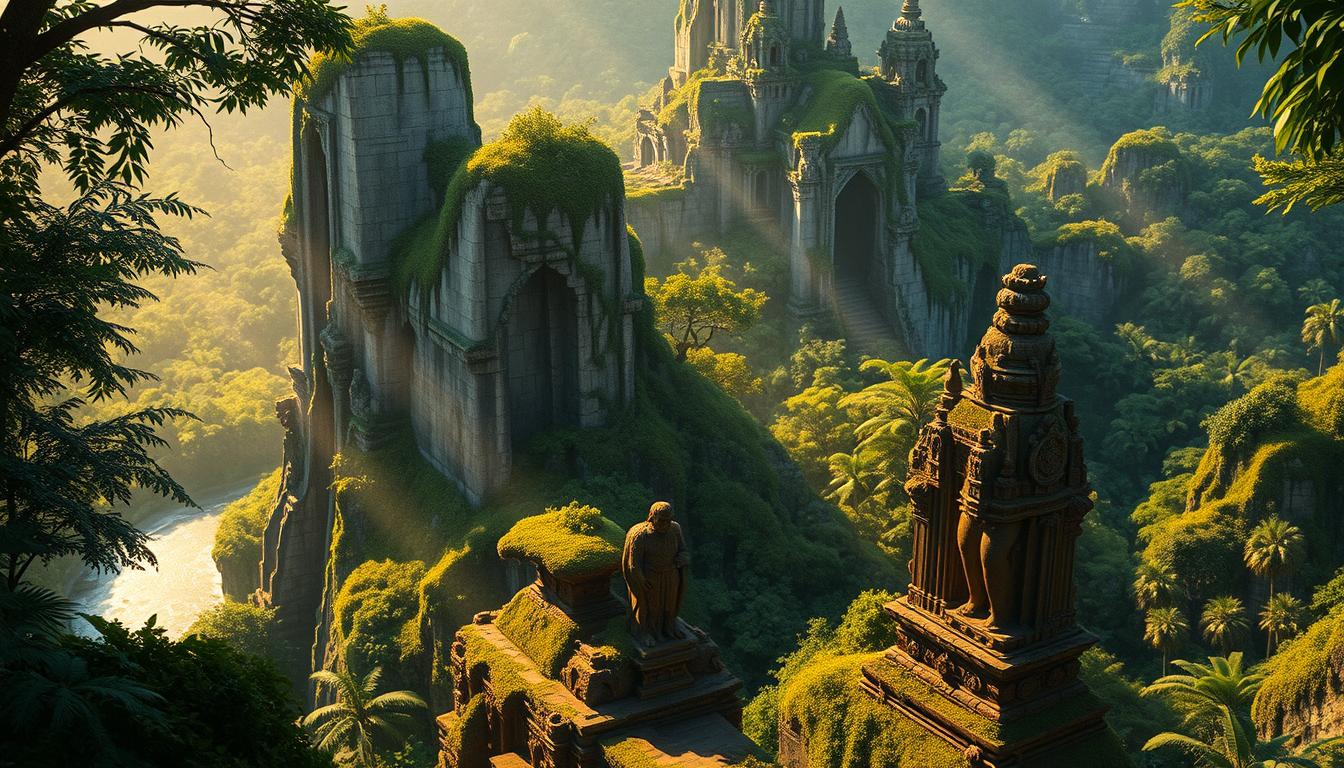
From the towering pyramids of the Maya to the underground city of Derinkuyu, forgotten ancient civilizations have left clues of their existence. Cities like Cahokia, once home to 20,000 people—comparable to medieval London—collapsed by 1350 A.D. This makes them part of the list of mysterious disappeared cultures.
The Ancestral Puebloans built cliff dwellings with hundreds of rooms across the American Southwest. Yet, by the 13th century, these vanished ancient societies abandoned their homes. They left behind silent stone structures.
Easter Island’s moai statues, some weighing 82 tons, stand as silent witnesses. A population that dwindled from 15,000 to just 100 by the 1800s. These lost ancient kingdoms, like the 402-acre Angkor Wat or Nabta Playa’s 9,000-year-old farming communities, remind us of humanity’s fragile relationship with time.
This journey through prehistoric civilizations and their sudden declines reveals how environmental shifts, wars, or resource scarcity could erase entire cultures. From Cahokia’s earthen mounds to the submerged ruins of Thonis-Heracleion, each site whispers stories of what once was—and why it vanished.
Introduction to Forgotten Ancient Civilizations
Archaeological mysteries surround civilizations like Aksum, once a rival to Rome, whose sudden decline remains unexplained. Ancient society collapse often stemmed from environmental shifts or wars, yet their legacies linger in artifacts and ruins. Historians and scientists work to unravel how these historical disappeared cultures vanished, blending clues from crumbling temples to buried tools.
Lost civilizations evidence emerges through cutting-edge tech: satellites spotting hidden pyramids or DNA tests revealing migration patterns. Sites like Cahokia’s sprawling mounds in Illinois show North America’s sophisticated urban centers, forgotten until modern . These ancient world mysteries challenge myths—some societies adapted, while others left no heirs.
Stories of the Xiongnu or Kushite rulers remind us that even mighty states can fade. By studying these vanished societies, we learn how resilience and failure shaped humanity’s journey. The next sections explore these vanished worlds, from Indus Valley cities to Maya stelae, revealing how past choices continue to impact us today.
The Indus Valley Civilization
The Harappan civilization thrived in the bronze age Indus region. It covered parts of modern ancient India Pakistan civilization and Afghanistan. This society was one of the world’s earliest urban centers.
It built cities like Mohenjo-daro ruins and Harappa. These cities showed early urban planning skills. They had grid-like streets, advanced drainage systems, and standardized brick sizes.

At Mohenjo-daro, archaeologists found a city with public baths, granaries, and citadels. Its drainage networks were integrated into homes, showing a focus on cleanliness. The Harappan civilization traded goods as far as Mesopotamia.
They used standardized weights and measures across their vast territory. Yet, their writing system, etched on seals, remains undeciphered. This leaves their history shrouded in mystery.
Despite its sophistication, this civilization faded around 1900 BCE. Climate shifts, river course changes, or drought may have disrupted agriculture. This led to its decline.
Today, sites like Mohenjo-daro—a UNESCO site—stand as testaments to its ingenuity. Ongoing research with 3D scanning and radar reveals new details. It helps us understand how this ancient society balanced innovation with environmental challenges.
The Minoans of Crete
The Minoans were a thriving Bronze Age Mediterranean society on Crete. They left clues to their advanced ancient Aegean civilization. Their main place was the Knossos palace, a huge complex with over 1,000 rooms, running water, and lively Minoan art culture.
Frescoes like the “Octopus” painting showed their love for nature. Linear A scripts suggest a complex bureaucracy, but it’s not yet understood.
Trade connected Crete to Egypt, Cyprus, and more, making them wealthy with goods like bronze and ceramics. But disaster hit around 1600 BCE with the Thera eruption. The volcano’s tsunami might have destroyed coastal towns, hurting their economy.
Mycenaean Greeks later took over Knossos, mixing Minoan ideas into their culture.
Despite their advanced ways, the Minoans disappeared by 1450 BCE. Their palaces, art, and unknown scripts are reminders of a society shaped by innovation and disaster.
The Olmec Culture
The Olmec, known as the Mesoamerican oldest civilization, started in pre-Columbian Mexico around 1500 BCE. They were based in the ancient Gulf Coast culture of Veracruz and Tabasco. Their most famous work, the colossal stone heads, show their skill.
These massive statues, up to 55 tons, were carved without metal tools. They were made from basalt boulders, 50 miles away.

Olmec art symbolism was rich, with jaguar-human hybrids and ritual masks. The La Venta site had a huge 112-foot pyramid. It shows their advanced building skills.
Their Cascajal stone, with glyphs from 900 BCE, suggests early writing. They traded goods as far as Guatemala. But, their sudden end by 400 BCE is a mystery.
Though they left no written records, their impact is seen in Maya calendars and Aztec rituals. Their work, done by hand, is awe-inspiring. It reminds us of the power of ancient cultures, even if they vanish without a trace.
The Hittites: A Powerful Empire
The Hittites were bronze age superpowers from their . They ruled over Anatolia and the ancient Middle East empire. Their created advanced weapons, giving them military power.
This left behind the city of Hattusa. It was a huge metropolis with temples and a royal archive. This archive had 10,000 clay tablets.
As rivals to Egypt, the Hittites made history’s first peace treaty after the Battle of Kadesh. Their chariots, manned by skilled warriors, made them a dominant force in Anatolia. Yet, by 1180 BCE, invasions by the Sea Peoples and internal strife led to collapse. Hattusa lay buried until archaeologists uncovered its walls in the 19th century.
This empire’s legacy includes legal codes protecting merchants and religious texts honoring a thousand gods. Their mastery of iron tools and trade networks shaped Anatolia’s history. Even could vanish, leaving only echoes in stone and soil.
The Mycenaeans: Warriors of the Aegean
The Mycenaean civilization flourished from 1600 to 1100 BCE. They built massive stone fortresses like Mycenae’s Lion Gate. Their society was connected to the Trojan War culture and shaped Homeric era society traditions.
Their cities were protected by Cyclopean walls, some blocks weighing 20 tonnes. Excavated Linear B writing tablets show their economy and military. They listed “ancient Aegean warriors” by rank and region.

Mycenaean armies used 12-foot spears and boar-tusk helmets. Their shield designs changed from tower shields to smaller aspis types. This change showed their society adapting to threats.
Linear B records also talk about the wanax (king) and his officials. They show a structured hierarchy tied to trade and warfare.
By 1200 BCE, their world collapsed with the broader Bronze Age upheavals. Earthquakes, droughts, and invasions disrupted trade networks. This led to a 300-year Dark Age.
Yet, their legacy lives on. Homer’s epics tell of their exploits, and Linear B’s decipherment in 1952 revealed their true history. Today, their ruins remind us of how quickly mighty civilizations can disappear.
The Carthaginian Empire
Carthage was a North African empire founded by Phoenicians around 814 BCE. By the 4th century BCE, it was a Mediterranean trading power. It was known for its advanced ships and wide trade network.
It was also a fierce ancient Rome rival. This rivalry led to three brutal wars. Rome destroyed Carthage in 146 BCE.
Carthage’s fall marked the end of a civilization that once shaped Mediterranean history. Its legacy survives only in fragments.
Carthage was Hannibal’s homeland. It produced military geniuses like Hannibal, who amazed Rome with his elephant march. Despite its innovations, like the cothon harbor, Romans destroyed its libraries.
Today, archaeology uncovers clues about this Punic civilization. It shows a society focused on trade and the sea. Though its story is buried, Carthage’s battle with Rome changed history.
The Sumerians: Cradle of Civilization
The Sumerians lived between the ancient Tigris Euphrates rivers. They built the Mesopotamian first cities like Uruk Ur civilization centers. By 3500 BCE, Uruk had walls that enclosed 40,000 people, making it the first big city.
These cities used irrigation canals to make floodplains fertile. This led to a growth in trade and government.
The cuneiform writing origin started here, around 3400 BCE. Scribes wrote on clay tablets. They recorded laws, stories, and trade deals.
The Code of Ur-Nammu was the first legal code. The Epic of Gilgamesh, humanity’s first epic poem, also came from these city-states. It tells stories of kings and gods.
Sumerian builders made huge Ziggurats like Ur’s ziggurat, which was 170 feet tall. These were made of mud bricks and honored gods like Enlil and Inanna. Their math, based on 60 units, is used today for hours and angles.
Even when the Akkadians took over, Sumerian culture lived on. Their writing and urban life ideas were passed down.
“They turned dust into empires, carving knowledge into stone and clay for future civilizations to rebuild.”
The Nabateans: Masters of Trade
The Nabateans built a thriving desert trading kingdom in one of the harshest environments on Earth. Their capital, Petra, carved into rose-red cliffs, stands as a testament to their ingenuity. These ancient Arab merchants turned barren deserts into a crossroads of commerce, dominating the incense route controllers network that spanned continents. Their mastery of rock-cut architecture transformed Petra into a wonder, with tombs and temples sculpted directly into stone.
Controlling the incense route, the Nabateans monopolized luxury goods like frankincense and myrrh. Their hydraulic engineering genius channeled scarce water into reservoirs, supplying 35 million gallons annually to sustain 30,000 residents. This desert kingdom thrived for seven centuries, collecting taxes from caravans carrying spices, silks, and gems between Asia and Rome. The Romans eventually absorbed their realm in 106 CE, but Petra’s legacy endures in its iconic Treasury building and labyrinth of hidden tombs.
At their peak, over 3,000 tons of incense passed through their hands yearly, enriching this once-nomadic people. Their water systems remain functional today—a lasting mark of their engineering brilliance. Though forgotten for centuries, Petra’s rediscovery in 1812 revealed a civilization that turned scarcity into prosperity through trade and innovation.
The Khmer Empire
The Khmer Empire flourished from 802 to 1431 CE in Southeast Asia. It built an incredible urban wonder, Angkor, which was home to over 700,000 people. The Angkor Wat builders created the world’s largest religious monument and a vast hydraulic city network.
This ancient civilization combined spiritual and practical skills. They built Hindu-Buddhist temples like Angkor Wat into the landscape. These temples reflected their cosmic beliefs.

The Hindu-Buddhist temples were more than places of worship. They were centers of social and economic life. The East Baray, a 7.1 km-long reservoir, and other waterways supported rice fields.
But by the 15th century, the empire faced challenges. Deforestation, erratic monsoons, and war with Thai armies weakened it. After 1431, Angkor was abandoned, leaving its hydraulic city network hidden for centuries.
Today, LiDAR scans show Angkor’s massive size. It had a grid of roads and canals like today’s cities. The Angkor Wat builders’ work is admired by over 2.6 million visitors yearly. Their legacy teaches us that even great empires can disappear, leaving mysteries for us to uncover.
The Mississippian Culture
North American mound builders, like the Mississippians, built one of the earliest indigenous urban centers in Cahokia, Illinois. At its peak around 1100 CE, this Cahokia civilization had 10,000–20,000 people. It was North America’s largest pre-Columbian city.
Monks Mound, its 100-foot-tall centerpiece, was built with 22 million cubic feet of soil carried by hand. This achievement is as impressive as ancient Egyptian construction.
These pre-Columbian Native Americans used their ancient Midwest cultures’ knowledge to build Woodhenge, a wooden astronomical calendar. Their trade networks stretched from the Rockies to the Atlantic, exchanging copper, shells, and ceremonial items. Cahokia’s decline after 1200 CE coincided with the Little Ice Age, which disrupted corn harvests.
By 1400, its population shrank as communities scattered. Yet, their legacy endures in modern tribes like the Natchez and Choctaw.
Mississippian villages thrived along rivers, using “three sisters” crops—corn, beans, squash—to fuel their complex societies. Their North American mound builders legacy includes over 100 mounded sites, with Emerald Mound in Mississippi as a key example. Despite their advanced urban planning and artistry, European diseases and warfare in the 1500s fragmented their chiefdoms.
Today, archaeology reveals their sophistication, challenging myths of “primitive” pre-European societies.
Conclusion: The Lessons of Lost Civilizations
The rise and fall of ancient societies like the Olmec and Sumerians show us ancient society collapse patterns. These patterns are linked to environmental strain and rigid governance. Even advanced societies, like the Minoans, fell when they couldn’t adapt.
Archaeological theories often point to resource depletion and climate crises as common causes.
Lost innovations, like Roman concrete, and mysteries, like the Voynich Manuscript, show cultural continuity disruption. But the rediscovery of the Antikythera mechanism proves human ingenuity never fades. Today, we face challenges like climate change and social shifts, urging us to focus on civilizational resilience factors like adaptable governance.
These historical sustainability lessons teach us that progress without sustainability leads to past mistakes. By learning from their weaknesses, today’s world can create systems that grow sustainably. The past’s stories guide us to avoid their failures.