
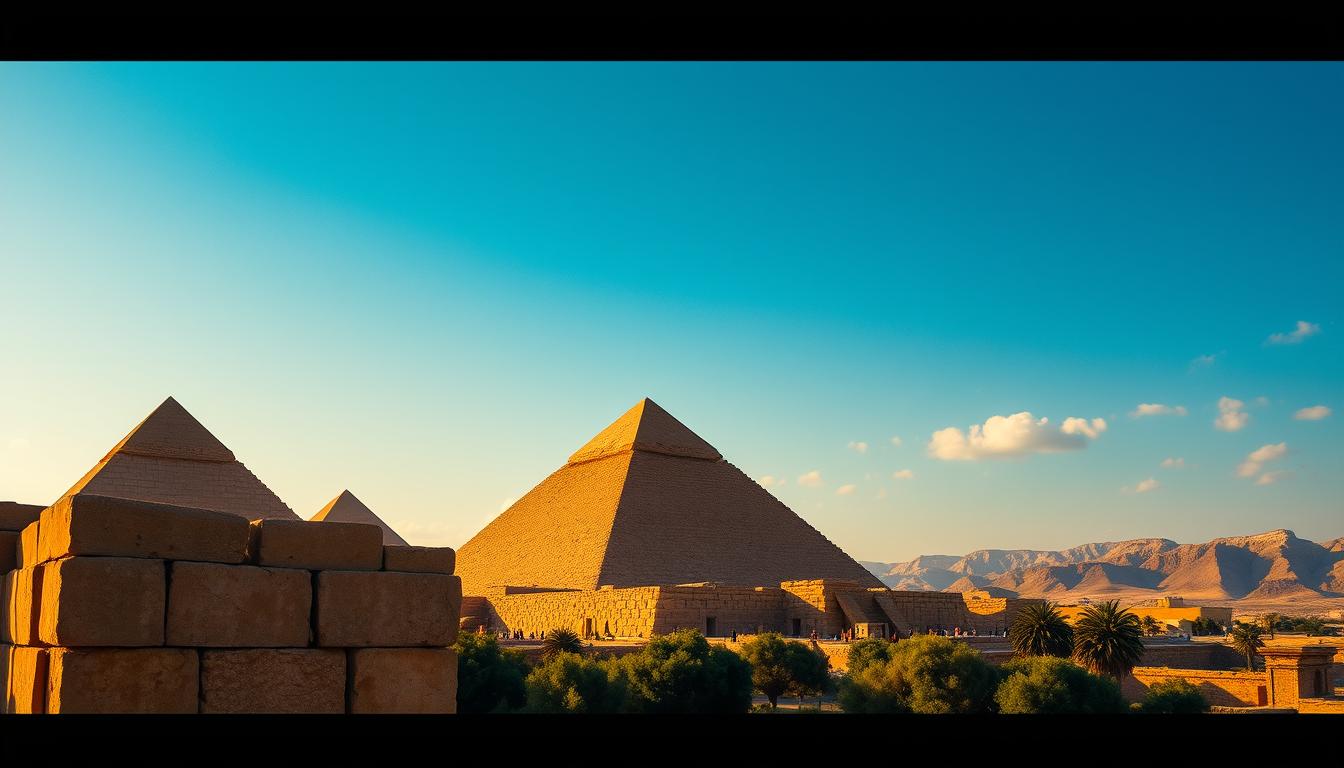
Recent finds are changing how we see ancient pyramids. Scientists found a 40-mile-long Nile branch, named Ahramat, near 31 pyramids in Egypt. This river, once key, might have influenced the Giza complex and other pyramids built over 4,700 years ago.
Modern tools like radar satellites and surveys showed Ahramat’s path. It stretches 64 km with widths up to 2,296 feet. Its close location to pyramids means workers used it to move stone blocks, solving long mysteries.
The river dried up around 4,200 years ago, hidden under sand until now. These discoveries reveal how ancient Egyptians used their environment. From hidden corridors in the Great Pyramid to restored Giza blocks, each find changes our view of these wonders. Stay tuned for more secrets from the ancient world.
Unveiling the Mysteries of the Pyramids
For centuries, pyramid mysteries have fascinated many. How did ancient people move and place so many stones with such care? Today, archaeological technology is uncovering pyramid secrets. Tools like satellite scans and radar have found hidden rooms and paths that were lost to time.
The Great Pyramid of Giza is a prime example of ancient engineering. Its sides are almost perfectly aligned with the compass. Recent discoveries have revealed a 30-meter space inside, suggesting there’s more to explore. Studies of the Nile’s ancient paths, like the “Ahramat” riverbed, show how water helped move stones. This mix of old and new is uncovering secrets that were once hidden.
New methods like muon particle detection and 3D modeling are helping us see without digging. For instance, the Red Pyramid’s sides are incredibly smooth. This shows how Sneferu’s builders improved on earlier designs. Even the Pyramid of Djoser, Egypt’s first step pyramid, used special joints to stay stable.
Every new discovery brings us closer to understanding these ancient wonders. The more we learn, the more we are amazed. As technology grows, so does our knowledge of ancient wisdom.
The Great Pyramid of Giza: A Marvel of Engineering
The Great Pyramid of Giza amazes experts to this day. Built over 4,500 years ago, it shows incredible precision. Its alignment with compass directions and Orion’s Belt is unmatched for ancient ancient Egyptian engineering.
Each of its 2.3 million stone blocks, weighing up to 15 tons, fits with gaps thinner than a credit card. This precision was unmatched until modern times.

Recent scans using ground-penetrating radar found an L-shaped structure near the pyramid. Researchers think it might lead to hidden chambers or tunnels within the Giza complex. This discovery is similar to the ScanPyramids project’s 2017 finding of a massive void in the pyramid’s core.
How did builders lift and position such massive stones? Ancient Egyptians likely used ramps, sledges, and Nile river routes to transport materials. The pyramid construction techniques are debated, but clues like worker villages and tool marks suggest organized labor and advanced logistics.
Every discovery, from buried structures to worker diets found in nearby bakeries, adds layers to this timeless puzzle. As technology evolves, the Great Pyramid of Giza keeps revealing its secrets—one scan, one stone, one mystery at a time.
Pyramids Beyond Egypt: A Global Perspective
Pyramids are found all over the world, showing our shared love for big buildings. They span continents, breaking down borders and time lines. For example, Mesoamerican pyramids like Chichen Itza’s El Castillo have staircases that cast serpent shadows during equinoxes.
In Asia, pyramids like Indonesia’s Gunung Padang are believed to be 35,000 years old. These structures show ancient people could be precise without today’s tools.
“Pyramids aren’t Egypt’s monopoly—they’re a universal language of power and spirituality,” says Dr. Sarah Parcak, space archaeologist.
In Sudan, there are over 200 Nubian pyramids, smaller but packed together. China has the Xian Tomb, a 108-meter terraced structure used as an imperial mausoleum. Unlike Mesoamerican pyramids, Asian ones often mix burial and celestial symbols.
Greece also has Hellenistic-era pyramids in Caria, showing cultural exchanges. These pyramids show ancient societies, despite their distance and time, built similar structures. They aimed to honor gods or show dynastic power, yet all reached for the sky.
Looking at these pyramids, we see history as a shared human dream. It’s a tapestry of ambition and creativity.
Recent Archaeological Discoveries
Pyramid archaeology has seen recent pyramid discoveries that change our view of history. A team from the University of North Carolina Wilmington found an ancient Nile branch near Giza’s pyramids. They used advanced radar and imaging to find it.
Prof. Eman Ghoneim said its exact location was a mystery until now. This waterway was key for moving construction materials.

Ground-penetrating radar (GPR) found an L-shaped structure near Giza. It was 33 by 49 feet and buried 6.5 feet deep. This site might hold hidden chambers and tombs from King Khufu’s time.
Scans also found deeper anomalies, possibly leading to more burial sites. These archaeological breakthroughs suggest the Western Cemetery is full of secrets. It might even rival the pyramids.
Statues like the basalt figure of Perniankh and limestone statue of Kapunisut Kai add to our understanding. The study was published in Archeological Prospection. It used non-invasive tech to map the area without digging.
This method is also used in Viking ship discoveries. It helps find history without harming fragile sites.
These recent pyramid discoveries show ancient engineers were smart. They used natural resources and advanced logistics for their time. As technology improves, we’ll learn more about these wonders and what’s yet to be found.
Theories Surrounding Pyramid Construction
Recent radar scans have changed pyramid construction theories by showing an ancient Nile branch. This waterway, hidden under sand for thousands of years, helped move big stones to Giza. Satellite data shows it was wide and deep enough to carry 2.5-ton blocks, proving stone transportation by boat.
These findings match a 4,500-year-old diary that talks about limestone shipments from Tura by river.
Experiments show ancient construction methods were efficient. In 1992, 44 workers built a 405-ton structure using ramps and sledges with water. Modern tests show 18 men could move 5,500-pound blocks over wet sand, reducing friction by half.
The tomb of Djehutihotep shows 172 workers moving a 60-ton statue. This proves humans could do these big tasks alone.
While some think aliens helped, the evidence shows human ingenuity. The 1984-1995 carbon dating studies, though debated, show science’s role in revising timelines. Workers’ cemeteries and records of paid labor debunk slave labor myths.
The use of copper tools, ramps, and precise water management shows advanced pyramid building techniques. Archaeologist Mark Lehner says, “These were skilled engineers, not unskilled laborers.”
Modern tech like 3D scans of Giza’s bedrock confirm internal ramps guided blocks upward. Even the 2.2-ton limestone bricks, carved with bronze saws, fit perfectly without mortar. Every discovery, from worker diets to the Nile’s role, adds to our understanding of this great mystery.
The Mystery of Pyramid Layouts
Recent discoveries show that pyramid layouts in ancient Egypt were influenced by both practical needs and the stars. The Ahramat branch of the Nile, a dry river now, once guided pyramid positioning across 31 monuments. This ancient waterway explains why pyramids cluster in today’s desert. It shows how builders chose to be close to water for construction and aligned structures with Orion’s Belt.
Researchers like Glen Dash found clues in astronomical alignments. In 2016, he used a gnomon rod during the fall equinox. This revealed how shadows helped builders align the Great Pyramid almost perfectly east-west. This method, part of ancient engineering, allowed Egyptians to align pyramids with just four minutes of arc off true north. This precision suggests a deep understanding of solar movements and religious ties to stars like Orion’s Belt.
These ancient architecture marvels were not random. The mix of waterways, star charts, and sacred beliefs created systems where each pyramid’s placement had both symbolic and practical value. As scholars continue to uncover these clues, the genius behind pyramid layouts becomes clear. It’s a blend of science, myth, and survival in a changing world.
Cultural Significance of Pyramids
Pyramids were more than just tombs. They were key to pyramid cultural significance in ancient societies. In Egypt, they were seen as pyramid religious meaning bridges between humans and gods. Pharaohs believed they would rise to the stars through these structures, a belief reflected in rituals and art.
These structures were not just monuments. They showed a civilization’s cosmic order. Their precise geometry mirrored spiritual ideals.
The pyramid symbolism spread beyond Egypt. Mesoamerican pyramids were temples to gods, and China’s Ming Dynasty mausoleums showed similar reverence for the afterlife. Each culture used pyramids in their identity, from religious ceremonies to watching the stars.
Building pyramids was a community effort. It brought people together, creating jobs and showing social order. Archaeologists found worker villages with bakeries and tools, showing organized systems for thousands.
“The stones were moved by river, not slaves,” notes the 4,500-year-old Diary of Merer, revealing how Nile logistics enabled these feats.
Today, pyramids like Giza’s are UNESCO World Heritage sites, attracting millions. They symbolize human ambition and spirituality. Pyramids remind us of our shared quest to connect earth and eternity.
Extraordinary Pyramid Discoveries
Recent scans under the Great Pyramid’s western cemetery found an L-shaped anomaly. This was done with pyramid technology like ground-penetrating radar (GPR) and electrical resistivity tomography (ERT).). The structure is buried 6.5 feet underground and is 33 feet long. It suggests there might be ancient treasures or hidden chambers yet to be found.
Researchers from Tohoku University, led by Motoyuki Sato, are studying the data. They aim to understand the purpose of this structure.

These unexpected discoveries are changing how we think about pyramids. The 2017 “ScanPyramids Big Void”—a 100-foot chamber—remains a mystery. The pyramid’s Grand Gallery also has unique acoustic properties.
These pyramid artifacts show ancient rituals and engineering skills. For example, the empty granite sarcophagus in the King’s Chamber might have had symbolic meaning.
Modern tools are rewriting history. The air shafts align with stars, and the pyramid’s base is almost perfectly symmetrical. This shows pyramid technology was more advanced than we thought.
Even the lost limestone casing once made the pyramid shine like a beacon. This was a remarkable achievement in ancient times.
Every unexpected discovery changes how we see the past. From hidden chambers to acoustic wonders, these finds show pyramids are full of secrets waiting to be uncovered.
The Future of Pyramid Research
Scientists are exploring new ways to study pyramids without harming them. Drones create 3D maps of pyramids. AI analyzes old data to find new patterns. Tools like muon detectors find hidden rooms inside pyramids, like the Great Pyramid, without damage.
“From the survey results, we cannot determine the material causing the anomaly, but it may be a large subsurface archaeological structure.”
But, some secrets can only be found by touching the pyramids. Teams are planning archaeological expeditions to unexplored pyramid sites in Sudan and Central America. These places might hold secrets about ancient civilizations that built pyramids.
Researchers also want to improve future archaeological methods. They plan to mix drones, AI, and old-school digging techniques. This mix could lead to more discoveries.
Every new find brings more questions. With advanced tools and teamwork, pyramid research is set to change history. The future looks bright, balancing new tech with respect for ancient sites.
Conserving Our Pyramid Heritage
Protecting ancient monuments like the pyramids is urgent. We face threats like climate change, tourism wear, and looting. Modern pyramid conservation uses advanced tools to balance access and preservation.
Projects like ScanPyramids, a collaboration between KEK and CEA, found a 100-foot void in the Great Pyramid. They used muon radiography. This shows how technology helps heritage protection without harming the structures.

Efforts like 3D scanning and drone monitoring track changes. Sustainable tourism plans limit overcrowding. Local communities help enforce rules.
Revenue from Egypt tour packages funds repairs. But balancing visits with preservation is a challenge. The Great Pyramid’s limestone blocks, each weighing 2.5 tons, face erosion from pollution and weather.
Global teams work to preserve these sites for future generations. Visitors can support heritage protection by choosing ethical tours and advocating for funding. Every action helps safeguard these wonders as vital links to ancient engineering brilliance.
Conclusion: The Enduring Fascination with Pyramids
Pyramid fascination grows as ancient mysteries unfold with every new discovery. From the L-shaped anomaly near Giza’s Western Cemetery to the 18 million tonnes of artificial concrete in Bosnia, these archaeological wonders defy simple answers. Modern tools like ground-penetrating radar reveal hidden chambers, proving even well-studied sites have secrets.
Human achievement shines in their design. The Great Pyramid’s alignment with true north and Fibonacci sequences showcase advanced math, yet no blueprints exist. The absence of tombs inside challenges old theories, while energy field fluctuations and celestial alignments fuel debates. Each clue—from Orion’s stars to 2.3 million blocks—adds layers to their purpose, blending fact and imagination.
These monuments are more than stone; they’re bridges to the past. Whether through 4,500-year-old engineering or unexplained energy readings, pyramids inspire awe. Every scan, scan, and scan reveals something new, turning them into timeless puzzles. As research continues, their legacy grows: symbols of curiosity that connect ancient ingenuity with modern wonder. The story isn’t finished—each discovery deepens the mystery, ensuring pyramids will forever captivate.