
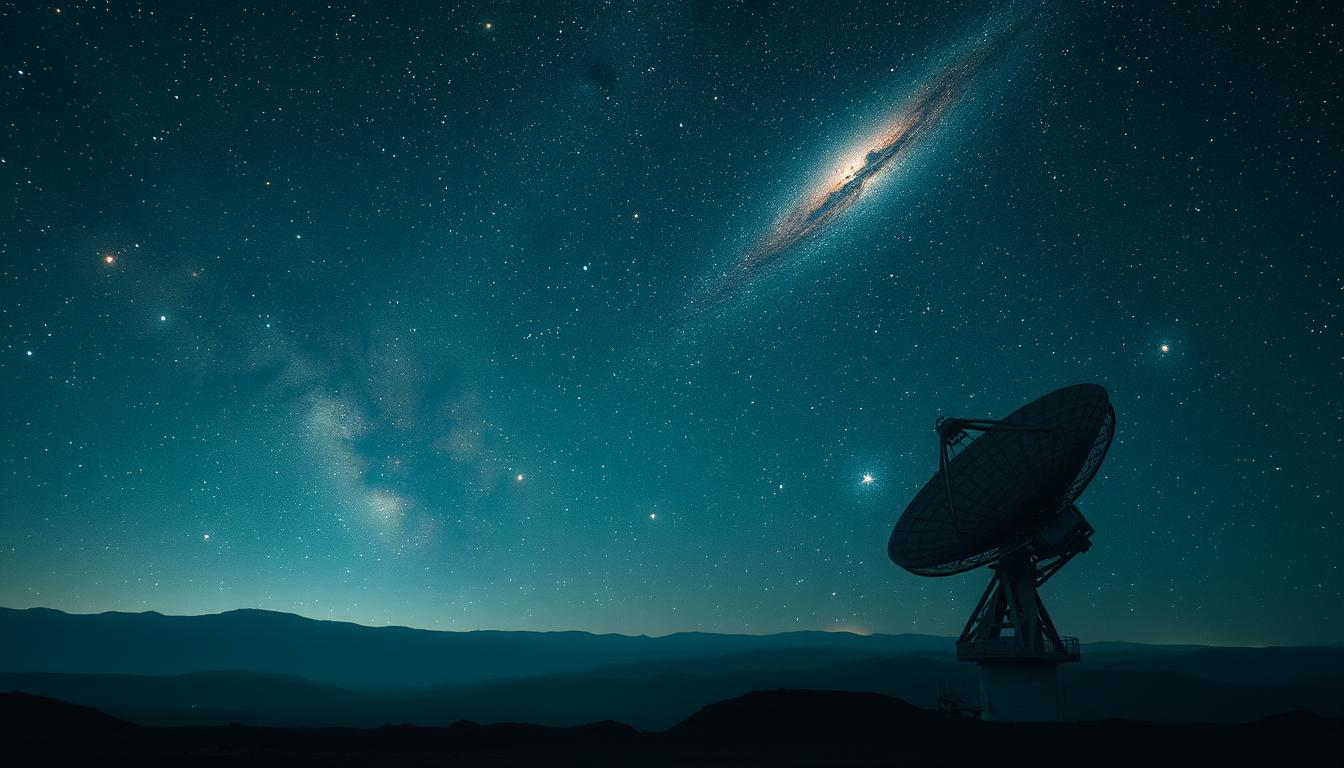
Deep space signals from the cosmos keep scientists puzzled. For over a decade, radio astronomy has found strange signals like repeating bursts from the Big Dipper constellation. These signals, such as the 2024 fast radio burst tracked from February to July, show us mysteries in the universe.
Recently, astronomers found a pulsing signal from a 11.3-billion-year-old galaxy 2 billion light years away. This galaxy is the most massive FRB host galaxy ever found, weighing 100 billion solar masses.
Radio telescopes like Australia’s Murchison Widefield Array and South Africa’s MeerKAT have found signals like GLEAM-X J0704-37. It emits three-hour pulses. Even stranger, ASKAP J1935+2148 has a 53.8-minute cycle, much slower than typical neutron star rotations.
These discoveries change how we see deep space signals. They mix cutting-edge radio astronomy with the excitement of unexplained cosmic phenomena.
Introduction to Deep Space Signals
Scientists have been listening to the universe’s hidden language through radio signals from space for decades. Karl Jansky’s discovery of cosmic static in 1932 started radio astronomy. Now, NASA’s Deep Space Network (DSN) decodes these astronomical signals to explore the cosmos.
The DSN has three global sites: Goldstone, Madrid, and Canberra. They work together to catch faint cosmic radio emissions from far-off stars and planets.
“The DSN is the world’s largest and most sensitive telecommunications system,” enabling scientists to track spacecraft and analyze signals weaker than a billionth of a billionth of a watt. These radio signals from space reveal clues about black holes, pulsars, and even possible life.
Every signal has a story. Pulsars act like cosmic lighthouses, while fast radio bursts flash briefly before disappearing. Distinguishing natural astronomical signals from human-made ones is a challenge. The DSN’s 70-meter antennas capture whispers from Mars rovers and distant quasars.
By turning radio waves into data, researchers solve mysteries hidden in cosmic radio emissions. As technology improves, each signal brings us closer to understanding our universe’s vast, silent symphony.
Types of Deep Space Signals
Understanding radio signal classification is vital to unlocking the universe’s secrets. Scientists divide space signal types into natural and artificial origins. Pulsars, for example, emit steady cosmic radio waves as they spin, reaching across galaxies.
Magnetars have magnetic fields 1,000 trillion times stronger than Earth’s, causing sudden bursts. Quasars shine brightly due to black holes, while “long-period transients” remain a mystery.
Some signals might be from technology. The “Wow!” signal’s discovery in 1977 is a topic of ongoing debate. Fast Radio Bursts (FRBs) like FRB 20220912A, captured by the Allen Telescope Array, show unique characteristics.
NASA’s Deep Space Station 13 uses seven hexagonal mirrors to track signals from 20 million miles away. This technology helps us better understand these cosmic messages. Future advancements, like a 64-segment antenna, could uncover even more secrets.
The Mystery of Fast Radio Bursts
Fast radio bursts (FRBs) are cosmic puzzles scientists are racing to solve. These millisecond radio signals burst with energy, equal to the Sun’s yearly output in just a fraction of a second. Astronomers, using telescopes like CHIME, have tracked thousands of them. But, their origins remain a mystery.
“The radio pulses are very similar to FRBs, but they each have different lengths,” explained researcher Shriharsh Tendulkar. “FRBs vanish so fast, leaving only clues behind.”
A 2022 burst from magnetar SGR 1935+2154 gave a breakthrough. This 20-kilometer-wide neutron star spins 3.2 times per second. It creates magnetic forces strong enough to crush a marshmallow into an atomic bomb. Before its 2022 radio blast, it erupted in X-rays, linking magnetars to FRB creation. Yet, not all bursts repeat—most are one-time flashes.
Recent findings add layers to the mystery. FRB 20240209A, spotted 2 billion light-years away, came from its galaxy’s edge—farther than any other FRB recorded. FRB 20221022A’s 2.5-millisecond flash pinpointed its source to a galaxy 200 million light-years away. Such clues hint at magnetar flares as one source, but many bursts remain unexplained.
FRB research races to solve why some signals repeat while others don’t. Each discovery—like 20240209A’s record-breaking distance—pushes theories forward. For now, these millisecond radio signals stay cosmic enigmas waiting to unravel their secrets.
The Search for Extraterrestrial Life
SETI research has been scanning the cosmos for decades for alien communication. Projects like Breakthrough Listen, launched in 2015, use advanced tech to analyze millions of star systems. This effort scans thousands of stars each year, collecting over a petabyte of data to find signs of extraterrestrial intelligence.

Early efforts like Project Ozma in 1960 started this field. Though it found no confirmed signals. The Wow! signal in 1977 is a famous mystery, detected at Ohio State’s telescope but never repeated. Today, tools like the Allen Telescope Array’s 42 dishes and China’s FAST telescope help in this search, looking for patterns in radio waves.
Challenges remain. False signals from satellites or Earth tech often confuse systems. In 2023, AI algorithms found 3 million signals from 820 stars, but most were dismissed as noise. Now, over 5,000 confirmed exoplanets guide targeted searches, focusing on stars like HD164595, which sparked excitement in 2015.
Future telescopes like NASA’s Habitable Worlds Observatory, launching by 2027, will study exoplanet atmospheres. Citizen science projects like SETI@home also let volunteers help analyze data. With billions of stars in the Milky Way, the quest continues, blending cutting-edge tech with the timeless question: are we alone?
The Role of Radio Telescopes
Radio telescopes are like cosmic ears for humans. The LOFAR telescope, with 81,000 antennas across Europe, found ILTJ1101+5521.
These telescopes catch radio waves from 1 millimeter to 10 meters. The LOFAR boosts weak signals by a billion billion times. It uses advanced tech to turn noise into cosmic secrets.
Places like the Very Large Array and the Square Kilometre Array use big dish networks. The Green Bank Telescope is 100 meters wide and tracks signals. The FAST in China scans deep space with its 500-meter dish.
New tech will make discoveries even better. The SKA and the Qitai telescope will offer clearer views. As radio telescopes get better, we learn more about the universe.
Analyzing Deep Space Signals
Scientists use radio signal analysis to understand messages from space. Each signal has clues like wavelength, frequency, and timing. For instance, the binary star system ILT J110160.52+552119.62 sends pulses every 125.5 minutes.
By tracking these rhythms, researchers find hidden patterns. Tools like the LOFAR telescope network collect huge data streams. Then, space data processing software sorts this data to remove Earth-made noise.
Signals reveal cosmic secrets. The signal pattern recognition of a magnetar’s 3.2-second spin helped link it to the 2022 FRB 20221022A. Even small changes in light waves, like a red star’s spectral fingerprint, show motion.
A shift toward longer wavelengths means an object is moving away. Shorter wavelengths mean it’s coming closer.

Challenges exist. A single magnetar glitch in 2022 slowed its spin 100x faster than expected. Deciphering such events takes patience.
Scientists also study how a neutron star’s crust cracking might trigger bursts. Each discovery adds to our understanding of how stars communicate across vast distances.
Significant Case Studies
One of the most intriguing discoveries in space is binary star radio emissions from a far-off system. For over ten years, scientists were baffled by radio bursts that happened every two hours. They found the source to be a pair of stars: a red dwarf and a white dwarf that orbit each other closely.
Their magnetic fields clash as they spin, creating bursts of energy. This system, named ILTJ1101+5521, solved a mystery that had puzzled scientists for decades. It showed how white dwarf signals can look like messages from aliens.
The Wow! signal in 1977 is another famous case. It was picked up by Ohio State’s Big Ear telescope for 72 seconds. Its frequency was near hydrogen’s natural emission, sparking hopes of alien signals.
Despite searches by Breakthrough Listen in 2022, no repeating signals were found. Researchers now think it might have been a cosmic event like a magnetar flare.
Repeating fast radio bursts (FRBs), like FRB 121102, also show the power of modern tech. AI tools help find patterns in these brief signals. These discoveries keep pushing the limits of what we know, blending curiosity with advanced technology.
As telescopes get better, mysteries like the Wow! signal’s origin continue to intrigue. They make us wonder if white dwarf signals might be from aliens or natural events.
The Science Behind Signal Patterns
Understanding cosmic radio generation begins with magnetic fields and rotation. Neutron stars, like pulsars, spin fast. They send out radio beams that sweep through space like cosmic lighthouses. Even white dwarfs can create strong pulses with a companion star, showing us new things.
These astronomical signal patterns tell us about objects’ sizes, magnetic fields, and how they move.
Take ASKAP J1935+2148, a neutron star that spins every 53.8 minutes. It’s the fastest-spinning radio emitter known. It has three states: bright pulses, weak flickers, or silence. This challenges current space physics theories.
Astronomers are trying to figure out why this slow-spinning neutron star can send out such strong radio bursts. It’s changing how we think about magnetic field interactions.

Radio signals also tell us about the past. For example, signals from Saturn’s rings show they formed 10–100 million years ago. The ASKAP telescope looks at huge areas of space. It finds rare events like ASKAP J1935+2148’s bursts.
Each pulse’s timing and polarization help us understand the universe better.
By studying these patterns, scientists are improving their models of neutron star interiors. Even short signals, like ASKAP J1935+2148’s 10-second bursts, give us clues about extreme gravity and magnetism. This mix of observation and theory is expanding our knowledge of space physics.
Public Interest and Media Coverage
Space news coverage often sparks curiosity. The New York Times reported on mysterious radio waves in 1933. The headlines said, “No Evidence of Interstellar Signaling.” Yet, today, stories about strange radio signals get millions of clicks. This shows how people are drawn to cosmic mysteries.
In 2022, astronomers found radio waves from a galaxy 8.8 billion light-years away. This discovery was shared online. But, media often struggles to balance excitement with accuracy.
Sensational headlines like “Alien Signal Found?” can overshadow the real science. Scientists find it hard to explain brief phenomena like fast radio bursts. These bursts last only milliseconds.
Public fascination drives support for research. Over 7,000 UAP reports each year show people’s curiosity. SETI, now privately funded, relies on this interest to continue its mission. Good reporting turns wonder into lasting interest, inspiring future scientists and funding.
When space news is both truthful and engaging, it connects labs and living rooms. Media can highlight discoveries like distant galaxies or cosmic explosions. This inspires a new generation to explore the universe and find answers to old questions.
Future of Deep Space Signal Research
Future radio astronomy will change how we explore the universe. New space telescopes, like the Square Kilometre Array (SKA), will scan the sky with great precision. They will find faint signals from billions of light-years away, revealing secrets of distant galaxies and mysterious phenomena.

NASA’s Deep Space Optical Communications (DSOC) has made big strides. The hybrid antenna in the Psyche mission sent data at 15.63 Mbps from 20 million miles away. Engineers aim to make this technology even better, using a 64-segment array for deeper space exploration.
“The missing matter in the universe isn’t just a puzzle—it’s a key to understanding cosmic evolution,” said Professor Ryan Shannon. “Advanced telescopes will reveal what’s been hidden.”
Scientists will focus on tracing fast radio bursts (FRBs) like FRB 20220610A, which took 8 billion years to reach us. New systems could find where these bursts come from, helping us understand galaxy evolution and dark matter. The SKA will also search for signs of alien technology, expanding our search for life beyond Earth.
As new tools are launched, scientists will map the universe’s hidden structures and track transient events. Each discovery brings us closer to solving old mysteries. The future is full of unknowns, but one thing is certain: the next decade will change how we see the universe.
Conclusion
Cosmic exploration pushes our understanding of the universe. Discoveries like FRB 180916.J0158+654253.0’s 16-day signals and Teegarden’s Star’s faint whispers are key. They show how brief signals can reveal big secrets.
The first periodic pattern in FRBs suggests binary star systems or magnetar collisions. The “WOW!” signal might have come from a magnetar hitting hydrogen clouds. These findings show how old mysteries connect with new ones.
Tools like the Arecibo telescope help us understand the universe. Yet, many FRBs are a mystery. The 28 cycles observed from 2018 to 2019 and signals near Teegarden’s Star show our curiosity drives us. Every discovery leads to more questions.
As we learn more, our interest in the stars grows. We study everything from 1,420 MHz frequencies to distant galaxies. These efforts show how exploring space expands our view of the universe. The next big discovery could change everything we know.