
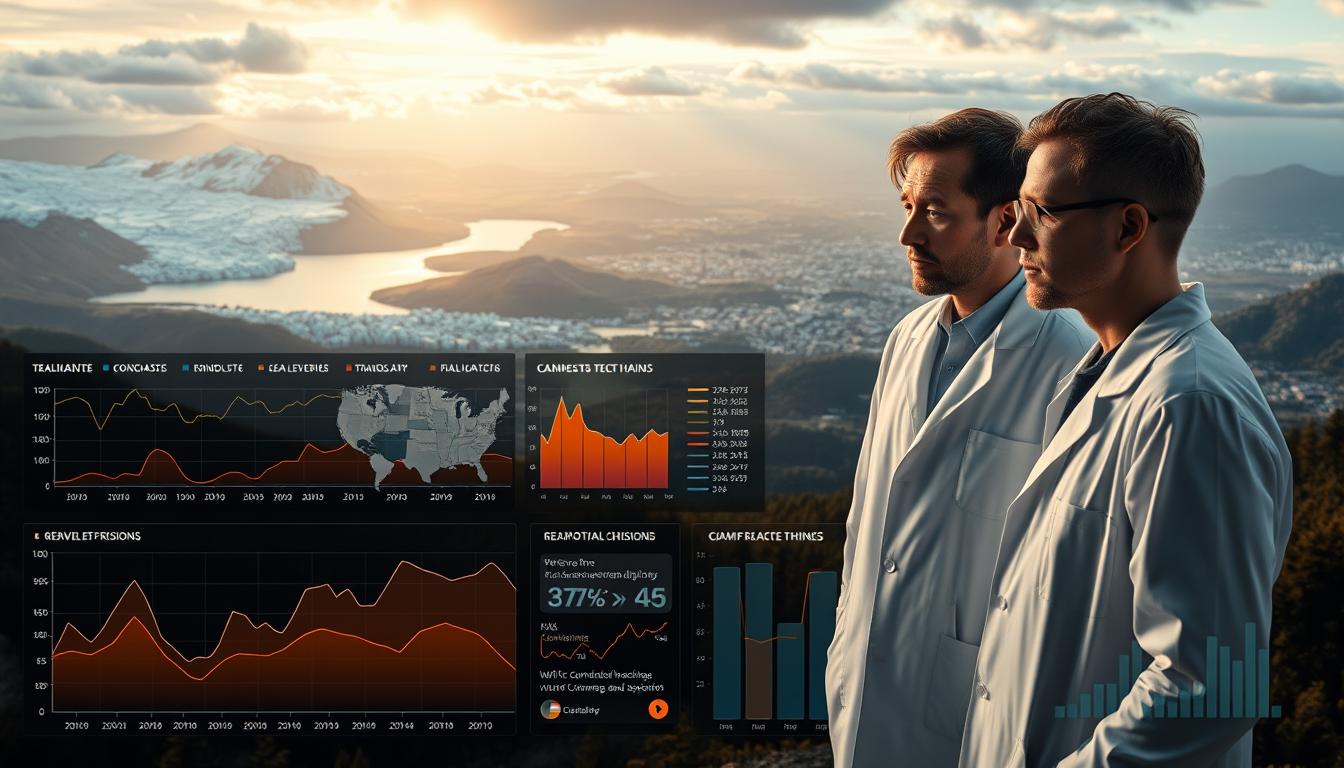
Climate change science shows Earth’s temperature has gone up by 1.1°C. This happened from the 1850-1900 average. 2023 was the hottest year, with a rise of 1.18°C above the 20th-century average. This warming is caused by human activities, like burning fossil fuels.
There’s no doubt about global warming. Satellite and temperature records show each decade is warmer than the last. The greenhouse effect, caused by CO2 and methane from fossil fuels, makes it worse. Temperatures have risen 1.7°C per century, much faster than natural changes.
Human activities like emissions, deforestation, and energy use cause climate change. The IPCC says a 1.5°C rise by 2030 could lead to big changes, like melting ice and extreme weather. Knowing about climate change is key to fixing its effects on our planet, economies, and daily lives.
Understanding Climate Change Science
Climate change science begins with the climate system, which includes Earth’s atmosphere, oceans, and land. Human actions, like burning fossil fuels, release greenhouse gas emissions. These emissions change the atmospheric composition and trap more heat.
Carbon dioxide levels have increased by 50% over the past 180 years. This rise has led to a 2°F increase in global temperatures.
The atmosphere acts like a blanket, keeping Earth warm. But too much of it, like extra CO₂, makes it too hot. Most CO₂ comes from burning fossil fuels. China, the U.S., and India are responsible for over half of these emissions.
This extra heat changes weather patterns, melts ice, and raises sea levels.
Scientists track changes through temperature records, ice cores, and satellites. Almost all agree that humans are the main cause of recent warming. The climate system is changing faster than before, with each decade warmer than the last.
Knowing this science is vital to slow down global temperature increases.
The Role of Carbon Dioxide in Climate Change
Carbon dioxide (CO2) wraps Earth in a blanket, trapping heat. Carbon emissions from fossil fuel combustion and industrial CO2 have raised atmospheric CO2 levels to 420 parts per million. This is higher than any time in 800,000 years.
Before the 1800s, nature kept CO2 levels balanced. Now, burning coal, oil, and gas for energy disrupts this balance.

Industrial CO2 from factories and vehicles has increased by 50% from 1750. The Keeling Curve, tracking Mauna Loa data, shows a steady rise. In 2024, global temperatures reached 1.5°C above pre-industrial levels, a dangerous threshold.
The IPCC’s 2023 report emphasizes the need to cut CO2 emissions to net zero by 2050. This is essential to prevent further warming.
Every year, 36 billion tons of CO2 are released into the atmosphere. Power plants and vehicles are responsible for 60% of these emissions. Even small reductions in fossil fuel use can help.
The U.S. reduced emissions by 12% from 2005 to 2023 by using more renewables. Yet, current pledges are not enough. The 2024 COP29 summit called for wealthier nations to fund climate action, aiming for $300 billion annually by 2035.
Other Greenhouse Gases and Their Effects
Agricultural greenhouse gases like methane and nitrous oxide are big contributors to global warming. Methane, from animals and landfills, traps heat 28–36 times more than carbon dioxide. In 2021, methane was 12% of U.S. emissions.
Livestock and rice paddies are major sources of methane. Manure management also adds to the problem. Nitrous oxide, from fertilizers and soil, is 270 times more potent than CO2. U.S. agriculture is responsible for 6% of emissions from these gases.
Lowering methane and nitrous oxide emissions can help slow warming more than cutting CO2. Simple steps like better fertilizer use or reducing food waste can help. Every effort to tackle these gases brings us closer to climate goals.
The Natural Climate Change Cycles
Natural climate shifts, like the Milankovitch cycles, have shaped Earth’s climate history for thousands of years. These cycles change Earth’s orbit and tilt, affecting sunlight. Ice cores, ocean sediments, and tree rings show these patterns.
Over 800,000 years, Earth went through eight ice ages and warm periods. These shifts took thousands of years.

Today, human-driven changes outdo natural climate shifts. While past changes took millennia, today’s warming is fast. NASA data shows Earth is now 1.2°C warmer than in the late 1800s.
This warming is 10 times faster than natural cycles. The climate history shows this speed is unmatched. Human activities, like burning fossil fuels, now control the climate.
Scientists use ice cores and coral reefs to study past climates. These records show CO2 levels are now at 420 parts per million. This is higher than any past peak.
The Milankovitch cycles alone can’t explain today’s changes. Models show only human emissions match the current warming trend. Knowing this is key to tackling climate change.
Evidence of Climate Change
Climate change indicators show us the truth. Temperature records show Earth’s surface has warmed by over 1°C in the last century. The fastest warming happened in the last 40 years. The seven hottest years on record have all been in the 21st century. This isn’t just a small trend—it’s a big pattern.
Melting ice sheets are another warning sign. Greenland loses 279 billion tons of ice every year, starting from 1993. Antarctica loses 148 billion tons annually. These losses mean rising sea levels. Coastal cities face higher flood risks as global sea levels have risen 8–9 inches in the last century.
“The data is unambiguous: human actions are intensifying Earth’s fever,” said NOAA scientists tracking global warming evidence.
Oceans absorb 25% of human-caused CO2, making them 30% more acidic than before industrial times. Warmer seas fuel stronger storms and coral bleaching. Snowpack is shrinking, and spring snow cover in the Northern Hemisphere has retreated. These changes affect water supplies, agriculture, and disaster risks.
From record-breaking heatwaves to vanishing ice, the evidence is clear. The question now is: how will we respond to these urgent signals before they become irreversible?
Consequences of Climate Change
Climate impacts are changing ecosystems and communities all over the world. Extreme weather like hurricanes, heatwaves, and droughts happen more often. In 2021, U.S. weather disasters caused $145 billion in damages, showing how climate change increases risks.
Biodiversity loss is a big threat to life on Earth. Species are disappearing at 1,000 times the natural rate, with over one million at risk. Coral reefs are bleaching, forests are shrinking, and migration patterns are disrupting, destabilizing ecosystems that support food and water systems.

Coastal flooding is a danger to millions. Rising seas could raise U.S. coasts by 1–6.6 feet by 2100, flooding neighborhoods and eroding shorelines. Saltwater intrusion threatens freshwater supplies, and storms intensify damage to coastal infrastructure.
Action is key. Cutting emissions can reduce the worst effects. Protecting ecosystems and moving to clean energy offers hope. Every step we take today shapes a safer future for communities and nature. The science is clear—the choices we make now define tomorrow’s world.
Climate Change and Human Health
Climate change is changing human health in big ways. We need to act fast. Over 3.6 billion people live in areas where heat stress is a big risk. This includes older adults, kids, and those without air conditioning.
Heat-related deaths have gone up by 37%. This could get worse as summer temperatures rise 1–4°C by 2030.
“Health is the human face of climate change.”
Warmer weather also lets disease vectors like mosquitoes spread further. This means more people are at risk for malaria and dengue fever. Without action, over 700,000 people could die from these diseases every year.
Wildfires and air pollution make breathing harder. Extreme weather also forces people to move, which can hurt their mental health. Public health systems are already struggling, facing costs of up to $4 billion by 2030.
Low-income families and people of color are hit the hardest. To fight these issues, we need to cut emissions and prepare for disasters. We also need to make sure everyone has access to healthcare. Every step we take helps protect lives now and for the future.
Mitigation Strategies in Climate Science
Climate solutions are within reach. Clean energy like solar and wind power now gives over a quarter of global electricity. This cuts down on fossil fuel use. These systems release much less carbon than coal or oil, helping to reduce carbon emissions.
The U.S. is leading in making solar panels more efficient. Offshore wind projects in coastal states also offer new ways to cut emissions.

Transportation, which is responsible for nearly 25% of global CO₂ emissions, is moving towards electric vehicles and green fuels. Advances in battery storage and smart grids help deal with the ups and downs of renewable energy. Carbon capture technologies, like trapping emissions in forests and advanced BECCS systems, are being scaled up.
Reducing food waste and making industrial processes more efficient also lowers emissions. Cities are adopting green building codes and updating their infrastructure to use less energy. Every step towards using more renewable energy brings us closer to cutting emissions by half by 2030.
While challenges exist, working together between governments and tech innovators is speeding up these climate solutions. The way forward requires action, but science proves we have the tools to build a safer future.
The Role of Policy in Climate Action
Climate policy guides how countries fight global warming. The Paris Agreement is a key law that brings countries together to reduce emissions. It works through national plans, known as nationally determined contributions, which outline actions like carbon pricing.
There are over 2,860 climate laws worldwide, showing progress. For example, the EU’s carbon pricing system has cut emissions while boosting clean energy. A study found 53 million Americans are worried about climate change, which can push for stronger laws.
Laws on energy and transport are common. They include incentives for wind and solar, mandates for electric vehicles, and standards for building efficiency. Research shows laws in strong legal systems can cut CO2 by 0.8% in three years. The best policies combine carbon taxes with renewable energy subsidies.
Public opinion is important. Studies show 70% of Americans in middle groups might support climate action. This silent support can open a “window of opportunity” for lawmakers. As disasters displace millions yearly, effective climate policy is a lifeline for vulnerable communities.
Moving Forward: Future of Climate Science
Advances in climate modeling are making future predictions better. This helps communities get ready for warmer temperatures and more extreme weather. Scientists are working on tools to show how different areas, like Wisconsin, will be affected.
They are also tracking important changes, like melting permafrost. This information helps make decisions to avoid dangers from heatwaves and floods.
Science communication is key to making climate data easy to understand. It shows how global changes, like a 1.1°C rise in global temperature, affect us locally. For example, Wisconsin has seen a 14% increase in rain and a doubling of Lyme disease cases.
This helps people see how climate change impacts their health and daily life. It makes it easier for them to make informed choices.
IPCC reports highlight the urgent need to cut emissions. Without action, temperatures could rise by 4.5°C by 2100. This would lead to more sea level rise and loss of biodiversity.
Even a 2°C rise could cause stronger downpours and higher seas, displacing millions. Every degree counts.
There is hope in working together. Better modeling, clear communication, and fair policies can lead to safer futures. By cutting emissions and protecting nature, we can build resilience.
By combining science with action, we can help communities adapt and thrive, even with the challenges ahead.