
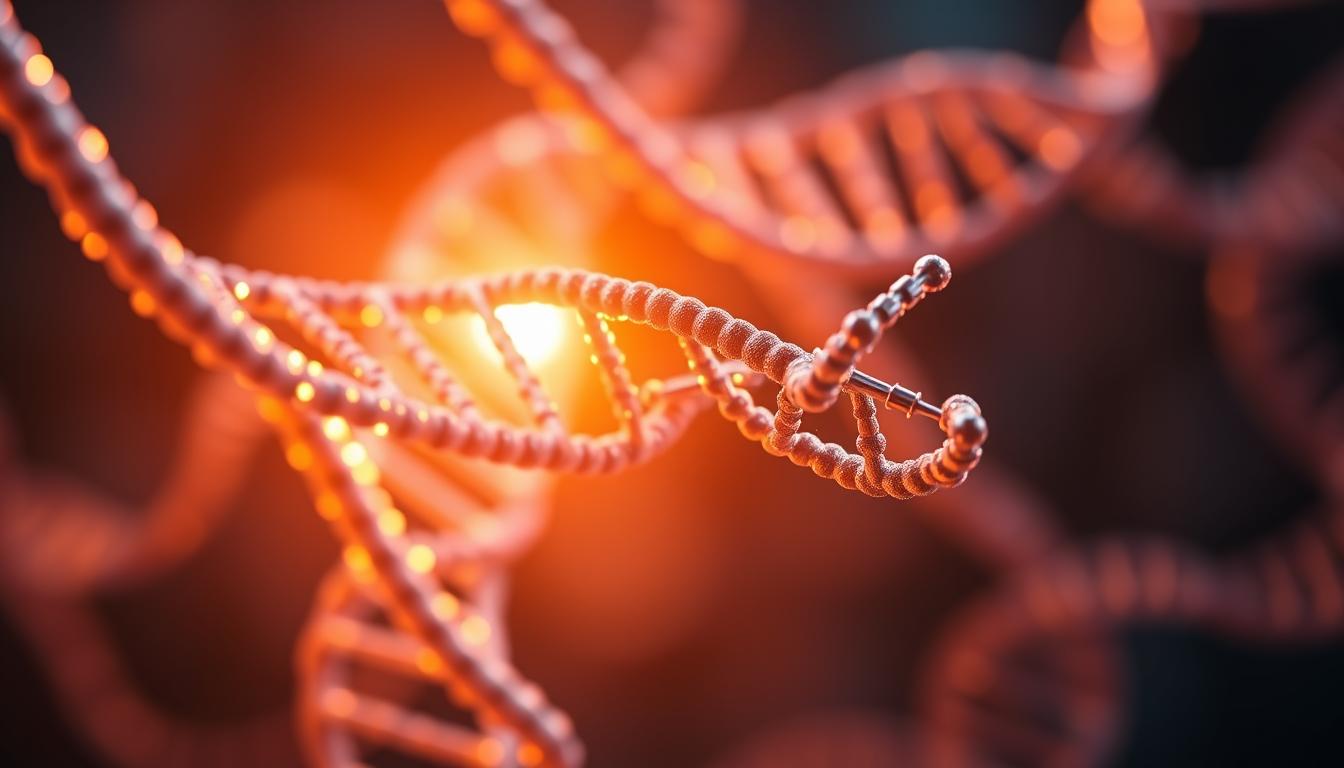
CRISPR technology comes from bacteria’s immune system, now a key tool for DNA changes. It was first used in 2012 to edit genes in humans. Now, it can fix diseases like sickle cell and muscular dystrophy.
In just a few years, CRISPR has changed plants, animals, and even primates. It could fix genetic problems and reduce the need for old methods. But, it also raises big questions about ethics and safety.
CRISPR can edit genes linked to cancer and create disease models in mice. Its possibilities are huge. But, we need to use it wisely. The next parts will look at the challenges and debates around CRISPR.
What is Genome Editing?
Genome editing is a way to make precise changes to DNA. This lets scientists change genes that cause diseases or traits. Before CRISPR, scientists used old tools like zinc finger nucleases (ZFNs) and transcription activator-like effector nucleases (TALENs).
These tools were slow and often took months to use. They had a very low success rate, with only 0.0001% of attempts working.
Think of DNA as a book. Old tools were like trying to edit a sentence by randomly flipping pages. Gene knockouts using ZFNs could only target short sequences. TALENs improved accuracy but were complex.
By 2015, even the best systems had big flaws. ZFNs caused unintended cuts 20% of the time. CRISPR changed this by using RNA guides like a GPS, making edits much faster.
Now, we see genome editing in real life. In 2017, scientists at the University of Edinburgh’s Roslin Institute made pigs resistant to a costly virus. A 2020 trial showed CRISPR safely edited cancer patients’ genes.
Even plants benefit. Japan now sells tomatoes bred via gene editing to boost stress-resistance. But, there are challenges. CRISPR can cause off-target edits, and rules vary worldwide. The NIH bans funding for editing human embryos, sparking ethical debates.
The Science Behind CRISPR
The CRISPR-Cas9 system comes from bacteria’s fight against viruses. Bacteria store virus DNA pieces in their genome. This memory helps them make guide RNA molecules.
These RNA pieces act like a GPS, targeting specific DNA sequences. When they find a match, the Cas9 protein cuts the DNA at that spot.

This method is precise because the guide RNA shows the Cas9 protein where to go. After cutting, cells try to fix the DNA. They can either mess up the gene or add new DNA, a process called homology-directed repair.
Scientists use this to fix genetic problems. For example, the FDA approved a treatment for sickle cell anemia using CRISPR.
“The CRISPR-Cas9 system’s simplicity and efficiency changed how we edit genes.” — Nobel Prize committee, 2020
Jennifer Doudna and Emmanuelle Charpentier’s work was a game-changer. They won the 2020 Nobel Prize for turning this bacterial defense into a gene editing tool. It lets researchers fix any DNA sequence, aiming to cure diseases caused by single-gene flaws.
Applications of Genome Editing
CRISPR is changing healthcare and more. The FDA approved Casgevy, a CRISPR therapy for sickle cell anemia and beta thalassemia. This shows CRISPR’s power in treating genetic diseases.
It edits patients’ blood cells. This is precision medicine in action. Imagine cells fixing DNA like tiny factories.
In cancer, CRISPR makes T cells attack tumors. Early tests look good for leukemia and melanoma. Scientists also use CRISPR to make crops pest-resistant, cutting down pesticide use.
Wheat with CRISPR fights mildew. This could lead to stronger food supplies.
CRISPR helps precision medicine tailor treatments to each person’s genes. For HIV, editing the CCR5 gene blocks the virus. It’s also being used for muscular dystrophy, cystic fibrosis, and inherited blindness.
Though there are challenges, like off-target effects, CRISPR’s uses keep growing. It’s changing what’s possible, editing life’s code one gene at a time.
Ethical Considerations in Genome Editing
Genome editing is advancing, and so are debates in bioethics. The question of whether to cure diseases or enhance traits like intelligence is key. Germline editing, which changes DNA for future generations, is a major concern.
In 2018, Chinese scientist He Jiankui edited embryos to resist HIV. This shocked the world and showed the dangers of unregulated human enhancement. It also showed how it could ignore global safety rules.
Studies show people support using genome editing for health but are wary of making non-essential changes. Yet, risks are real: 16% of CRISPR trials had unintended effects, like chromosome 6 deletions. The DARC gene example shows how editing to block HIV could make future generations more vulnerable to malaria.
Cost is another issue, leading to concerns about fairness. Gene therapy like Lenmeldy, priced at $4.25 million, could widen health gaps. Religious and cultural views also add to the complexity, with some regions like Oceania having unique worries about germline editing’s long-term effects.

Experts say we need to balance innovation with safety. Public input is essential, but current policies often leave out those most affected. Ensuring informed consent and fair access will decide if genome editing helps everyone or creates new inequalities.
Regulatory Landscape in the U.S.
In the U.S., gene editing rules vary across different laws and policies. Agencies like the FDA and NIH manage these rules. The FDA checks all gene therapies as drugs or devices, needing thorough testing for approval.
Clinical trials must follow strict guidelines to ensure safety and work well. This is to protect people from harm.
Therapies like CRISPR for sickle cell disease need to meet FDA standards in clinical trials. But, changing genes in embryos is banned. A 2016 law stops federal funding for such research, following a 1996 rule.
No U.S. trials for changing genes in embryos have been allowed. Congress has also blocked funding for this research.
“Clinical trials for gene editing could be appropriate to avert serious diseases, but only under strict oversight,” concluded a 2017 National Academy of Sciences report.
Most Americans, 70%, support editing genes to prevent inherited diseases. But, federal rules are strict. In 2019, senators called for a global ban on editing genes for heritable traits, showing ethical worries.
The FDA makes sure therapies like Luxturna in 2022 are safe. But, research on changing genes in embryos is banned. The U.S. aims to balance new discoveries with caution to avoid past mistakes in gene therapy trials.
CRISPR in Disease Research
Scientists use CRISPR to create disease models in animals. They edit genes in mice to study diseases like epilepsy and Parkinson’s. This helps them understand how genes cause illness and test treatments.
For example, mice with HCN1 mutations show traits of epilepsy. This lets scientists see how drugs work.

In 2019, Victoria Gray was the first U.S. patient to get CRISPR therapy for sickle cell anemia. They removed her stem cells, fixed the gene, and put them back. This method is now being tested for other blood disorders like β-thalassemia.
Studies show it can improve hemoglobin levels for a long time. This is a big step forward.
CRISPR is also being used for Leber congenital amaurosis, a rare eye disease. Researchers are working on HIV by editing CCR5 genes in stem cells. So far, there are no major side effects after 19 months.
Now, CRISPR is focusing on over 75,000 genetic variants linked to inherited diseases. This includes cystic fibrosis and muscular dystrophy.
But there are challenges. Editing genes can sometimes cause unwanted changes. Finding ways to deliver treatments directly to the body is also a problem. Yet, the FDA approved in vivo trials for inherited blindness in 2019. This gives hope for future successes.
Limitations of Current Genome Editing Technologies
CRISPR safety is a big worry for scientists trying to improve gene editing. Off-target effects, where mistakes are made in DNA, happen in more than half of CRISPR/Cas9 tests. These errors can cause unwanted genetic changes, making it tough to use CRISPR in medicine.
Getting CRISPR into cells is also a problem. Its big size makes it hard to deliver. New tools like CasMINI might help, but many systems struggle to reach cells well. Researchers are looking at viral vectors and lipid nanoparticles, but finding the right balance is hard.
There are more technical hurdles. Mosaicism, where some cells are edited and others aren’t, can mess up treatment results. Also, the body’s immune system might react badly to CRISPR, like in some gene therapy trials. DNA repair pathways are not always precise, adding to the problem.
Studies show off-target effects are a big issue, even with the best systems. While new tools like SpCas9-HF1 help, we need more testing before using CRISPR widely. Finding the right balance between innovation and caution is key to making progress safely.
The Future of CRISPR Technology
Epigenome editing is leading the way in genetic engineering. It allows for controlling gene activity without changing DNA. This could change how we treat diseases like diabetes and Alzheimer’s.
Base editing and prime editing are making DNA changes more precise. They can fix single-letter mutations, like those causing sickle cell disease. This is a big step forward.

Scientists are working on better ways to get CRISPR into cells. Enveloped delivery vehicles (EDVs) could make this process safer and less invasive. They aim to avoid the need for bone marrow procedures.
Stability breakthroughs, like GeoCas9, are also improving CRISPR. This enzyme comes from heat-resistant bacteria. It makes CRISPR work better in different environments, from human cells to crops.
CRISPR could soon help solve big global problems. For example, it could make crops more resistant to climate changes. This could help with food shortages.
Medical breakthroughs are also on the horizon. Scientists are working on using CRISPR to block HIV infection and fix genetic defects in embryos. Even treatments for bacterial infections are being explored.
As CRISPR technology advances, its possibilities grow. These innovations aim to make treatments safer, cheaper, and more accessible. With ongoing improvements, CRISPR could solve problems that were once thought unsolvable.
Public Perception of Genome Editing
People have mixed feelings about genome editing, thanks to the media. Some see it as a breakthrough, while others fear it could lead to bad things. In the U.S., 30% think it’s good for society, but nearly half are unsure.
Misleading news and headlines often get in the way of clear information. This makes it hard for people to understand the science behind it.
Scientists like Sam Sternberg are trying to change this. They use programs like the Taste of Science to talk about CRISPR in simple terms. They want to improve genetic literacy and help people understand the good and bad sides of editing DNA.
But, there are big challenges. Only 16% of Americans really know what germline editing is and what it means.
Religion also affects opinions. People who are very religious are more likely to be against using it, while those who are less religious are more open. Yet, over 80% are worried about it being misused. At the same time, 66% think it could help with health care.
This shows we need to talk about it in a way that respects everyone’s beliefs. A recent survey found 72% support using CRISPR to treat diseases, but only 5% for changing looks. This highlights the need for clear and honest conversations.
Sheila Jasanoff suggests creating a global observatory. It could help create ethical rules that match what people value.
Conclusion: The Path Forward for CRISPR
CRISPR’s future depends on balancing scientific progress with ethical thinking. Advances like fixing genetic defects in animals are promising. But, the ethics of editing genes in future generations need careful thought.
The 2018 Napa meeting brought scientists and ethicists together. They talked about the need for global rules for CRISPR. This could help avoid different rules in different places and ensure everyone follows the same standards.
Scientists must also think about risks and make sure everyone can use CRISPR. Sharing CRISPR tools worldwide, like Feng Zhang’s team did, is a step in the right direction. But, finding ways to deliver big enzymes is a big challenge.
How CRISPR affects society is also key. It’s important to involve patients, policymakers, and communities in decisions. This way, everyone can benefit, not just those who can afford it.
As CRISPR moves forward, we need to work together. Global talks and open discussions will help use it wisely. By focusing on safety, fairness, and teamwork, we can make CRISPR a tool for healing without losing our values.