
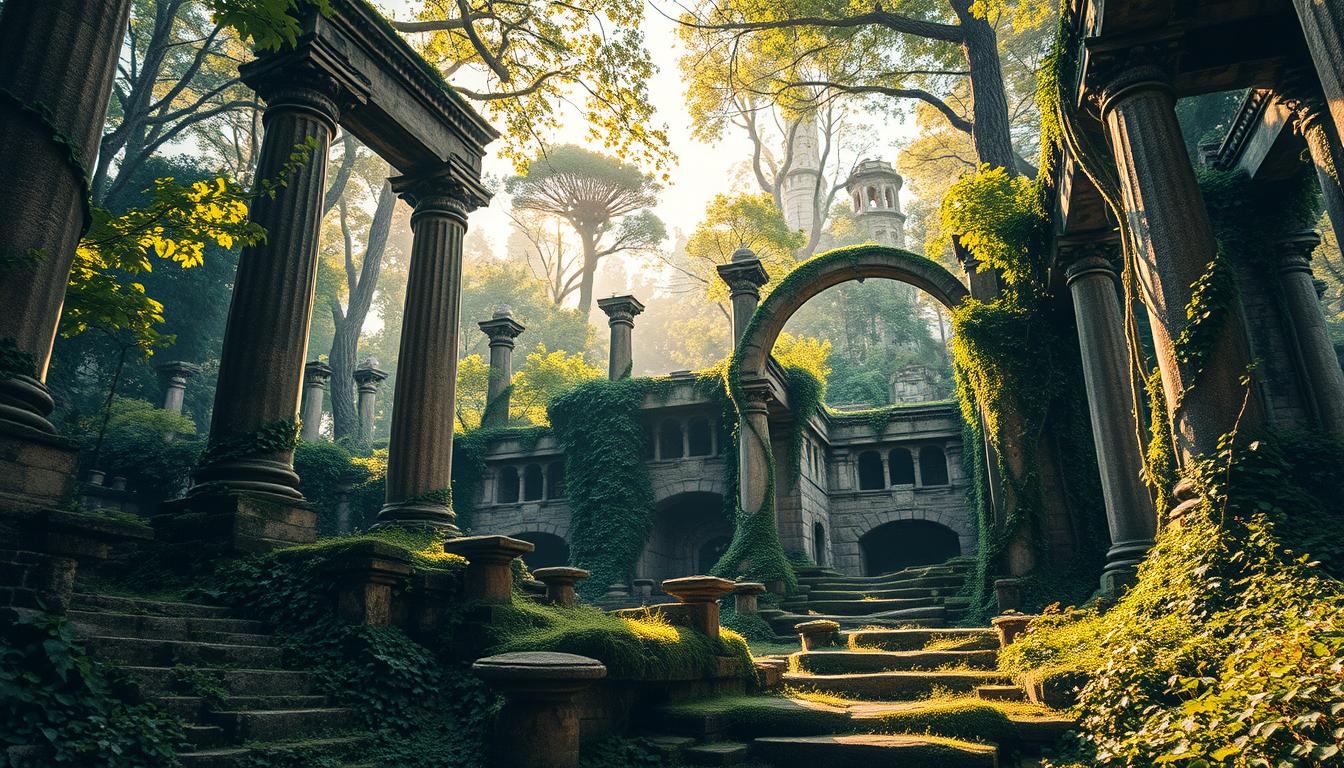
Lost cities were once home to thriving societies that vanished from memory. Archaeologists have found these ancient ruins, sharing stories of forgotten civilizations. Places like Machu Picchu in Peru and Helike in Greece remind us of how history can be buried by time.
Pompeii was hidden by Mount Vesuvius’s eruption in 79 A.D. Carthage was lost to war and abandonment. The discovery of sites like Great Zimbabwe or Angkor gives us glimpses into past engineering, art, and life.
The rediscovery of Machu Picchu in 1911 by Hiram Bingham or Helike in 2001 after sinking in 373 B.C. shows how ancient ruins connect us to the past. Each site, whether an Incan estate, a Greek coastal city, or a Mesopotamian capital, adds to humanity’s shared history.
From the Indus Valley’s Mohenjo-daro to the Maya city Lagunita, these ruins tell of civilizations’ rise and fall. Exploring these forgotten civilizations helps us understand how cultures adapt, thrive, and sometimes disappear, leaving mysteries to be found.
The Allure of Hidden Cities
Lost cities like Atlantis and El Dorado have captured our imaginations for centuries. These historical mysteries of ancient urban centers mix myth and reality. Explorers, from Columbus to today’s archaeologists, have made exploration history a global quest.
They seek to uncover clues about vanished societies. Each find, from Pompeii’s ash-preserved streets to Machu Picchu’s mountain cliffs, helps us understand their archaeological significance.
What draws us to these sites? Their tales blend adventure and science. Over 100 expeditions searched for El Dorado, showing how historical mysteries spark our curiosity.
Today, technology like satellite scans helps find ruins faster. This has increased discovery rates by 50% in recent years. Yet, challenges persist: 66% of Pompeii remains buried, and Cahokia’s earthen mounds in the U.S. Midwest show advanced urban planning.
These sites remind us that ancient cities are more than ruins. They are time capsules waiting to share their stories.
Machu Picchu: The Lost Incan City
Machu Picchu is a wonder of the Incan civilization nestled in the Andes. It sits 7,972 feet high, surrounded by the Urubamba Valley’s peaks. Built around 1450, its purpose is a topic of debate among scholars.

In 1911, explorer Hiram Bingham found the site with local guide Melchor Arteaga. Though Agustín Lizárraga visited before, Bingham’s 1913 National Geographic article made it famous. The site’s stone walls and terraced fields show advanced engineering.
The Intihuatana stone suggests it had a ritual purpose. Why the Spanish missed it? Its remote location and dense cloud forest likely hid it. Today, over 420 bird species live there, and UNESCO named it a World Heritage Site in 1983.
Visitors are amazed by its dry-stone walls and misty views. They wonder if it was a royal retreat or spiritual center. Its origins are a mystery, drawing millions to explore.
Petra: The Rose City of Jordan
Petra, in Jordan’s desert, became the capital of the Nabataean kingdom by the 4th century BCE. Its rock-cut architecture, like the Treasury and Monastery, shows a civilization that turned cliffs into cities. This UNESCO World Heritage Site, covering 264 km², was once a key spot for ancient trade routes.
Today, travelers explore the narrow Siq canyon to find hidden tombs and temples. The Nabataeans’ skill in engineering is seen in their water channels, making the desert land thrive. By the 1st century CE, Petra had 20,000 people, thanks to taxes on goods from ancient trade routes.
Its decline started after the Romans took over in 106 CE. Yet, its grand buildings and Middle Eastern archaeology discoveries, like the 2024 tomb with 12 skeletons, keep its legacy alive.
Even though Petra has been famous worldwide for over 200 years, half of it is yet to be explored. Visitors can feel the magic of a city where Nabataean kingdom innovation turned the desert into a marvel. Whether hiking to cliffside tombs or enjoying the “Petra by Night” tour, its pink cliffs remind us of human creativity—and the secrets hidden beneath the sands.
Angkor Wat: A Khmer Treasure
Angkor Wat is a stunning temple complex at the heart of the ancient Khmer Empire. Built from 1122 to 1150 CE, it covers 402 acres. It stands 65 meters high and is 162.6 hectares in size.
Its Khmer architecture is known for its grand scale and fine details. A 3.6-kilometer outer wall surrounds it. Inside, you’ll find galleries, libraries, and reservoirs.

The bas-reliefs show scenes from Cambodian history, like battles and myths. The site’s Hindu-Buddhist monuments show a shift from Hindu to Buddhist. Statues of Avalokiteshvara, inspired by King Jayavarman VII, are a key part of this.
Advanced water systems and hidden cities were uncovered by LiDAR scans. These discoveries highlight the Khmer’s engineering skills, which were once hidden by the jungle.
Now, Angkor Wat welcomes over 2.5 million visitors each year. This puts a strain on its 800-year-old structures. UNESCO declared it a World Heritage Site in 1992, but 20% of its reliefs are fragile.
The temple’s alignment with celestial events, like the sunrise during equinoxes, shows its spiritual and astronomical importance.
Recycled stones and a 1,150-foot causeway show the Khmer’s resourcefulness. Efforts to preserve it balance tourism’s benefits with the need to protect this piece of Cambodia’s history.
The Ancient City of Pompeii
For nearly 1,700 years, Pompeii was hidden under volcanic ash. The Vesuvius eruption of 79 AD started its story. The volcanic preservation by pumice and ash stopped time, sealing streets and homes.
This Roman archaeology treasure was buried until 1599. That’s when architect Domenico Fontana found ruins during construction.
By the 1700s, excavations showed Pompeii frozen in ancient daily life. Lavish villas and bakeries ovens were found. Graffiti on walls told of a bustling port town.
Over 1,150 body casts revealed victims’ final moments. The eruption’s heat was so high, it instantly killed those who stayed.
“At that time, it was likely a treasure grab,” says Caitie Barrett, a Cornell University archaeologist. Early Bourbon rulers focused on looting statues and mosaics to fund their court, delaying scientific study.
Today, Roman archaeology shows Pompeii’s global connections. Egyptian grain and Greek wine were common. The city had 20,000 people.
Now, 2.5 million visitors see its streets each year. But climate and tourism are a challenge. UNESCO’s 1997 designation helps protect this ancient daily life snapshot. Each layer of ash and pumice tells a new part of history.
The City of Teotihuacan
In central Mexico, Teotihuacan was a thriving city before the Aztecs. Its pyramid complex, with the Pyramid of the Sun and Moon, stands tall. The city was laid out in a grid, showing off advanced ancient urban planning.
It covered 8 square miles and was home to 250,000 people at its peak. This made it one of the biggest cities in history. But, the people who built it left no written records, leaving archaeologists to figure out its start.

The Avenue of the Dead, nearly two miles long, was aligned with the stars. This shows the city’s deep connection to the sky. Underneath, archaeologists found tunnels, mercury, and mass graves.
In 2015, they discovered 75,000 artifacts near the Temple of Quetzalcoatl. These included human remains from sacrifices. The city fell by 750 CE, possibly due to drought and internal fights.
Even though it was abandoned, Teotihuacan’s impact lasted. The Aztecs, who came later, called it the “City of the Gods.” Today, its ruins, a UNESCO site, let visitors see how it shaped Mesoamerican culture.
The Lost City of Z
In 1925, British explorer Percy Fawcett vanished during his Amazon exploration, searching for a fabled city he called “Z.” His aimed to prove the existence of advanced civilizations in regions dismissed as uninhabitable. Fawcett, inspired by and colonial-era accounts like Manuscript 512, believed the Amazon hid ruins of a sophisticated society. His 1920 trip ended abruptly due to disease and harsh conditions, yet he returned years later with his son Jack and friend Raleigh Rimmel. They vanished, sparking over a century of speculation.
Modern has unveiled clues to Fawcett’s obsession. LiDAR scans in 2022 revealed vast settlements in Bolivia’s Llanos de Moxos, including pyramids and causeways. These findings validate his belief in Amazonian urban centers, though diseases brought by Europeans likely caused their collapse. Fawcett’s story lives on in pop culture, including a 2016 film starring Tom Holland. Despite its $30 million budget, the movie grossed $19.3 million globally, yet its themes of obsession and discovery resonated widely.
Today, researchers combine Fawcett’s notes with cutting-edge tech to map lost networks of villages. His tragic quest reminds us that the Amazon’s past is yet to be fully uncovered—a blend of myth, science, and human curiosity.
The Ruins of Tikal: A Maya City
Deep in Guatemala’s rainforests, the jungle ruins of Tikal tell tales of the Maya civilization. This city flourished in the Classic Period Maya era, around 250 CE. It was a major force in trade and politics.
Its pyramids, like Temple IV, reach 213 feet high. They show the engineering skills of the Maya. Over 3,000 structures cover 16 square miles, hidden until the 19th century.
Guatemalan archaeology shows Tikal grew from a small village to a large city. It housed 10,000 people at its peak. Stelae and carvings tell of its rulers and rituals.
By 900 CE, Tikal’s glory had faded. Droughts and wars likely led to its decline. It was forgotten until 1848. Now, LiDAR scans reveal its vast networks, changing our views.

Today, Tikal National Park protects this UNESCO World Heritage Site. It attracts visitors to its ancient plazas. Explorers continue to find secrets, showing Tikal’s lasting legacy.
Chichen Itza: A Mayan Marvel
On Mexico’s Yucatan Peninsula, Chichen Itza is a marvel of Mayan astronomy and architecture. This ancient city is famous for the Kukulkan pyramid. It shows how the builders tracked the stars with great accuracy.
El Castillo’s sides have 92 steps, matching the solar year. During equinoxes, its shadow forms a serpent, like the feathered serpent god Kukulkan.
At the heart of Yucatan archaeology is El Caracol, an ancient observatory. It has windows that point to Venus and the stars. These structures show how astronomy guided daily life and rituals.
The Sacred Cenote, a natural well, held offerings of gold and jade. These offerings were for religious ceremonies tied to the rain god Chaac.
“The pyramid’s design defies chance—it’s a monument to human curiosity about the cosmos.”
Chichen Itza started around 600 CE and became a major trade hub. It had over 100 paved pathways. By 1500, it declined but its legacy lived on.
Today, this UNESCO World Heritage Site attracts millions every year. Its secrets are slowly being uncovered. Ongoing research shows how this ancient city combined science, faith, and art.
Nineveh: The Capital of Assyria
Nineveh, the ancient capital of the Assyrian empire, was a major force in the ancient Near East. It was founded around 6000 BCE and grew into a huge city under rulers like Sennacherib. By 700 BCE, it had massive walls, palaces, and canals that brought water from far away hills.
Today, Mesopotamian archaeology shows us its grandeur. Ashurbanipal’s library had over 20,000 clay tablets. Excavations by Austen Henry Layard found reliefs and statues, giving us a glimpse into this ancient city.
The city fell in 612 BCE, as the Bible’s Book of Nahum tells us. After being buried for centuries, ISIS damaged it in 2015. Now, conservators are working hard to save this important site.
Once the biggest city in the world, Nineveh’s walls were 12 kilometers long. They surrounded palaces like Sennacherib’s, with 80 rooms. Its libraries kept texts like the Epic of Gilgamesh. But after its fall in 612 BCE, only ash layers remain. Now, we’re trying to save this piece of history.
The Ancient City of Carthage
Carthage started as a Phoenician colony in 814 BCE. It grew into a major Punic Wars foe of Rome. Located in Tunisia, it was a key trade center in the Mediterranean.
By 221 BCE, Carthage’s population soared to nearly five million. This was thanks to its thriving olive oil and wine trade. But, its rivalry with Rome led to three Punic Wars. The wars ended in 146 BCE with Rome’s harsh Roman conquest.
Rome’s soldiers destroyed the city, even salting its fields. This act symbolized the end of Carthage’s power.
Today, North African archaeology uncovers Carthage’s rich history. Excavations have found massive 13-meter walls and a harbor complex. Ruins on Byrsa Hill show ancient homes, temples, and a marketplace.
The Romans rebuilt Carthage after its destruction. They turned it into a thriving provincial capital. This new Carthage rivaled Alexandria in size, with wide streets and public baths.
Now, its ruins blend with modern Tunis, a UNESCO site. It tells the story of ancient triumph and tragedy.
Archaeologists keep finding artifacts, from Punic amulets to Roman mosaics. These discoveries show Carthage’s lasting legacy. Walking through its remains, visitors see the rise and echoes of empires.
Lessons from Rediscovered Cities
Modern technology has changed how we see ancient civilizations. LiDAR scans have found 60,000 Maya structures, showing complex city networks. This changes what we know about history, revealing different ways of ruling.
Studies of 20 Mesoamerican cities show that working together led to longer-lasting societies. The Amazon’s earthworks and Teotihuacan’s design show ancient innovation in sustainability and urban planning.
It’s important to protect these sites to keep our cultural heritage safe. Tools like underwater surveys and satellite imagery help uncover hidden sites. Ancient solutions to environmental problems, like firebreaks and water systems, offer lessons for today.
But, rising seas and deforestation threaten these sites. We need to act fast. Innovations like biochar, inspired by Amazonian dark earth, show how ancient wisdom can help modern farming.
Rediscovered cities teach us about resilience and adaptability. By preserving these sites, we honor the past and build a sustainable future. Each site we protect teaches valuable lessons for future generations.