
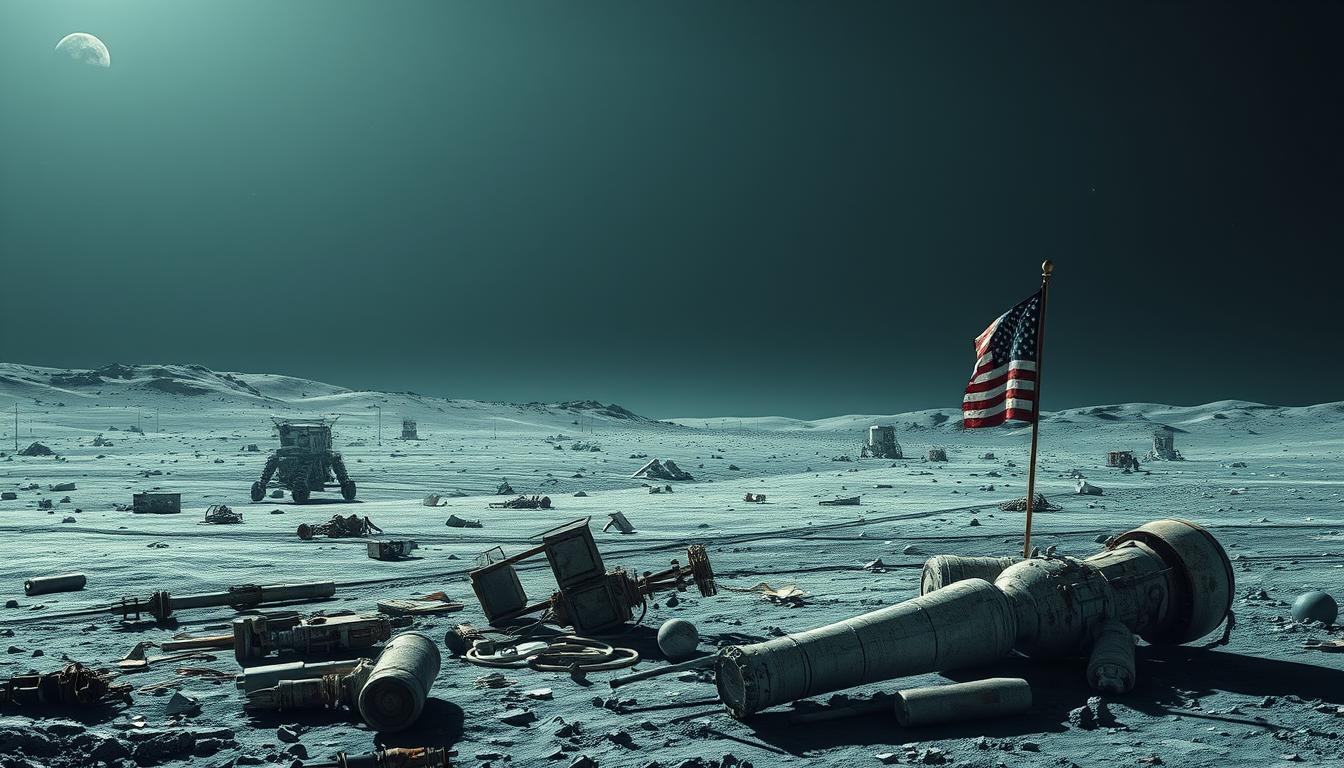
Over 400,000 pounds of items left behind by astronauts now sit on the Moon’s surface. This includes 96 bags of human waste and a tiny ceramic wafer by Andy Warhol. There are also 12 discarded Hasselblad cameras and a communion kit used by Buzz Aldrin on Apollo 11.
Even family photos and golf balls hit by Alan Shepard are left behind. These objects tell a story of humanity’s journey to the Moon.
Astronauts left these items to make room for moon rocks. Apollo 11 left 106 objects, including a silicon disc with messages from 74 nations. Later missions added LEGO figurines and Eugene Shoemaker’s ashes.
This mix of tools and keepsakes turns the Moon into a cosmic junkyard. It also serves as a silent record of humanity’s exploration beyond Earth.
Unusual Artifacts from Historic Moon Missions
Apollo mission items left on the moon include deeply personal memorabilia. During the 1972 Apollo 16 mission, astronaut Charles Duke placed a 3-by-5-inch photo of his family on the lunar surface. The image, now bleached by decades of harsh sunlight, bears a handwritten note: “This is the family of Astronaut Duke from Planet Earth.”
Political memorabilia also exists among moon mission artifacts. A plaque signed by President Richard Nixon during the Apollo 12 mission marks the first and only presidential signature on the moon. Also, a bizarre moon object like the Moon Museum ceramic wafer—smuggled aboard Apollo 12—holds sketches by artists like Andy Warhol, a clandestine tribute to creativity in space.
Scientific tools and oddities mix with these treasures. Alan Shepard’s two golf balls from Apollo 14 symbolize human whimsy, while David Scott’s 1971 feather and hammer experiment tested Galileo’s theories under moon gravity. Even the Fallen Astronaut statue, a 3.3-inch memorial for fallen astronauts, blends emotion with exploration.
These lunar mission memorabilia—from family photos to presidential plaques—reflect humanity’s duality. They’re both relics of adventure and intimate reminders of Earth’s ties to space. Over 400,000 pounds of such items now rest on the moon, each telling a unique story.
The Legacy of Space Boots and Tools
Moon bootprints in the lunar dust are more than just footprints. They are permanent signs of humanity’s first steps off Earth. These moon bootprints are frozen in time, thanks to the lack of wind or water. They remain as silent markers of our journey into space.
The lunar tools left behind tell a story of their own. Hacksaws, scoops, and the famous hammer used for samples are all part of this tale. These tools create a museum of early space exploration, sitting in the same place for decades.

Apollo mission tools, like the plaque on the Apollo 11 landing stage, hold deep meaning. It reads, “Here men from the planet Earth first set foot upon the Moon.” It’s a permanent mark left by humans. Even the moon buggy’s dashboard had a Bible, showing the personal touch of astronauts.
These space equipment on moon artifacts are like time capsules. They give us clues about how materials withstand extreme conditions. Future missions might study them to make better suits or drills for lunar bases.
Alan Bean, the only moonwalker turned artist, used his spacesuit fabric and lunar dust for paintings. His works show that even small Apollo mission tools—like visors and gloves—have stories to tell. The legacy is not just about technology; it’s about the human touch on another world. Every tool and footprint connects past bravery with future exploration.
Monuments and Symbols on the Lunar Surface
Humanity’s journey to the moon left lasting marks beyond footprints. The fallen astronaut statue is a quiet tribute. It was placed by Apollo 15 in 1971.
Belgian artist Paul Van Hoeydonck created this small aluminum figure. A plaque nearby lists 14 names—astronauts and cosmonauts who died in space missions. The statue’s faceless design sparked debate: was it a universal memorial or a political symbol?
Flags on the moon also tell a story. Each Apollo mission planted a U.S. flag using special metal rods. Over 50 years, harsh sunlight bleached the fabric, turning them white.
Five flags remain standing, but Apollo 11’s flag fell during liftoff, leaving only its base. What once waved as national pride now exists as weathered relics.
These lunar memorials mix legacy and mystery. The statue’s abstract form invites reflection, while the faded flags symbolize time’s passage. Together, they show how humanity marks achievements—and remember those who reached for the stars.
Oddity of the Moon’s ‘Golf Balls’
In 1971, astronaut Alan Shepard made the moon a golf course. He attached a golf club head to a tool during the lunar golf game. His two swings sent moon golf balls flying in the moon’s low gravity.
“It went miles and miles,” Shepard said. But NASA later said it was about 200-400 yards. The balls are buried in the dust near Fra Mauro.

“Why not?” Shepard joked about his moon golf. His golfing on the moon stunt is now legendary. It mixed NASA’s science with a bit of fun.
Scientists think the moon golf balls are probably fine. There’s no weather or erosion to damage them. Shepard’s shots could last for centuries.
His stunt even inspired ideas for lunar tourism. But NASA is sticking to science. Shepard’s legacy shows our playful side in space.
The Mystery of Moon Dust
Lunar regolith, the sharp, glassy dust on the moon, has long fascinated scientists. It was first seen when Apollo missions brought moon soil samples to Earth. This dust is made from billions of years of meteorite impacts, creating jagged particles without weathering.
Under a microscope, each grain shows a world of tiny rocks fused into glassy coatings. This happens from explosive collisions.
Astronauts soon learned to fear hazardous moon dust. During Apollo 17, Jack Schmitt’s boot went through three protective layers. The dust stuck to suits, clogged tools, and even floated in the lunar module after missions.
Its electric charge, caused by solar winds, made it cling to surfaces like static cling.
Studies of moon soil samples reveal hidden dangers. Tiny metallic iron specks in the dust could harm lungs if inhaled. NASA’s 2010 safety standards tried to limit exposure, but challenges persist.
Researchers at the 2008 Joint Meeting warned of iron toxicity from prolonged contact. This could complicate long-term stays on the moon.
Now, modern tech like magnetic filters and “dust suckers” tries to solve the problem. Yet, lunar regolith’s quirks, like holding water ice in shadowed craters, keep scientists intrigued. The moon’s dust isn’t just debris; it’s a puzzle with clues to the moon’s origins and our future there.
Strange Junk: Space Trash on the Moon
Astronauts left more than just footprints. Over 96 bags of human waste on moon—including urine, feces, and vomit—sit on the lunar surface. During the Apollo missions, crews chose to bring back moon rocks over trash. So, bags were left behind to save space. These sealed lunar waste packets now add to the moon’s landscape.

Abandoned gear also adds to the moon garbage pile. Twelve Hasselblad cameras, worth over $900,000 when one was auctioned in 2014, were left behind. Astronauts removed film canisters from these cameras. Tools, scientific devices, and even personal hygiene kits became space junk moon, totaling 187,400 kg of debris. Most items, like the 100 $2 bills dropped by Apollo 15, lack exact locations, making them ghostly relics of exploration.
Scientists today see this trash as a time capsule. The human waste on moon could reveal how organic material decays—or doesn’t—in vacuum and radiation. Discarded tech might hint at how equipment weathers lunar extremes. Even trash, it turns out, tells a story.
The Impact of Human Presence
Lunar archaeology now looks at moon landing sites as time capsules of humanity’s first steps beyond Earth. Over 100 spacecraft and 300 hours of human activity have left a lasting mark. Neil Armstrong’s footprints and Apollo 17’s scientific gear are more than relics—they’re part of a fragile record of exploration. Yet, these preserving lunar artifacts face threats from future missions and environmental changes.
Human activity has changed the lunar surface faster than natural processes. Apollo missions accidentally warmed moon landing sites by disturbing light-reflecting regolith. Darkened soil absorbed more sunlight, raising temperatures near landing zones.
Even small actions, like deploying experiments, leave lasting traces. Studies show surface temperatures rose near Apollo 15 and 17 sites after 1971. This proves humans alter the moon’s environment.
As nations like ISRO and China explore the moon, preserving these sites becomes urgent. No laws yet protect them from future landings or resource extraction. Scientists urge cataloging lunar archaeology sites to balance discovery with heritage. The moon’s pristine ancient landscapes now mix with human-made changes—a reminder that every step forward demands thoughtful stewardship.
The Science of Lunar Artifacts
Scientists are now focusing on how to preserve lunar artifacts. The moon’s harsh environment, with radiation and space weathering, changes everything left behind. Dr. George Carruthers’ gold-plated telescope, for example, is surprisingly functional after years. Its gold coating likely protected it from harmful radiation.
But nylon flags and plastic tools have not fared as well. They have faded or cracked due to long-term exposure. This teaches us important lessons for future missions.

Space weathering changes surfaces through tiny meteorites and solar particles. Even Alan Shepard’s golf balls from Apollo 14 are now pitted. Researchers study these items to learn about corrosion and durability.
NASA’s Lunar Reconnaissance Orbiter has taken over 800 photos of Apollo objects. These show how dust builds up and radiation marks surfaces.
Future missions, like Lunar Vertex, will explore magnetic areas like Reiner Gamma. They hope to uncover geological secrets. Apollo’s laser retroreflectors also continue to measure distances between Earth and the Moon.
As Artemis prepares to land again, preserving artifacts becomes more critical. These items are not just trash; they hold valuable data. Protecting them ensures we keep history alive and advance lunar science for future generations.
Public Perception of Moon Items
Humanity’s leftovers on the moon spark debates. They question the cultural value of moon objects and moon artifact ownership. The Moon Museum, a tiny ceramic chip from Apollo 12, is at the center of this. It’s small, just 0.75 inches by 0.5 inches, but holds art by Andy Warhol and others.
Artist Forrest Myers secretly included it. Its existence is a mystery, but it sparks big questions. Who owns art on the moon?
Legal issues are big. The 1967 Outer Space Treaty bans national claims. But space law moon artifacts is unclear. Does it include lunar footprints or flags as lunar heritage sites?
NASA wants to protect Apollo landing zones. But enforcing this is hard. Items like golf balls hit by Alan Shepard or Nixon’s messages on a silicon disc show humanity’s mixed legacy.
The public is both amazed and ironic about these items. Over 400,000 pounds of trash and memorabilia now litter the moon. From urine bags to a tiny sculpture honoring fallen astronauts, it’s a lot.
As private companies plan to visit the moon, debates grow. Should we keep these sites as shared heritage or let new missions erase history? The moon’s surface is more than rocks. It’s a canvas for Earth’s evolving ambitions and ethics.
Future of Moon Missions and Preservation
Future moon missions, like NASA’s Artemis program, are on the horizon. They bring a need to balance exploration with preserving the moon. The debate is about protecting historic sites, like the Apollo 11 landing spot, where U.S. flags remain.
New landers could harm these sites. This has led to calls for creating heritage zones around important areas. This would help keep the Apollo 11 and 12 sites safe.
Sustainable moon exploration is key. It means not damaging the moon with rocket exhaust and dust. Missions must avoid stirring up lunar dust, which can travel far and harm footprints and equipment.
Legal issues, like the 1967 Outer Space Treaty, are unclear. This treaty doesn’t clearly state who owns space resources. The U.S. and UAE are now considering private ownership of space resources. This includes the moon’s water-ice deposits, found in recent Apollo samples.
Preserving Apollo hardware is a global effort. The Artemis program aims to reuse data from past missions. This shows how past discoveries help new science.
But, with lunar tourism and mining coming, debates will grow. The moon’s future is not just about discovery. It’s also about protecting our cosmic legacy as we explore further.