
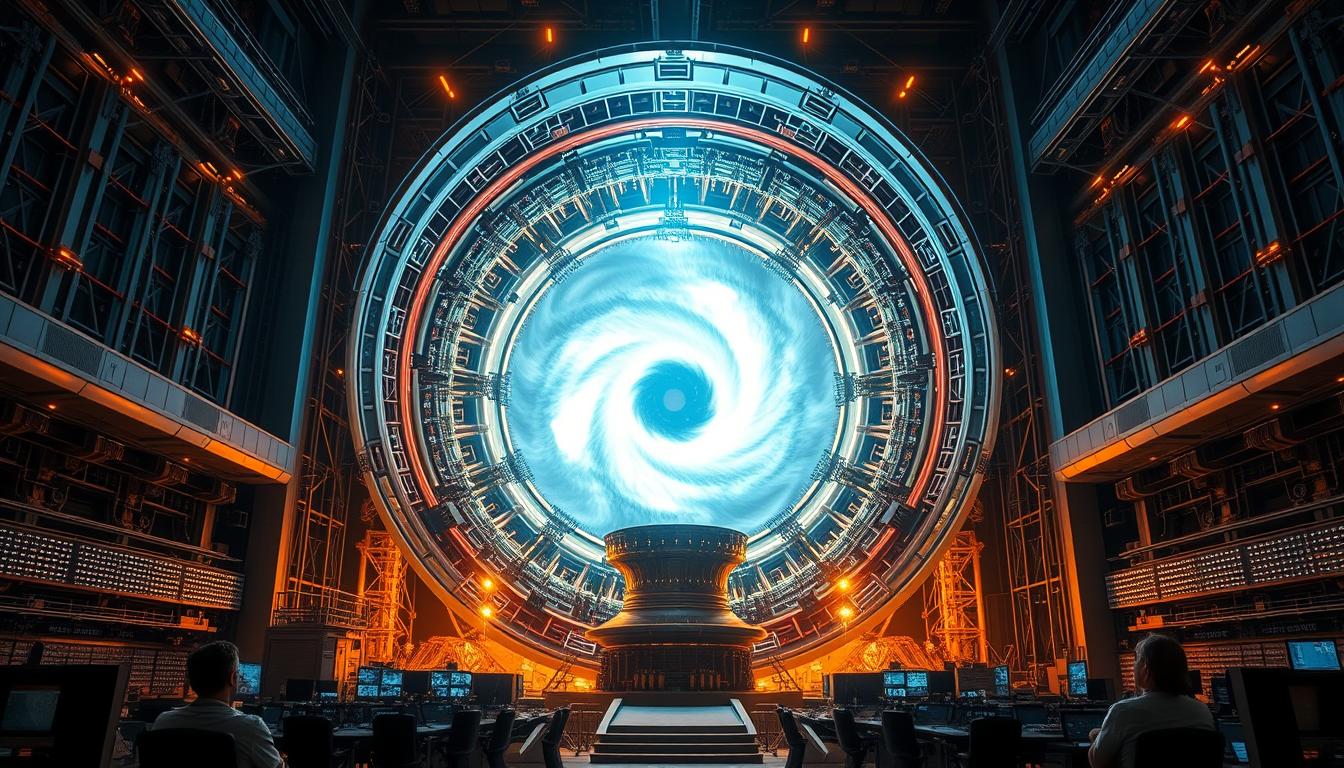
The world is facing a big energy crisis because of our use of fossil fuels. These fuels make climate change worse. Nuclear fusion, which powers the sun, could be a big help. It’s different from today’s nuclear plants because it doesn’t make long-lasting radioactive waste.
Fusion combines light atoms like hydrogen isotopes. It could give us clean energy for cities for many years. This energy comes from seawater and lithium, which are easy to find.
For over 60 years, the U.S. government has supported fusion research. In 2022, a big step was made at the National Ignition Facility. This breakthrough shows fusion could be a real solution.
One truckload of fusion fuel can match the energy of 2 million tons of coal or 10 million oil barrels. The ITER project, costing $22 billion, aims to show fusion works by 2036. Over 50 countries are working together to make fusion reactors ready for use by 2050.
But, there are challenges. Fusion needs to work at 100 million°C and we need to find ways to capture its energy. Despite these problems, scientists are excited about fusion’s promise. It could be a huge step towards a cleaner, more sustainable future.
What is Fusion Energy?
Fusion energy is like the sun’s power. It happens when atomic nuclei fuse under high heat and pressure. This fusion releases a lot of energy.
At its heart, deuterium-tritium fusion uses hydrogen isotopes from water and lithium. Scientists use plasma physics to ignite these fuels. This creates superheated plasma, hotter than the sun’s core.
In 2022, the National Ignition Facility (NIF) hit a big milestone. Their lasers made more energy than they used. This was thanks to deuterium-tritium fusion.
Two millimeter-wide fuel pellets were compressed by 192 lasers. The plasma got as hot as 180 million degrees Fahrenheit. This is like the sun’s core.
Fusion is different from nuclear fission. Fusion doesn’t split atoms and doesn’t make long-lasting radioactive waste. It makes helium and neutrons instead.
Oceans have enough deuterium to power sustainable energy for thousands of years. Tritium is made from lithium, which is easy to find. Fusion’s waste goes away in decades, not millennia.
Companies like Commonwealth Fusion Systems want to make small reactors by 2030. They use new materials to keep plasma hot. ITER in France is working on a big project to show fusion works by 2035.
The Promise of Nuclear Fusion
Nuclear fusion could be a game-changer for fighting climate change. It offers zero-carbon energy from seawater. Deuterium, a hydrogen isotope, is almost endless, cutting down on fossil fuel use and energy conflicts.
This clean energy doesn’t produce greenhouse gases. It also makes less radioactive waste than traditional nuclear plants.

In 2022, the National Ignition Facility (NIF) hit a big milestone. They got fusion ignition, making 3.15 megajoules of energy from 2.05 megajoules of input. This achievement brings the U.S. closer to its goal of net-zero by 2050.
Fusion is safer than traditional nuclear reactors. It doesn’t risk meltdowns, making it a better climate change solution for the world.
Places like the University of Tennessee and Oak Ridge National Laboratory are working hard. They’re improving materials for fusion reactors. The Tennessee Ion Beam Materials Lab (TIBML) is getting new tools to test these materials under tough conditions.
Private investors have put over $6 billion into fusion. The U.S. government is also increasing its funding in 2024. This shows a lot of faith in fusion’s future. Over 150 nuclear companies in the Knoxville-Oak Ridge area are excited for fusion’s growth.
Fusion is not ready for the market yet, but it’s promising. It could work well with wind and solar, providing constant power. As more money goes into it, fusion could change how we get energy in the future.
Current State of Fusion Research
In December 2022, a fusion breakthrough shook the scientific world. The National Ignition Facility (NIF) hit a milestone: it produced more energy from fusion than the lasers that started it. This achievement is a big step toward finding new energy solutions.
“Artificial intelligence is rewriting how we approach plasma instability—a key hurdle for fusion technology,” said researchers Dr. Carolyn Kuranz of the NIF team.
AI is now helping at places like Princeton’s fusion lab. It predicts plasma disruptions before they happen. Also, China’s EAST reactor set a record by holding 70-million-degree plasma for 17 minutes. This helps advance fusion technology.
Compact tokamaks, like Energy Singularity’s quick prototype, aim to make things cheaper and easier to produce. But, there are big challenges ahead. Keeping plasma stable and finding materials that last for decades are major hurdles.
The ITER project, supported by 35 nations, aims to create 500 MW of power by 2035. China is spending almost $1.5 billion a year on fusion, close to the U.S. federal spending of $800 million.
Private investors have put $7 billion into fusion research, with 80% coming from U.S. companies. Despite the challenges, each fusion breakthrough brings us closer to a clean energy future.
Major Fusion Projects Around the World
The ITER project is at the center of fusion efforts worldwide. It’s a $22 billion project in southern France. This tokamak fusion reactor aims to produce 500 MW of power. But, delays and the pandemic have pushed its start back by nearly three years.
Its massive design, with a 23,000-ton weight, is a key part of fusion research. It has a 6.2-meter plasma radius.
But, there are other important projects too. China’s EAST tokamak recently kept plasma at 160 million°C for 1,056 seconds. This is nearly 10 times longer than ITER’s initial goals.
Germany’s Wendelstein 7-X, a stellarator, is exploring new magnetic confinement methods. It shows that designs other than tokamaks also have promise. South Korea’s K-DEMO and the U.S.-led CFETR are also working towards fusion breakeven.
“Fusion’s future hinges on both scale and innovation,” says the ITER Organization. “Every project contributes a piece to the puzzle.”
Private companies like Commonwealth Fusion Systems (SPARC) and General Fusion are also pushing forward. SPARC’s 12.2-tesla tokamak could reach net energy gain by 2030. Startups like TAE Technologies are working on compact fusion reactors for quicker use.
These efforts show a shift from government labs to fast-moving startups. This shift is bringing fusion closer to reality.
Challenges Facing Fusion Energy
Fusion energy has big hurdles in plasma physics and engineering. Keeping plasma at 100 million degrees Celsius in a tokamak or fusion reactor is a major challenge. Even the strongest metals, like tungsten, melt from plasma’s neutron hits.
More than 200 tokamak prototypes have been made. But no material can safely line reactor walls for decades.
Creating fuel sustainably is another big challenge. Tritium, a key fuel, is rare. So, fusion technology must “breed” it using lithium blankets.
Companies like Commonwealth Fusion Systems and TAE Technologies are working hard. But scaling these systems is unproven. Small delays in plasma stability or neutron shielding could push timelines past 2035.
Economic challenges are also huge. ITER has $20 billion, and startups have $6 billion. But building commercial reactors could cost billions more. The public and private sectors must work together on testing facilities and training engineers.
Regulatory frameworks also need improvement. There’s no clear way to license fusion plants yet.
Despite progress, like the 2022 energy gain milestone, scientists say there are gaps. Without better materials and data, fusion’s timeline is uncertain. Yet, each challenge drives innovation, showing the world’s top minds are tackling these obstacles.
Fusion Energy vs. Other Renewable Sources
Fusion energy is a clean alternative to solar and wind. Unlike solar and wind, which depend on sunlight and wind, fusion works day and night. This makes it a reliable source for the future of energy.
It can help renewable energy systems when it’s calm or cloudy. This stability is key to replacing fossil fuels.

Fusion doesn’t have the drawbacks of other systems. It doesn’t produce long-term radioactive waste like nuclear fission. Solar and wind need a lot of land, but fusion reactors can be smaller.
Unlike coal or gas plants, fusion doesn’t emit CO2. It uses hydrogen and lithium fuels, which are easy to find worldwide. This is different from rare earth minerals needed for wind turbines.
“Wind and solar are today’s cost leaders for new clean energy projects,” noted analysts at McKinsey’s 2022 report. Fusion’s role may focus on baseload power, not competing with wind or solar’s affordability.
Current fusion tech, like ITER, aims to reach 500 megawatts by 2035. Commercial plants could start by 2040. Even though it’s expensive now, costs will drop as technology improves.
Using fusion with solar and wind creates a balanced system. It offers renewable energy for peak times and fusion for constant supply. This mix could meet global energy needs while reducing emissions to net-zero.
Future Prospects of Fusion Energy
Fusion power plants won’t replace fossil fuels right away. But experts think they’ll play a big role in the future by the 2050s. Projects like ITER, being built in France, aim to produce 500 MW of energy by the 2040s. This is a big step towards making fusion energy affordable.
“Fusion’s timeline is realistic now—no longer a distant dream,” says a researcher at MIT’s Plasma Science Center. They point to recent achievements, like the National Ignition Facility’s net energy gain in 2022.
“Fusion isn’t a quick fix for the energy crisis, but it’s a climate change solution with unprecedented potential,”
emphasizes a study led by MIT’s Energy Initiative. They think fusion could give 10–50% of global electricity by 2100, if costs go down. Early fusion plants might start in places like the U.S. Southeast, where renewable energy is hard to find.
Building fusion plants is expensive, with ITER costing $5.45 billion. But, making more plants could make each one cheaper by 46% by 2100. Fusion has big advantages, like using sea water for fuel and making very little waste. By 2100, fusion could save $8.7 trillion, helping poor countries get energy.
Fusion won’t stop climate change by itself in the next 10 years. But, it can help make energy grids stable and support renewable energy. The goal now is to build the first commercial fusion plant. This could change how we get energy by mid-century.
Government and Policy Support
The energy crisis calls for quick action, and governments are stepping up. The U.S. Department of Energy (DOE) has pledged $1.4 billion in 2023 for fusion projects. This includes the National Ignition Facility and the ITER collaboration. The goal is to find sustainable energy solutions through fusion research.
In the U.K., the government has made new rules for the STEP project. They’ve skipped traditional nuclear licensing to speed up innovation.

Public-private partnerships are essential. The DOE’s $50 million program got 15 applications, more than expected. The U.S. also gave $760 million to Fusion Energy Sciences in 2023. This aligns with the White House’s aim for net-zero emissions by 2050.
The U.K. has changed its rules to help fusion technology grow. This shows how policy can clear the way for new energy solutions.
Working together across borders is also important. The U.S. is teaming up with Japan and the U.K. to share knowledge. The DOE aims to spend $1.04 billion on fusion research, showing its commitment.
It’s important to balance safety and innovation. Governments must make policies that support progress without losing public trust. With more global investment, the right policies could make fusion a reality. This could solve the energy crisis and lead to sustainable energy systems.
Public Perception of Fusion Energy
A 2023 survey by the University of Oklahoma found most Americans see nuclear fusion as a clean energy breakthrough. They admit they don’t fully understand it. While there’s optimism, confusion with fission energy leads to safety concerns.
Over 70% trust regulators, but skepticism grows when breakthroughs don’t quickly turn into working plants.
Recent milestones, like the 2022 National Ignition Facility experiment, spark interest. Yet, turning these into commercial fusion power plants requires solving technical hurdles, like plasma stability. Open communication about realistic timelines builds trust.
Education matters. Clear explanations of fusion’s benefits—no long-term waste compared to fission—counter misinformation. Balancing optimism with honesty ensures public support for this sustainable energy future. Transparent updates help maintain backing as projects like ITER aim for first plasma in 2034.
How Fusion Could Transform Energy Accessibility
Fusion energy could be a big change for the energy crisis. It uses deuterium from seawater, making sustainable energy available to areas without usual resources. This could bring clean energy to communities everywhere, cutting down on fossil fuel use and helping the shift.

But, there are big challenges. Minerals like lithium and cobalt, needed for reactors, raise ethical questions. Mining these can harm nature and local people. For example, lithium processing in China uses toxic mercury, causing environmental justice worries. We must solve these problems to make sure fusion’s benefits are fair for everyone.
Working together globally is essential. Projects like ITER, with 35 countries involved, show hope. But, we must make sure technology and resources are shared fairly. Developing countries, often left out of energy breakthroughs, need fusion’s help to avoid more inequality. International agreements and sharing tech can help bridge this gap.
As fusion gets closer to reality, we must balance innovation with ethics. With the right planning, it could be a key part of sustainable energy systems. It could provide clean power while respecting our planet and people’s rights all over the world.
Conclusion: Is Fusion the Future of Energy?
Fusion energy is a key part of the future of energy. It faces challenges like needing precise laser alignment. But, progress is clear, with achievements like the National Ignition Facility’s 2022 net energy gain.
Experts say fusion power plants won’t be ready before 2050. This means we must use clean energy like solar and wind now. Fusion is an investment in the future of sustainable energy.
Projects like ITER aim to create sustained plasma by 2025. JET’s 59-megajoule breakthrough shows fusion’s promise. One kilogram of fusion fuel equals the energy of 10 million kilograms of coal.
This efficiency, with zero carbon emissions, makes fusion a future cornerstone. But, it needs funding and collaboration from governments and innovators.
For now, wind and solar must fight climate change. Fusion’s strength is its future promise—a reliable, carbon-free energy source. Decisions today will shape fusion’s role in sustainable energy.
The path to fusion is long, but the reward is worth it. Fusion’s future is not just a dream; it’s a goal for generations to come.