
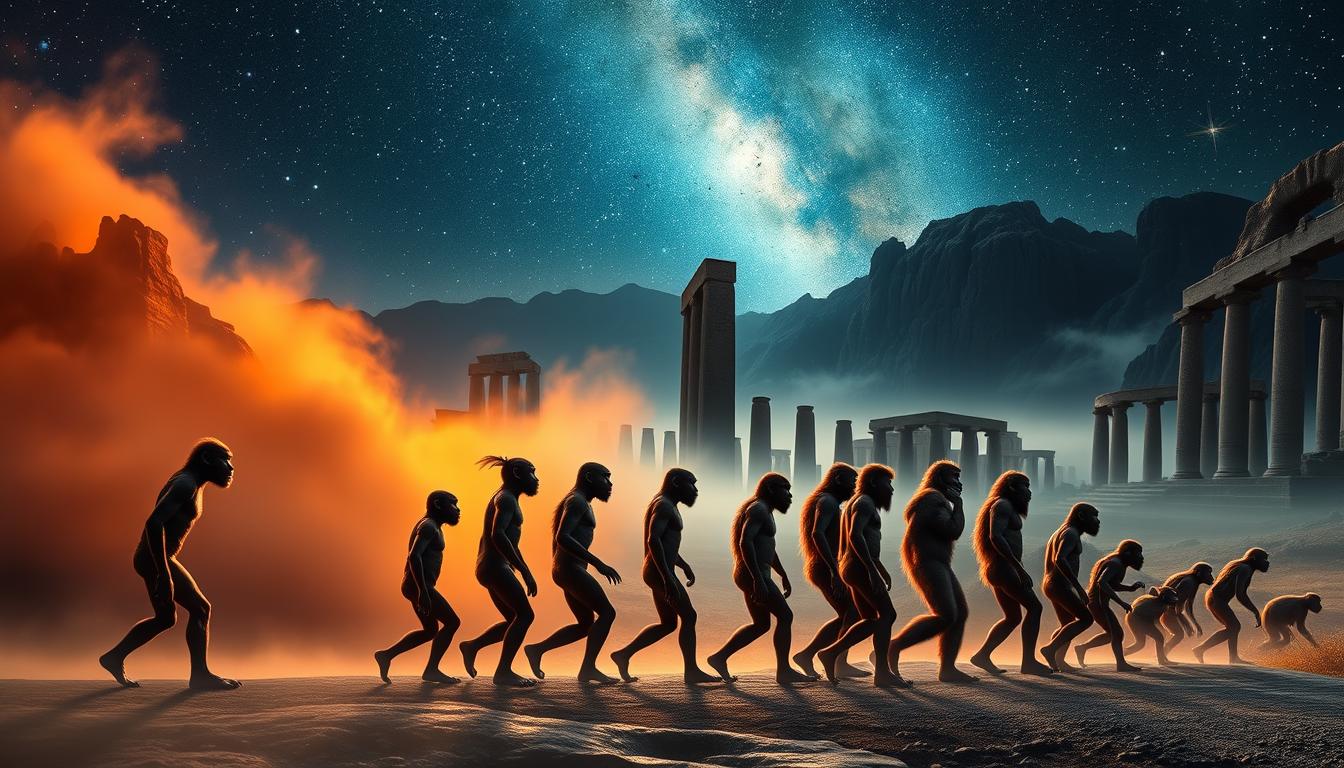
Recent discoveries are changing how we see our origins. Finds like a 700,000-year-old Homo floresiensis limb bone from Indonesia show our ancestors were adaptable. A 160,000-year human presence on the Tibetan Plateau also shows resilience.
Other breakthroughs include a 75,000-year-old Neanderthal skull reconstruction. There’s also a 250,000-year genetic map showing interbreeding between Neanderthals, Denisovans, and modern humans.
Discoveries like a 130,000- to 160,000-year-old Denisovan molar in Laos are exciting. A 50,000-year-old French site also pushes back when modern humans arrived. These finds show our ancestors were smarter and more complex than we thought.
From Neanderthal adhesives to ancient beer in Egypt, these discoveries are eye-opening. Each new finding, like surgical amputations 31,000 years ago, changes how we see our place in nature’s story.
New Fossil Finds Transforming Our View of Ancestors
Recent ancient human fossils from Asia and Africa are changing our understanding of human origins. In China’s Hualongdong cave, scientists found 11 new hominin species remains in 2024. They discovered a rare foot metatarsal over 300,000 years old.
This bone tells us about how these early humans walked and their height. Over 20 fossils found in the last decade show a mix of modern and ancient traits. They reveal East Asia’s role in the evolution of Homo sapiens.
Excavations in Sicily’s underwater caves and Indonesia’s jungles also challenge old theories. The paleoanthropology findings from Flores Island include a tiny 700,000-year-old arm bone. This hints at Homo floresiensis—a species once thought to be a myth.
Re-examined Sahelanthropus tchadensis fossils from Chad, dating to 7 million years ago, suggest an earlier human-ape divergence than believed.
At Hualongdong, stone tools and animal bones show sophisticated survival strategies. The 2015 discovery of a 13-year-old girl’s skull, found alongside 400 artifacts, highlights advanced social behaviors. These ancient human fossils now place Asia at the center of humanity’s evolutionary journey, alongside Africa.
As researchers like Louise Leakey’s team continue uncovering traces of footsteps and tools, the puzzle of where we came from grows clearer—and bigger.
Ancient DNA Revelations
Advances in paleogenetics have changed how we see human origins. Nobel laureate Svante Pääbo uncovered the Neanderthal DNA, showing Homo sapiens and extinct cousins interbred. A key study compared 2,000 living humans’ genomes with those of three Neanderthals and a Denisovan. It showed early humans shared genes many times, challenging old views.

The Denisovan genome was found in a small finger bone, but its impact is huge. People in Southeast Asia, Papua, and the Philippines have up to 5% Denisovan DNA. This proves they mixed with modern humans a long time ago.
Studies of 30 olfactory genes in ancient DNA suggest Neanderthals had fewer smell receptors than Denisovans. This hints at possible sensory differences. The Allen Ancient DNA Resource now has over 10,000 genomes. It has found genetic links among Bronze Age steppe populations like the Yamnaya.
These findings from ancient human genetics show our family tree is complex. It’s not a simple line, but a web of exchanges. Each new discovery helps us understand how DNA influenced survival, migration, and our species’ diversity.
Tools of the Trade: Key Archaeological Advances
Modern archaeological techniques uncover stories hidden for ages. High-tech artifact analysis lets scientists study tiny residues on tools. This shows early humans processed plants and meat in ways we didn’t know before.
For example, dating methods like obsidian sourcing show tools from Kenya’s Olorgesailie Basin came from volcanic rocks 95 kilometers away. This proves ancient trade networks existed. These discoveries change how we see migration and innovation.
Advanced excavation technology changes fieldwork. 3D scans map sites quickly, showing details like tool wear or sediment layers. At the Olorgesailie Basin, these scans show how early humans adapted to changing landscapes.
They moved from handaxes to finer blades as grasslands grew. Chemical tests on 28,000-year-old bone harpoons and 100,000-year-old Moroccan beads confirm symbolic behavior earlier than thought.
Climate clues are important too. Sediment cores reveal the basin changed from wetlands to dry grassland 800,000 years ago. This change is linked to tool innovation. By using drones and AI, teams fill in timeline gaps, like the 200,000-year overlap between Neanderthals and modern humans in some areas.
Insights from Behavioral Studies
Old views of prehistoric human behavior saw ancient societies as strictly divided by gender. But new studies show this isn’t true. In 80% of studied foraging groups, women hunted using tools like atlatls, debunking the “Man the Hunter” myth.
Burials in Viking Denmark and Bronze Age Iberia reveal women leading communities. This changes our understanding of prehistoric gender roles and ancient social structures. It suggests equality was part of human societies much earlier than we thought.

Studies of chimpanzees using crushed leaves as medicine show ancient caregiving practices. This shows that cognitive evolution is older than we thought. It suggests that traits like altruism and innovation aren’t just human.
Even burial sites 100,000 years old show complex rituals. This means complex social systems existed long before modern times.
These findings change how we see survival strategies. When women co-led hunts and made decisions together, it built strong networks. By studying these patterns, scientists uncover the roots of shared knowledge and empathy in today’s societies.
The Role of Climate Change in Evolution
Climate and human evolution are closely linked. Early humans had to adapt to survive due to prehistoric climate change. The Denisovans, for example, lived on the Tibetan Plateau 200,000 years ago. They adapted to extreme cold, making places once thought uninhabitable, habitable.
During the Pleistocene, rising arid conditions forced hominins to innovate. The Oldowan tool industry started 2.6 million years ago as a response to scarce resources. Fire use, which began around one million years ago, helped them survive in changing climates.
Even burial practices at Shanidar Cave show how climate stress influenced social behaviors. This shows how climate change shaped human evolution.
Today, scientists are working to understand how climate change affected early humans. The Olorgesailie Drilling Project in Kenya is uncovering how early humans adapted to environmental changes. Genetic studies also link skin color variation to UV changes over 200,000 years.
Yet, 40% of hominin sites lack detailed climate data. This calls for global drilling programs to fill these gaps. Understanding these patterns is important today. It teaches us about adapting to current climate challenges.
Evolving Standards in Dating Techniques
Accurate fossil dating methods are changing how we see human origins. The Liujiang skeleton was once thought to be 67,000 years old. But new dating technique advancements show it’s actually 159,000 years old. This shows how science updates our evolutionary timeline.

Now, radiocarbon dating, uranium series, and optically stimulated luminescence work together. They help confirm ages. For example, the Sterkfontein caves in South Africa showed Australopithecus fossils are 3.4–3.7 million years old, not older.
Techniques like electron spin resonance can date teeth and shells. Molecular clocks track genetic changes over time. These tools help bridge the gap between old ideas and new findings. They show Homo erectus left Africa earlier than we thought, changing migration theories.
Every new date adds to our understanding of humanity. By using fossil dating methods and global data, researchers create a clearer archaeological chronology. These dating technique advancements keep our evolutionary timeline up to date with new discoveries.
Genetic Engineering and Human Evolution
Breakthroughs in evolutionary genetics show how old DNA adaptations affect our health today. For example, the CD33 gene helps us fight brain diseases like dementia, a trait Neanderthals lacked. This discovery shows how human genetic adaptation over time could lead to new treatments in evolutionary medicine. But, editing genes to mimic these traits raises big genetic engineering ethics questions.
Recent studies have mapped Human Accelerated Regions (HARs), showing 90% of them control brain development genes. For instance, the SSTR2 gene, linked to schizophrenia, acts differently in humans than in chimps. Another gene, EVC2, influences facial differences between species, with lower human activity linked to 23 distinct features. These findings come from 3D genome studies comparing stem cells from both species.
Such research shows how past adaptations, like CD33’s fight against infections, could inspire new treatments. But, changing genes to enhance traits could have unintended effects. Scientists call for careful study before applying genetic fixes. NIH-funded work also shows how changes in cis-regulatory elements, not just genes, make humans unique.
Understanding these pathways could lead to cures for brain disorders while respecting the ethics of rewriting evolution’s blueprint. This mix of ancient DNA clues and modern technology opens new doors. But it also reminds us to learn from biology’s slow, precise process.
New Perspectives on Human Migration
Recent migration pattern discoveries are changing how we see ancient human migration. No longer just a simple “out of Africa” story, we now see a complex network of paths. The Persian Plateau, for example, was a key human geographic dispersal spot, connecting Africa to Eurasia.
Underwater caves in Sicily, made accessible by new diving technology, have revealed tools and fossils. These show that coastal routes were important. This new information shows that prehistoric population movements were much more complex than we thought.

Modern studies of tiny volcanic particles, called cryptotephra layers, have helped Arizona State University’s STEP Lab pinpoint timelines. In Sicily, 74,000-year-old tools show early humans adapted to tough climates. Genetic data from 44 Nama individuals also shows a 120,000-year-old split, suggesting long-term mixing between groups.
These findings paint a picture of survival strategies. For example, early humans might have shifted to fishing during dry times or used rivers for migration. This shows how they adapted to their environments.
Ice Age models now help us understand how climate changes pushed ancient human migration waves. The Toba super-eruption 74,000 years ago forced humans to adapt, yet they survived. By studying genetic diversity in modern groups, scientists can see how environmental pressures and social networks shaped global dispersal.
These insights connect us to our ancestors who braved deserts, seas, and ice. Their journey is etched in stone, DNA, and ash.
Unveiling Homo naledi
The Homo naledi discoveries in South Africa’s Rising Star cave system have changed how we think about human origins. Over 1,500 fossils found there show a species with a brain as small as 460 cm³. Yet, it had human-like hands and feet.
These Rising Star cave findings challenge the idea that brain size equals intelligence. They found these fossils deep in the Dinaledi Chamber.
There’s a big debate about whether H. naledi was intentionally buried in the cave. Some say its small brain couldn’t handle such complex actions. Others see its long legs and bone markings as signs of advanced behavior.
This debate shows how much we don’t know about primitive hominin behavior. It makes us question how our ancestors evolved.
Scientists believe the fossils are between 236,000 and 335,000 years old. This time frame overlaps with early Homo sapiens. The mix of primitive teeth and advanced body structure suggests evolution took many paths.
As studies go on, these fossils keep changing our understanding of who we were.
The Intersection of Technology and Evolution Studies
Modern evolutionary research technology is changing how we learn about our past. Tools like protein analysis in ancient teeth have already changed our views. For example, they showed a 4,000-year-old Iberian leader was a woman, which was a surprise.
This new approach combines lab work with data science. It makes discoveries that were once thought impossible. This is a big change in how we study our history.
Computational studies now create detailed models of ancient migrations and genetic interactions. These models help turn theories into real tests. They also help in healthcare by finding cancers early and creating personalized treatments.
This shows how technology is changing anthropology. It uses algorithms to analyze genetic data from big studies like the DiscovEHR project. This project looked at 50,726 genomes to understand disease origins.
Virtual reality lets researchers explore ancient sites as if they were there. AI also helps understand stone tools and how they relate to our brain development. The use of proteins and DNA has changed how we study old tools.
AI is becoming more common, with 16% of Americans using smart speakers. This shows how technology is becoming a big part of our lives. It could change many industries, from healthcare to transportation.
By 2030, AI is expected to improve diagnostics and infrastructure. It will also change jobs. But, this revolution is like our history—humans have always used tools to survive.
Today’s computational evolution studies and genetic tools are part of our story. As technology grows, so does our understanding of being human.