
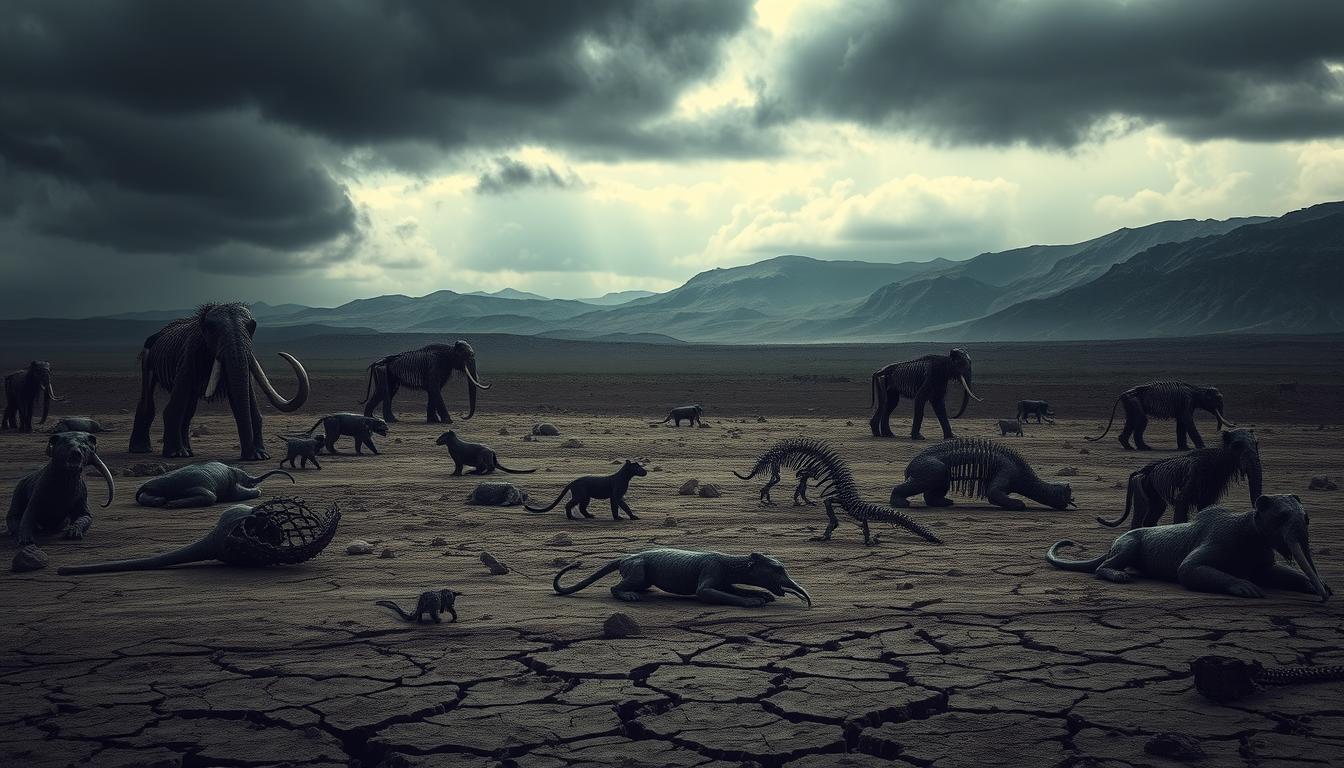
Imagine a world where mammoths roamed freely and giant sloths towered over forests. The Pleistocene extinction wiped out over 178 species of large mammals heavier than 44 kilograms. This event reshaped ecosystems worldwide.
Africa lost only 21% of its megafauna, while Australia lost 88% and North America 72%. The extinction pattern shows a clear bias toward giants. 78.8% of mammals over 1,000 kg vanished globally, while smaller species survived.
The European cave lion disappeared 14,000 years ago, and the American mastodon went extinct 10,000 years ago. This timeline aligns with human expansion. Australia’s large animal disappearance began 50,000 years ago, coinciding with early human arrival.
North America’s 70% large mammal loss around 13,000 years ago overlaps with Clovis culture migration. Climate shifts also played a role—warmer temperatures turned forests into deserts. Yet, human-driven fires and hunting intensified pressure.
Recent studies at La Brea Tar Pits reveal extinction peaks 13,000 years ago, predating the Younger Dryas cold snap. Fossil dates and pollen records show tree cover collapse and human-linked fires rising alongside megafauna decline. With 65% of global megafauna gone by 8,000 BCE, scientists debate whether Pleistocene extinction was driven by human hunters, climate chaos, or both.
This mystery holds clues to modern conservation challenges—teaching us how human actions shape ecosystems across millennia.
Overview of Megafauna Extinction
The megafauna definition includes species over 44 kg. The biggest, like mammoths and giant sloths, were at the highest risk. Their loss changed Earth’s ecosystems, which scientists study today.
The extinction timeline shows big differences by region. Australia lost its big animals 50,000 years ago. The Americas saw big losses around 13,000 years ago. This matches when humans first arrived.

In North America, 32 genera went extinct in 2,000 years. This is the fastest rate anywhere. Eurasia’s extinctions took much longer, unlike the Americas.
The Holocene extinction saw 100 genera disappear worldwide. Australia lost 88% of its big mammals. This shows how size made animals more vulnerable.
Scientists think humans might have caused some of the extinctions in the Americas. But climate changes also played a part. Figuring out how these factors worked together is a big challenge.
Learning about these extinctions helps us today. It shows how size and where animals live affect their survival.
Historical Context of Megafauna
The Pleistocene epoch lasted from 2.6 million to 11,700 years ago. During this time, Ice Age animals like woolly mammoths and cave lions roamed the Earth. These animals thrived in prehistoric ecosystems shaped by glacial cycles.
Examples of megafauna evolution include the woolly rhinoceros and dire wolves. In Spain’s northern regions, herds of wild horses and reindeer roamed. This was depicted in Mauricio Antón’s reconstructions. North America’s La Brea Tar Pits, immortalized in Charles R. Knight’s murals, preserved remnants of this lost world.

These animals were more than just large creatures. They were ecosystem architects. Mammoths’ grazing prevented forests from overtaking grasslands, while ground sloths spread seeds across continents.
Their disappearance left irreversible gaps. Studies show over 80% of mammals over 2,200 lbs vanished by 11,700 years ago. Fire-adapted plants like chaparral and pine forests replaced open landscapes as megafauna vanished, altering prehistoric ecosystems forever.
Recent research funded by the National Science Foundation analyzed 169 fossil specimens. It revealed how Pleistocene environments collapsed. Human expansion and climate shifts disrupted delicate balances.
The sabertooth cats and glyptodonts armadillos, once thriving in these ecosystems, now exist only in fossils. Their legacy reveals how megafauna evolution and prehistoric ecosystems were intertwined—a lesson in Earth’s fragile biodiversity.
Human Impact on Megafauna
The overkill theory says human hunting greatly reduced megafauna numbers. Early humans moving around the world often led to mass extinctions. Paul Martin’s work showed how prehistoric human migration brought human hunting impact to new places, overwhelming species not used to humans.
Tools like spear points and butchering marks found worldwide prove early human tools were used to hunt big animals like mammoths and giant sloths.
Island megafauna often lasted longer than those on the mainland. Woolly mammoths on Wrangel Island survived until 1650 BCE—6,000 years after they disappeared on the mainland—until humans arrived. This delay supports the idea that human arrival directly caused their decline. Caribbean ground sloths also survived until humans reached those islands.
Studies show big losses: Australia lost 88% of its megafauna after humans arrived 44,000 years ago. North America saw 72% losses as humans spread 15,000 years ago. Some argue small human populations couldn’t cause such extinctions. But slow-reproducing species were vulnerable even to modest hunting pressure.
These findings show how human actions changed ecosystems. Early tools and migration patterns left a lasting impact on Earth’s largest animals. They altered landscapes and food webs for thousands of years.
Climate Change and Its Role
prehistoric climate change was key in shaping Earth’s largest animals’ fate. When the Ice Age warming sped up 15,000 years ago, landscapes changed a lot. Forests took over tundra, and rivers made new paths, changing the homes of big animals.
The Younger Dryas, a sudden cold snap 12,900 years ago, was once thought to cause extinctions. But, La Brea Tar Pits show species went extinct before this cold event. This timing challenges theories that blame the cold event or a meteor strike for their disappearance.

As the Ice Age warmed, habitats shrunk due to droughts and changing plants. In California, juniper woodlands turned into drought-tolerant shrubs. This left mammoths and other big animals with less food and made it harder for them to survive.
Studies found that as the planet warmed, oxygen levels in water dropped, stressing marine life. The NGRIP δ18O record shows a link between climate changes and population drops. This points to climate as a major reason for their decline.
Recent studies show a 0.1% annual drop in big animal numbers, matching aridification trends. By 10,000 years ago, 80% of North America’s big animals were gone, during a time of long droughts. While humans arrived then, models show they didn’t significantly affect animal numbers. Climate changes, not hunting, were the main cause. Today’s warming planet reminds us of the vulnerability of ecosystems to fast environmental changes.
Competition with Other Species
Ecological niches faced pressure as megafauna competitors vied for survival. When resources became scarce, species competition reshaped ancient ecosystems. Studies show that rising temperatures forced plants and animals into smaller habitats, squeezing populations into overlapping ranges.
In North America, mastodons and early bison shared woodlands. This pushed both toward extinction as forests shrank.

Predators like the American lion and dire wolf faced intense competition. Fossil records from California’s La Brea Tar Pits reveal increased tooth fractures in carnivores. This signals desperate feeding on scarce prey.
Megafauna needing vast territories struggled as human hunters altered landscapes. Humans burned forests to create open spaces. These spaces favored smaller, adaptable species.
Australia’s 88% megafauna loss correlates with human arrival 50,000 years ago. Early humans hunted giant kangaroos and modified habitats. In South America, ground sloths vanished as jaguars and humans competed for food.
Ecological niches once occupied by mammoths were taken over by bison. This shows how adaptable species outlasted giants.
Resource scarcity hit large herbivores hardest. Their specialized diets left no room for adaptation when plants vanished. Today’s data reveals 78% of giant species perished globally, while smaller mammals survived.
This pattern hints that competition’s impact depended on how quickly species could shift their ecological roles.
Disease and Its Effects
Could prehistoric disease have wiped out ancient giants? The hyperdisease theory suggests that megafauna pathogens spread fast when humans moved around the world. Think of a world where unknown extinction diseases hit animals with no defense.
Mammoths on Wrangel Island survived until 4,000 years ago. But, being isolated might have left them vulnerable to new sicknesses.
Today, we see similar effects. The Tasmanian devil facial tumor and amphibian chytrid fungus have devastated populations. Between 1840–1920, over 50 disease outbreaks hit Australian mammals.
Only 31 of 833 extinctions in the 2004 IUCN Red List were due to disease. But, this might be just the tip of the iceberg. Megafauna’s slow growth made recovery almost impossible.
Critics say fossil evidence is lacking. Yet, statistical clues point to disease’s role. The 2006 Red List listed 54 mammals threatened by disease. Small pathogens like mange parasites led to 11 Australian mammal extinctions.
The hyperdisease theory gets stronger when climate stress is added. Warmer temperatures let disease-carrying insects spread. Think of avian malaria wiping out Hawaiian birds or trypanosomiasis killing Christmas Island’s rats.
Disease alone might not have caused all extinctions. But, it likely pushed stressed populations over the edge. This left us with today’s biodiversity crises.
Evidence from Fossils
Megafauna fossils buried for millennia now reveal clues about ancient extinctions. Recent studies at the La Brea Tar Pits uncovered radiocarbon dating breakthroughs. They found 170 new dates showing key species vanished 13,000 years ago—before a sudden cold snap. These megafauna fossils of saber-toothed cats and dire wolves confirm sudden population declines.
In Australia’s South Walker Creek site, paleontological findings expose a 40,000-year timeline. Fossils of a 2.5-meter-tall kangaroo and the 6-meter Megalania lizard show these giants persisted longer than thought. Excavations backed by the Queensland Museum and BHP uncovered 16 species, including extinct crocodiles and the marsupial lion. These extinction evidence layers clarify how human activity overlapped with survival.
Blood residue on Paleoindian tools from North Carolina revealed proteins from mammoths and mastodons. This paleontological findings shows humans hunted these species until their final years, with horses surviving longer than others. Such discoveries challenge earlier assumptions about extinction timing, proving human interaction played a direct role.
Despite advances, dating remains tricky. Older fossils beyond 50,000 years require new methods like isotope analysis. Yet, DNA from permafrost-preserved remains and cave dung offers fresh insights. These clues, paired with global sites like Siberian ice caves, build a clearer picture of why these giants vanished.
Conservation Lessons from Megafauna Extinction
Learning from the loss of giants like mammoths and ground sloths shows us how ecosystems change over time. Today, megafauna conservation aims to restore the balance these animals once kept. Without them, forests, soils, and climates can change forever.
“Studying past extinctions shows how human choices today echo ancient mistakes,” says Dr. Emily Lindsey of La Brea Tar Pits. “These fossils aren’t just history—they’re roadmaps for survival.”
Now, more than 60% of large carnivores are at risk of extinction. In Southeast Asia, places like Singapore have lost 85% of their megafauna. But areas like Khao Yai, with less human activity, have kept species like tapirs.
Tigers and rhinos are disappearing quickly in areas broken up by humans. This is similar to what happened in the Pleistocene era. Wild boars now fill areas once home to extinct giants like Smilodon.
But there’s hope. Bringing back elephants to North America’s prairies could help restore ecosystems. Protecting genetic diversity and habitats, like those of tapirs and sun bears, could slow down biodiversity loss.
Ignoring these lessons could lead to the decline of Earth’s largest mammals. As mammals shrink, conservation efforts must act fast. By learning from the past, we can protect not just species, but the entire ecosystem.
Future of Large Animals
Modern megafauna are racing against time due to the climate crisis. Studies show that current warming could lead to mass die-offs like in the Permian extinction. Texas fossils reveal how past extinctions changed ecosystems, leaving empty spaces for new species.
Today, threats like habitat loss, poaching, and climate changes are faster than ever. Conservation efforts offer hope. Rhinos, for example, have grown from 40 to over 4,000, showing that saving species is possible.
Protected areas and technology, like satellite tracking, help species like elephants and wolves. Yet, elephants take decades to reproduce, making recovery slow. Over 60% of big animals are endangered, similar to the Pleistocene era.
Scientists urge us to act fast. The Permian study warns of 20% to 50% warming by 2300 if we don’t act soon. Community-led programs, like in India, show the power of local involvement. Global agreements like CITES help, but we need to protect more habitats.
Dr. Emily Lindsey warns, “We know the threats. The tools exist. But time is slipping away.” We must scale up conservation efforts to fight the climate crisis. Saving modern megafauna is key to keeping ecosystems stable for the next century.