
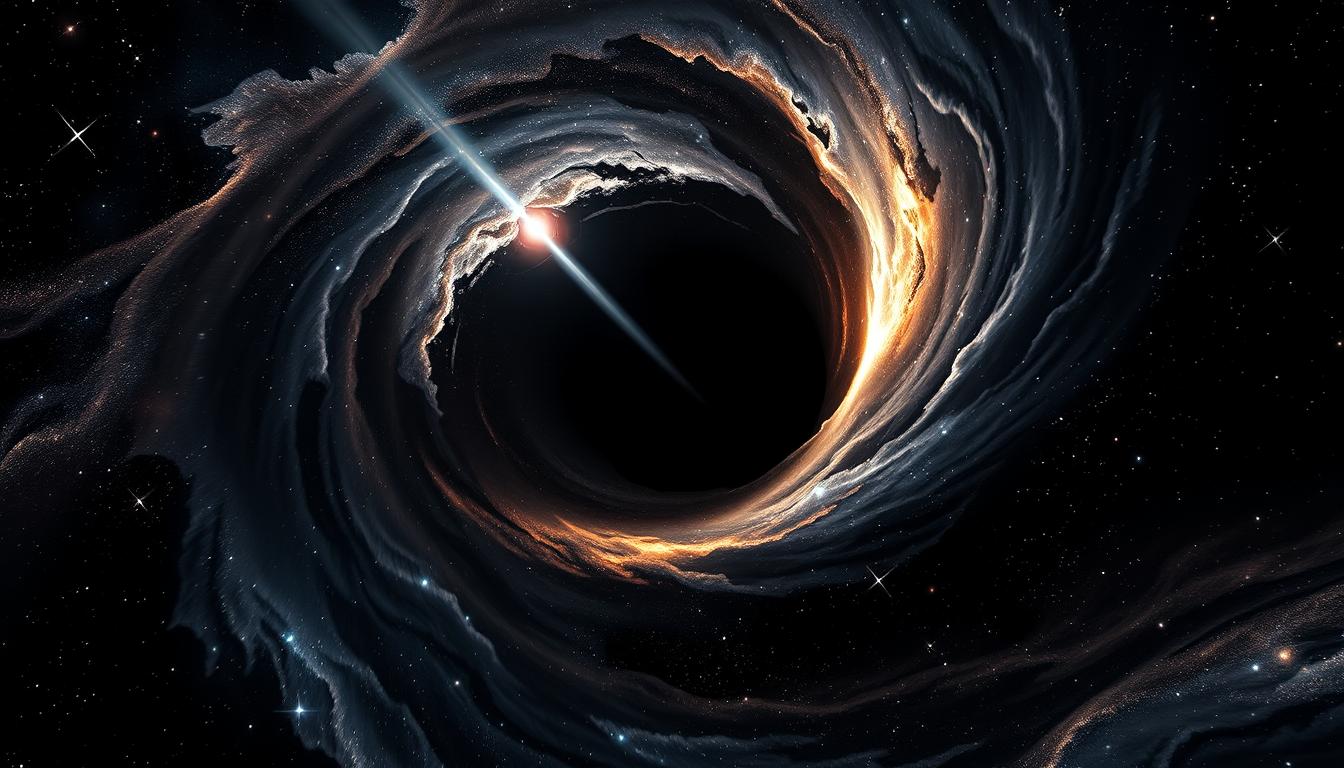
Black holes are cosmic wonders that mix science and fantasy. They are not empty spaces but dense objects that pull in light and matter. Despite years of research, many questions about black holes remain, like how they form and what’s inside them.
Our galaxy is home to millions of black holes. The nearest one is 1,000 light-years away. They come in different sizes, from small stellar-mass black holes to huge supermassives like Sagittarius A*.
In 2019, scientists captured the first image of M87*, a supermassive black hole. This image confirmed theories about event horizons and extreme gravity. But, many questions are left unanswered.
For example, how do supermassive black holes grow so big? What happens beyond the event horizon? Hawking radiation suggests they slowly lose mass, but many mysteries remain. This article will dive into what we know and what we don’t about black holes.
The Basics of Black Holes
A black hole definition begins with gravity so strong it warps spacetime into gravity wells. Once past the event horizon, there’s no escape. They form when massive stars collapse, leaving behind dense cores.
Their gravity bends light, making them invisible. Yet, we can spot them through X-rays from heated material or stars moving strangely.
The event horizon is a point of no return in space. Anything crossing it is stretched by spacetime warping into thin strands. Scientists track our galaxy’s black hole, Sagittarius A*, by studying stars orbiting it.
These stars move fast, showing the black hole’s massive size. Accretion disks of gas around black holes also glow, helping us find them.
Black holes aren’t holes but dense remnants of stars. Their gravity wells warp space, changing nearby objects’ paths. We find them by looking for clues like stars speeding toward invisible centers or sudden light flares.
These cosmic giants shape our galaxies, and their secrets are slowly being uncovered.
Types of Black Holes
Black holes fall into different black hole categories. The most well-known are stellar-mass black holes. They form when stars much bigger than our sun explode and collapse. These dense objects can weigh from a few to hundreds of solar masses.
Scientists think there could be up to 100 million of these black holes in our galaxy. This is a staggering number.

Galaxy center black holes are much bigger than stellar-mass black holes. They are like the giants of the universe. For example, the Milky Way has a black hole called Sagittarius A* that weighs 4 million solar masses.
There’s also Holmberg 15A, a black hole with an incredible 40 billion solar masses. These supermassive black holes are found at the centers of galaxies. They are mysterious and scientists are trying to figure out how they form.
Primordial black hole theory proposes that tiny black holes existed in the early universe. These mini black holes could have formed just after the Big Bang. They could be as small as atoms or as massive as stars.
Even though scientists have been searching for decades, no one has found any. This makes their existence a topic of debate. Yet, the idea that they could be connected to dark matter keeps scientists looking for evidence.
Discoveries in Black Hole Research
In 2019, the Event Horizon Telescope team made history. They captured the first-ever black hole image. This was the shadow of a supermassive black hole in the M87 galaxy. By 2022, they showed us the first black hole photograph of Sagittarius A*, our galaxy’s central black hole.
These images were made by linking telescopes all over the world. They proved Einstein’s predictions about gravity’s effects. This was a major breakthrough.
The LIGO discoveries were also groundbreaking. In 2015, the Laser Interferometer Gravitational-Wave Observatory detected gravitational wave detection signals. These signals came from merging black holes, confirming ripples in spacetime.
Over 100 such collisions have been recorded. This has changed how scientists study black holes. Now, tools that detect waves work with telescopes to make invisible phenomena visible.
These milestones show how working together across continents and technologies changes astronomy. They confirm relativity and map the universe’s hidden architecture. Each discovery adds a new chapter to our cosmic story.
The Role of Black Holes in the Universe
Supermassive black holes, weighing millions to billions of suns, anchor galaxies like our Milky Way. Their gravitational pull shapes galactic evolution, guiding how stars form and distribute within their host galaxies. Scientists observe a black hole galaxy relationship where these cosmic giants regulate starbirth rates, preventing galaxies from growing too fast or too large.

At the heart of many galaxies, active galactic nuclei (AGN) spew energy, reshaping galactic environments. This feedback loop hints at their role in sculpting the universe’s cosmic structure. Even smaller stellar black holes, born from collapsing stars, contribute to spreading heavy elements essential for planets and life. Their collisions detected via gravitational waves, like those recorded by LIGO, offer clues about universe formation dating back billions of years.
Black hole cosmology explores how these objects might have formed alongside galaxies. Primordial black holes, theorized to exist from the Big Bang, could explain dark matter’s mystery. While most dark matter searches focus on particles, some models suggest tiny primordial black holes might account for it. Observations like LISA’s upcoming mission aim to test these ideas, revealing how black holes influenced the cosmos’ architecture.
From regulating star systems to shaping galaxy clusters, black holes are not just destroyers—they’re cosmic architects. Their study bridges gaps in understanding everything from starbirth to the galactic evolution that made our existence possible.
Mysteries Surrounding Black Holes
What’s inside a black hole’s black hole interior is a big mystery. Singularity physics says matter gets infinitely dense at its center. This goes against what we know about physics.
When something crosses the event horizon, theories get mixed. Some say a “firewall” of intense energy stops travelers. Others believe spacetime bends smoothly.
The information paradox has puzzled scientists for decades. It asks if matter disappears forever or escapes. Recent studies in 2019 suggest quantum entanglement might save information, but there’s no agreement.
Some theories, like wormhole theories, suggest black holes could connect to other places or universes. These ideas are supported by math but lack proof. The Event Horizon Telescope’s 2022 image of our galaxy’s supermassive black hole gives hints, but the center remains a secret.
Scientists, like those at the Institute for Advanced Study, keep exploring. They mix quantum mechanics and relativity to understand what Einstein’s equations can’t explain.
Every new finding, from gravitational waves to the first image, brings us closer. But the heart of a black hole remains a mystery. These puzzles drive scientists to explore new areas of physics.
The Science of Hawking Radiation
Stephen Hawking changed how we see black holes. In 1974, he said quantum effects near a black hole’s edge let it release thermal radiation. This thermal radiation means even these huge cosmic objects can shrink over time.
For big black holes, this shrinking takes a very long time. But tiny ones might disappear in just seconds. The time it takes for a big black hole to shrink is so long, it’s hard for us to imagine.

Quantum effects play a big role here, challenging old physics ideas. Hawking’s work connected quantum mechanics and gravity, starting black hole thermodynamics. His equations showed black holes have temperature and entropy, traits once thought impossible.
This discovery led to the “information paradox.” It asks, what happens to data about matter swallowed by a black hole? This question has sparked ongoing debates about physics at extreme levels.
Recent studies suggest quantum entanglement might solve the paradox. Stephen Hawking’s theories are also guiding the search for a unified theory of quantum gravity. Scientists are debating whether information escapes during black hole evaporation or is lost forever. This mystery is as deep as the voids these enigmas create.
The Relationship Between Black Holes and Time
Imagine standing near a black hole’s edge—your watch ticks slower than someone far away. This isn’t science fiction; it’s gravitational time dilation, a real effect of relativistic physics. Einstein’s theories show that strong gravity warps spacetime distortion, bending time itself. Get close to a black hole’s event horizon, and every second stretches into hours, days, or even years for distant observers.
Astronauts near a black hole wouldn’t notice their own time slowing. But to someone watching from Earth, they’d appear frozen at the horizon, their descent eternally paused. This time travel theories twist isn’t just theoretical. NASA’s studies of neutron stars and X-ray binaries hint at these effects. While you can’t rewind time, a round trip near a black hole could technically send you decades ahead of those who stayed behind.
Black hole time effects also challenge our grasp of reality. The spacetime distortion near a black hole’s core traps light and distorts physics. Some theorists propose that quantum entanglement or wormholes might let information escape, but these remain relativistic physics puzzles. For now, black holes remain cosmic time machines—pointing to futures we can’t yet fully grasp.
Technological Advances in Black Hole Observation
Watching black holes is a big challenge because they don’t give off light. Scientists use the Event Horizon Telescope (EHT) to see them. This is a network of telescopes around the world.
The radio astronomy work won the Nobel Prize in 2020. It showed us Sagittarius A*, the huge black hole at our galaxy’s heart.

Gravitational wave detectors like LIGO and Virgo find ripples in space from black holes. They prove Einstein was right. Soon, the James Webb Space Telescope will study black holes more closely.
Future telescopes, like the Next Generation Event Horizon Telescope, will see more clearly. The LISA mission will find even more gravitational waves. These steps help us learn more about black holes.
Public Perception and Cultural Impact
Black holes in movies like Interstellar and Event Horizon have captured our imagination. They are seen as voids that swallow everything. This idea sparks curiosity but also spreads myths.
Books and films use black holes as plot devices. They mix science with fantasy, creating a blend of reality and imagination.
Black holes have also influenced our language. Phrases like “falling into a black hole” are common. But, many people misunderstand what black holes really are.
They don’t suck things in like a vacuum. Instead, they pull with gravity. This shows how stories can shape our views, even when they’re not true.
Imagine a place where time bends, not just disappears. This idea is explored in studies, like the 2023 Physical Review Letters paper. It suggests black holes could turn into white holes, changing time’s flow.
“The public’s awe mirrors our own curiosity,” said physicist Andrew Fabian, who studies how black holes impact galaxies. “They’re more than cosmic oddities—they’re gateways to understanding the universe’s rules.”
With discoveries like the James Webb Space Telescope, science is closing the gap between myths and facts. By separating truth from fiction, we learn more about black holes. They are truly more amazing than what we see in movies.
Future Directions in Black Hole Research
Scientists are racing to unravel the mysteries of black holes. They aim to merge Einstein’s relativity with quantum mechanics. This could change how we see spacetime.
Experiments like the Event Horizon Telescope and advanced gravitational wave detectors will help us understand black holes better. They will show us how these cosmic giants behave.
Exploring dark matter is another exciting area. Some theories say primordial black holes could be part of dark matter. Astronomers are looking at distant galaxies for clues.
Particle accelerators are also testing black hole physics. They want to see if it mirrors dark matter’s elusive nature. This could reveal a deep connection between cosmic giants and reality.
Future discoveries might come from extreme environments. Space telescopes will study supermassive black holes and their effect on galaxy formation. Simulations will model their role in the universe’s future.
Even the search for Hawking radiation’s faint signals is ongoing. It could show how black holes evaporate over time. Each step forward brings us closer to understanding these cosmic wonders.
Every advancement, from spotting black hole jets to decoding gravitational waves, moves us closer to a unified theory. The next decade will bring new tools like next-gen radio telescopes and AI-driven data analysis. These will turn today’s speculations into tomorrow’s discoveries.
The universe’s most extreme objects continue to challenge our understanding. Whether exploring quantum gravity or tracing dark matter, black holes remind us of the power of curiosity. The journey is far from over, and what we don’t know yet could change everything.
Future Directions in Black Hole Research
Scientists are racing to unravel the mysteries of black holes at the intersection of quantum gravity and unified theory physics. These fields aim to bridge Einstein’s relativity with quantum mechanics, a breakthrough that could redefine how we view spacetime itself. Experiments like the Event Horizon Telescope’s next-generation imaging and advanced gravitational wave detectors will refine our grasp of black hole behavior.
Exploring the dark matter connection is another frontier. Some theories suggest primordial black holes could form part of the universe’s unseen dark matter. Astronomers are scanning distant galaxies for clues, while particle accelerators test how black hole physics might mirror dark matter’s elusive nature. Discoveries here could link cosmic giants to the fabric of reality itself.
Future black hole discoveries may come from extreme environments. Upcoming space telescopes will study how supermassive black holes influence galaxy formation, while simulations model their role in the universe’s distant future. Even the search for Hawking radiation’s faint signals could reveal how black holes evaporate over eons.
Every advancement—from spotting black hole jets to decoding gravitational waves—pushes science closer to a unified theory physics framework. The next decade promises tools like next-gen radio telescopes and AI-driven data analysis, turning today’s speculation into tomorrow’s discoveries. The cosmos holds secrets, but each answer opens new black hole research frontiers.
As telescopes sharpen their gaze and theories evolve, the universe’s most extreme objects continue to challenge our understanding. Whether probing quantum gravity’s edges or tracing dark matter’s hidden threads, black holes remind us that curiosity drives progress. The adventure is far from over—what we don’t know yet may just change everything.