
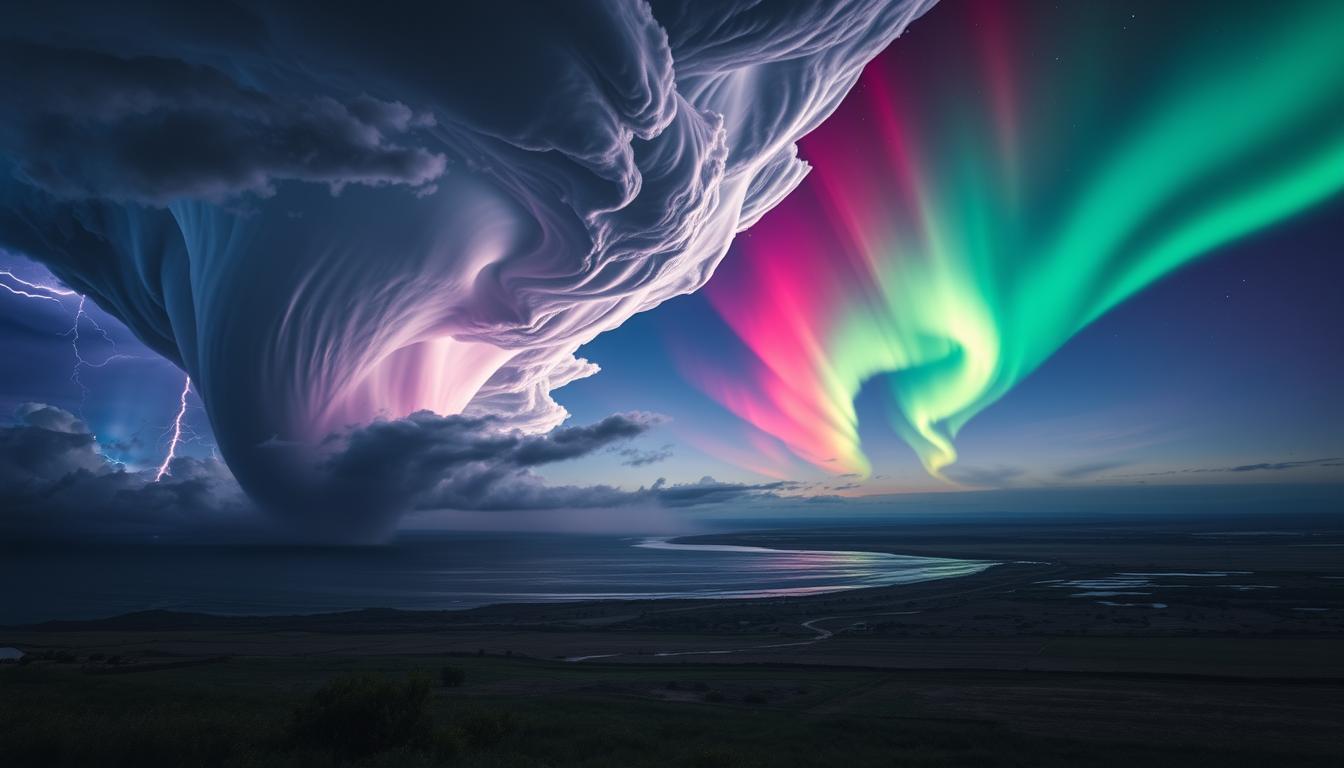
Nature’s skies can act like scenes from a movie. Events like fish falling from the sky or loud snowstorms remind us of the atmosphere’s unpredictability. These events, from frost quakes to fire whirls, show the amazing sights in our skies.
Strange weather like fogbows painting grey rainbows in mist or the Belt of Venus’s pink glow at dawn, shows beauty in the unexpected. Fire rainbows shimmer like ice crystals, and ball lightning’s floating orbs are mysteries. These remind us of the secrets our skies hold.
Spotting sun halos, capturing Brocken Spectres from mountain peaks, or entering the Standard Chartered Weather Photographer of the Year (deadline June 18, 2024), invites us to explore nature’s wonders. These unusual conditions turn ordinary days into extraordinary stories. Let’s uncover why these events happen and how they make our days special.
Introduction to Freaky Weather Events
Some weather events seem like they belong in a fairy tale. Freaky weather events like hailstorms the size of softballs or dust devils in the sky are real. Scientists study them a lot. These weather anomalies include rare things like red snow, which gets its color from algae, and unusual patterns like winter thunderstorms.
In 2017, Serbia saw fish falling from the sky. It sounds like a myth, but it’s caused by tornado-like winds. Thundersnow, where snow falls instead of rain, happens when cold air meets unstable weather. These events show how weather anomalies can surprise us yet follow natural rules.
These events are more than just oddities. The National Climate Assessment says freaky weather events like extreme heat and hurricanes are getting more common. The U.S. has seen over 300 weather disasters costing $1 billion or more. Hurricane Harvey alone caused $155 billion in damage. These numbers show how unusual weather patterns impact communities and economies.
Learning about these phenomena starts with curiosity. Whether it’s blood-red rain or ice balls bigger than softballs, each teaches us about Earth’s atmosphere. As scientists study these trends, they find clues about climate changes and our future.
The Science Behind Extreme Weather
Extreme weather science reveals how normal weather can become extreme. Atmospheric physics plays a key role, using temperature, pressure, and wind to shape storms, heatwaves, and floods. Meteorological conditions like air mass collisions or sudden humidity drops can cause events like haboobs or squall lines.
NASA satellites and historical data from the 1800s help track these patterns. They show how human actions, starting with the Industrial Revolution, have changed Earth’s balance.

Climate change makes these extreme weather events worse. The IPCC’s 2021 report shows that rising greenhouse gases increase disaster risks. For example, the 2003 European heatwave killed over 70,000 people, a tragedy made worse by warming.
A 2004 study found human activity doubled the risk of such heatwaves. This finding is supported by modern research.
Human influence has doubled the risk of extreme heat events,” according to a 2004 study.
Today, 74% of studied events are linked to climate change. In 2022, 623 heat-related deaths in Switzerland might have been reduced by 60% without human-caused warming. Kerala’s 2024 rainfall was 10% higher due to climate shifts.
These findings come from over 700 global studies. Europe and Asia lead in research efforts.
Understanding weather formation helps predict disasters. Attribution studies have grown from 50 to 500+ today. Scientists now know how small changes in atmospheric physics can lead to big catastrophes.
This knowledge helps save lives. It guides forecasts for cyclones like Idai or record-breaking heatwaves.
Unbelievable Tornado Experiences
Tornadoes are unpredictable and terrifying. In 2020, a tornado in Tennessee lifted a family 250 feet and dropped them across the street. Events like this defy logic, such as the 2011 Ohio tornado that threw 2-inch pipes 14 feet.
The Dallas, TX, EF3 tornado had 140 mph winds, covering 13 football fields. These extreme winds leave deep scars on landscapes and minds.
Funnel cloud formations tell strange stories. Sea-based tornadoes, or waterspouts, can cause “rains” of fish when they sweep marine life inland. California’s 2018 fire tornado, fueled by wildfires, reached EF3-strength winds, showing destructive power in unexpected places.
The 1974 Super Outbreak’s F5 tornadoes reshaped communities, claiming lives and changing history. Survivors say seconds can mean the difference between life and death. In 2019, Little Rock residents escaped just in time.
These stories show nature’s fury. From airborne 2x4s to EF4s flattening towns, they highlight the power of funnel cloud formations. This is why Tornado Alley is a hotspot for these incredible, life-changing events.
Rare Snow and Ice Events
Winter’s cold sometimes brings unusual snow phenomena that amaze even the most experienced weather watchers. We see things like rolling snow cylinders and frost quakes that shake the ground. These rare ice formations are unlike anything we usually see in winter.
Take snow rollers, for example. They are like natural snowballs formed by the wind. Or hair ice, which are thin strands of ice that stick to dead wood. These wonders show us the hidden side of nature during winter weather anomalies.

Nieves penitentes are tall, spire-like ice towers found in high places. They can reach up to 16 feet. Thundersnow storms, which are rare, bring lightning to snowfall, like in the 2008 Gulf Coast snowstorm.
NOAA says these events happen less than once a decade in the Southeast. There, snow is just 5% of winter weather.
“Extreme cold and storms underscore how climate boundaries shape our planet’s extremes.” – NOAA Climate Blog
History shows us these oddities, like the 2017 North Central Gulf Coast snowfall and the 2014 Deep South ice storm. Frost quakes, which happen when groundwater freezes quickly, also show winter’s strength. While tornadoes are common in the South, these icy wonders remind us of snow’s surprises.
From diamond dust in Arctic air to ice volcanoes near frozen lakes, these events are both beautiful and dangerous. They change landscapes and lives.
Bizarre Rain Phenomena
Rain isn’t always ordinary. Colored precipitation like blood-red or black rain has baffled experts. In 2001, Kerala’s crimson showers sparked debates over space dust or microbes. These unusual rain events reveal weather’s hidden secrets.
Non-water rain includes frogs or fish falling from the sky. Waterspouts hoist creatures into clouds, delivering them far from water. These strange rainfall incidents prove the skies’ surprises.
Virga creates ghostly rain streaks that vanish midair. Phantom showers and megacryometeors—ice giants from clear skies—add to the mystery. Even common rain holds extraordinary twists when nature aligns perfectly.
Epic Heat Waves and Their Consequences
Extreme heat events, like the 2023 California heat wave, show how dangerous they can be. In September, Sacramento hit 116°F, while Napa and Long Beach saw 114°F and 109°F. These record temperatures led to a 10-day crisis, with emergency calls rising to 146 heat-related cases—a 14-fold increase.

Heat bursts, where temperatures spike 20°F in minutes, often happen at night. They are unpredictable. Heat domes, where hot air is trapped, make these effects worse. In Death Valley, extreme heat events can create mirages due to temperature inversions.
These thermal anomalies are not just natural wonders; they are deadly. During the 2023 wave, ER visits for heat illnesses increased sevenfold over Labor Day. Yet, only 0.9% of 9,100 encounters were heat-related on the peak day. Heat deaths in California are often underreported due to delayed data collection.
As climate change makes things hotter, communities face growing risks. Vulnerable groups, like outdoor workers and the elderly, are hit hard. Heat also affects ecosystems: rocks expand, and dry thunderstorms start wildfires without rain. Understanding these heat wave phenomena is vital to protect lives and infrastructure.
Unusual Fog Events
Nature’s fog displays can turn ordinary landscapes into surreal scenes. Strange fog phenomena like fog anomalies often surprise even seasoned meteorologists. Consider unusual mist formations such as glories—rainbow-like rings around shadows—seen in mountain mists.
These vapor phenomena occur when sunlight bends through tiny water droplets, creating optical illusions. A similar effect, the Brocken spectre, casts giant shadows that appear to hover above fog layers, inspiring folklore worldwide.
Steam fog, or “sea smoke,” forms when cold air meets warmer water, like over the Arctic Ocean. Fog anomalies like this create ghostly veils over oceans. Fogbows—pale rainbows in fog—add color to these scenes.
In 1952, London’s unusual mist formations caused a deadly smog event, a mix of fog and pollution that lasted five days.
Modern tech now mimics nature’s vapor phenomena. Fog harvesters in Chile’s Atacama Desert collect moisture from coastal fogs, providing clean water. Even fleeting strange fog phenomena like sudden “ghost fogs” that vanish without warning hint at Earth’s atmospheric creativity.
Record-Breaking Hailstorms
Extreme hailstorms can be very dangerous, turning the sky into a hazard. The world’s largest hailstone was 8 inches in diameter and fell in Vivian, South Dakota, on July 23, 2010. It weighed nearly 2 pounds, showing the power of severe ice precipitation.
In June 2024, Oklahoma broke its own record with a 5.25-inch hailstone. This was the largest hailstone recorded in the U.S. in over 50 years. Such massive hailstones can cause a lot of damage, like the 2024 storm in Oklahoma that damaged 170 vehicles at a local Nissan dealership.

Historic storms like the 1888 Moradabad, India, hailstorm killed 246 people. Bangladesh saw 92 fatalities in 1986. These events show how deadly extreme hailstorms can be.
In 2024, there were over 10,092 hail events worldwide. This includes 101 days with hail larger than 5 cm. But, there are challenges in reporting these events because of different ways to measure hail.
Severe ice precipitation is costing more and more. In 2023, the U.S. saw $92.9 billion in damages from billion-dollar disasters. Hailstorms like Italy’s 2024 8-cm hailstorm damage thousands of vehicles every year. It’s important to understand and prepare for these storms.
The Wonders of Lightning
Lightning isn’t just the bright flashes we see during storms. It shows nature’s hidden power. From glowing orbs to red flashes high in the sky, these rare types show how electricity works in surprising ways. Scientists like Ron Holle study these anomalies to understand their causes and impacts.
Volcanic eruptions can spark lightning as ash particles collide, creating dramatic displays. Ball lightning—a floating sphere of light—puzzles researchers, but new theories suggest plasma interactions might explain it. High above storms, sprites dance as red flashes reaching 60 miles up. Discovered in the 1990s, these phenomena were first studied by experts like Holle, who has spent decades analyzing atmospheric electricity patterns.
Rare lightning types like bead lightning, which breaks into glowing segments, or ribbon lightning, which splits into branches, add to Earth’s electrical mysteries. Positive lightning, capable of striking miles from storms, holds extra danger due to its longer duration. Even St. Elmo’s Fire—the blue glow on ship masts or airplane wings—links to atmospheric electricity, fascinating sailors and pilots for centuries.
Recent records highlight lightning’s extremes: a 200-mile strike and a 16-second-long flash. Events like Flandrau’s “Flashes of Brilliance” presentation explore these wonders, combining science with live shows and telescope stargazing. With 2,000 thunderstorms active globally at any moment, understanding these rare lightning types helps safeguard lives and deepen our awe for nature’s power.
How to Prepare for Freaky Weather
Start by knowing your risks. Look at NOAA’s geographic risk assessments to find out about dangers like tornadoes or flash floods. Use a NOAA weather radio for real-time alerts, even when power is out.
For safety, have an emergency kit with 12 gallons of water for a family of four and nonperishable foods. Practice by designating safe rooms and running drills, as RJWestmore’s tornado modules teach.
Stay informed to be ready for weather anomalies. Follow CDC guidelines to avoid power lines and never drive through flooded roads. Install surge protectors for appliances during outages.
Review your flood insurance policies. Most auto policies cover flood damage, but home insurance rarely does. Use NAIC’s resources to check coverage and report claims quickly after disasters.
Stay calm and proactive. Keep phones charged and emergency contacts updated. Share credible updates from trusted sources to avoid misinformation.
Even small steps help, like layering clothing in cold snaps or avoiding overexertion while shoveling snow. Over 500 U.S. lives were lost to severe weather in 2017—preparation saves lives. Start today by reviewing your region’s risks, building a kit, and staying tuned to alerts. When nature surprises, you’ll be ready to protect yourself and loved ones.