
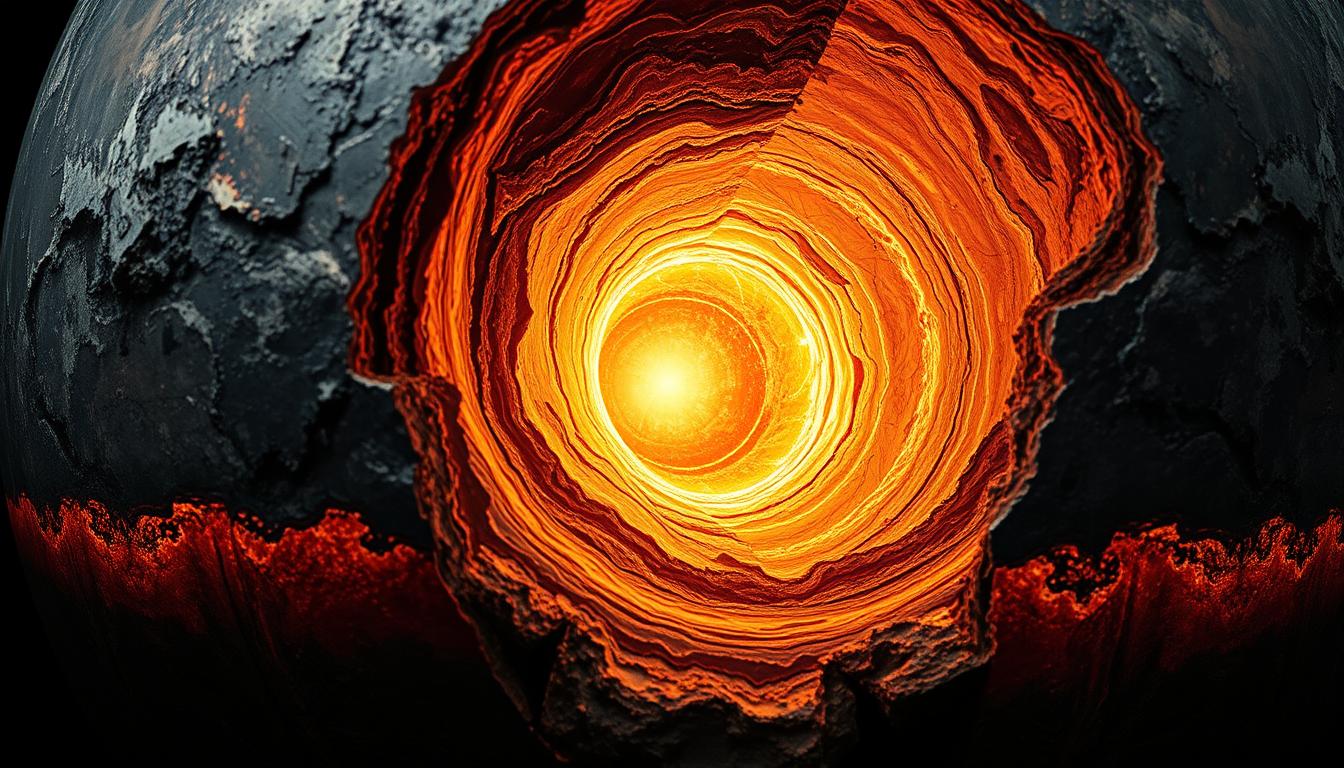
At the heart of our planet lies the inner core, a hidden world holding earth’s core secrets. This iron-nickel sphere, just 2,440 km wide, generates Earth’s magnetic shield—a vital defense against space radiation. Smaller than the moon, its structure remains one of earth’s center’s greatest puzzles.
Recent breakthroughs reveal an inner-inner core, half the size of the full inner core. Iron crystals in its outer layers point north-south, while deeper crystals align east-west. This inner core structure was uncovered using seismic wave analysis, published in Nature Geoscience on February 9. Supported by the U.S. and China’s National Science Foundations, the study tracked 168 earthquake pairs to map its movements.
Surprisingly, the inner core spins faster than Earth itself—a phenomenon called superrotation. While its shape changes might subtly alter Earth’s day length, direct links remain unclear. Unraveling these mysteries helps us grasp how earth’s center shapes life on the surface—and why its secrets matter to everyone.
Introduction to Earth’s Core and Its Layers
Earth’s structure is like a layered cake, with the core at its center. The crust, where we live, is thin. Below it, the thick mantle and the core layers follow. The core, Earth’s deepest layer, formed 200 million years after Earth was born 4.5 billion years ago.
The core is almost half as wide as Mars. Yet, it withstands pressures 3.6 million times stronger than Earth’s surface.
In 1936, Danish seismologist Inge Lehmann found the inner core. She analyzed seismic waves and found a solid layer at 5,150 km depth. Today, we know the inner core’s temperature is as hot as the Sun’s surface, reaching 5,200°C.
The outer core’s liquid iron drives Earth’s magnetic field. This magnetic field protects us from harmful solar winds.
“The core’s extreme conditions are unlike anything on the surface,” explains geophysicist Dr. Barbara Romanowicz. “Its heat and pressure create forces that shape our planet’s future.”
The core’s two layers power life above. The outer core’s metals generate a magnetic shield. The inner core grows at 1 millimeter yearly.
These core layers are hidden under 2,900 km of rock and metal. They are a world that science is slowly uncovering.
The Composition of the Inner Core
The core composition of our planet is a big mystery. Scientists say the inner core material is mostly iron and nickel. These metals are solid because of the extreme pressure, 3.5 million times more than at the surface.
Despite the heat, over 5,000 K, the core stays solid. Recent studies show its crystals line up like tiny magnets, following Earth’s rotation.

As the earth’s center composition forms, lighter elements like oxygen and carbon move outward. This movement helps the outer core move slowly, possibly affecting our magnetic field. A 2021 study found the eastern inner core grows iron crystals 60% faster than the west.
The inner core grows just 1 millimeter each year as iron freezes. It’s estimated to be between 500 million and 1 billion years old. But, there’s debate about this age. Some theories suggest it might be younger than we think.
Today, scientists are puzzled by a few things. Why does the inner core’s rotation speed sometimes change? How does it work with the mantle above? These questions keep researchers exploring the heart of our world.
How Do We Study the Earth’s Core?
Studying Earth’s core is a big challenge because we can’t get there directly. Scientists use seismic waves from earthquakes to learn about the core. These waves change as they go through different parts of the Earth, giving us clues about what’s inside.
Earthquakes send out P-waves and S-waves, but scientists also look for J-waves. J-waves are hard to find but are key to understanding the inner core. They use special tools called seismometers to detect these waves.

Today, geophysical studies use supercomputers and lab tests. Researchers at the Australian National University (ANU) used data from a UN network to study the core. They found that the inner core is softer than thought.
Supercomputers help simulate how iron crystals behave under extreme pressure. This helps scientists understand the core’s solid layers. It’s like solving a puzzle from 5,000 km away.
But there are hurdles to overcome. Finding J-waves is tough, requiring lots of seismic data. ANU scientists worked with data from 50,000 earthquakes over 20 years. They confirmed the inner core has two layers.
Future research might include lab tests to mimic core conditions. Satellites could also watch how the magnetic field changes. These new ways will keep revealing secrets from deep within our planet.
Theories About the Earth’s Core Formation
Earth’s core started forming when the solar system was just dust and gas. Over 4.5 billion years ago, this material clumped into planetesimals. These rocky bodies collided, melting and letting dense metals sink to the center.
This planetary formation process created Earth’s layered structure. Iron pooled at the center, forming a solid inner core. The outer core stayed liquid due to extreme pressure—over 50 gigapascals.

Scientists study how this core formation shaped Earth’s development. The inner core solidified surprisingly recently, between 500 million to 1.5 billion years ago. It grows at 1 millimeter yearly as Earth cools.
A 2013 Stanford study in Nature Geoscience used earthquake data to map these changes. It revealed clues about the core’s evolving structure.
Recent findings show the inner core’s two layers have different crystal orientations. The outer layer’s particles align north-south, while the inner layer faces east-west. This suggests a major event reshaped the core early in Earth’s history.
While theories like percolation—where molten iron seeped through the mantle—explain parts of this puzzle, mysteries linger. Researchers continue piecing together how these layers formed and how they’ll shape Earth’s future.
Magnetic Field Generation
The earth’s magnetic field starts deep within our planet’s core. At its heart, the geodynamo process begins when heat from the solid inner core rises into the liquid outer core. This movement, combined with Earth’s rotation, stirs up swirling currents of molten iron. These flowing metals act like a giant generator, creating the magnetic shield that surrounds our planet.

This core magnetism protects life by deflecting solar wind and cosmic rays. Without it, Earth’s atmosphere could erode, exposing living beings to deadly radiation. Scientists have noticed the field’s strength has weakened by 10% over the past 183 years. They use networks like the U.S. Geological Survey’s Boulder observatory, active for over 50 years, to monitor this.
Recent studies published in PNAS (October 2023) reveal iron atoms in the inner core move in ways that mimic liquid behavior under extreme pressure. This discovery could explain why Mars lost its magnetic field—or why Earth’s persists. Satellites and astronauts face risks near weak zones like the South Atlantic Anomaly, where radiation leaks threaten technology and human health.
The Geomagnetism Program tracks these hazards, aiming to predict space weather events. Their 2020–2024 research focuses on minimizing risks to power grids, pipelines, and GPS systems. Every compass needle, animal migration path, and space mission relies on this invisible force born from the core’s churning heart.
Unexplored Mysteries of the Inner Core
For decades, scientists have tried to understand Earth’s innermost layers. Dr. Thanh-Son Phạm and Prof. Hrvoje Tkalčić found seismic waves moving between the core and crust. This has given them clues about the inner core rotation.
Their research has also raised questions. Why do seismic waves speed up in certain paths near the inner core’s edge? They think there might be a smaller “inner-inner core” with special iron crystals.
Recent studies show the inner core grows faster on its eastern side, near Indonesia’s Banda Sea. But the western side, near Brazil, grows slower. This uneven growth might be due to uneven cooling.
Earth’s rotation has also slowed down, starting in 2020. This could be linked to changes in the inner core’s spin. Some believe it might have stopped or even reversed direction, like a “stuck gear” in Earth’s engine.
Temperatures near the core-mantle boundary are incredibly high, rivaling Everest’s height. But, we don’t have enough data from polar regions. As the core cools, it’s thought to be younger than previously believed, thanks to supercooling effects.
These findings show that the core’s full story is yet to be told. New tools and creativity are needed to uncover its secrets.
The Core’s Impact on Earth’s Surface
The core’s hidden core effects shape life on Earth in unseen ways. The solid iron-nickel inner core spins on its own, creating Earth’s magnetic shield. This shield keeps us safe from harmful solar radiation. But, recent studies show its strength has dropped 9% over 200 years.
NASA’s Weijia Kuang points out this decline is most noticeable in the South Atlantic Anomaly (SAA). This weak spot covers South America. The SAA already causes problems for satellites passing through it.
The SAA’s reduced magnetic intensity lets charged particles disrupt technology, researchers explain. Suchsurface impacts could get worse if the field reverses. This process takes thousands of years.
Historical records show field reversals happen every 200,000–300,000 years. We’re long past due for one. A weakened field might make ecosystems and power grids more vulnerable to solar storms.
Scientists also look into the core-climate connection. The inner core’s slow rotation and temperature changes might affect Earth’s tilt. This, in turn, could change seasons and climate patterns.
While direct links are debated, the core’s outer layer drives plate tectonics. This shapes mountains and oceans. Even small changes in the core could alter surface environments over time.
From migratory birds using magnetic fields to satellites avoiding the SAA, the core’s rhythms affect our daily lives. As researchers watch the SAA expand, understanding these core effects is key. It helps us prepare for a future where technology and nature adapt to Earth’s innermost secrets.
Future Research Directions
Earth scientists are working hard to learn more about the inner core. They use core research and future studies to do this. New tools like global seismometer networks and satellite-based magnetic field tracking are helping a lot.
Dr. Nguyên Phạm says, “The transitional layer between the innermost core and upper regions remains a puzzle waiting to be solved.”
“This question can be addressed soon,” says Phạm, pointing to improved seismic data from recent decades. Modern sensors have tracked shifts in the inner core’s shape, showing height changes of up to 100 meters in some areas. These discoveries hint at dynamic processes beneath our feet.
Scientists have many questions. Why does the inner core’s growth seem uneven? What triggers sudden magnetic field “jerks”? How does the core’s slow solidification over billions of years affect life?
High-pressure lab experiments and supercomputer models will help answer these. Satellites like SWARM are already mapping magnetic field wobbles linked to core dynamics.
Global teams are working together. They use data from earthquakes and satellite observations. For example, studies of seismic waves show the inner core’s rotation pace slowed then accelerated—a mystery tied to heat flow.
Also, the core’s iron-nickel alloy structure, under pressures 3.6 million times surface levels, demands advanced imaging tech to study.
Future missions aim to map the core’s outer boundary shifts. With the inner core expanding just 1 mm/year, patience and precision are key. Every breakthrough brings us closer to predicting how Earth’s heartbeat—the core—will shape our planet’s future.
Conclusion: The Importance of Understanding Earth’s Core
Earth’s core is a silent guardian that shapes our planet’s future. Its magnetic field, created by the outer core, protects us from harmful solar radiation. This protection is key to keeping earth’s habitability alive. Without it, Earth might lose its atmosphere and become uninhabitable, like Mars.
Learning about the core teaches us important planetary science lessons. It grows very slowly, just 2 millimeters each year. This slow growth shows how Earth’s interior changes over billions of years. The inner core is adding iron at a rate of 8,000 tonnes every second, but it won’t solidify for 91 billion years.
Before that, the Sun will expand into a red giant, changing our solar system. The core’s rotation and magnetic field changes affect life on Earth. For example, a recent 8% decline in the South Atlantic Anomaly shows how delicate this balance is.
Scientists study seismic waves from earthquakes to learn more about Earth’s core. They uncover secrets about our planet’s past and future. This research is not just for scientists; it helps predict space weather, guides satellite technology, and finds mineral resources.
Understanding the core importance is vital. It teaches us about Earth’s story and how planets evolve over time. As the core’s rotation wobbles and its structure changes, it shares lessons about our planet’s evolution.