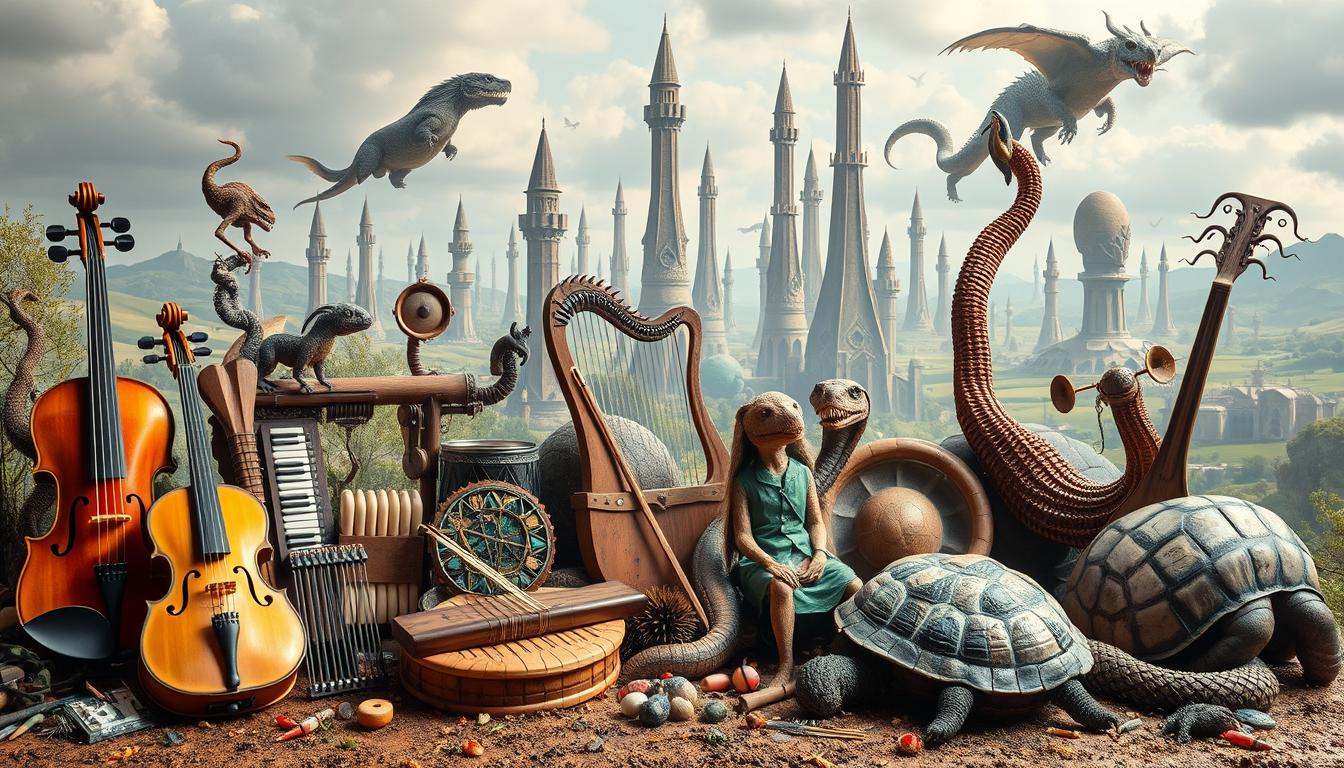
The Theremin, invented in 1920, is one of the first electronic instruments. The Wintergatan Marble Machine uses 2,000 steel marbles to create music. These oddest musical instruments come from different cultures and times.
The nyckelharpa is a 16-string Swedish folk instrument with 37 sliding keys. The Pyrophone burns propane to make eerie sounds. Even famous bands like the Beatles used the Mellotron.
The Hang Drum uses steel vibrations, while the Hydraulophone is powered by water. The Pikasso Guitar has 42 strings and challenges traditional design. The Zeusaphone combines science and art with its 900 Hz coils.
This journey shows how creativity and culture shape music. From ancient flutes to modern tech, it’s a fascinating exploration. Are you ready to discover instruments that change the way we think about music?
The Hurdy-Gurdy: A Unique Stringed Instrument
Imagine a cranked string instrument that sounds like bagpipes and a violin. The hurdy-gurdy is one of the oldest medieval instruments. It uses a hand-turned wheel to rub strings, making a continuous drone sound.
Its history goes back before the 11th century. Early versions, like the organistrum, needed two people to play. Over time, it became a portable tool for European folk instruments traditions.
By the Renaissance, the hurdy-gurdy was popular in royal courts. But by the 1700s, it fell out of favor, earning names like the “peasant’s lyre.” Despite this, it survived in rural areas, played by traveling musicians in Hungary, France, and Ukraine.
Modern revivals started in the 1960s. Donovan’s song “Hurdy Gurdy Man” sparked interest, even though the instrument wasn’t in the song.
Today, hurdy-gurdies have 24 keys and up to four drone strings. They produce rich, buzzing tones. From folk festivals to avant-garde music, its legacy lives on. Its unique sound reminds us of history’s hidden musical gems waiting to be discovered.
The Theremin: An Electronic Marvel
Leon Theremin invented the theremin in 1920, changing electronic instruments forever. This touchless instrument uses two antennas to sense hand movements. Pitch goes up as hands get closer to the top rod, and volume goes down near the side antenna.
Its unique, gliding tones are famous in sci-fi sound effects. You can hear them in movies like Spellbound and The Lost Weekend.

Despite being called a “people’s instrument,” RCA’s 1928 New York production had issues. It was expensive, $230, during the Great Depression. Only 306 units sold in 1930, dropping to just one the next year.
Critics saw it as a “new sensation of the machine age.” But its complexity scared off many people.
“The theremin’s ghostly voice is pure magic,” said Clara Rockmore, a virtuoso who mastered its ethereal tones. Bands like Led Zeppelin later embraced it, adding it to tracks like Babe I’m Gonna Leave You.
Leon Theremin’s life was as mysterious as his invention. Accused of espionage, he vanished in 1938 and was later imprisoned in Siberia. Yet, his creation lives on, haunting soundtracks and inspiring new tech.
Today, its Leon Theremin invention is celebrated in museums and by indie bands. It shows that music can come from nothing.
The Glass Armonica: A Delicate Tuning
Benjamin Franklin invented the glass armonica in 1761. It turned wine glass music into a sophisticated instrument. Instead of using upright glasses, Franklin mounted 37 hand-blown bowls on a spinning spindle. This made it compact.
Players moisten their fingers to touch the rims, creating sound through friction. This was a big step from tapping individual glasses. It allowed musicians to play chords.
The glass armonica’s haunting tones were like an “angel’s whisper.” They captivated audiences in 18th-century Europe. Mozart and Beethoven wrote music for it, filling concert halls with its ethereal sound.
The instrument’s glass bowls were tuned to specific pitches. This created frequencies between 1–4 kHz. It made the sound feel both intimate and distant. But myths about lead poisoning and its quiet volume led to its decline by the 1800s.
Today, modern versions use safer materials like silica glass. This has revived its mystical appeal. Performers like Dennis James have recorded albums, and it appears in films like Star Trek II.
The Franklin Institute in Philadelphia displays an original model. It honors this unique legacy. Though rare, the glass armonica continues to enchant those who seek its timeless sound.
The Hang Drum: A Modern Creation
In 2000, Swiss creators Felix Rohner and Sabina Schärer introduced the hang drum. It’s a percussion instrument that stands out. Made from two steel halves, it combines science and art.
It was born at PANArt, where the creators drew from steel pan drum sounds. This mix created its unique sound.

The hang drum is 20 inches wide and 9 inches tall. Its surface has dented fields that vibrate with a touch. Each sound healing instrument is a one-of-a-kind piece.
It has scales like the Hijaz-inspired 11-note version, making enchanting melodies. Players use special techniques to create soothing sounds. These are great for meditation music instruments sessions.
Even though PANArt stopped making Hangs in 2013, their impact lives on. Musicians around the world use handpans, the hang’s descendants, for healing sounds. The hang’s calming sounds now inspire workshops and recordings. It shows that rare instruments can start global musical trends.
The Didgeridoo: Ancient Yet Timeless
Aboriginal instruments like the didgeridoo hold thousands of years of cultural wisdom. Made from eucalyptus logs hollowed by termites, they are more than tools. They are vessels of stories.
Each tube, often over 3 meters long, has a unique shape. This shape gives it a deep, resonant tone. For Indigenous communities, the didgeridoo is a bridge to their ancestral traditions.
Playing the didgeridoo requires mastering circular breathing techniques. Musicians inhale through their nose while exhaling through their lips. This allows them to sustain drones for minutes.
This technique creates the instrument’s signature sound. It’s a meditative hum that echoes ancient rituals. Modern musicians now use these drone instruments in genres from rock to orchestral scores. They blend tradition with innovation.
Rock art over 1,500 years old shows players, highlighting its role in storytelling. Today, its hypnotic rhythms connect listeners to Australia’s first peoples. Whether in ceremonies or global stages, the didgeridoo’s voice remains a living link to the past.
The Ukulele: Small but Mighty
The ukulele started in Hawaiian instruments in the 1880s. Portuguese immigrants brought small string instruments to Hawaii. Its name, meaning “jumping flea,” shows the quick finger movements needed to play it.
Today, this string instruments gem mixes tradition with modern appeal. It’s a great portable guitars alternative. Despite its small size, it’s a big player in island music instruments, used in folk to pop.

Tiny Tim’s 1969 hit “Tiptoe Through the Tulips” made the ukulele famous, reaching #17 on Billboard charts. Years later, Israel Kamakawiwo’ole’s version of “Somewhere Over the Rainbow” got over 50 million YouTube views. This sparked a global comeback.
Now, players like Jason Mraz and ukulele festivals show it’s more than a novelty. It’s a serious string instruments choice.
Manufacturers like Magic Fluke Co. see huge demand, with months of backorders. Music shops and schools offer ukulele lessons, calling it a “gateway instrument” for beginners. It comes in sizes from soprano to baritone, making it perfect for travelers and hobbyists.
Though often seen as “happy,” the ukulele can play a wide range of music. Clubs like Kansas City’s groups play darker tunes like “Folsom Prison Blues,” showing it’s more than just a happy instrument. Its comeback isn’t just a trend—it’s a lasting legacy. As Tiny Tim’s story shows, this small instrument keeps coming back, proving size doesn’t matter.
The Bajón: A Rare Wind Instrument
The Bajón, a nearly forgotten Spanish instrument, once filled cathedrals with its deep, resonant sound. It was a key part of historical wind instruments and played a big role in Spanish church music during the Renaissance. Its design, with a wooden body and flared bell, helped shape the modern bassoon, making it a true bassoon ancestors pioneer.
As time went on, the Bajón’s use declined as orchestras turned to more flexible instruments. Now, researchers study old manuscripts to bring back its sound. This work keeps its legacy alive, showing its importance in the evolution of renaissance instruments.
Today, the Bajón sometimes appears in modern performances, mixing its ancient voice with today’s music. Its comeback shows how historical sounds can inspire new generations, keeping traditions alive.
The Musical Saw: A Surprising Sound
Can a carpenter tool make music? The musical saw shows it’s possible. This tool turns a simple handsaw into a device that makes eerie sounds. By bending the blade into an S-curve and bowing it, players create haunting melodies.
Playing the saw needs skill. Pressing the handle changes the pitch, and wrist shakes add vibrato. Artists like Evgeny Zholkovsky have mastered this, playing classics like “Swan Lake.”
Its history is fascinating. Rural American folk first used it as an instrument. Now, it’s a unique part of orchestras and avant-garde shows. Next time you see a handsaw, think of its musical side.
The Cuatro: The Puerto Rican Four-String Guitar
The cuatro looks like a small guitar but has a unique sound and story. It’s a four-course string instrument made from pine or cedar. It carries the spirit of the Caribbean islands.
It’s similar to other Latin American string instruments but has ten strings. These are arranged in five pairs. It evolved from its four-string ancestor by 1875.
In Chicago, the cuatro is a big deal in the Puerto Rican community. The Chicago Cuatro Festival started in 1999. It’s held at places like the Field Museum and the Gateway Theatre.
By 2021, it moved to the historic Chicago Theatre. This made it the biggest celebration of this instrument outside Puerto Rico. The festival shows how Caribbean instruments are growing in urban areas.
Young musicians like Anissa Vega and Grace Garriga love the cuatro. They start learning at 8 years old. Teachers at Humboldt Park Fieldhouse guide them.
Carlos Flores has been teaching for ten years. He says the cuatro is key to keeping cultural heritage alive. The Cuatro Project started in 2004 to document this tradition.
The cuatro’s bright sounds connect old and new music. It shows that small guitars can tell big cultural stories. It’s a quiet hero in the world of Caribbean instruments.
The Ondes Martenot: An Early Electronic Instrument
In 1928, French inventor Maurice Martenot created the Ondes Martenot. This French electronic instruments innovation had a keyboard and a ribbon controller. It let players glide between notes with precision, unlike the theremin’s unpredictable waves.

The Ondes Martenot had a metal speaker called the “diffuseur,” which amplified ethereal tones. Musicians could bend pitches smoothly, making it a reliable theremin alternatives. French composer Olivier Messiaen used it in his 1948 masterpiece Turangalîla-Symphonie, blending it with orchestras to create cosmic textures.
Film composers later used its haunting tones in Lawrence of Arabia and Mad Max III. They amplified tense moments with alien-like resonance. Today, artists like Radiohead’s Jonny Greenwood revive its retro-futuristic edge. Tracks like “How to Disappear Completely” showcase its eerie, shimmering tones.
Even Daft Punk experimented with it for their electronic soundscapes. Over 95 years later, the Ondes Martenot remains a bridge between analog experimentation and modern music. It proves its lasting influence on early synthesizers.
The Moog Synthesizer: Revolutionizing Sound
In 1964, Robert Moog introduced the modular synthesizers that changed music forever. His analog synthesizers allowed artists to control sound with voltage. This turned complex circuits into creative tools.
These keyboard synthesizers soon moved from labs to studios. They made electronic sounds available to musicians everywhere.
Electronic music pioneers like Wendy Carlos used Moog’s designs. She blended classical pieces with futuristic tones. Her 1968 album Switched-On Bach won a Grammy and showed keyboard synthesizers could go beyond experimental music.
Bands like The Beatles and Pink Floyd adopted Moog systems. They added eerie textures to their hits.
The Minimoog, released in 1970, was a game-changer. It was smaller and more affordable than early modular synthesizers. This let artists perform live with portable gear.
Tracks like Donna Summer’s disco anthem “I Feel Love” used its rich tones. This cemented its role in pop history. Even when Moog’s company faced struggles in the 1980s, its legacy lived on.
Today, Moog is known for innovation. Modern models like the Spectravox show a revival of analog sound. They prove the lasting impact of these analog synthesizers.
From 1960s labs to 21st-century stages, Moog has reshaped music-making and listening.
The Waterphone: An Instrument of Mystery
The waterphone is a sound effect instrument that turns water into music. It was invented by Richard Waters in 1968. This stainless steel bowl filled with water creates eerie echoes that change as performers bow its bronze rods.
Films like Poltergeist and The Matrix use its ghostly tones to unsettle audiences. This makes it a favorite in suspenseful storytelling.
This experimental percussion tool combines water instruments and avant-garde design. The water inside the bowl moves with each strike, altering pitches. It produces whale-like moans or alien whispers.
Musicians like Johan Söderqvist have used it in films like Let the Right One In. It proves its power to amplify tension. Each instrument is crafted by Waters himself, ensuring every note carries its signature mystery.
From horror soundscapes to modern film scores, the waterphone shows how unconventional instruments shape our emotions. Its haunting tones remind us that even the strangest creations can become timeless tools for storytelling. Next time you hear a spine-chilling sound in a movie, you might just be listening to water and metal turned into magic.