
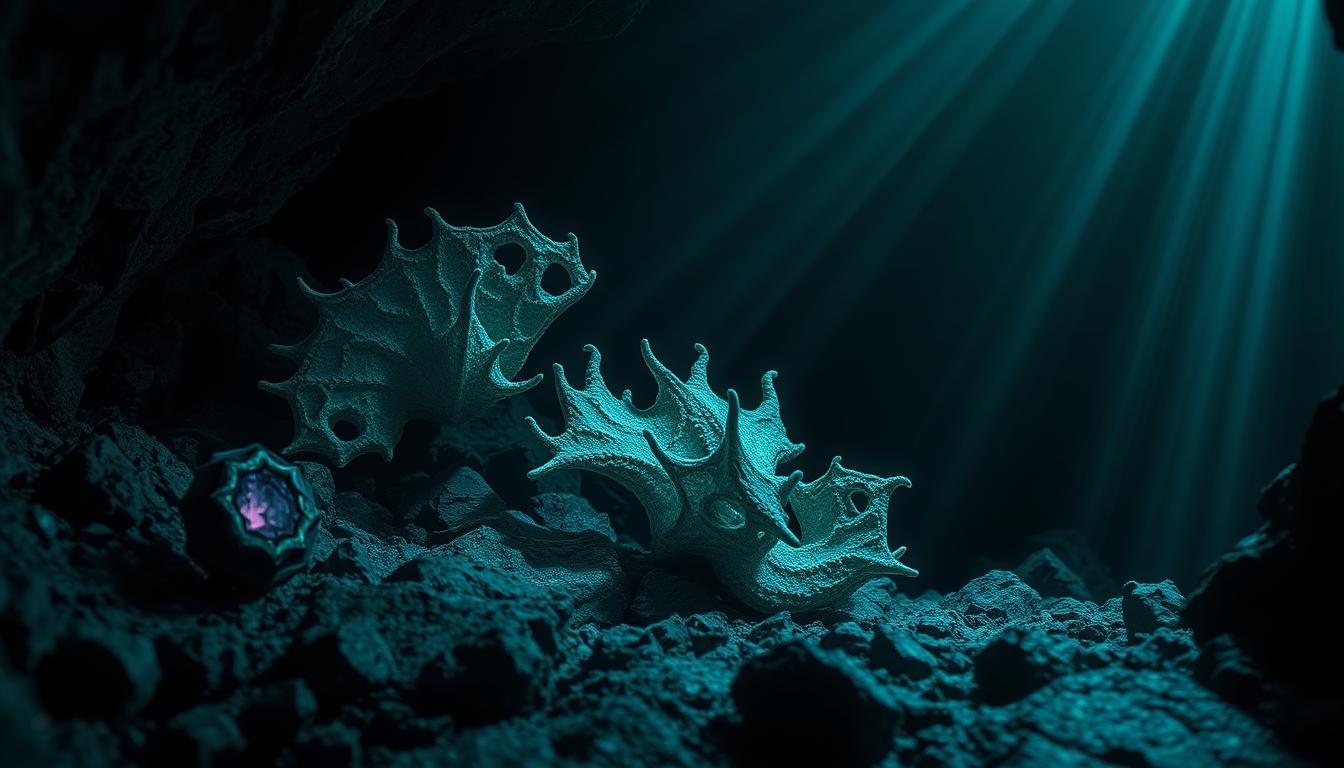
Bizarre fossils and unusual prehistoric remains are changing how we see Earth’s history. Imagine a dinosaur poop museum in Arizona with 8,000 fossilized droppings called coprolite. Or a 70-million-year-old Protoceratops nest in Mongolia with 15 baby skeletons, showing dino parenting.
These aren’t just weird finds—they’re clues to ancient life. They show us how different life was back then.
Discover the weirdest fossil finds, like 66-million-year-old fish vomit from Denmark or a 450-million-year-old arthropod preserved in fool’s gold. Even sex cells from Antarctica’s 50-million-year-old clitellate worms or a 425-million-year-old crustacean’s fossilized penis reveal shocking details. These finds, from Tullimonstrum’s “Tully Monster” mystery to 3.7-billion-year-old Greenland stromatolites, blur the line between science and sci-fi.
Each fossil—from ancient sperm to battling dinosaurs—proves prehistoric life was wilder than we knew. Join us as we explore these extraordinary paleontological finds that challenge what’s possible.
What Are Fossils and Why Are They Important?
Fossils form when organisms are buried quickly. This lets fossil preservation happen through mineralization or sediment impressions. Emmy Smith uses sunlight to find tiny fossils, showing how delicate traces last.
These clues, like bones and footprints, tell us about life long ago. They are prehistoric evidence of life that once was.
Each fossil formation method has its own story. Mary Anning found a 5.2-meter Ichthyosaurus at 12 in 1811. Her discoveries of the Plesiosaurus and Dimorphodon showed sea creatures from 201 million years ago.
Despite being kept out of groups like the Geological Society, her work filled gaps in the paleontological record. Her Jurassic Coast finds, now a UNESCO site, guide researchers today.
Amber fossils, like a 100-million-year-old spider-wasp struggle, freeze moments in time. Rare finds, like a legless salamander or 60-egg insect clusters, show life’s diversity. These clues help scientists understand ecosystems and evolution.
Every fossil, from dinosaur bones to insect wings, helps us understand vanished worlds. Anning’s story shows how fossils change myths into science.
“Duria Antiquior,” painted in 1830, was the first artwork of prehistoric life based on Anning’s fossils. Her legacy shows how fossils transform myths into science.
Every fossil, from dinosaur bones to insect wings, helps us understand vanished worlds. Anning’s story reminds us: even rare specimens, like her 1828 Dimorphodon, unlock secrets older than flowers or flowering plants. Without them, our understanding of evolution and ancient climates would remain lost in time.
The Weirdest Fossils of All Time
Unidentifiable fossils like the Ediacaran biota baffle scientists. These strangest fossil specimens were found in Nevada, Australia, and Namibia. They look nothing like life today.
Dating back 550 million years, their shapes are hard to classify. Experts debate if they’re animals, algae, or something new.

The Tullymonstrum gregarium is another mystery. This 300-million-year-old fossil from Illinois has eyes, a snout, and a tail fin. It’s only 10 inches long.
Despite decades of study, its true identity is unknown. “It’s like a chimera of unrelated creatures,” says a researcher.
Other weird creatures include the 5-centimeter Titanomyrma, a 50-million-year-old giant ant. And the 4.5-kilogram Beelzebufo, a frog with teeth sharp enough to crush prey.
Even everyday actions leave fossils. 50-million-year-old sperm was found in Antarctic rocks. A spider attacking a wasp, frozen in amber 100 million years ago, shows life’s quirks.
These strangest fossil specimens remind us of Earth’s hidden history. Each one changes our view of ancient life—and what might be discovered next.
Peculiar Plant Fossils
Strange plant fossils like Othniophyton elongatum show how ancient plants were unlike today’s. Found in the Green River Formation, these fossils are 47 million years old. They have stamens stuck to mature fruits, a rare sight in today’s plants.
In 1969, scientists first found these fossils but didn’t know what they were. Later, more discoveries with twigs and leaves showed their uniqueness. Tiny fruits and internal structures found through microscopy proved they’re not like ginseng or magnolias.
This Othniophyton challenges our understanding of plant history. Today, we know over 400 flowering plant families. Yet, Othniophyton doesn’t fit into any known family. Its survival into the Mesozoic era, long after its relatives disappeared, suggests it had special survival traits.
These fossils also reveal past mistakes in science. Older scientists often put fossils into modern categories, which was wrong. With better tools, we’re uncovering forgotten paths in plant evolution. This changes how we see Earth’s green past.
Deep Sea Oddities: Marine Fossils
Unusual marine fossils like the coelacanth show us secrets of the past. This fish was thought to be extinct for millions of years. But in 1938, it was found off South Africa, shocking scientists.
Its strange features, like fleshy stalks, suggest it had unique adaptations. These unusual marine fossils make us rethink what lived in ancient oceans.

Other odd fossils include sharks with spiral teeth and squid with complex shells. These ancient beings lived in places where oxygen was scarce or sediment fell fast. This helped preserve their delicate details.
Today, deep-sea trenches hold secrets. Some fossils hint at creatures unlike any alive today. This shows how diverse life can be.
Conditions like volcanic activity or cold seeps helped preserve these fossils. The coelacanth’s discovery shows some species can hide for ages. Today, we find living fossils like the megamouth shark, first seen in 1976. It shows life can adapt in ways we can’t fully understand.
Looking into these ancient creatures reveals a world beyond our imagination. Jellyfish-like beings and armored fish lived in dark depths. Each fossil is a piece of a puzzle, showing us how alien yet familiar these ancient seas were.
Invertebrates with Unusual Features
Strange invertebrate fossils from Earth’s earliest oceans show life forms that surprised us. The Cambrian Explosion 540 million years ago was a time of rapid evolution. It left behind creatures like Gaojiashania cyclus, a worm-like animal seen only as shadowy imprints in rock.
These soft-bodied fossils are rare but very important. They show how life tried out different forms before hard shells became common.
Bizarre prehistoric insects and arthropods like Anomalocaris thrived. This three-foot predator with spiny claws ruled the oceans. Wiwaxia had armor plates like living tanks.
Trilobites with spiky backs and Isoxys, a two-eyed arthropod, show evolution’s creativity. Even tiny Helicocystis, just two inches tall, had a spiral mouth groove. This hints at feeding habits we don’t see today.
Unusual arthropod fossils like Marrella (over 25,000 specimens found) show how common species could have odd traits. Fossils of Canadaspis and Waptia reveal claws, tails, and body shapes that vanished over time. These clues help scientists understand ecosystems where squishy bodies sometimes lasted longer than expected.
Even ancient shellfish left traces of weirdness. Tamiscolaris, a three-foot filter feeder, and armored Aysheaia with clawed claws show different survival strategies. Their fossils, though rare, prove Earth’s first animals pushed biology’s limits long before dinosaurs existed. Every ripple in rock tells a story of life’s endless experiments.
Jurassic Jumbles: Dinos and Their Relatives

The debate over bizarre dinosaur fossils like unusual prehistoric reptiles shows how science changes. Take Torosaurus and Triceratops, once seen as different, now thought to be the same at different ages. This change shows how weird Mesozoic creatures keep scientists guessing.
In 2016, a find in China revealed Bashanosaurus primitivus, a 9-foot-long armored dinosaur from the Middle Jurassic. Its odd armor and young bones suggest it was like earlier species. This blurs the lines between strange dinosaur species.
Adratiklit boulahfa from Morocco, dating back 140 million years, is another mystery. It has traits from both old and new dinosaurs. Pterosaurs, the flying reptiles, also left their mark. In Brazil, fossils show Caiuajara dobruskii lived in colonies, hinting at social behavior.
“We’re a very small group, and we don’t really get along,” joked a paleontologist. This highlights the field’s competitive nature.
“Every bone tells a story—even if it takes decades to decode it.”
Liaoning’s volcanic sediments preserved delicate pterosaur eggs and embryos. This shows young ones could fly early. But, their fragile bones make finding fossils hard.
Quetzalcoatlus, with a 35-foot wingspan, flew like modern sailplanes. Even fossils like Protocetus, a 45-million-year-old whale ancestor, challenge our views. Its teeth and skull suggest a shift from land to sea, adding to the weird Mesozoic creatures that change our understanding of evolution.
Long-lost Mammals and Their Funky Features
Strange mammal fossils show our ancestors were quite different. Adalatherium hui, found in Madagascar, lived 66 million years ago. It had 28 vertebrae, more than most ancient mammals, and a unique snout.
Its skeleton suggests it sniffed out food in Gondwana’s shadows. This discovery is fascinating.
Thylacoleo, a marsupial lion, had sharp premolars like scissors. Desmostylus had a hippo body and unique teeth. Even tiny fossils, like a 20-million-year-old flea in amber, reveal evolution’s secrets.
These odd mammals thrived in isolated places, like Madagascar. The “island rule” made some species grow bigger.
Fossils from 100 million years ago, like those from Burmese amber, show mammals’ wild past. They had extra bones, strange teeth, and odd sizes. These traits show life’s endless creativity.
By studying them, we learn about evolution. It reminds us that humans are part of a family tree with creatures that seem like they came from fiction.
Fossilized Footprints and Their Mysteries
Scientists study mysterious trace fossils like ancient footprints to solve puzzles left by prehistoric life. Recently, in South Korea, they found prehistoric tracks from a bipedal crocodylomorph. This shows these reptiles walked on two legs long after the Triassic period.
These 113-million-year-old ancient footprints suggest crocodylomorphs adapted to diverse environments. This defies earlier assumptions about their behavior.

Tracks like Batrachopus, once linked to Jurassic amphibians, now show links to crocodile relatives. Researchers found that “pterosaur” tracks actually belonged to bipedal crocodilians. This shows how fossilized animal behavior clues rewrite our understanding of ancient ecosystems.
Even without bones, footprints expose movement patterns and social interactions.
In Tanzania, Laetoli’s 3.6-million-year-old human-like tracks hint at early walking styles. In Tanzania, Laetoli’s 3.6-million-year-old human-like tracks hint at early walking styles. Engare Sero’s 400+ footprints in cracked mud reveal a group of 12 humans jogging together 10,000 years ago.
Australia’s Willandra Lakes tracks add to this story, capturing prehistoric tracks from 20,000 years back. Each print is a snapshot of life’s dance across time.
These traces solve mysteries but also raise questions. No skeleton matches the South Korean crocodylomorph tracks, leaving scientists curious about creatures that vanished without leaving body fossils. Yet every mysterious trace fossil offers clues—like a detective story written in stone.
Extraterrestrial and Exotic Fossils
Could meteorite fossils reveal secrets of life beyond Earth? Scientists are divided over claims like the Mars rock ALH84001, which made headlines in 1996. This controversial fossil discovery showed tiny structures that looked like microbes. But critics say they could be just mineral formations.
The unusual fossil origins of ALH84001 are a topic of ongoing debate. It’s similar to the discussions about Earth’s oldest microbes found in 3.5-billion-year-old Apex Chert. Tools like SIMS (secondary ion mass spectrometers) help study these finds. But, claims need careful verification.
Even “dead” species like the coelacanth, thought extinct for 66 million years until 1938, teach us to question our assumptions. This shows that life can surprise us, but so can lab mistakes. Each controversial fossil discovery must be thoroughly examined.
Future missions to Mars or asteroids could bring clearer answers. Until then, labs around the world are using advanced technology to test samples. These efforts not only explore space’s secrets but also help us understand life’s origins on Earth.
What Can We Learn from Strange Fossils?
Strange fossils are more than just oddities; they hold secrets. Discoveries like the 430-million-year-old scorpion from Ontario and the giant trilobite found by Toronto teens show how life evolved. These finds give us clues about how ancient creatures adapted to their environments.
Even the gaps in the fossil record teach us valuable lessons. The theory of punctuated equilibrium, developed by Eldredge and Gould, explains why some species remain unchanged for long periods. Then, they undergo rapid changes.
Every odd fossil challenges our current understanding. The debate over Torosaurus and Triceratops is a great example. New evidence can change how we classify species.
Public contributions are also key. At the Peace Region Paleontology Research Centre, 75% of finds come from everyday people. A nine-year-old in P.E.I. even found a reptile fossil older than dinosaurs. These discoveries teach us about the complexity of biodiversity.
Today, we leave our own marks on the planet. Items like wind turbine blades and plastics, which resist decay, may become technofossils. Studying these alongside ancient fossils helps us understand how life adapts and how humans impact the planet.
Strange fossils show us that life’s history is full of surprises. From a flightless bird on Vancouver Island to silicon chips in landfills, each find adds to our understanding of Earth’s history. By sharing discoveries, we can all contribute to uncovering the stories hidden in rock and sediment.