
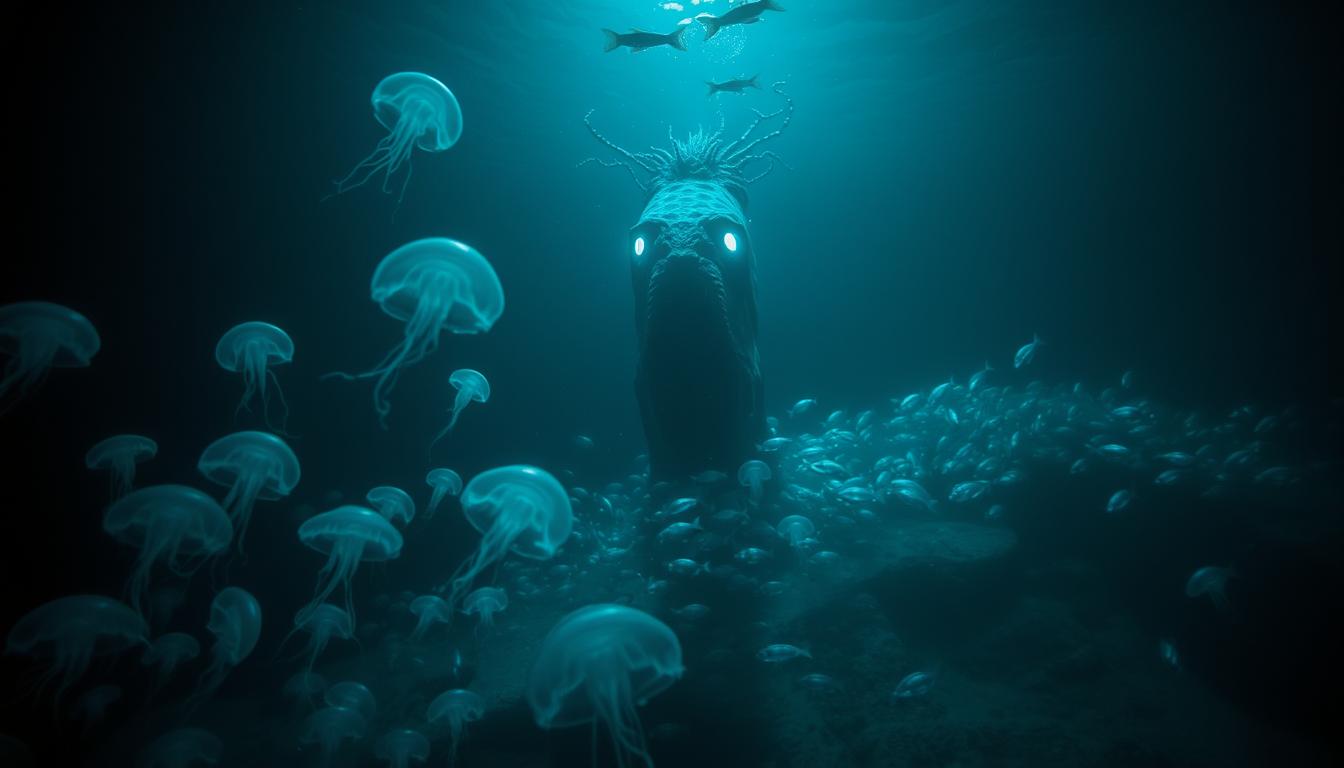
Earth’s oceans are home to hidden worlds. Here, mysterious sea animals live in total darkness. Creatures like the gulper eel and vampire squid thrive in these deep-sea mysteries below 200 meters.
Most of Earth’s habitat is in these depths, but it’s mostly unexplored. Only about 5% of the ocean has been studied. This means many species are yet to be found.
Creatures like the Johnson’s abyssal seadevil live in places where sunlight never reaches. They have evolved strange traits to survive the crushing pressures and extreme cold.
New technologies are now uncovering ocean mysteries. DNA studies have solved mysteries like the 184-year-old Cerataspis monstrosa. Each discovery shows how life can thrive in the deep.
Overview of Deep Sea Mysteries
Earth’s ocean depths are full of secrets that science is just starting to uncover. Despite covering 70% of our planet, the ocean is one of the last unexplored places. Deep sea exploration shows how creatures live under pressures 1,000 times higher than at the surface. In the dark depths, life finds ways to thrive.
Marine biology explores life near hydrothermal vents, where 2°C waters support life without sunlight. The hadal zone, below 6,000 meters, is home to giant tubeworms and clams. Yet, only 1% of the seafloor is mapped, leaving much to discover.
New submersibles aim to explore 99% of the ocean depths. They are finding lifeforms scientists never thought existed. Each dive brings new wonders, like whale falls feeding 400 species or massive coral forests.
With two-thirds of seafloor life unknown, each expedition teaches us more about life’s strength. As technology improves, these deep sea exploration missions reveal the importance of these ecosystems. They show us the endless stories hidden in the uncharted abyss.
The Creatures of the Abyss
Thousands of meters below the surface, abyssal creatures live in a world without light or warmth. At the Mariana Trench, the pressure is 1,000 times that of sea level. Yet, their bodies and proteins help them survive.
The sea pig, looking like a translucent starfish, moves with hydraulic legs. The giant siphonophore, 40 meters long, drifts like a living chain. These deep ocean animals face cold temperatures and darkness, but they adapt.

Bioluminescence lights their dark world. Many creatures glow to hunt, communicate, or hide from predators. Near hydrothermal vents, tube worms and shrimp live without sunlight, feeding on chemicals from Earth’s core.
Even with ROV dives reaching 6,000 meters, 90% of abyssal species are unknown. The 2016 Okeanos expedition found a ghost fish at 2,500 meters and discovered 1,000 new species yearly. With 80% of the ocean unmapped, the deep ocean is full of secrets.
The Enigmatic Giant Squid
The giant squid (Architeuthis dux), a deep sea squid, has long been a symbol of oceanic mystery. Unlike the colossal squid, its larger cousin, sightings remain rare. In 2007, a 1,090-pound colossal squid was caught in the Ross Sea, yet live encounters with either species are scarce.
Breakthroughs came in 2004 when the first live giant squid photo was captured. By 2010, scientists filmed one in its habitat, revealing behaviors hidden for centuries. These cephalopods thrive at 200–1,000 meters, where sunlight fades into eternal darkness.
With eyes up to 10 inches wide—the largest in the animal kingdom—giant squids hunt in the abyss. Their battles with sperm whales leave scars on both predator and prey. Colossal squids possess claw-like hooks, while giant squids rely on bioluminescence to lure prey.
“Their eyes are like flashlights in the deep,” said deep-sea researcher Dr. Steve O’Shea, highlighting adaptations to extreme conditions.
Recent discoveries include a 2019 Gulf of Mexico sighting and a 14-foot specimen in New Zealand. Genetic studies reveal their genome holds 2.7 billion DNA base pairs—nearly matching humans. Over 100 protocadherin genes suggest advanced neural complexity for survival in the dark.
Despite centuries of searching, giant squids remain enigmatic. Each discovery—like the 2010 video—fuels curiosity about these deep-sea giants.
The Unseen Universe of Microbial Life
Giant squid and deep-sea fish get all the attention, but microscopic ocean life is thriving in the dark depths. Marine microbes and deep sea microorganisms are the backbone of ocean ecosystems. They drive processes essential for all life. These tiny beings, including ocean bacteria and archaea, live in places where sunlight never reaches.

At hydrothermal vents, chemosynthetic bacteria turn minerals into energy. This creates lively ecosystems in the deep. Dr. Sarah Hu of Texas A&M University is studying how these microbes fuel food webs. Her NSF-funded research shows their role in carbon cycling.
Her team’s experiments reveal how microbes like methane-eating archaea stop greenhouse gases from escaping. This is important for our planet’s health.
Some ocean bacteria team up with creatures like anglerfish. They provide bioluminescent lures to catch prey. These tiny partnerships show nature’s cleverness in solving survival challenges in the dark.
Deep sea microorganisms even live in waters hotter than boiling. They thrive in extreme conditions where pressure is crushing and it’s dark.
Despite being invisible, these microbes are key to our planet’s climate and ocean health. They consume methane and recycle nutrients, supporting life far beyond the deep. As scientists like Dr. Hu learn more, we see how these tiny lives hold secrets to Earth’s past and future.
Remarkable Deep Sea Fish
Deep sea fish have evolved to live in extreme conditions. The gulper eel is a great example. It can open its mouth wide to eat prey bigger than itself. Its jaws stretch like elastic nets.
These deep sea predators live in total darkness. They use other senses to find food.
The anglerfish uses light to catch prey. It has a glowing lure on its head. This lure attracts prey into its jaws.
Its stomach can expand to hold lots of food. This helps it survive in areas where food is scarce.
Other fish, like the barreleye, look up through transparent skulls. The fangtooth fish have huge teeth for their small bodies. These fish show that life can exist in the deepest parts of our planet.
Mysterious Deep Sea Habitats
Under the waves, Earth has some amazing deep sea ecosystems. Hydrothermal vents, with hot water rich in minerals, are home to many creatures. They live without sunlight, thanks to chemosynthesis.
These vents are filled with giant tubeworms and shrimp without eyes. Nearby, cold seeps release methane and sulfur, creating special environments. These areas are found off the U.S. West Coast and support unique life forms.

These ocean floor habitats show us new ways life can exist. At the Von Damm Vent Field, there are towering mineral spires 75 meters high. They are home to species that don’t need sunlight.
Even whale falls, or sunken whales, become temporary homes for life. They feed special organisms for years. These places help us understand how life can survive and even thrive in harsh conditions.
But, over 80% of the seafloor is unexplored. Hydrothermal vents alone have 100,000 times more life than the surrounding waters. These cold seeps and vents teach us about survival and Earth’s history.
Yet, they are at risk from deep-sea mining. Each new discovery shows us how much we don’t know. The deep sea is full of secrets, where darkness supports life in incredible ways.
Sharks: Guardians of the Deep
Deep sea sharks have survived for millions of years. The frilled shark, unchanged for ages, shows the power of evolution. They’ve lived longer than trees and made it through five mass extinctions, including the one that wiped out dinosaurs.
Sharks have adapted to life in the dark depths. The goblin shark uses a spring-loaded jaw to catch prey. Wobbegongs, with their tasseled skin, blend in with the seabed.
Angelsharks, with bodies like rays, sneak up on their prey. These rare sharks show how life can adapt over time.
Despite living in the dark, sharks face dangers today. Overfishing harms their slow growth. But their ancient DNA offers insights into life’s ability to survive. Sharks keep the balance in dark and sunny ecosystems alike.
The Legendary Deep Sea Creatures
For thousands of years, tales of sea monsters and mythical marine animals have captivated us. Cryptozoology, the study of unknown creatures, shows how science backs up these legends. The giant squid, once a sailor’s story, was proven real in 2002 when it was filmed.

Oarfish, long fish that can grow up to 36 feet, might have inspired sea serpent myths. They live in deep waters and are rarely seen near shore, sparking curiosity. The 1934 “surgeon’s photograph” of the Loch Ness Monster was a big hoax.
Today, cryptozoology is about real discoveries like the hoodwinker sunfish, found in 2017. Yet, 75% of Earth’s oceans are unexplored, leaving room for more surprises.
Every mythical marine animal, from the kraken to the sea monsters on old maps, reminds us of nature’s secrets. As technology improves, each find makes the line between myth and reality blur. The ocean’s depths hold answers to old legends and new ones yet to be discovered.
Ocean Exploration Technologies
Modern underwater exploration uses advanced deep sea technology to explore Earth’s depths. From the 1960 bathyscaphe Trieste’s dive to today’s robots, innovation leads the way. Manned submersibles like Alvin found hydrothermal vents in 1977, reaching up to 3,600 meters.
Now, ROVs like the Deep Discoverer lead the exploration. This robot, run by the Global Foundation for Ocean Exploration, dives to 6,000 meters. It has seven-jointed arms and high-def cameras, collecting samples in extreme pressure.
Robotic advancements allow scientists to study cold, dark ecosystems. The DSV Limiting Factor dives to 10,928 meters, finding life near 400°C vents. Autonomous AUVs map the seafloor and collect DNA from seawater.
Tools like the Deepsea Challenger’s vessel can handle extreme conditions. As technology improves, we uncover secrets like the Galápagos Rift’s seafloor spreading. Every new tool brings us closer to understanding the 95% of oceans yet to be explored.
Conservation of Deep Sea Wonders
Protecting the deep sea’s fragile ecosystems is urgent. Deep sea conservation faces challenges from ocean threats like mining and climate change. Slow-growing coral and rare fish need our help to survive.
Most of the ocean is unexplored, yet it’s already harmed. Bottom trawling has led to a 99% decline in deep-sea fish in 30 years. Species like the giant squid, living in darkness, are threatened by pollution and habitat loss.
“Every species in the deep holds secrets to life’s resilience. Losing them means losing medical breakthroughs and ecological balance.” – Pristine Seas Research Program
Initiatives like the Argonauta sub’s eDNA sampling and marine reserves offer hope. These efforts help map biodiversity in unknown areas. We need international policies that balance exploration with preservation.
Every action, big or small, helps protect the deep sea. By supporting conservation, we ensure future generations can explore and learn from Earth’s last frontiers.
Conclusion: Embracing the Mysteries of the Deep Sea
Humans have barely explored Earth’s final frontier—the ocean. More than 80% of the seafloor is uncharted, hiding many species and ecosystems. With tools like ROVs and AUVs, we’re discovering life in extreme conditions.
Every new find changes how we see life. Places like hydrothermal vents and cold seeps show life without sunlight. But, mining and pollution threaten these worlds before we fully grasp them.
Working together is key. Scientists and leaders must balance discovery with care. By using ethical methods and protecting areas, we can learn more while preserving the deep sea.
The future of ocean exploration is exciting and challenging. Each dive reveals new wonders, showing there’s much to discover. As technology improves, so does our responsibility to explore with care. The deep sea’s secrets are a treasure we must protect for all to enjoy.