
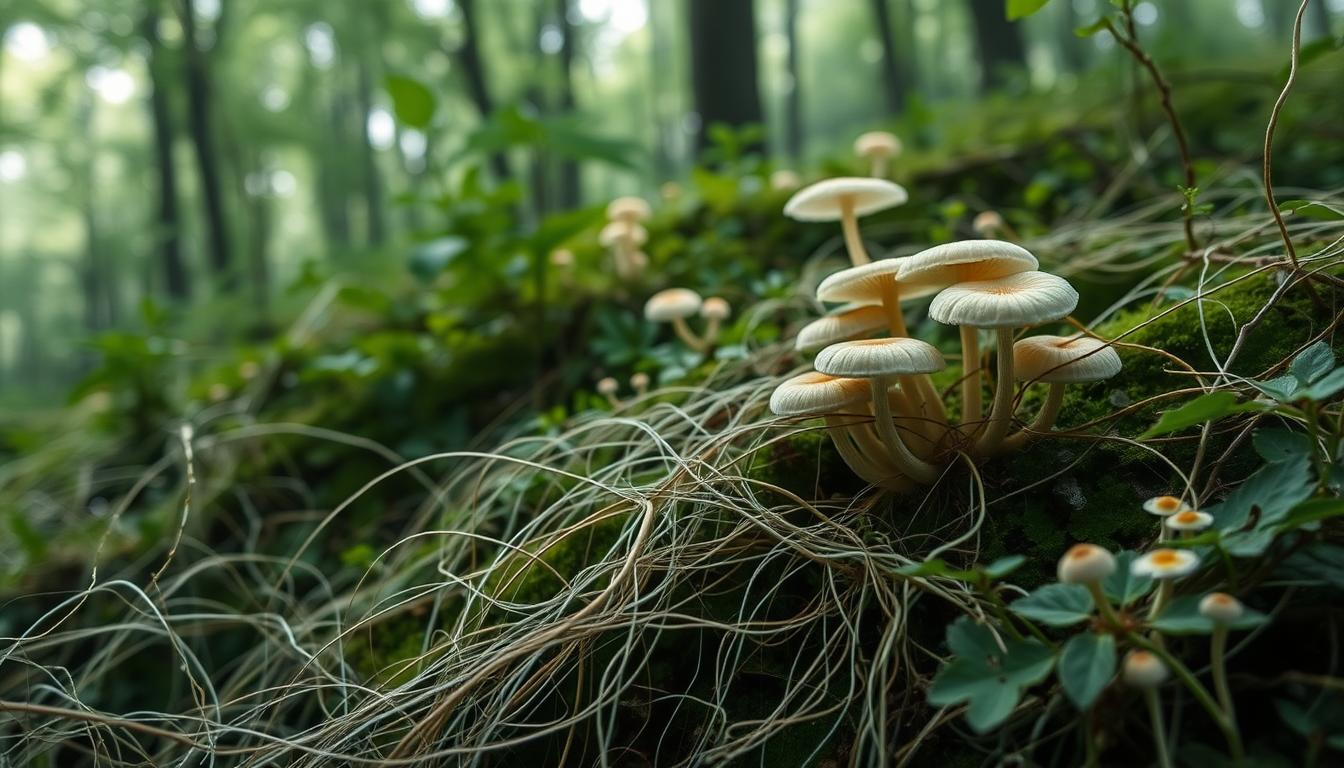
Recent studies show fungi use electrical signals like humans do. Researchers at the University of the West of England found fungal networks have patterns like 50-word “vocabularies.” These patterns match human language structures.
These networks, vast underground systems in forests, act as living communication highways. They send impulses through threadlike hyphae. This challenges old ideas about how organisms think, showing even those without brains can solve problems through electrical “conversations.”
Studies on species like Phanerochaete velutina show fungi change their growth based on their surroundings. When faced with wooden blocks, their electrical firing rates went up. This shows fungi can solve problems.
These findings, published in Fungal Ecology, change how we see nature’s hidden networks. Fungi’s silent language might be Earth’s oldest form of smart collaboration. They break down wood and guide bacteria.
Understanding Fungi Intelligence
Scientists are changing how we think about intelligence. They now see it as more than just brains and neurons. Fungi use mycelium brain networks, made of thick hyphae webs, to process information.
These distributed intelligence systems let fungi make decisions without a central nervous system. Studies show fungi can solve problems like finding food or avoiding obstacles.
A 2023 study in Fungal Ecology found that Phanerochaete velutina mycelium kept shapes like circles for months. This fungal decision-making helped them avoid crowded areas, showing they can make smart choices. Electrical signals move through hyphae, creating a non-neural intelligence system.
Fungi “remember” past conditions, adjusting their growth to survive. This shows they can adapt and learn.
These networks show fungal cognition by balancing resource use and threat responses. Unlike animal brains, their intelligence spreads across vast underground systems. This challenges old ideas about what “thinking” means in nature.
By studying these systems, researchers explore how life can solve problems without a brain.
Mushroom Communication Methods
Recent studies show fungi have complex ways to share info. They use hyphal networks to send electrical signals. These signals create fungal language patterns similar to human speech.
Researchers found up to 50 different “words” in these signals. The split gill fungus (Schizophyllum commune) shows the most complex signaling.

Fungal electrical signals talk about food, threats, and growth. These signals vary in strength and timing. They form sentences in mycelial communication webs.
A 2022 study found 15-20 recurring signals. These signals act like common phrases in fungal “vocabularies.” Fungi also use chemicals to communicate, like pheromones to attract mates or trick insects.
“Fungi exhibit spatial reasoning and short-term memory, suggesting sophisticated communication,” noted biologist Nicholas P. Money in 2021.
Mycorrhizal networks connect plant roots, enabling nutrient swaps and warning systems. When one plant faces pests, connected neighbors defend themselves. The Humongous Fungus in Oregon, spanning 10 sq km, shows how vast hyphal networks can coordinate ecosystems.
These systems, evolving over a billion years, shape forest health and resilience.
The Role of Fungi in Ecosystems
Fungi are like Earth’s hidden lifelines. The wood wide web connects trees, sharing nutrients and survival signals. It guides sugars from strong trees to weak saplings, keeping forests diverse.
Underground, soil mycelium breaks down dead matter. It recycles carbon and minerals, making them useful again. Without fungi, trees would starve, and forests would lose strength.
Fungi help forests survive drought by moving water and sending danger signals. They even “learn” from stress, adapting faster to heat after facing it before. This makes forests stronger.
The wood wide web also fights off invasive species, keeping native plants in balance. This keeps forests healthy and diverse.
These networks are not just passive. Mycelium can sense obstacles and grow around them. It branches out to absorb nutrients, making forests resilient. Fungi are not just decomposers; they are ecosystem architects.
Problem-Solving Abilities of Fungi
Fungi show amazing fungal problem-solving skills without a brain. Slime molds, like Physarum polycephalum, solve mazes quicker than humans. They create efficient networks, inspiring new ways for logistics and AI.

Mycelium networks make smart choices about resources. In cross-shaped setups, fungi grow towards outer blocks. This helps them plan better for the future.
In circular setups, they avoid the center. They focus on areas with more resources. This shows their ability to map and adapt to their environment.
Fungi also solve fungal maze solving challenges by adapting to obstacles. White rot fungi break down plastics with special enzymes. They even remember their growth paths, guiding decisions over large areas.
Studying fungi gives us clues for solving big global problems. From cutting carbon emissions to smarter cities, fungi’s abilities inspire us. As adaptive mycology grows, fungi keep surprising scientists with their problem-solving skills.
Fungi and Their Impact on Agriculture
Modern agricultural mycology brings new ways to grow food. Mycorrhizal farming uses fungi and plant roots to help each other. A 2008 study found strawberry yields went up 17% with these partnerships.
Peppers also saw a 23% increase in fruit after being linked to fungi. These fungi help plants get phosphorus, zinc, and copper, as the Rodale Institute found.
Switching to organic farming is hard. Sri Lanka’s 2022 ban on chemical fertilizers led to a drop in tea yields. It shows rebuilding soil health takes years.
Companies like Dynomyco now offer mycorrhizal inoculants to U.S. farmers. This boosts crops like cannabis. These methods reduce the need for synthetic inputs, supporting sustainable fungal agriculture and protecting soil biodiversity.
Fungal biocontrol fights pests without chemicals. Myco-remediation breaks down pollutants, cleaning soils contaminated by pesticides. Yet, fungal diseases destroy 20–40% of global crops yearly.
Using fungi’s natural abilities could save enough food to feed 600 million annually. By embracing these partnerships, farms can reduce losses and fight climate-driven disease spread.
Global crop systems face threats like wheat stem rust spreading to England. Sustainable fungal agriculture offers solutions based on nature’s intelligence. Farmers adopting these techniques build resilient ecosystems that nourish both soil and harvests.
Fungi’s Role in Climate Change Mitigation
Fungi are nature’s hidden climate heroes. They trap carbon in soil for decades through fungal carbon sequestration. Mycorrhizal fungi produce glomalin, a protein that binds carbon into soil, storing it for centuries. This turns forests and farmlands into powerful carbon sinks.

Scientists are using mycelium climate solutions to fight pollution. Mycoremediation uses fungi like Trametes versicolor to clean up oil spills and pesticides. In lab trials, this oyster mushroom degraded 52% of grape stalk lignin in 42 days.
White rot fungi can digest lignin, unlocking stored carbon without releasing CO2 too soon.
Every year, 181.5 billion tons of lignocellulosic waste are generated globally—only 4.5% is used. Fungi’s fungal decomposition powers recycling of this biomass. Species like Phanerochaete chrysosporium turn agricultural waste into fertile soil while reducing methane emissions from landfills. Their enzymes break down plastics and dyes in polluted waterways.
Emerging environmental mycology projects show promise. In permafrost regions, Helotiales fungi activate ancient carbon cycles, preventing greenhouse gas releases. By studying these microscopic networks, researchers design strategies to harness fungal intelligence for cleaner air and soil. Every forest, farm, and lab becomes a front line in this underground climate battle.
The Future of Mycology Research
Advanced mycology is breaking new ground as scientists dive into fungal research. Imperial College London found that psilocybin boosts brain connections in depressed patients. This shows how fungal compounds could change mental health care.
This breakthrough is a great example of how fungi inspire medical innovation. It combines biology and technology in new ways.
“Increased brain connectivity lasting up to three weeks”
Fungal network technology is now using AI to understand mycelial networks. This reveals how fungi solve problems. Mycelium innovations, like self-healing materials and eco-friendly composites, are starting to appear.
Companies are testing mycelium-based packaging, which cuts carbon footprints by 30% compared to plastics. These materials use nature’s blueprints, showing how fungi optimize resource use.
Researchers are also studying fungal biodiversity. They think there are over 5.1 million species, many yet to be discovered. Tools like high-throughput sequencing help find new species every day.
These discoveries could lead to new agrochemicals or bioremediation solutions. For example, Trichoderma harzianum can make antibacterial nanoparticles. This shows fungi can fight superbugs.
But there are ethical questions to consider. Do fungi have sentience? How do we balance innovation with conservation? These questions will guide future policies.
While we ponder these questions, labs are working on decentralized computing systems inspired by mycelial networks. These systems often outperform human-made designs, showing nature’s solutions are powerful.
Real-Life Examples of Fungal Intelligence
Slime mold experiments show amazing problem-solving skills. In a famous study, Physarum polycephalum, a brainless organism, mapped out Tokyo’s rail network. It was fed oat flakes like city centers. This mycelium decision-making showed routes as good as human-made ones, proving fungi’s smart spatial thinking. 
Maze tests show slime molds solve puzzles quicker than humans. When faced with U-shaped barriers, 96% of them found food shortcuts without knowing beforehand. Their skill to retract unproductive paths is like human neural pruning—a trait now studied for AI. These examples show nature’s design without a nervous system.
Medical breakthroughs like psilocybin therapy are examples of mushroom cognition. Studies show it boosts brain connectivity for weeks, helping with depression. Unlike drugs, it strengthens neural pathways, opening new mental health tools. Such uses could change medicine and environmental cleanup.
Forests use mycorrhizal networks to share resources, helping trees survive. In Canada, researchers used these systems to restore burned forests, boosting seedling survival by 40%. Also, oyster mushrooms clean up oil spills, and mycelium breaks down plastic. These show fungi’s practical uses for pollution solutions.
The Importance of Fungal Biodiversity
Fungal biodiversity is key to solving global problems. Yet, over 90% of Earth’s fungal species are unknown. Only 8% have been named, with just 358 assessed for conservation by the IUCN. This lack of knowledge risks losing the genetic blueprints of ecosystems.
It’s critical to protect mycelial networks. Mycorrhizal fungi alone store carbon worth over $52 trillion. A single teaspoon of soil can have mycelium stretching 100 meters. Yet, only 1% of medicinal fungi have their conservation status documented, with 2 already endangered. Traditional knowledge, like Indigenous practices using fungi for healing, offers clues to sustainable coexistence.
Mushroom conservation must go beyond just counting species. It’s about protecting communication patterns. Electrical “vocabularies” in enoki and other fungi hint at untapped problem-solving abilities. Protecting these networks could unlock innovations in medicine—penicillin’s $2 billion market shows their economic value. But with 92% of tree species relying on fungal symbiosis, preserving mycological diversity isn’t just about ecology—it’s about preserving nature’s intelligence.
“Fungi are Earth’s original network engineers.”
Efforts like sequencing the 148,000 known species and valuing fungal carbon sequestration at $24 trillion show urgency. Without action, humanity risks losing libraries of evolutionary knowledge stored in mycelium—a loss felt in medicines, agriculture, and climate resilience.
How to Get Involved with Fungal Research
Exploring fungal intelligence doesn’t need a lab coat. Amateur mycology is for anyone curious. Join citizen mycology projects like Fungal Observation Notes or iNaturalist to map local species. Upload photos and help scientists track biodiversity—over 1.5 million fungal species remain unstudied, and your data matters.
Start with mushroom growing kits. Grow oyster or turkey tail mushrooms to observe mycelium’s problem-solving. Try simple experiments: place food sources in mazes to see how mycelium navigates. These hands-on fungal observation methods mirror studies in Fungal Mycology, where mycelium’s information-sharing networks were mapped in wood blocks. Tools like microscopes or timelapse cameras let you document growth patterns.
Deepen your knowledge through mycology education. Books like Mycelium Running by Paul Stamets or online courses from universities provide foundational skills. Podcasts like “Fungi Perfecti” and documentaries like King of the Mushroom Forest offer insights. Track advancements in mycoremediation or biodegradable packaging projects to see real-world impacts.
Whether growing mushrooms or analyzing data, every contribution helps uncover fungi’s hidden world. With 95% of species yet to be studied, there’s room for everyone—from gardeners to tech enthusiasts—to shape the future of mycology. Your curiosity could unlock solutions for agriculture, climate, or even new materials. The amateur mycology movement shows that even small steps fuel big discoveries. Grab a spore print kit or join a local group today.