
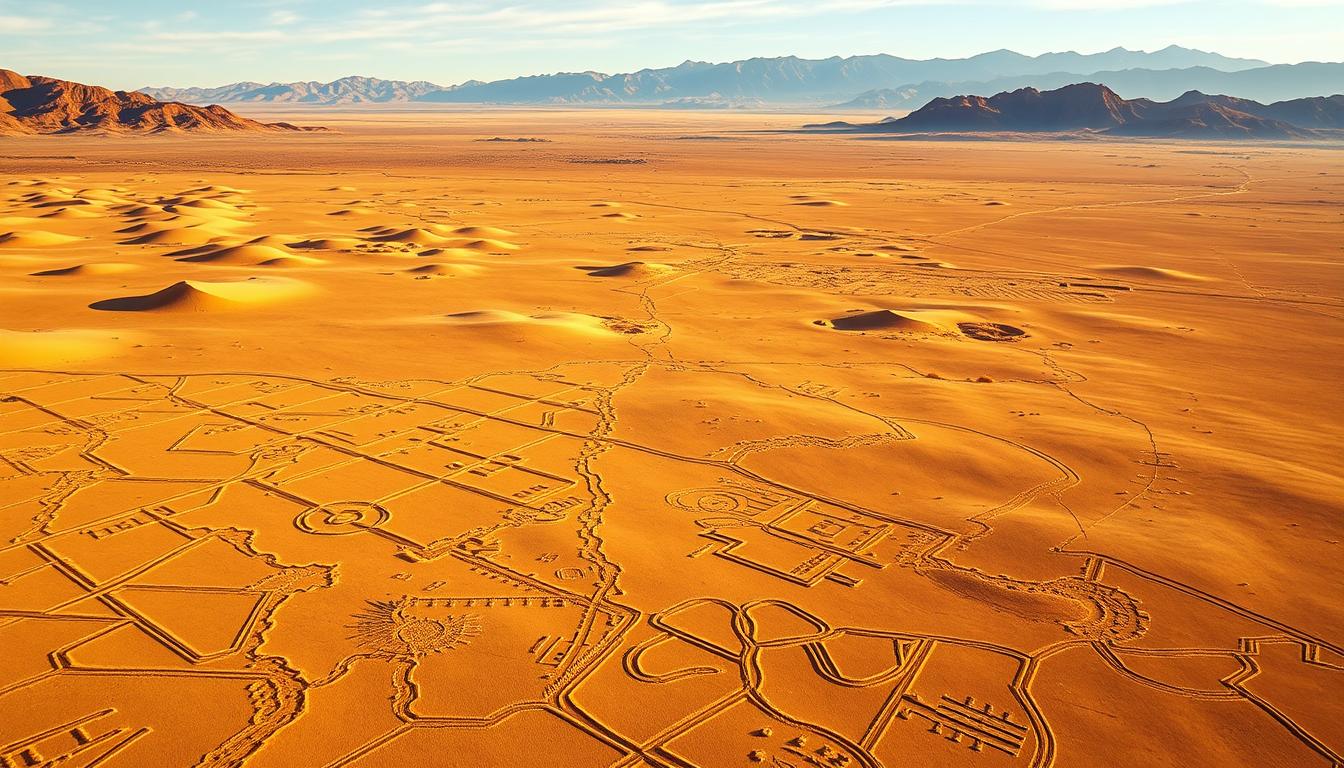
The Nazca Lines in Peru stretch across the desert like giant puzzles. Over 700 figures, including monkeys, birds, and shapes, were carved into the soil 2,500 years ago. These lines, up to 1,200 feet long, are a UNESCO World Heritage Site. But why were they made to be seen only from the sky?
Created between 500 BC and 500 AD, the Nazca Lines cover nearly 19 square miles. The dry climate has preserved them for millennia. But what was their purpose? Were they celestial maps, sacred rituals, or something else? Let’s uncover the secrets of a long-lost civilization.
Introduction to the Nazca Lines
The Nazca Lines are a mystery in the Peruvian desert. They are a huge collection of geoglyph figures that have fascinated people for years. Over 1,300 km of lines and shapes cover 19 square miles of the Pampas de Jumana.
This area is a high, dry plateau between Nazca and Palpa. The designs include long straight lines, complex spirals, and detailed animal figures. You can see a 360-foot monkey and a 935-foot pelican among them.
The Nazca civilization made these designs between 200 BCE and 600 CE. They were created long before the Inca Empire. Some geoglyphs might even go back to the Paracas culture.
The spider, hummingbird, and condor figures show amazing skill. They were made by removing weathered rock to reveal lighter soil beneath. The dry climate has kept these geoglyph figures in great shape for so long.
Researchers like Maria Reiche have studied these lines for decades. Projects like the Nasca-Palpa initiative are also uncovering more secrets. Today, the Nazca Lines are a UNESCO World Heritage Site. They invite visitors to wonder about their purpose and the creativity of the Nazca civilization.
The Theories Behind Their Creation
Discovered in the 1940s, the Nazca Lines theories have sparked endless debate. Paul Kosok, a pioneer in , first noticed the lines’ alignment with the sun during the winter solstice. He called them the “largest scale calendar in the world,” linking them to . His student, Maria Reiche, later expanded this idea, suggesting animal figures mirrored constellations visible in the night sky.

Other theories suggest the lines were for survival in the desert. Johan Reinhard proposed the geoglyphs were sacred paths for rituals honoring mountain gods linked to water. This makes sense in a region receiving less than an inch of rain yearly. Donald Proulx and Stephen Mabee added that some lines might map groundwater sources, supported by nearby “Puquios”—ancient underground aqueducts.
Modern analysis shows the Nazca people used ropes and stakes to carve lines up to 30 miles long. Over 300 biomorphs, like the 1,200-foot hummingbird, may symbolize fertility in a harsh climate. While no single theory fully explains the mystery, each Nazca Lines theories highlights human ingenuity in one of Earth’s driest landscapes.
Cultural Significance of the Nazca Lines
The Nazca Lines show the Nazca culture’s deep spiritual and social beliefs. A 2011 discovery found a small decapitation scene, hinting at rituals. These rituals were about collecting “trophy heads.”
Studies from 2009 showed these practices were part of local traditions, not external conflicts. The geoglyphs, like the 1,200-foot-long monkey, were sacred spaces. They honored nature deities and ancestors.
These designs also had political roles. Projects like 30-mile-long straight lines showed elite authority and communal unity. Today, the lines are a key part of Peru’s national Peruvian heritage. They draw millions to marvel at their mystery. Yet, challenges like 2018’s truck damage remind us of their fragility.
Modern research, including drone-discovered glyphs from 2018, uncovers new layers of the Nazca culture’s artistry. Debates over their exact meaning continue. Yet, these lines remain a bridge between ancient practices and Peru’s cultural identity. Protecting them ensures future generations can explore this pre-Columbian art legacy, blending science and reverence for a civilization’s legacy.
How the Nazca Lines Were Made
The Nazca Lines were made using a smart process that took advantage of the desert’s unique features. Ancient engineers removed a layer of iron-rich pebbles, revealing lighter sand underneath. This made the figures stand out when viewed from high up.
The dry, windless climate helped keep these desert geoglyphs intact for over 1,500 years. It preserved the details in the dry soil.

There were two ways to create the designs. For outline figures, like the 935-foot pelican, they only cleared rocks along the edges. For filled figures, like the 443-foot condor, they removed pebbles over the whole shape.
Teams used ropes, stakes, and grids to make large designs from small models. Ancient engineering was based on math and teamwork, not fancy tools. Even big animals, like the 360-foot monkey, were drawn with simple materials, as Joe Nickell showed.
Without the ability to see from the air, builders marked points along lines on the ground. They connected these points to create the designs. The spider geoglyph, 150 feet long, is a testament to their precision and teamwork.
The Nazca people’s understanding of geometry and the land allowed them to create art that spanned vast distances. Their creativity turned the desert into a canvas, showing that monumental art can exist without modern technology.
Modern Technology and the Nazca Lines
Modern Nazca Lines research is changing how we see history. Drone archaeology and AI archaeology are leading the way. In 2019, a team from Yamagata University and IBM Japan used AI to find 143 hidden geoglyphs.
By 2024, they found 303 more, doubling the known number. They used machine learning to analyze satellite images. These discoveries date back to 200 BC, showing how ancient cultures changed.
Researchers now use drones to scan the 400-square-kilometer plateau in days. Before, it took years. AI makes geospatial data analysis 21 times faster.
Drones take high-resolution images, and algorithms find patterns humans can’t see. In 2024, they found a 5-meter humanoid, a 19-meter fish, and a 17-meter bird with detailed legs. These were missed for centuries.
These technologies also help protect the site. 3D scans and VR models let scientists study without harming the geoglyphs. The 303 new finds show a culture more complex than we thought.
From parrots to decapitated heads, each glyph has a story. These stories are preserved thanks to modern innovation.
Conservation Efforts for the Nazca Lines
Keeping the conservation of Nazca Lines safe is a big challenge. They were named a UNESCO World Heritage Site in 1994. But, they face dangers from the weather and human mistakes.
The dry desert helped keep the lines safe for 1,500 years. But, storms and human actions have caused damage. In 2009, rainwater from the Pan-American Highway flooded parts of the site, smudging the lines.
Five years later, Greenpeace activists left footprints near the hummingbird geoglyph. These marks damaged the desert varnish, a thin layer that took millennia to form. Even a truck that went off-road in 2018 left permanent scars.

To protect this UNESCO World Heritage Site, strict rules and drones are used. Authorities watch over the 174-square-mile area to stop people from entering without permission. Environmental protection plans also deal with the effects of climate change.
Local guides teach visitors how to respect the site. International teams use 3D mapping to record every detail. They want to keep the 1,000+ figures, like the 285-foot pelican and 450-foot condor, safe for future generations.
Every step, whether from rain or people, can erase 2,000 years of history. Saving these ancient symbols of ingenuity needs the world’s attention and care.
Visiting the Nazca Lines
Exploring the Nazca Lines is a top highlight of Peru travel. The best way to see the geoglyphs is by taking Nazca flights. These flights give a stunning aerial view Nazca of the ancient designs.
Flights last 30–90 minutes and show off the monkey, spider, and hummingbird figures. If flying isn’t possible, the Nazca Lines tourism scene has the Torre Mirador. It’s a 43-foot tower near the Pan-American Highway that shows some figures.
New elevated platforms also let you see some areas up close without harming the site.
Visit during the dry season (May–October) for better skies and cooler weather. Early mornings are best for smoother flights. Companies like Nazca Tour Peru or Andean Travel Agency offer Nazca flights with English guides.
Tickets cost $70–$120, depending on the operator. Always check reviews and safety certifications before booking.
On the ground, stay on marked paths to avoid damaging the site. The spider geoglyph and the 450-foot condor figure are must-sees. Nearby, the Cantalloc Aqueducts show the Nazca culture’s cleverness.
Respect the UNESCO-protected site by not touching the ground. Support conservation by choosing certified tours.
Impact on Local Economy
Peruvian tourism has made Nazca a world-famous spot, boosting the local economy. The area now relies on visitors who want to see the ancient geoglyphs. Hotels, restaurants, and tour guides do well as people explore the lines by air or on foot.
Money from tourism helps families and small businesses in the area. This income is key for their survival.
Tourism creates jobs and brings in money, but it also has its downsides. Businesses face tough times when there are fewer visitors. The huge area of geoglyphs draws many, but it also puts a strain on the infrastructure and the environment.
There’s a push to grow tourism in a way that doesn’t harm the environment. This effort is about finding a balance between growth and preservation.
Local communities keep their traditions alive through festivals and crafts. This connects cultural tourism to their heritage. Artisans sell items like textiles and pottery that tell stories of their ancestors. This exchange makes visitors’ experiences richer and helps locals make a living.
Steps are being taken to protect the site, like strict rules and eco-friendly practices. UNESCO recognized the Nazca Lines as a World Heritage site in 1994. The Peruvian government wants to see more visitors, aiming for 7 million by 2021.
Projects now focus on long-term benefits without harming the desert. This is a big step towards sustainable development.
“Balancing tourism growth with environmental care ensures the Nazca Lines endure for future generations.”
The Nazca Lines have a big impact on jobs and cultural pride. As Peru’s cultural sites get more attention worldwide, it’s important to use responsible strategies for the future.
The Nazca Lines in Popular Culture
The Nazca Lines have sparked endless imagination, with many believing in the ancient aliens theory. Erich von Däniken’s 1968 book Chariots of the Gods? suggested the geoglyphs were UFO landing strips. Despite scientists like Maria Reiche calling it pseudoscience, the idea lives on in movies, books, and online discussions.
“The lines were made by human hands, not aliens,” argued Reiche, who spent decades studying the site. Her work disproved von Däniken’s claims, showing Nazca builders used simple tools.
Today, popular archaeology goes beyond just speculation. Documentaries like National Geographic’s Mysteries of the Nazca Lines explore theories about rituals and water worship. Even video games like Assassin’s Creed: Valhalla feature Nazca-inspired puzzles, mixing history with fun.
Archaeological mysteries continue to fascinate people. The 2019 discovery of 143 new geoglyphs, including some found by AI, made big news. These finds show how interest in the Nazca Lines drives real research, separating fact from fiction.
The Nazca Lines media legacy is vast, inspiring both curiosity and creativity. Yet, their true story—human achievements rooted in culture and environment—is just as captivating as any alien tale.
Ongoing Research and Discoveries
Recent breakthroughs in Nazca Lines discovery have revealed hundreds of new geoglyphs. This has changed how we see these ancient artworks. A 2024 international archaeology project used AI and drones to find 303 hidden figures.
This effort by teams from Japan, Peru, and the U.S. nearly doubled the known geoglyph count. From 430 to 733 in just six months. Advanced AI analysis made these discoveries 20 times faster than before.

In 2019, Japanese researchers found many bird figures looked like exotic species. This suggested cultural exchanges. A 2020 discovery—a cat-shaped geoglyph on a steep hill—showed how erosion hid designs for decades.
The new geoglyphs, some dating to 200 BC, show scenes of daily life and rituals. This indicates a cultural shift from earlier times. Images of humans with decapitated heads and camelids suggest connections between communities once thought isolated.
Now, modern tech like multispectral imaging and ground-penetrating radar reveal clues buried for millennia. Researchers think thousands more geoglyphs are waiting to be found. The Nazca Lines discovery journey continues, proving these ancient lines have stories yet to be told.
Why the Nazca Lines Remain a Mystery
The mystery of the Nazca Lines has lasted for decades. Over 800 lines and 70 biomorphs cover 310 square miles. Yet, their purpose remains unknown to scholars.
The Nazca people left no written records. Spanish chroniclers also didn’t shed much light on their traditions. Archaeologists must gather clues from landforms, soil, and faint history.
Alberto Rossel Castro proposed three possible uses: irrigation guides, ritual pathways, or astronomical markers. But this theory doesn’t explain all the designs. Some lines stretch for 30 miles with incredible precision.
Studies by Johan Reinhard and David Johnson suggest links to ancient water rituals. But solid proof is hard to find.
Modern technology has uncovered new details but also raised more archaeological puzzles. Gerald Hawkins’ 1968 study rejected celestial alignment theories. Maria Reiche’s work and Earthwatch experiments showed the lines could be made quickly.
Yet, their purpose remains a mystery. With over 300 geometric shapes and 41 documented ceque systems, the unsolved mysteries grow. Theories clash, leaving us with more questions.
These ancient symbols are a riddle from a culture that thrived 1,500 years ago. Their survival in Peru’s dry climate preserves the art but silences the creators’ voices. The Nazca Lines challenge us to keep exploring their secrets.
Conclusion: Unraveling the Mysteries
The Nazca Lines in Peru’s desert are over 2,000 years old. They show human creativity and cultural heritage. Despite years of study, their true purpose is a mystery.
Archaeologists found they were made by removing rocks to show lighter soil. The dry climate helps keep them safe, with only 20 minutes of rain a year. These designs, covering 50 kilometers, show over 800 figures, hinting at rituals tied to water and the sky.
Today, we use satellites and drones to find new lines. But, we’re not sure if they were for rituals, to guide the stars, or to find water. Protecting these designs is key, balancing tourism with preservation.
150,000 visitors a year help local economies but can harm the lines. We have special areas off-limits and watch the climate to protect them. This way, they can last for generations to come.
Researchers are looking into links between the lines and Nazca’s water systems or the stars. But, the Nazca Lines’ secrets are not all revealed. Their lasting power shows human creativity and cultural legacy, sparking curiosity for ages.
These ancient designs, seen from planes or studied by satellites, remind us of the ongoing mystery. Every new discovery brings more questions, keeping the Nazca’s story alive.