
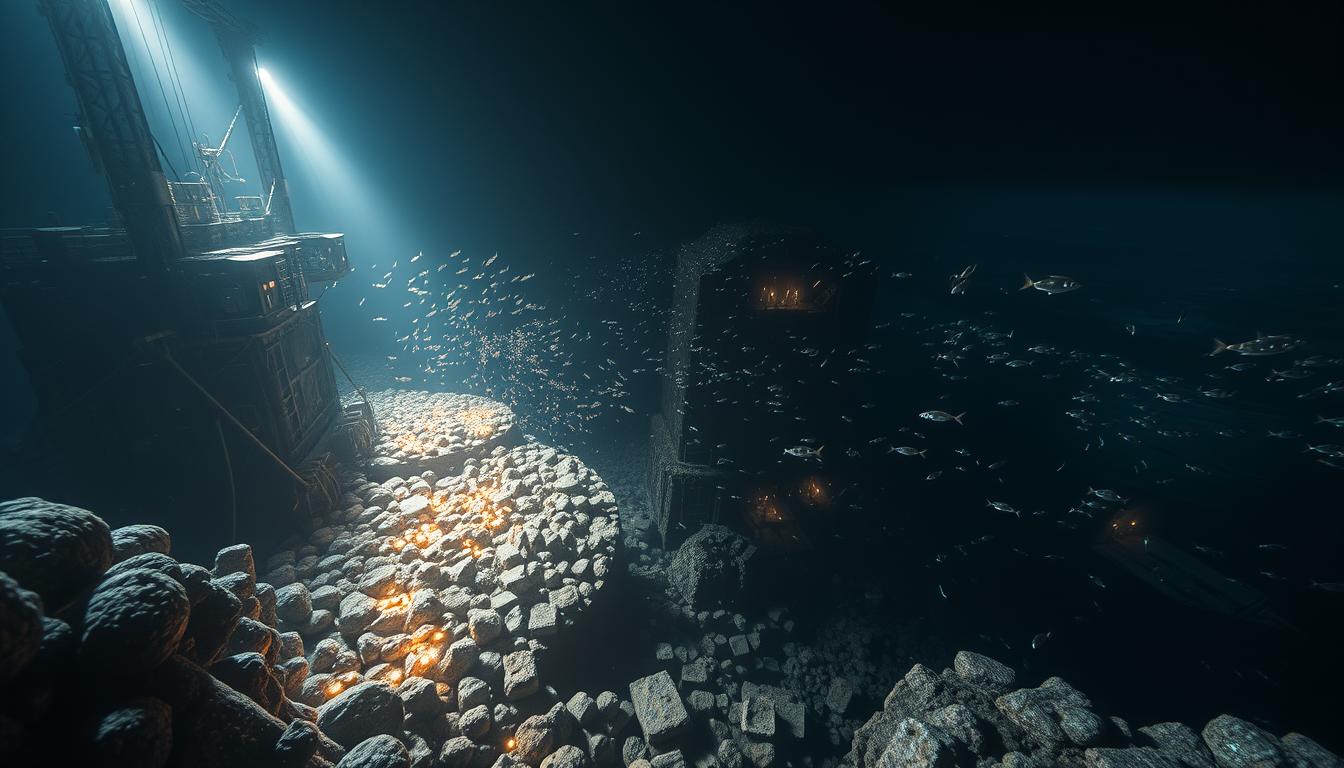
The ocean’s depths are filled with treasures worth over $60 billion to $100 billion. This wealth spans 100 million square miles, under the International Seabed Authority’s watch. Polymetallic nodules, found underwater, hold six times more cobalt and 6,000 times more tellurium than land deposits. These nodules take over 3 million years to form.
Marine exploration shows life thriving at depths of 26,000 feet. Hydrothermal vents there blaze at 700°F. The discovery of the scaly-foot snail highlights the fragility of these ecosystems.
Thirty companies are now exploring these deep-sea treasures. They might soon get permits for commercial mining. The Mariana Trench is home to life, with amphipods and snailfish found at 36,000 feet.
Nauru could earn $100 million annually from deep-sea mining. This contrasts with its past phosphate mining disasters. Universities now teach deep-sea mining courses, inspired by a 1974 submarine recovery operation. This project was deeper than any before, showing the impact of marine exploration on technology and the economy.
Over 28,000 marine compounds could lead to medical breakthroughs. Yet, only 20% of the seafloor is mapped. As the global seabed mining market approaches $7 billion, finding a balance between discovery and conservation is key.
Introduction to Deep-Sea Mining Discoveries
Deep ocean exploration has revealed a wealth of polymetallic nodules and marine minerals on the ocean floor. These include copper, cobalt, and rare earth elements, key for our tech like smartphones and electric cars. As land-based resources dwindle, companies and nations are looking to the seabed. Here, the underwater mining possibilities are vast but largely unexplored.
Polymetallic nodules, shaped over millions of years, are found in areas like the Clarion-Clipperton Zone in the Pacific. These small lumps are packed with metals needed for green energy. Cobalt crusts are found on underwater mountains, and polymetallic sulfides near volcanic vents. The International Seabed Authority manages 29 active exploration contracts, with 17 for nodules, 7 for sulfides, and 5 for crusts.
“The ocean floor holds minerals worth trillions, but we must ensure extraction doesn’t harm ecosystems,” said an ISA official in 2018. Over 700 scientists later echoed this caution, urging a pause on mining until environmental impacts are understood.
Despite progress in technology, mining in the deep sea faces many hurdles. Equipment must withstand extreme pressure and cold. Companies plan to start mining by 2026, but concerns over environmental damage are growing. With only 5% of the ocean floor mapped, the challenge is to find a balance between resource extraction and protecting marine life.
Historical Overview of Deep-Sea Mining
The history of deep-sea mining started in the 19th century. Early underwater exploration history began in 1868 when scientists found polymetallic nodules in the Arctic Ocean. But, their value was unknown for many years.
The HMS Challenger expedition from 1872–1876 mapped these nodules worldwide. They showed how common they were. But, it took over a century for technology to match our dreams.

In 1977, the ship Sedco 445 made the first ocean floor excavation at 5,180 meters deep. By the 1960s and 1970s, countries like Germany and the U.S. started working together on marine mining development. But, economic issues slowed them down.
Nickel price changes in 1977 also caused delays. Environmental worries grew as studies showed nodules take 200 million years to form.
Today, we’re trying to move forward while protecting the ocean. The International Seabed Authority manages 31 exploration contracts. They aim to set rules by 2025. As technology improves, the history of deep-sea mining keeps shaping our search for ocean resources.
Types of Resources Uncovered in the Deep Sea
The ocean’s depths are full of treasures important for our lives today. Deep sea mineral deposits like polymetallic nodules cover parts of the Pacific’s Clarion-Clipperton Zone. This area stretches for 5,000 kilometers.
These nodules are rich in metals like cobalt, nickel, and copper. They also have rare earth elements used in electronics and green energy. Seafloor massive sulfides and manganese crusts on underwater mountains add gold, silver, and zinc to these treasures.
Over 1.5 million square kilometers of international seabed are set aside for exploration. This area is as big as Mongolia and is managed by the International Seabed Authority. By 2022, they had issued 31 contracts for exploration.

The deep ocean also holds marine biological resources with great promise. Creatures near hydrothermal vents, like extremophiles, produce unique compounds. These underwater pharmaceutical compounds could change medicine, helping treat diseases or advance biotech.
The genetic diversity of these species shows the ocean’s vast, untapped possibilities. It combines economic and scientific value, making it a treasure trove for us all.
The Technology Behind Deep-Sea Mining
Deep-sea mining happens at depths over 6,000 meters, where water pressure is 60 MPa. Underwater mining technology is at the edge of engineering. Deep-sea ROVs with HD cameras and robotic arms explore these depths. They collect polymetallic nodules full of cobalt and nickel.
These submersible mining tools work with seabed extraction equipment from firms like Royal IHC. They help get resources from the deep sea.

Advanced sonar and magnetometers help find nodules on the seabed. They guide drones to map the Clarion-Clipperton Zone. The Metals Company uses this tech to aim for 2024 production goals.
Engineers are working to make these systems better for the environment. New materials and AI help navigate these deep waters.
But, there are big challenges. The equipment must fight off seawater corrosion and total darkness. The International Seabed Authority is working on rules by 2025.
These technologies are key to finding a balance between mining and protecting the sea. From ROVs to riser systems, the tools show human creativity and the ocean’s power.
Environmental Impact of Deep-Sea Mining
Deep-sea mining poses a big risk to the delicate habitats. The machines could create sediment plumes that suffocate life. The noise from mining could also confuse marine animals.
More than 90% of species in areas like the Clarion Clipperton Zone are unknown. This means we could lose many species before we even know they exist. It could take thousands of years for these ecosystems to recover, as seen with the slow formation of nodules.

Marine conservation groups push for better protection. The MIDAS consortium is studying ways to reduce harm, like using real-time monitoring. They also want to create a Seabed Sustainability Fund to support research and restoration.
But, there are big challenges. Sediment waste could poison phytoplankton, which are key for the ocean’s carbon absorption. Scientists say even small disturbances can harm species that rely on stable conditions.
The 2023 IUCN report warns of “inevitable” biodiversity loss. It calls for caution. The ISA has set a 2025 deadline for regulations, but 31 nations want a moratorium until risks are understood. Companies like Nautilus Minerals’ failed 2007 venture show the dangers of rushing without proper safeguards.
As we need more clean energy minerals, we must focus on sustainable practices. We need to protect the environment with measures like protected zones and strict monitoring. The future depends on science guiding us, not just profit.
Regulatory Framework Governing Deep-Sea Mining
Deep-sea mining rules are complex, with many international agreements and disputes. The international seabed authority is part of the UN’s marine resource governance system. It oversees mining under the UN Convention on the Law of the Sea (UNCLOS).
For years, ocean mining legislation for big projects has been stuck. By 2024, ISA talks are slow, with no clear rules for the environment or sharing profits.
One big problem is making rules work in unknown areas. Over 800 scientists say mining could harm undiscovered species. The ISA’s 2023 meeting in Jamaica showed big gaps in monitoring and penalties.
Even simple things like noise limits or protecting habitats are not set. Companies like The Metals Company are moving forward, planning 2024 mining despite the lack of deep-sea mining regulations.
“The deep sea’s biodiversity is a global asset, not a corporate playground.”
Now, 32 countries, including Canada, want a mining pause. Big names like BMW and Apple say they won’t use seabed minerals. Deutsche Bank also won’t fund it.
The ISA’s ability to oversee is limited, and there’s no enforcement. The future of the ocean depends on making laws keep up with mining’s pace.
Economic Implications of Deep-Sea Mining
Deep-sea mining is a complex issue. On one hand, it could bring in $60–$100 billion. Minerals like cobalt and nickel are key for batteries. But, there are big financial risks.
Over 37 financial institutions, with $3.3 trillion in assets, now oppose it. They worry about the environment and the economy. Insurers like Hannover Re and Zurich won’t cover ocean mining, showing they’re not sure about its future.
Underwater resource market projections are not matching up. Starting a DSM project costs $4–$6 billion. But, it might only make $9–$11 billion over 30 years.
Even if it’s profitable, the returns are small. Low-income countries might only get $97,800 a year. Also, companies like BYD and Tesla are using less of the minerals DSM targets. This means less demand for DSM’s products.
There’s growing opposition due to environmental concerns. Scientists say habitat destruction could cost over $465 billion. This is more than the profits DSM might make. Investors need to think carefully about the short-term gains and long-term losses.
Future Prospects for Deep-Sea Mining
The future of deep-sea mining depends on finding a balance. Trends show a push for ocean extraction innovation. This includes using robots and AI to reduce human impact.
These advancements could lower costs and environmental risks. Yet, there are hurdles to overcome. Experts say, “It’s important to develop slowly. Too many metals could drop prices.”
“The ISA has awarded 19 exploration contracts covering over 1.25 million km², signaling growing interest in marine mining development,” noted the International Seabed Authority. New technologies aim to extract polymetallic nodules containing copper, nickel, and cobalt critical for clean energy batteries.
Global demand for rare metals is increasing fast. The European Commission expects clean energy to use 40% of copper and 60-70% of cobalt by 2040. Companies like The Metals Company plan to start operations by 2024.
But over 30 countries want a delay to study environmental effects. New tech for monitoring and processing could help. Yet, studies warn of losing marine life forever.
The ISA’s new leader, Leticia Carvalho, must finalize rules by 2025. Sustainable practices could cut metal needs by nearly half by 2060. As we move forward, we must focus on research and protecting the ocean.
Conclusion: Balancing Exploration and Conservation
The world is in a rush to find more minerals like cobalt and lithium. This push for responsible seabed mining must go hand in hand with sustainable ocean resource use. With mineral needs expected to jump up to 600%, the deep sea could be a key player. But, it must be managed carefully.
The International Seabed Authority has set a 2025 deadline to make new rules. This shows how urgent it is to balance marine conservation balance with economic goals.
Dutch companies are making big strides in technology. But, we need policies that keep up. The Clarion-Clipperton Zone is huge, with 1 million square kilometers up for grabs. It’s home to thousands of unknown species.
Coastal communities rely on the sea, and mining could harm them. We must ensure mining is done ethically. This means careful oversight to protect biodiversity and ecosystems.
Global agreements like the United Nations Convention on the Law of the Sea offer guidance. But, enforcing these rules is a big challenge. New recycling and battery tech could help reduce the need for mining.
Working together is key. Governments, scientists, and industry must make decisions that protect the deep sea. This way, we can meet our energy needs without harming the planet.
Deep-sea mining’s future depends on sustainability. We must value unexplored ecosystems as much as minerals. Only through ethical underwater extraction can we use ocean resources responsibly for future generations.