
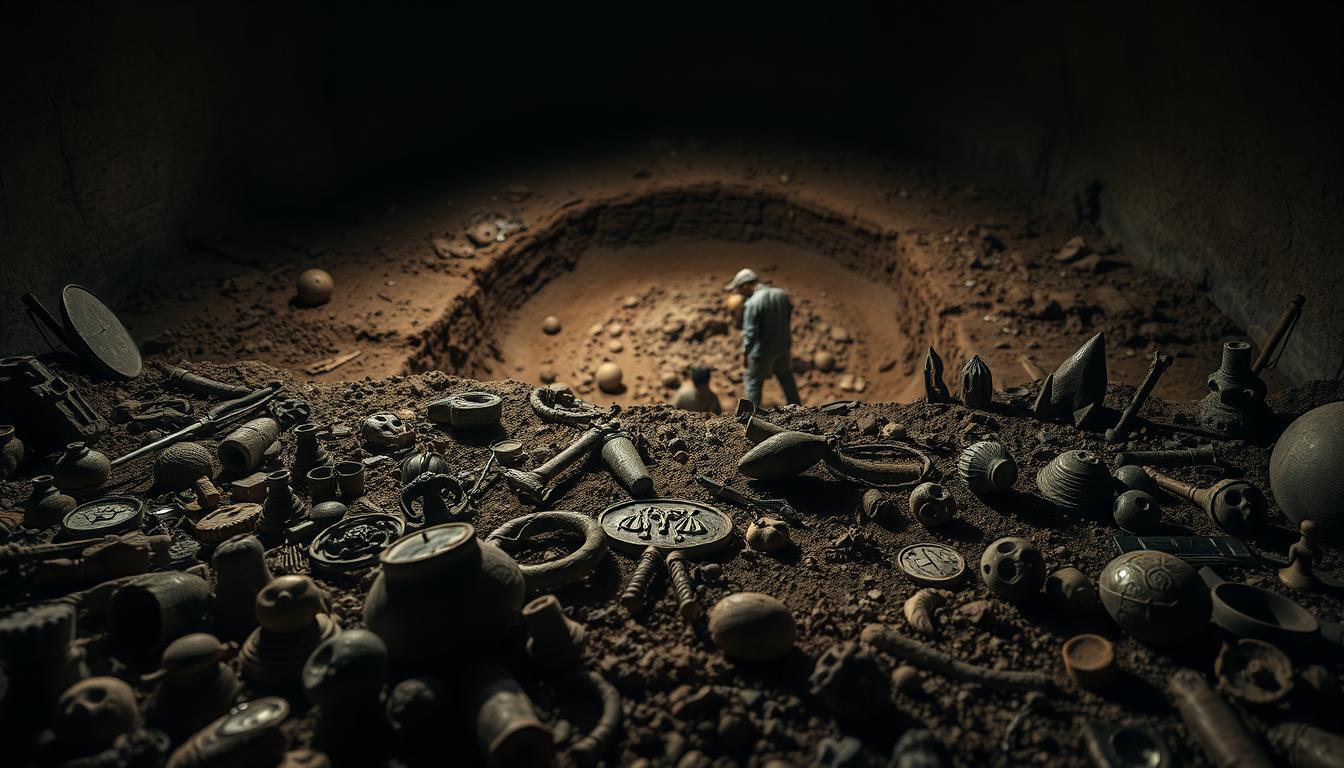
Archaeologists often find things that change how we see history. They’ve found 26 human skeletons frozen in time at Sweden’s Sandby Borg massacre site. In China, there are 8,000 terracotta warriors guarding Qin Shi Huang Di’s tomb.
These discoveries, like the 2,000-year-old Antikythera mechanism or Peru’s Nazca Lines geoglyph, show us forgotten technologies and rituals. They hint at secrets from the past.
Strange artifacts like the 25,000-year-old mammoth bone structures in Russia or a Roman dagger found by a 19-year-old intern, show history’s hidden layers. These treasures, from Viking relics in Norway to Mongolia’s warrior women graves, tell stories buried for millennia.
Whether it’s ancient Italy’s coffin births or 78,000 years of occupation in Kenya’s Panga ya Saidi caves, each artifact invites us to rethink the past.
Introduction to Unexpected Historical Discoveries
History is full of surprises. Unexpected archaeological finds like the Nebra Sky Disc or the Antikythera Mechanism reveal ancient societies’ hidden knowledge. These mysterious artifacts—from Roman dodecahedra to Neolithic stone balls—highlight historical anomalies that rewrite history. Each item is an ancient puzzle, urging researchers to dig deeper.
Archaeologists tackle these mysteries using cutting-edge tech, leading to archaeological breakthroughs. The 1999 Mittelberg Hill discovery uncovered Bronze Age astronomy tools, while the Antikythera Mechanism’s gears show advanced engineering. These finds prove past civilizations held knowledge we’re yet to uncover.
Every discovery—whether a strange tool or a hidden city—adds to our knowledge. These finds remind us there’s always more to learn from the past. The journey continues, one mysterious artifact at a time.
Ancient Egyptian Mysteries Unveiled

Archaeologists keep finding ancient Egyptian discoveries that change what we know. The Hierakonpolis zoo shows how wealthy Egyptians used historical animal keeping to show off. They found elephants, baboons, and hippos with healed bones, proving they cared for animals 5,000 years ago.
Recent digs have uncovered unexpected Egyptian artifacts in a Middle Kingdom tomb. This tomb had 11 people buried with jewelry that had never been seen before. A necklace with amethyst and agate beads and copper mirrors shaped like Hathor are among the finds. There’s also a statue made of 4,000 clay beads and an incense table with bull motifs.
Now, with modern scans and DNA tests, we learn even more. Skull fractures on King Tut’s remains spark debates about his death. Radar scans suggest there might be hidden tombs. Each ancient Egyptian discovery—from exotic pets to mysterious burial goods—adds to our understanding of this fascinating civilization.
The Terracotta Army and Its Origins
In 1974, farmers in Xi’an found the Terracotta Warriors discovery while digging a well. This find changed how we see the Emperor Qin’s mausoleum. For over 2,000 years, an ancient Chinese army of 8,000 soldiers, horses, and chariots protected Emperor Qin Shi Huang in the afterlife. Only a quarter have been found, showing detailed ears and faces.
Archaeologists found unexpected Chinese artifacts like sharp bronze weapons and colorful pigments. Tests showed ancient artists used egg and milk in their paints. Even the warriors’ shoes show advanced techniques, matching historical records.
The Emperor Qin’s mausoleum is mostly unexcavated due to preservation fears. Historical texts warn of deadly booby traps, but scans show underground rivers and mercury. Over 700,000 workers built this archaeological surprise, combining mass production with artistry. Yet, many questions remain, like why some warriors have hollow bones.
Unexpected Items from the Roman Era
Roman archaeological finds often include items that baffle modern researchers. The Roman dodecahedra, mysterious Roman artifacts, are bronze 12-sided objects with tiny holes on each face. Found across the Roman Empire’s northwestern provinces, these unexplained Roman objects have sparked endless debate. Over 100 examples exist, but no records or practical wear marks explain their use.
Theories suggest they were measuring tools, religious symbols, or even knitting aids—yet their true purpose stays hidden.
Ancient Roman technology like concrete and hydraulic mining showcased their engineering genius. The Pantheon’s dome and Spain’s gold-mining systems are amazing. Yet, even these innovations can’t clarify the dodecahedra’s role.
Their design and lack of wear hint at symbolic or ceremonial uses. But answers remain elusive. These enigmas remind us how much of the past is beyond our grasp.
Viking Artifacts That Surprise
In the mountains of British Columbia, a reindeer hunter found a Viking sword 1,600 meters up. There were no signs of battle or graves nearby. This find challenges our view of Vikings.
These frozen Viking artifacts show Vikings were more than just raiders. As glaciers melt, they reveal preserved Viking items like clothes, tools, and weapons. These items give us a glimpse into their daily lives and travels.
Viking archaeological discoveries also change how we see trade. The Galloway Hoard in Scotland has over 100 items, including a silver cross and a jar with a bishop’s inscription. These unexpected Viking treasures show connections to far-off lands.
A Norse penny found in Maine, dated 1065–1093, suggests Vikings may have reached North America. Trade routes were longer than we thought. Items like silver ingots from the Middle East and African artifacts show the complexity of Norse trade evidence.
These finds challenge old myths. The Maine coin found alone at a Native American site raises questions about contact. The Gressli hoard’s 2,301 coins in Norway show Vikings had a deep economy.
Together, these discoveries show Vikings were explorers and merchants, not just warriors. Each find reshapes history, revealing a vast and surprising Viking world.
Mysterious Mayan Discoveries
In Mexico’s Yucatán Peninsula, Mayan archaeological mysteries intrigue archaeologists. Ivan Šprajc’s team found cities like Chactún and Ocomtún. They discovered unexpected Mayan artifacts, including pyramids over 15 meters tall.

The Mayans were masters of astronomy. They tracked stars with great accuracy, inventing the zero and calendars. Their “Maya Blue” pigment, found in murals, puzzles scientists. It lasts for centuries, despite being made from organic materials.
Tombs reveal mysterious Mayan treasures like jade masks and detailed stelae. These finds change our view of their art and trade.
LiDAR scans recently found Valeriana, a city as big as Calakmul. It spans 10 square miles and had 30,000–50,000 people. The ancient Mesoamerican discoveries there include ball courts and plazas.
These finds show the Maya’s skill and knowledge. But many questions remain. Why did cities like Ocomtún, with its 25-meter pyramid, disappear? How did they create pigments and track stars without modern tools?
Every new discovery, from Balamkú’s hidden shrines to Valeriana’s size, highlights the Maya’s genius. It also shows how much is yet to be uncovered in the forest.
The Enigma of the Antikythera Mechanism
In 1900, divers found a corroded lump of bronze gears near Greece. This Antikythera Mechanism discovery—an unexpected technological artifact—lay hidden for over a century. Its complex gears and dials were a mystery until modern scans uncovered its purpose.
X-ray scans revealed a device far beyond its time. This ancient astronomical computer had 30 interlocking gears to track celestial movements. It predicted eclipses and followed the Olympic Games cycle, all thanks to Babylonian math.
Its gears, like a 223-toot wheel tied to lunar cycles, showed the historical engineering mysteries of its makers.
Forged in ancient Greece, the mechanism stunned experts. Ancient Greek technology here rivaled Renaissance-era precision. Over 80 fragments survived, but many secrets remain. Each gear’s placement aligns with planetary cycles, hinting at lost knowledge.
Today, the device changes how we see ancient innovation. Its gears and inscriptions show advanced science existed 2,000 years ago. Yet, questions remain: Who built it? Why was this knowledge forgotten? The Antikythera Mechanism’s enigmas remind us history’s lessons are never fully written.
Unexpected Treasure from the Gold Rush
Gold Rush archaeological findss rewrite America’s wild west story. Preserved frontier items and unexpected pioneer artifacts tell new tales of survival and culture. A hidden trove near Utah’s Range Creek stunned experts, hiding 1,000-year-old Fremont Indian settlements.
These historical American discoveries show life as it was, with ancient tools and rock art. It’s like stepping back in time.

In California, the 2013 Saddle Ridge Hoard—a trove of 1,427 gold coins—was found in a field. It stunned locals. Such findss shed new light on Gold Rush mysteries.
They reveal stories of Indigenous tribes and marginalized groups, challenging old myths. Even today, private land protects sites like Range Creek. A rancher’s family guarded secrets for generations.
These discoveries show history’s gaps hold clues. Every shovel of dirt uncovers truths once buried. It reminds us the past is full of stories waiting to be told.
Unusual Items from World War II
In 2017, a melting glacier in Switzerland uncovered frozen WWII remains of Marcelin and Francine Dumoulin. They had been missing for 75 years. This WWII archaeological discovery highlights how climate change reveals the past.
From icy mountains to hidden bunkers, these finds shed light on history’s harsh realities. They remind us of the human cost of war.
In Italy, icy mountains have revealed unexpected wartime finds. These include rifles and letters from the “White War.” A German wall held historical war objects like gas masks and Nazi badges.
Even a restored Enigma machine, used to crack codes, now sits in museums. It shows how preserved war artifacts tell stories we never knew.
Every item, like a faded photo or a soldier’s diary, makes history personal. These finds humanize war, showing it’s not just about armies. Each preserved war artifact brings the past closer to us, telling of lives cut short.
The Secrets of Stonehenge
Stonehenge’s history is being rewritten with new discoveries. Scans have uncovered hidden structures like “Super-Henge” near Durrington Walls. This is part of a vast Neolithic ritual network.
Unexpected finds include a 25-stone circle unearthed in 2009. It suggests a larger ceremonial landscape. Laser surveys have also shown damage from visitors taking souvenirs.

Prehistoric artifacts like the Folkton Drums reveal complex rituals. The Altar Stone, once thought Welsh, was found to come from northeast Scotland. This journey shows sophisticated trade networks.
Neolithic sites like Woodhenge and Durrington Walls now show Stonehenge as a hub. It’s not just a single monument.
“The stones whisper of a society far more organized than we imagined,” noted researchers studying the 56 Aubrey Holes, pits once holding missing megaliths.
Modern technology like ground-penetrating radar has revealed the origins of the stones. Sarsen stones came from Marlborough Downs, and bluestones from Wales. Even the Slaughter Stone’s chisel marks tell of ancient attempts to move it.
These discoveries remind us that Stonehenge’s mysteries are being solved one discovery at a time.
Discoveries That Challenge Our History
History-changing discoveries keep rewriting the story of human progress. Göbekli Tepe in Turkey is a prime example. It’s 11,500 years old and has complex stone pillars. Built by hunter-gatherers before farming, it challenges our timeline of complex societies.
This site shows early humans could organize massive projects without agriculture. It’s a prehistoric innovation that changes how we see history.
Other finds also show ancient advanced technology. A 7,000-year-old antelope bone from South Africa has poison-tipped arrow marks. This shows early mastery of chemistry.
Wooden handcarts in New Mexico, dating back 22,000 years, predate wheels by 17,000 years. The Treasure of Villena’s meteorite iron artifacts also hint at advanced metallurgy skills.
Unexpected evidence keeps coming. Sloth bones in the Americas show humans lived with these megafauna 3,500 years ago. This is thousands of years later than we thought.
In France, a 3D cave map from 18,000 years ago rewrites our understanding of early mapping skills. These finds force us to rethink how advanced ancient societies were.
Every new discovery challenges old stories. From Roman coins found underwater to Bronze Age cannibalism remains, each find surprises us. With tools like DNA analysis and remote sensing, more secrets are uncovered. History is a living story, always changing and full of surprises.
Conclusion: The Importance of Keeping an Open Mind
Every artifact, from the Antikythera Mechanism to the Terracotta Army, shows how our views change over time. New finds make us question what we thought we knew. For example, when Roman-era surgical tools were found, experts had different ideas about them. It took new methods to understand their role in ancient medicine.
Curiosity drives future discoveries. Tools like LiDAR uncover hidden cities, and DNA analysis changes our understanding of ancient migrations. These advances show that history is always evolving. Even places like Stonehenge, once misunderstood, now reveal more about the past with new methods.
Archaeology’s strength comes from embracing the unknown. Every excavation or scan could reveal something new. Stay open to surprises—history’s biggest secrets often lie in plain sight. Remember, every major discovery, from penicillin to insulin, started with questioning the status quo.