
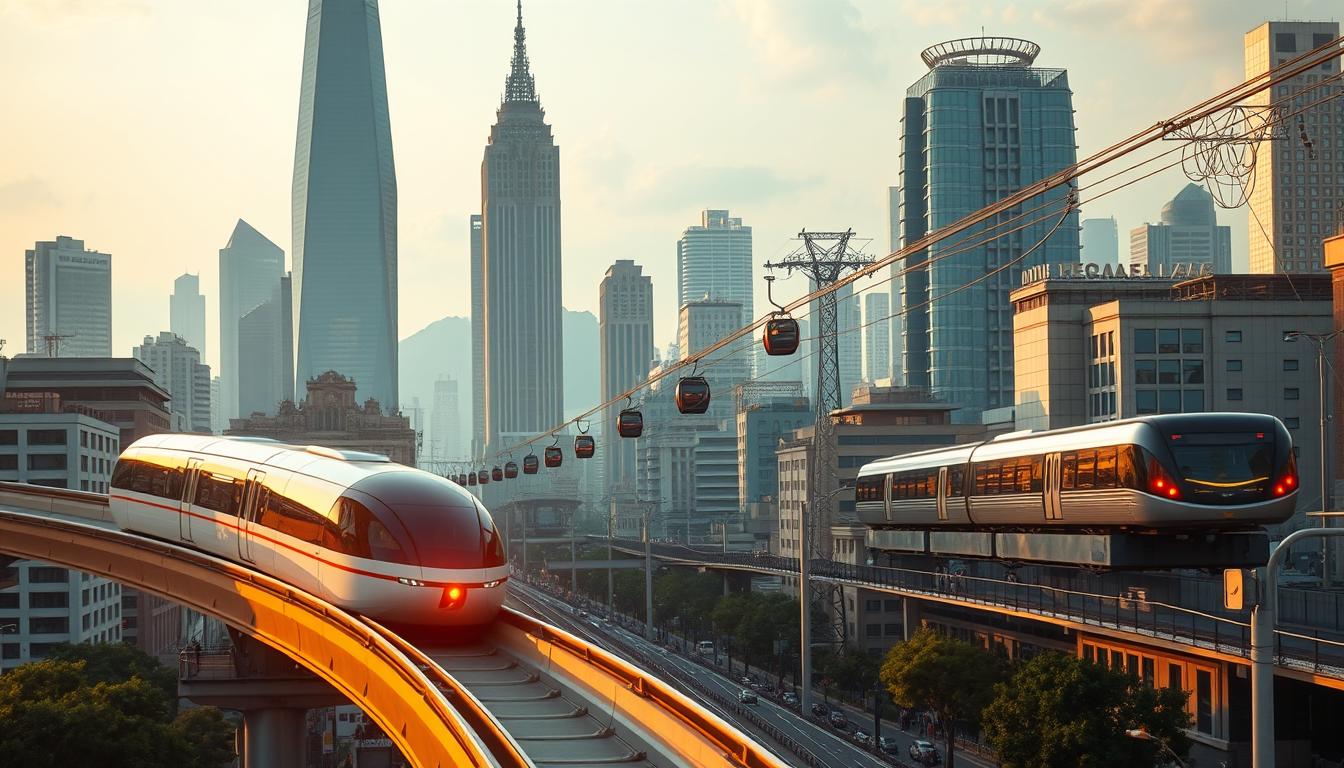
The world is full of odd ways to travel, like suspended railways and bamboo trains. These methods are not just different; they also show off history, innovation, and culture. For example, the Schwebebahn in Germany, built in 1901, carries 85,000 people every day. It’s a steel monorail that floats over streets, proving old ways can be effective.
In Cambodia, bamboo trains move at 40 km/h. China’s Maglev goes even faster, reaching 431 km/h. It gets you to Pudong Airport in just 7 minutes. These unusual vehicles are not just fun; they’re also useful. In the Philippines, Jeepneys, made from WWII vehicles, are a common sight. They add color to the roads. In Finland, eSleds offer quiet rides through Lapland, where reindeer are common.
Feluccas have been sailing the Nile for over 4,000 years. Madeira’s wicker toboggans go 50 km/h. These systems show how people adapt to their environments. They reveal the creativity of humans in facing challenges. Exploring these strange vehicles is more than just seeing sights; it’s a look into our creative side.
1. The History of Eccentric Transportation
Historical transportation methods started as simple solutions. The Totora Boats of Lake Titicaca, used for over 3,000 years, show ancient travel innovations made from reeds. Dog sleds, first used 9,500 years ago in Arctic regions, highlight how traditional transport vehicles adapted to extreme climates.
Venetian gondolas, built in the 11th century, are a mix of vintage travel modes and tourism. They glide through canals today.
These examples show the evolution of transit. From reed crafts to sleds, they reveal how communities used local resources for movement. Their survival is not just history—it’s a legacy of creativity that shaped how we travel.
Modern cities may buzz with tech, but these timeless methods guide our paths.
2. Unconventional Animal-Powered Travel

Animal-powered vehicles are key in many cultures around the world. In Alaska, dog sled transportation is a big deal. Teams of 4 to 6 huskies pull sleds through snowy landscapes. The Iditarod race, a 1,150-mile journey, celebrates this tradition.
In Finland’s Lapland, reindeer sleighs are a big part of Sami culture. These animals move easily through snow, carrying riders. Now, e-sleds are used too, mixing old ways with new tech.
Other places use different animals for travel. In deserts, camels carry goods. In the Andes, llamas help with mountain trails. In Southeast Asia, elephants are used for tours. Even in historic towns, horse-drawn transit is common.
These ways of traveling are not just old. They connect people in remote places and offer special experiences. But, challenges like climate change and urban growth threaten them. Husky teams and reindeer sleighs show our long bond with animals.
3. Watercraft That Defy Expectations
Water travel is more than just ships. It includes unusual boats and strange watercraft made for special needs. The Uros people of Lake Titicaca create floating islands and reed boats, like the Totora Boats, which last for centuries. Egypt’s Feluccas sail the Nile with triangular sails, showing exotic boats with a rich history.
Today, unconventional water vehicles are pushing limits even further. The Netherlands’ Amfibus takes people between land and water, reaching 60 mph on roads and 6.5 knots on canals. In the Philippines, a hybrid trimaran is set to change travel. It can carry 100 passengers and vehicles, cutting emissions by a third and using 80% local materials.
Despite typhoons and quarantines, this eco-friendly boat shows the Philippines’ need for new unique water transportation ideas.
Global shipping data shows the importance of this: 12.9 million TEU move internationally every year. Yet, shipping emissions account for 9% of transport totals. This trimaran combines tradition and technology, showing water travel’s role in balancing culture and sustainability. As sea trade grows 3.8% yearly, these unusual boats prove creativity meets needs on waterways.
4. High-Flying Adventures
High above the ground, suspended transit systems and cable car networks offer thrilling ways to traverse landscapes. The Wuppertal Suspension Monorail in Germany has been leading the way for over a century. It uses 19,200 tonnes of steel to create the world’s oldest electric elevated railway.
Its hanging cars carry 85,000 passengers daily, gliding 12 meters above the Wupper River with minimal noise—a marvel of elevated travel methods.

Modern innovations like Wuhan’s Optics Valley Photon train showcase futuristic designs. This hyper-modern suspended monorail turns travel into an experience, with upside-down cars. They offer 270-degree views at 43 mph.
While in remote regions, sky transportation relies on daring solutions. In Alaska, bush planes land on water or gravel. They link isolated communities while giving passengers bird’s-eye vistas of untouched wilderness.
These systems blend practicality with adventure. The Schwebebahn’s quiet operation contrasts with the Photon train’s speed. This shows suspended transit systems can adapt to any terrain. From historic railways to eco-conscious air travel concepts, such methods redefine how we connect—and see—the world.
5. Creative Land-Based Transportation
Human creativity is on full display in bizarre land vehicles that change how we travel. In Vietnam, the cyclos show off pedal-powered transit. Riders sit in front of the driver, who pedals backward. This design dates back to the 1930s French colonial era.
In Southeast Asia, exotic wheeled transport like Malaysia’s neon trishaws become strange street vehicles at night. They play music and attract crowds. In Kolkata, hand-pulled rickshaws from the 1800s are a symbol of strength.
There are also motorized unusual cars worth mentioning. In the Philippines, jeepneys are WWII jeeps painted in bright colors and decorated with religious symbols. They show local pride.
In Cuba, coconut taxis are yellow shells on wheels. They offer cheap rides and have been around for the 1990s. Guatemala’s chicken buses are old U.S. school buses now carrying people and animals. They are a cultural icon.
These vehicles are more than just ways to get around. They tell stories of adaptation, culture, and resourcefulness.
6. Bizarre Modes of Public Transit
Shanghai’s Maglev train is a marvel of strange public transportation. It floats on magnetic tracks and reaches speeds of 431 km/h. But, it doesn’t go through central Shanghai. It’s a unique, high-tech option that feels isolated.

Istanbul’s Tünel funicular is an odd public transport system from 1874. It goes up 60 meters and is a key for Beyoğlu’s hills. Dakar’s car rapides are 1970s French buses repurposed as weird mass transit. They’re known for their bright colors and crowded rides.
The U.S. Capitol Subway moves at a slow 4 mph. Yet, it’s used by lawmakers for security. These systems, from the Maglev to the car rapides, blend function with flair. They show transit is more than just moving people—it reflects culture and compromise.
7. The Rise of Eco-Friendly Innovations
From Lapland’s icy trails to bustling cities, green transportation methods are changing how we travel. Electric snowmobiles, like Finland’s e-sleds, move quietly across the Arctic. They replace old snowmobiles’ pollution with zero emissions. In Scandinavia, reindeer sleighs show low-impact transportation that respects culture and the environment.
Urban areas are quickly adopting eco-friendly travel options. In 2023, Europe added 6,354 electric buses. Copenhagen now has 43% of its buses electric. China leads, but cities like Bogotá aim for 25,000 e-buses by 2030.
Even classic vehicles are changing. Brazil’s bioethanol buses and India’s electric plans show environmentally conscious vehicles are spreading. Yet, 95% of transport energy comes from oil. The EU’s Clean Cities Campaign shows regional gaps, but progress is seen—like Denmark’s free transit in Luxembourg.
By 2050, transport emissions must drop 90%—a target shaping everything from e-bikes to solar-powered ferries.
From icy trails to city streets, these changes show sustainability is the future of travel.
8. Festivals Featuring Unique Transportation
Transportation festivals around the world celebrate culture and creativity. The Iditarod Trail Sled Dog Race in Alaska is a 1,150-mile transit heritage festival. It honors dog sledding traditions and excites the crowd.
In Venice, the Historical Regatta and in Cambodia, the bamboo train festivals highlight historic vehicles. They mix history with vehicle celebration events.
The Red Bull Soapbox Race is a competition where homemade transportation race entries face off. The World Championship Punkin Chunkin uses engineering to hurl pumpkins. The Rickshaw Run in India turns auto-rickshaws into colorful art, attracting many to vehicle celebration events.
These events are more than races; they’re cultural moments. The Frozen Dead Guy Days in Colorado is a bit quirky but draws thousands. It combines humor with history.
From amphibious car rallies to pedal-powered aircraft contests, these festivals bring communities together. They keep traditions alive and inspire new designs. Transportation is a spectacle worth celebrating.
9. Extreme Modes for Adventure Seekers
For those craving heart-pounding journeys, extreme transportation methods turn travel into an adrenaline rush. In Madeira, the Monte toboggan rides slide down steep streets at 60 km/h. Riders cling to wicker armchairs, guided by carreiros in white hats. These rides, once a 19th-century lifeline, now rank as a top adrenaline transportation experience.
Thrill-seekers also ride bamboo trains in Cambodia, balancing on wooden planks over railways at 30 mph. These dangerous travel modes blend risk and culture, giving a glimpse into local life. They push physical limits. Zip-line networks and cliffside elevators in Nepal are today’s adventure travel vehicles, made for rugged terrains.
Some methods are daily staples in remote regions, but seen as thrill-seeking transit options for outsiders. Mountain cable cars in India or rope bridges in Peru show how necessity meets excitement. With over 50 types of extreme sports, like heli-biking or white-water rafting, humanity seeks to push limits.
Travelers must balance curiosity with respect. UnCruise Adventures’ small ships navigating Alaska’s fjords show ethical exploration. As markets grow, the line between bravery and recklessness is thin. For those ready to embrace the unknown, these methods redefine moving through the world.
10. Futuristic Concepts in Transit
New futuristic transportation ideas are changing how we see travel. The Hyperloop, a next-generation transit system, aims to travel from San Francisco to Los Angeles in 35 minutes. It could reach speeds of 760 mph but faces a $100 billion price tag.
China’s 600+ mph maglev trains and Dubai’s experimental vehicles, like Joby Aviation’s flying taxis, show different ways to change mobility.

Wuhan’s upside-down monorail and Amsterdam’s solar-powered innovative travel concepts like autonomous water taxis show creativity. The Skylon, a hypersonic aircraft, could travel from London to Sydney in four hours. But its $1 billion cost is a big challenge.
Even small ideas, like Velo-City’s bike networks, offer practical solutions. They can cut infrastructure costs by 20%.
But, there are big challenges. Dubai’s seaglider project aims for a 30-minute Abu Dhabi trip at $45 a ticket. But it faces technical trials. Flying taxis, though exciting, can only carry four people per flight. This means thousands would be needed to ease traffic.
Hyperloop’s delays and the Vegas Loop’s underused stations show the gap between promise and reality. Transportation technology must balance bold ideas with affordability and scalability to truly change our lives.
11. Conclusion: Embracing the Unusual
Choosing unusual travel experiences, like Cambodia’s bamboo trains or Wuppertal’s overhead monorail, makes trips memorable. These rides show how communities use geography and tradition. Riding Madeira’s toboggan or Mexico City’s transit systems is more than a trip; it’s seeing history move.
As cities evolve, unique transit faces challenges from modern trends. The International Transport Forum’s 64 member countries focus on combining new and old ways of moving. Even in times of change, like the pandemic, cities like Paris and Lisbon show how transport impacts our lives. Travelers can support this mix by choosing these options for their adventures.
Every time you choose a heritage tram or a vintage ferry, you help keep transportation culture alive. These choices are important: 66% of young travelers now prefer active transport, showing a desire for creative travel. Make your next trip include a suspended railway or a historic streetcar. Every journey has a story worth sharing.