
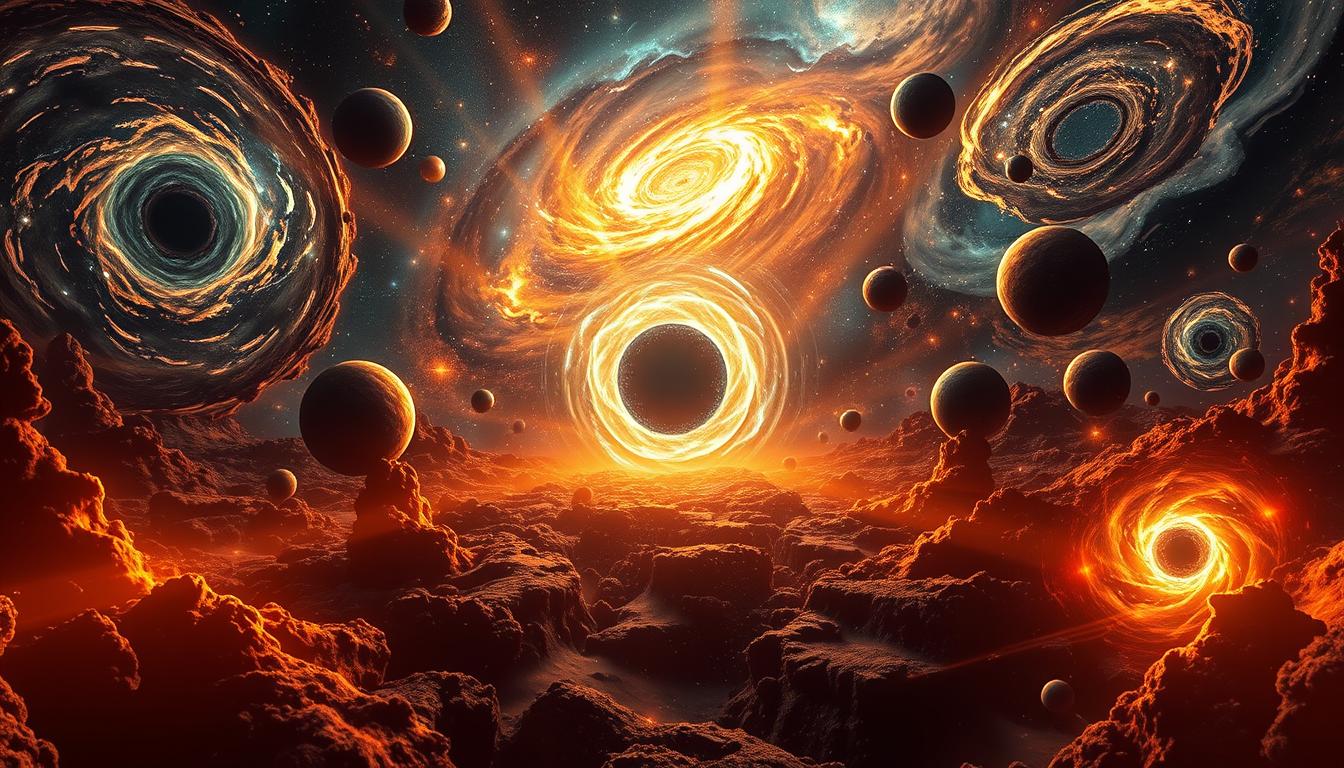
Imagine our universe as just one page in an endless book of possibilities. Scientists wonder if there are other universes beyond what we can see. The Many Worlds interpretation of quantum mechanics suggests every choice creates a new universe.
These multiverse theories are not just for science fiction. Real scientists, like Andrei Linde, study eternal chaotic inflation. This theory says new multiple universes form like bubbles in a fizzy drink.
The mystery of our universe’s “fine-tuning” is at the heart of this debate. Gravity and electromagnetism must be just right for life to exist. Tiny changes could mean no life at all.
The Large Hadron Collider explores the universe’s early moments. It looks at conditions a trillionth of a second after the Big Bang. But, questions remain: could parallel universes have alien physics where time moves backward?
Some scientists think multiverse ideas are too hard to test. But others believe they’re the only explanation for our universe’s existence. Lord Rees even suggests most life in a multiverse might be artificial intelligence, not beings like us.
These cosmic reality debates involve quantum math, ancient philosophy, and modern telescopes. They show we’re far from fully understanding existence.
Understanding Multiverse Theories
Modern science looks into multiverse ideas, thanks to quantum mechanics and cosmic growth. The quantum multiverse comes from quantum physics, where particles can be in many states until seen. This idea, known from Hugh Everett’s 1957 theory, says every quantum choice splits reality into many paths.
The cosmological multiverse connects to cosmic inflation, a fast growth period after the Big Bang. Scientists like Andrei Linde think this inflation never stops, making endless “bubble universes” with different physical rules.
These bubble universes might form like soap bubbles in endless foam. String theory multiverse models suggest extra dimensions where universes come from vibrating strings. But, finding direct proof is hard.
While quantum experiments show wave function behavior, multiverse claims rely on indirect signs. For example, in 2015, Dr. Ranga-Ram Chary found a brightness spike 4,500 times higher than expected in cosmic background data. This could be a sign of collision with another universe, but there’s ongoing debate.
“A single unexpected signal could hint at deeper realities beyond our senses,” noted cosmologists studying early universe data.
Even with interesting theories, there’s no solid evidence yet. Critics say multiverse ideas might become untestable philosophy. But supporters see them as natural extensions of inflation and quantum math. As discussions go on, these ideas link ancient philosophy to modern physics, changing how we see existence.
Different Types of Multiverse Theories
The many-worlds interpretation changes how we see reality. Physicist Hugh Everett said every quantum choice creates a new universe. A simple coin flip leads to both heads and tails existing in their own parallel realities.
This quantum multiverse keeps growing. Every decision makes more versions of reality.

Cosmic inflation theory suggests endless bubble universes form. They grow like bubbles in boiling water. Each is separated by light-speed gaps, possibly with alien physics.
Andrei Linde’s work shows these bubbles might have unique constants. This means they could have different gravity or light speeds, making them unrecognizable to us.
String theory adds another layer. It suggests 10500 possible universes, each with different laws. While most might not support life, ours is a rare gem in this vast cosmic library.
Max Tegmark organized these ideas into four levels. From endless space (Level I) to abstract realities (Level IV), each level fits together like a puzzle. This shows how theories can overlap without conflicting.
The Science Behind Multiverse Theories
At the heart of multiverse debates lies the universe parameters that allow life to exist. Gravity’s strength, the speed of light, and forces shaping atoms all fall within a narrow range. Change these values slightly, and stars, planets, or even atoms might never form. This “fine-tuning” has led scientists to explore cosmic inflation theories, where rapid early expansion could create endless regions with varying physical laws.

Quantum mechanics adds another layer. The many-worlds interpretation suggests every quantum choice splits reality, creating parallel universes. For instance, experiments show particles exist in multiple states until observed—a concept supporting infinite branches of existence. Yet, scientific evidence remains elusive. Researchers study cosmic microwave background patterns for clues, but no smoking gun exists yet.
Brandon Carter’s anthropic principle argues we observe these constants because only such a universe could host life to ask the question. While this explains our existence, critics argue it lacks predictive power. Cosmic inflation models propose endless “bubbles” of universes, each with unique physics. Yet, testing these ideas challenges current technology, leaving debates unresolved.
The Role of String Theory
String theory changes how we see reality. It uses vibrating strings, tiny loops of energy. These strings vibrate to create particles like electrons or photons.
These strings exist in a world with extra dimensions. These dimensions are tiny and fold into small shapes. Physicist Leonard Susskind showed in 1969 that these strings are the heart of nature’s laws. He found that 10 or 11 dimensions are needed for math to work.

The string theory landscape is a huge map. It shows 10500 possible universes, each with its own physics. When extra dimensions compactify, they curl up into shapes like Calabi-Yau manifolds.
This creates different physical rules. The discovery of dark energy in 1998 made scientists believe in this multiverse. Our universe is just one of many in this vast landscape.
Membrane theory takes it further. It says that branes (higher-dimensional membranes) can collide or separate. This shapes universes in 11D spacetime.
Even though it’s not proven, these ideas suggest a much richer universe than we can see. Susskind said, “Every solution to string equations could be a universe waiting to be discovered.”
Philosophical Implications of the Multiverse
The multiverse hypothesis makes us think deeply about philosophical questions like free will and reality interpretation. If every choice creates a new universe, does our freedom really matter? Picture a world where every choice, big or small, has its own universe.
This idea makes us question our control over our lives. It suggests that our choices are set in stone across all possible universes. This could mean that our lives are predetermined, no matter how many universes there are.
Reality becomes a mystery. The anthropic principle wonders why our universe is just right for life. Physicists like Martin Rees point out six key factors that make life possible. In a multiverse, these factors might be random, making our existence less special.
If many universes are empty, our world’s setup might be inevitable. This means our existence could be seen as a statistical certainty in an endless universe.

Existential implications grow when we think about who we are. John Locke believed our identity comes from our memories. But the multiverse idea suggests there could be countless versions of us, each with their own choices.
This raises questions about our sense of self. Jean-Paul Sartre’s idea that we are responsible for our choices seems to lose meaning. If every choice is made in another universe, do we lose our moral responsibility?
These ideas challenge the boundaries of science and philosophy. Are we just pawns in a game of cosmic chance, or do we have a purpose in an endless universe? The debate is ongoing, showing that exploring the multiverse helps us understand ourselves as much as it does the universe.
Challenges and Criticisms of Multiverse Theories
At the heart of multiverse debates lies the question of unfalsifiable theories. Critics say that if other universes can’t be observed or tested, they’re not part of scientific methodology. Without empirical evidence, some scientists call these ideas metaphysical, not scientific. For example, string theory suggests 10^500 possible universes, showing theoretical physics limitations and making predictions nearly impossible.
Physicists like Paul Steinhardt say valid theories must make testable predictions. In a 2014 Nature article, he and George Ellis warned that multiverse claims risk undermining science. They compare it to the Marvel Cinematic Universe—exciting but unproven. Proponents argue that some theories, like cosmic inflation, started as radical ideas later validated by data.
“A scientific theory should be selective, not a catch-all,” argues Steinhardt, pointing to the multiverse’s lack of specificity. Its broad claims risk explaining everything—or nothing.
While supporters cite cosmic microwave background data as indirect clues, skeptics demand clearer evidence. The debate reflects a deeper tension: where does science end and speculation begin? For now, the multiverse remains a hypothesis in search of proof.
Multiverse in Popular Culture
From Everything Everywhere All at Once to Spider-Man: Into the Spider-Verse, multiverse movies and science fiction have made complex physics easy to follow. These films dive into alternate realities to ponder: What if our choices changed everything? The Marvel Cinematic Universe brings parallel universes in media to life, mixing action with deep questions about who we are.
TV shows like Dark and Rick and Morty explore timelines and infinite realities, echoing our curiosity about “what if?” Books, such as Blake Crouch’s Dark Matter, blend alternate realities with personal stories, making complex ideas relatable. The 2022 Oscar winner, Everything Everywhere All at Once, shows that multiverse themes can tackle family issues, proving science fiction is about feelings, not just tech.
“The multiverse lets us see ourselves in infinite forms, showing us that somewhere, someone’s life turned out differently.” — New Scientist, 2014
Stories about parallel universes capture our deep curiosity. The Mandela Effect, where people remember events that didn’t happen, shows how our minds deal with different paths. Even memes and online culture play with reality, mixing science and fantasy. These tales turn quantum theories into something we can feel, not just think about.
The Future of Multiverse Research
Scientists are exploring new ways to find observational evidence in future cosmology. They hope to use new telescopes to see ripples from other universes. Also, quantum experiments might show if particles can talk to each other across different dimensions.
New tools in theoretical physics advancement could change everything. Quantum computers, like Google’s Willow chip, can solve problems super fast. This could lead to new math inspired by the multiverse.
Researchers like David Deutsch think these computers might connect to parallel worlds. This idea matches Hugh Everett’s “many-worlds” theory. It links quantum theory with big cosmic questions.
But, there are also doubts. Some studies look for signs of colliding universes in the cosmic microwave background. Particle colliders also search for signs of extra dimensions. Even those who doubt it agree that the search will lead to new discoveries.
The journey ahead is full of unknowns. But, the drive to learn keeps pushing science to explore the unknown.
Concluding Thoughts on the Multiverse
The multiverse idea makes us think about a world beyond what we see. Theories like string theory and cosmic inflation suggest endless universes with different rules. But, we don’t have solid proof yet.
Stephen Hawking spent years studying this, and today, scientists keep debating. Even without proof, the idea of the multiverse sparks our curiosity. It makes us wonder why our universe’s constants are so perfect for life.
This idea changes how we see our place in the universe. It makes us think about our existence in a possibly endless cosmos.
Scientists are searching for clues, like studying cosmic microwave radiation. This search shows our endless desire to learn. The multiverse is more than just math—it’s our quest for meaning.
Whether these theories stick around or not, they teach us to keep exploring. The question of why we exist in this universe is as big as the universe itself.