
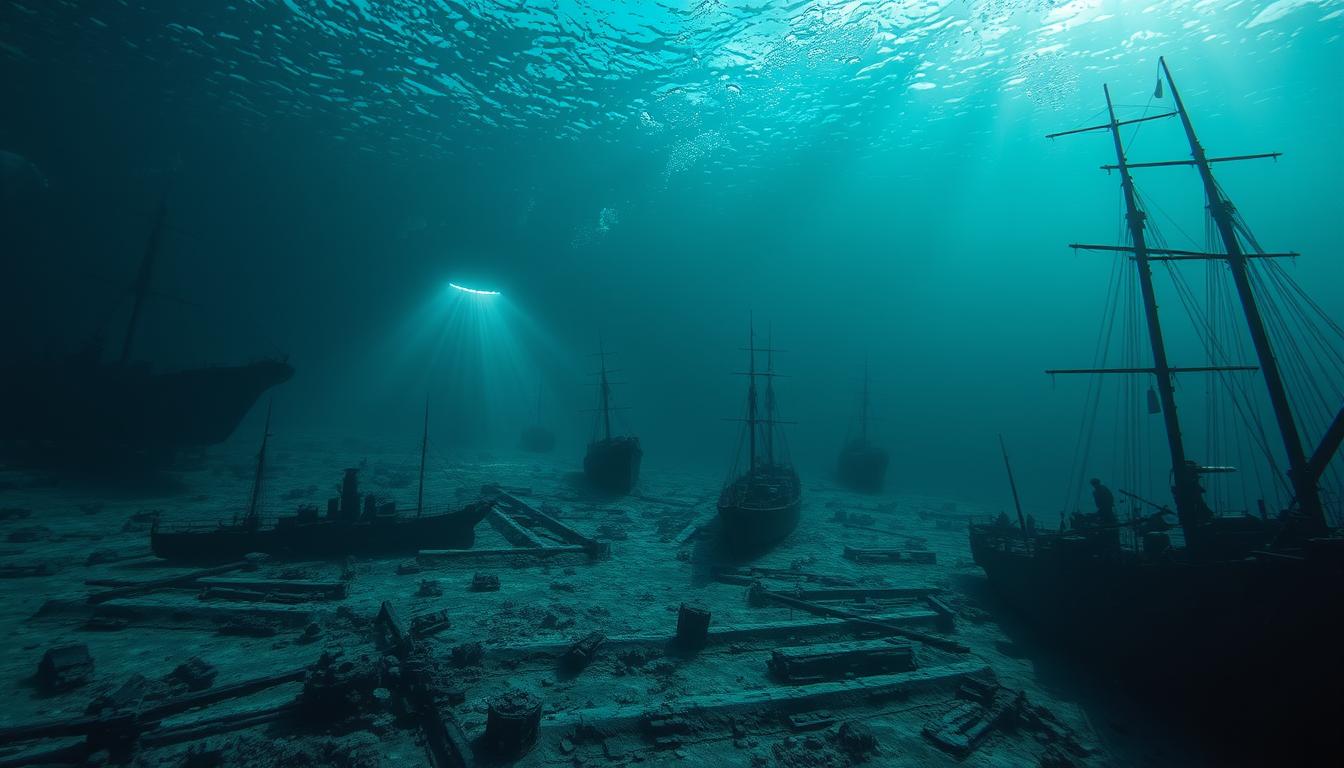
From the ocean’s depths, historic shipwrecks share secrets of the sea. Finds like the HMS Tyger, USS Johnston, and USS Stewart shed light on key naval battles. These sunken ships honor the bravery and sacrifice of those who fought.
The HMS Tyger, a British warship from 1742, was found near the Florida Keys in 2021. It had 50 cannons and a crew of 300, telling tales of the War of Jenkins’ Ear. The USS Johnston, found 6 kilometers deep in the Philippine Trench, commemorates its WWII role. The USS Stewart, known for its mysterious past, has served in both U.S. and Japanese fleets.
Thanks to explorers like Paul Allen and the Petrel, over 30 vessels have been found. These discoveries keep maritime history alive, linking past battles to today’s curiosity. Each wreck is a piece of the deep sea’s silent history.
What Are Sunken Warships?
Sunken warships are military vessels lost at sea. They serve as silent memorials to naval history. Battleships, destroyers like the USS Johnston, and British warships such as the HMS Tyger are examples. They sank due to combat, accidents, or intentional scuttling, preserving moments frozen in time.
Over 1,000 such vessels lie scattered globally. This represents about 10% of the world’s 3 million shipwrecks.
These sites hold immense value for naval heritage. They offer clues about past conflicts and technology. Maritime archaeology experts study them using advanced tools. Recoveries have risen 25% in the last decade.
Yet, only 5% have been fully explored. This leaves countless stories untold. Many remain protected under international laws, like the 2001 UNESCO Convention ratified by 60 nations. This safeguards these underwater graves.
Over 13,000 World War II shipwrecks have been mapped in an 8-year global study.
Legal frameworks ensure nations retain ownership of their vessels indefinitely. Policies from France to the U.S. stress respect for these sites as maritime graves. Despite their historical importance, 70% face threats from looting or salvage.
Protecting these historic shipwrecks ensures future generations can study them safely. This balance between exploration and preservation is key.
Famous Sunken Warships Around the World
The USS Johnston, a World War II ship, lies almost 6.5km deep in the Philippine Sea. It was found in 2022, after sinking in the Battle of Leyte Gulf. This battle was the largest naval fight in modern times.
The destroyer’s crew bravely fought against huge odds. Its discovery in 2022 shows how technology uncovers history’s secrets.

The HMS Tyger, a British warship from 1742, is found in the Florida Keys. It sank during the War of Jenkins’ Ear, a conflict in the 18th century. Its remains share stories of naval patrols back then.
The USS Stewart had a unique role—it served in both the U.S. and Japanese navies during WWII. This shows how alliances changed in naval battles.
Victor Vescovo’s team found the USS Johnston using advanced submersibles. The ship’s depth is deeper than the Titanic. This shows the limits of underwater exploration.
These wrecks, from ancient galleons to WWII icons, tell stories of bravery and tragedy. Each site is a silent witness to wars fought on the high seas. Now, they rest in the ocean’s darkest zones.
The Search for Sunken Warships
Deep-sea exploration has changed how we see history. New underwater tech like autonomous vehicles and advanced sonar uncover secrets. In 2022, Victor Vescovo’s Limiting Factor submarine found the USS Johnston at 6km depth. This showed submersibles can reach depths once thought impossible.
Ocean Infinity’s systems, using synthetic aperture sonar, found the USS Stewart after years. This shows how ocean exploration uses the latest tech to solve historical mysteries.
ROVs and AUVs explore huge areas, while sonar maps show where battles took place. The USS Perch’s 300-foot hull was found in the Java Sea using 3D imaging. But, finding these sites is hard due to rust, sediment, and legal issues.
The USS Houston’s site is threatened by scrap metal theft. This shows the need to balance discovery with preservation.
Technologists and historians work together to keep these sites as memorials. Discoveries like the HMS Hood’s hull and the Japanese carriers found in 2019 add to our knowledge. “These ships aren’t just metal—they’re time capsules,” says Dr. Sandra Steiger, a marine archaeologist. As tech improves, so does our understanding of naval history.
The Battle of the Atlantic and Its Wrecks
The Battle of the Atlantic was the longest and deadliestnaval battlesof World War II. It lasted five years, with a fight to control shipping lanes. German U-boats targeted Allied convoys, making it a race against time.
By mid-1942, U-boats sank ships off the U.S. East Coast. North Carolina saw 90 vessels destroyed. TheseWorld War II ships now lie on the seabed, creating a silent museum ofmaritime history.
NOAA’s expeditions from 2008 to 2011 found key sites like U-576 and SS Bluefields. They were sunk in the 1942 Battle of Convoy KS-520. These wrecks show the human cost: 36,200 naval lives lost and 3,500 ships destroyed.
By 1943, Allied technology outpaced U-boats. This ended the U-boat “happy time.” Advances like radar and codebreaking were key.
Today, these sunken sites remind us of the Atlantic’s key role. Sonar scans and submersible dives uncover stories of sacrifice and innovation. Protecting these relics lets future generations study the strategies and sacrifices ofmaritime history.
The ocean floor holds more than steel. It holds the echoes of a battle that nearly starved Britain. It shows the sea’s lasting impact on war itself.
Diving into History: Sunken Warship Tourism
Shipwreck tourism lets divers explore naval heritage up close. Turkey’s Gallipoli Historical Underwater Park, opening in 2023, will have 14 wrecks from 1915. This includes the British HMS Majestic. These sites, 80 meters deep or shallower, tell the stories of over 100,000 lives lost.
Places like Chuuk Lagoon and Egypt’s Thistlegorm are popular for divers. The Thistlegorm, at 95 feet deep, is a favorite for underwater discovery. The Hirokawa Maru, 475 feet long, lies between 10–200 feet, inviting exploration.
It’s important to protect these sites. Rules help visitors respect the delicate ecosystems and memorials. The Gallipoli park uses depth markers and guided tours to preserve its treasures. Divers learn to explore carefully, preserving history and marine life.
Shipwreck tourism connects the past with the present. By diving responsibly, explorers help keep these underwater ruins as lessons for the future.
The Role of Marine Archaeology
Maritime archaeology connects history and science, revealing stories hidden under the sea. Thanks to Jacques Cousteau’s SCUBA invention in 1943, divers have explored depths up to 30 meters. This has uncovered secrets of naval heritage.
Now, advanced tools like photogrammetry create 3D models of sites. For example, the 110-meter-deep Phoenician wreck near Malta is preserved without disturbing its fragile artifacts.

Underwater discovery requires a balance between curiosity and respect. Warship wrecks, like the USS Monitor at 70 meters, hold both historical value and serve as war graves. Researchers work with families and veterans to ensure ethical exploration.
Victor Vescovo, for instance, avoided certain sites to honor the wishes of victims’ relatives. This shows how modern maritime archaeology values dignity alongside discovery.
Despite progress, challenges remain. Deep-sea environments need specialized equipment to fight corrosion and decay. The Vasa, raised in 1961, took decades to preserve, revealing 17th-century shipbuilding secrets.
Climate change and rising seas threaten submerged sites. Storms and human activities like trawling also risk damaging these underwater museums.
Every expedition combines the latest technology with respect for the past. By documenting naval heritage without disruption, marine archaeologists ensure these stories last for future generations to learn, remember, and honor.
The Influence of Climate Change
Climate change is changing the fate of sunken warships, affecting ocean preservation and maritime history. Rising temperatures and acidifying waters speed up corrosion. This turns metal hulls into fragile skeletons.
Storms, now stronger due to warming seas, stir currents. These currents scrape away sediment, exposing wrecks to further decay. In New York’s waters alone, over 5,000 shipwrecks, including Civil War-era vessels, face these threats. Hurricane Sandy’s 2012 devastation showed how extreme weather can damage submerged sites.
Researchers like marine archaeologist Jennifer McKinnon stress urgency: “These wrecks are time capsules. Once lost, their stories vanish forever.” Bacteria feeding on oil residues in ships like the V-1302 John Mahn alter local ecosystems. Pollutants like TNT linger in sediments.
Warmer waters could worsen chemical leaks, affecting marine life. John Bricker’s dives revealed shocking damage to an armored cruiser within weeks. This shows how climate shifts amplify decay.
Efforts like underwater discovery projects now use drones and AI to map wrecks before they vanish. Yet, balancing access for exploration with protection remains critical. As ocean acidity rises, preserving these sites demands global action—not just for history, but to safeguard fragile underwater environments. Every corroded hull is a reminder: climate change’s ripple effects touch even the deepest corners of our seas.
Protecting Warship Wrecks
Legal frameworks like the UNESCO Convention on the Protection of Underwater Cultural Heritage and the 2015 Institut de droit international resolution shape global shipwreck protection efforts. These agreements ensure sunken military vessels remain sovereign property of their flag states, even after centuries underwater. The U.S. enforces this through the Sunken Military Craft Act (SMCA), which prohibits unauthorized disturbance of military wrecks in U.S. waters, imposing fines up to $100,000 per violation.

Nations like the U.S., UK, and Japan uphold naval heritage by treating wrecks as maritime gravesites. The Naval History and Heritage Command oversees 2,500+ U.S. wrecks, stressing respect for service members’ remains. Laws like the SMCA also guard against hazardous interference with unexploded ordnance, as seen in the 1941 sinking of HMS Prince of Wales and HMS Repulse, where 842 crew perished.
Maritime archaeology plays a key role, using non-invasive methods to document sites like the USS Hatteras. International cooperation under the UNESCO UCH Convention helps balance preservation with environmental concerns, ensuring wrecks aren’t disturbed unless authorized. These measures preserve both history and ocean ecosystems for future generations.
Uncovering Stories from the Deep
Every shipwreck has secrets waiting to be shared. The USS Johnston was found at a record depth of 6,220 meters. It shows a moment of respect between enemies.
Survivors told of a Japanese captain saluting as the destroyer sank during the Battle of Leyte Gulf. This rare gesture is etched in maritime history. It connects us to the bravery and humanity of those who served.
The USS Stewart has its own story. This vessel was captured and reused by Japan after it sank in 1942. It became a symbol of shifting naval heritage.
Its dual service shows how ships can have more than one story. Artifacts like letters or uniforms add a personal touch to these accounts. They turn statistics into real lives.
“These ships are more than metal—they’re echoes of courage and sacrifice,” said marine archaeologist Dr. Emily Carter.
Today, underwater discovery projects like the Research Vessel Petrel keep finding these stories. In 2019, they found the USS Hornet and Japanese carriers at Midway. This brought closure to families.
Even small items, like a sailor’s diary or a family photo, help historians piece together the past. These discoveries remind us that warships are vessels of memory.
By studying their final moments, we honor those who served. We preserve their legacies for future generations. Every dive into the deep unearths a new chapter in our shared maritime history.
Cultural Heritage and Sunken Warships
Naval heritage is more than just battleships and cannons. Sunken warships tell stories of bravery, sacrifice, and national pride. For Spain, the 1,500 lost colonial-era warships in the Atlantic represent centuries of maritime history. Their cargo, like gold from the Andes, is a topic of legal and cultural debate.

Maritime archaeology uncovers these stories. The Nuestra Señora de las Mercedes, a Spanish frigate lost in 1804, led to a legal battle between Peru and Spain over its cargo. Colombia’s Law 1675, passed in 2013, claims control over Spanish galleons like the San Jose, highlighting national sovereignty over sunken treasures. Yet, the 2001 UNESCO Convention faces challenges in gaining global support, leaving some sites unprotected.
The USS Stewart’s recommissioning after being recovered in WWII shows how these ships become emotional symbols. Courts, like the U.S. 11th Circuit, have ruled that nations keep ownership of lost warships, even after centuries. The U.S. policy also states that title to sunken State craft never expires, even in international waters.
Today, technology allows us to explore wrecks virtually, sharing maritime history worldwide. Museums display artifacts, like coins from the Odyssey case, but debates over access continue. Finding a balance between preservation and public access requires international cooperation. As technology improves, so does the need to protect these underwater treasures for future generations.
The Future of Marine Exploration
There are over three million shipwrecks waiting to be found on the ocean floor. Victor Vescovo’s new sonar suite can scan depths up to 10,000 meters. This technology could uncover secrets like the ARA San Juan or the Battle of the Atlantic mysteries.
Robots like the Deep Trekker DTG3 and Hugin AUVs are already exploring areas once thought unreachable. They are mapping places that were once off-limits.
Artificial intelligence and better imaging will help find shipwrecks quicker. Teams like the R/V Petrel’s crew have already found the USS Indianapolis. Even people who aren’t experts can help by analyzing data from projects like the Armada’s autonomous fleet.
Soon, virtual reality could let us explore these sites from anywhere. This could make the deepest wrecks accessible to everyone. But, we must also protect these sites. We need to keep the 2,000-year-old Roman shipwreck and other treasures safe for future generations.
With only 1% of shipwrecks explored, the future of ocean exploration is exciting. It will answer old questions and protect Earth’s hidden stories.