
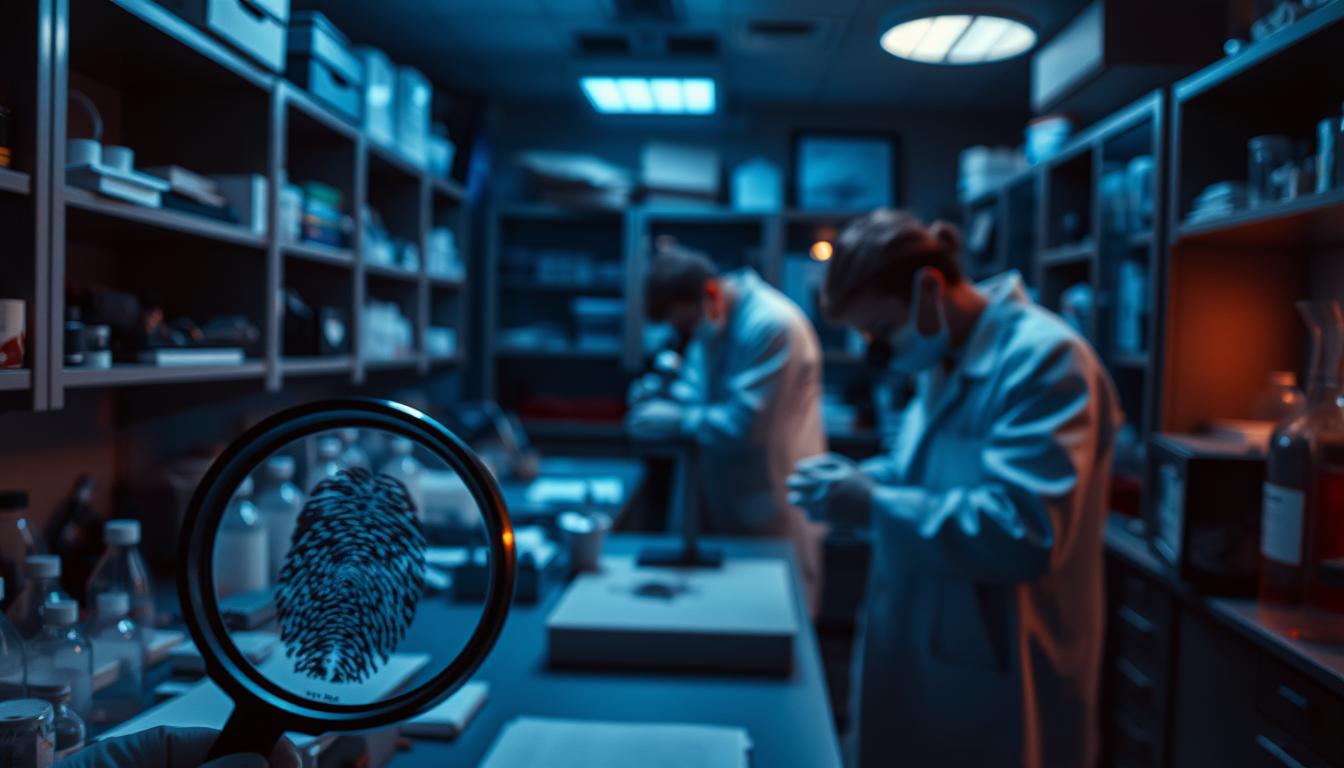
Imagine a priceless painting vanishing from a museum. A stray hair, a discarded phone, or synthetic drug traces could be clues. Forensic science turns these into proof, using DNA, digital forensics, and toxicology tests.
Every year, crime-solving techniques get better. They help solve cases from drug overdoses to thefts. Now, criminal investigation uses tools like NIST’s DNA standards and digital databases for justice.
NIST’s work makes sure labs worldwide use reliable methods. Their digital tools recover hidden data, while DNA standards match suspects. As synthetic drugs come and go in months, forensic science keeps up.
By combining chemistry, biology, and technology, this field finds answers in small details. It solves drug-related deaths and analyzes bullet casings, making unsolvable crimes solvable.
Understanding Forensic Science
Forensic science connects solving crimes with the courtroom. Forensic specialists transform clues like fingerprints and DNA into court evidence. They use chemistry, biology, and technology to find hidden details at crime scenes.
These experts follow a key principle. For example, forensic entomologists study insects on bodies to guess when someone died. DNA experts can match profiles with incredible accuracy, one in a quintillion. Even tiny things like pollen or glass fragments become important court evidence when analyzed by experts.
Forensic science has grown a lot over time. From early fingerprinting to today’s DNA databases, it has evolved. Now, forensic specialists use physics and chemistry to link suspects to crimes. Their work turns small clues into big wins in court, helping justice be served through science.
Types of Forensic Science Specialties
Forensic science has over a dozen specialties. Each one deals with different clues found at crime scenes. Experts in these fields turn scattered evidence into puzzles that can be solved. The American Academy of Forensic Sciences has recognized 12 key areas, making sure every piece of evidence gets the right expert.

Digital forensics is a key area. Specialists here recover data from phones, computers, and networks. They find hidden messages, deleted files, or internet histories that reveal cybercrimes or connect suspects to physical crimes. For instance, a missing person’s case might use digital footprints from GPS data or cloud backups.
Forensic toxicology deals with detecting drugs, alcohol, or poisons in samples. It helps figure out if substances caused death or impaired someone. Experts study how chemicals affected victims or suspects, helping in court about cause of death or intoxication levels.
Ballistics experts study firearms and ammunition. They match weapons to crime scenes by comparing bullet markings or trajectories. A bullet fragment or gunpowder residue can link a suspect to a shooting, which is vital in homicide or assault cases. Modern labs use 3D imaging to compare microscopic striations on bullets.
Other fields like document analysis or DNA profiling are also important. Handwriting examiners check signatures, while trace evidence specialists identify fibers or soil. All these specialties work together, making sure every clue, from a deleted text message to a bloodstain pattern, helps solve cases. The FBI and DEA rely on these experts every day, combining science and law to solve crimes across the country.
How DNA Evidence Works
DNA evidence is like a biological fingerprint, uniquely identifying individuals through their genetic code. Every cell, from a drop of blood to skin cells on a doorknob, contains DNA. Genetic fingerprinting focuses on sections called short tandem repeats (STRs), which repeat in patterns as unique as a snowflake.
These STRs form a profile that’s nearly impossible to duplicate. The chance of two unrelated people sharing the same 13 STR markers used in U.S. databases is less than 1 in a quintillion.
Crime scene investigators collect DNA from items like masks, weapons, or even licked stamps. Even tiny traces matter: a single cigarette butt or a glass rim can yield enough saliva for analysis. Once collected, samples are tested to create a profile.
This profile is then compared to the CODIS database, a national system housing over 10 million entries. CODIS links unsolved cases by matching crime scene DNA to offenders’ profiles. It has helped solve over 170,000 investigations.
But DNA’s power comes with challenges. Environmental factors like heat or time can degrade evidence. Labs must prevent contamination, as even a single stray cell could skew results.
Some jurisdictions face backlogs, delaying justice. Despite this, advances like touch DNA—extracting genetic material from surfaces like gun grips—have expanded its reach. When properly handled, DNA evidence can confirm a suspect’s presence or clear the innocent, proving vital in cases from thefts to cold hits.
The Role of Forensic Pathology
Forensic pathology is key in solving crimes. Medical examiners, experts in this field, figure out why and how someone died when it’s not clear. They use their medical knowledge and detective skills to find answers when death is sudden.
Every day, these pathologists do autopsies to find out what killed someone. It could be from natural causes, accidents, suicide, or murder. Their work helps decide legal outcomes and keeps communities safe. For example, they use tests to find drugs or injuries that can’t be seen with the eye.

But, the field faces big challenges. Only about 21 full-time forensic pathologists start work each year. This is much less than what’s needed. Becoming one takes over a decade of education and training.
Forensic pathologists also work with police to piece together what happened. Their evidence in court is often very important. In disasters, they help identify victims and find patterns that help public health. Their work connects medicine and justice, making sure every death is understood with science.
Crime Scene Investigation Basics
Crime scene investigation starts with securing the area to protect evidence. First, investigators cordon off the space to keep it clean. They take photos, videos, and sketches before touching anything. This crime scene investigation method makes sure no clues are missed.
The “spiral method” guides teams to work from the outside in. This helps preserve fragile evidence like blood spatter or shell casings.
Evidence collection begins with a visual sweep. Teams use gloves and sterile tools to gather clues. Biological samples, like blood or hair, are stored in special containers. Each item is labeled with time, date, and location to avoid mix-ups.
Proper packaging prevents evidence from degrading. A chain of custody log tracks who handles evidence. This ensures evidence is accepted in court.
Onsite tests, like chemical strips for blood, help decide which samples to send to labs. This reduces backlogs.
“Every mark, no matter how small, tells part of the story.”
Modern CSI combines science with practicality. Rural agencies might not have high-tech tools. They rely on trained officers for basics like sketching. Urban teams might use 3D scanners or drones for detailed mapping.
Training varies: some states require certification through the International Association for Identification. Others rely on on-the-job learning.
Whether analyzing tire tracks or reconstructing timelines, the goal is the same. It’s to turn clues into answers. Each step, from dusting for prints to sealing a bloodstain sample, helps solve cases.
The Impact of Fingerprint Analysis
Fingerprint analysis is key in solving crimes. For over a century, it has helped link suspects to crime scenes. Today, it combines old methods with new tools like digital imaging.

A 2020 NIST study found examiners face challenges. Out of 169, 85% made mistakes in matching prints. Yet, they rarely got it wrong when prints were clear.
Forensic labs are working to make the process more consistent. They use the ACE-V method to improve accuracy. NIST is also developing better algorithms for faster and more reliable matches.
Despite its long history, fingerprint analysis is getting better. New tools like multispectral imaging and AI are being used. The goal is to make it easier to solve crimes with fingerprint evidence.
Role of Forensic Anthropology
Forensic anthropology uses skeletal analysis to find clues that other methods miss. Experts study bones from old mummies to recent cold cases. They figure out age, ancestry, and injuries.
The Smithsonian’s National Museum of Natural History has been leading in this field for over 100 years. It has 30,000 skeletal specimens. These help improve how we identify remains.
For example, they solved the 1609 Jamestown cannibalism case. Bone trauma showed how desperate people were to survive.
Tools like CT scans and microscopic imaging help analyze bones without harming them. Forensic anthropologists can make faces from 3D scans or clay. This turns anonymous skeletons into people we can recognize.
Dr. Douglas Ubelaker studied European skulls. He found how facial structures changed over time. This shows how skeletal clues can tell us about history.
Human identification often uses DNA with skeletal findings. The DNA Doe Project solved the “Buckskin Girl” case in 2018. This shows how DNA and bones can solve cold cases.
Over 40 cold cases have been solved this way. It brings closure to families after years. Chemical tests, like arsenic detection, also help solve cases.
Forensic anthropologists work with pathologists to find out how someone died. They look at fractures or bullet paths. Their work helps identify missing persons and tell their stories.
By using old and new methods, this field keeps improving how we identify people.
The Evolution of Forensic Technology
Forensic technology has changed a lot over time. In 200 BC, the Babylonians used fingerprints to sign contracts. Later, in the 19th century, tools like microscopes and Sir Francis Galton’s fingerprint classification were developed. These steps started a journey that continues today with exciting forensic advancements.

DNA analysis changed investigations in 1984, thanks to Sir Alec Jeffreys. Now, forensic genealogy uses SNP profiling to link DNA evidence with public databases. This method helped solve big cases like the Green River Killer arrest in 2001. It shows how forensic technology keeps improving to solve tough mysteries.
Digital forensics now deals with cybercrime, like the 2011 arrest of hacker “Sabu.” New tools like 3D crime scene modeling and AI-driven blood spatter analysis make investigations more accurate. Portable DNA analyzers and cloud-based evidence storage show how forensic advancements make investigations easier. But, they also raise questions about privacy and reliability.
From 19th-century microscopes to AI algorithms, each step has changed justice. As technology advances, so do the ethical questions about its use. This shows that innovation in digital forensics is a double-edged sword, balancing progress with responsibility.
Ethics in Forensic Science
Forensic ethics guide how scientists handle evidence to ensure fair outcomes. Expert testimony must reflect scientific standards, avoiding assumptions or bias. For instance, labs using validated methods improve accuracy, yet 20% of wrongful convictions stem from flawed analyses.
Forensic scientists face pressures like dry-labbing—falsifying results—or letting bias influence conclusions. Dr. Kelly Elkins, a leading educator, stresses that 85% of professionals admit external pressures can cloud judgment. Her work highlights the need for ongoing training, as 70% of experts agree regular education maintains competence.
Confidentiality breaches affect 60% of cases, risking legal issues. Private consultants, lacking strict oversight, face higher ethical risks. Public labs like Maryland’s Forensic Sciences Division enforce strict protocols across three labs and 13 offices. Adhering to these standards ensures evidence holds up in court, per 95% of scientists who link protocols to admissibility.
Ethical dilemmas also arise when psychologists balance roles in legal cases. Transparency and informed consent protect clients. Over 90% of scientists document procedures to ensure accountability, yet 50% struggle to simplify findings during testimony.
Forensic ethics matter because they prevent wrongful arrests. The October 10, 2023 webinar on this topic underscored reforms like standardized ethics codes. By prioritizing integrity, the field can reduce errors and uphold justice.
Real Cases Solved by Forensic Science
Cold cases once thought unsolvable have found closure through forensic breakthroughs. The Golden State Killer case, unresolved for over four decades, was cracked using DNA evidence. This evidence was linked to a distant relative on a genealogy database. Teams like HudsonAlpha Discovery pioneered this method, leading to the identification of Joseph James DeAngelo.
This brought justice to victims’ families. The DNA Doe Project also helped identify an unidentified victim connected to John Wayne Gacy. This shows how modern tools can resolve even decades-old mysteries.
Forensic science also exonerates the wrongfully convicted. Organizations like the Innocence Project use DNA evidence to overturn wrongful criminal convictions. They have freed hundreds of people wrongfully convicted.
Historical cases, like Tommy Lee Andrews’ 1987 conviction, show how methods evolve. Early breakthroughs, like the 1784 bullet comparison trial or the 1248 arsenic detection methods, laid the groundwork for today’s precision.
Today’s advancements, from fingerprint accuracy to toxicology tests, continue shaping justice. Forensic anthropologists, toxicologists, and digital experts collaborate globally. They solve crimes that once seemed beyond reach.
As techniques improve, so does the hope for victims’ families. Whether through historic milestones or cutting-edge tech, forensic science remains a pillar of justice. It proves science can turn cold cases into resolved convictions.