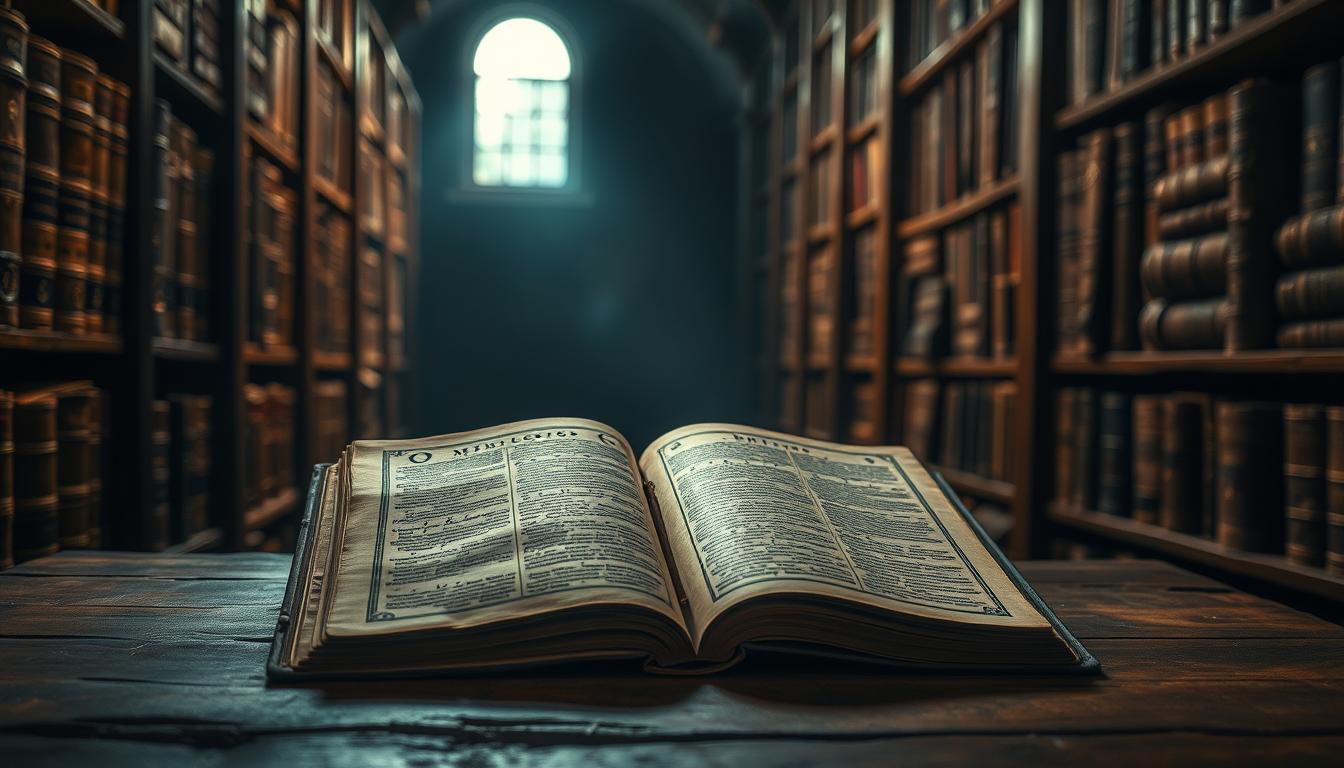
The Voynich Manuscript is a big mystery from the past. It’s a book from the early 1400s with strange pictures and text. Despite many tries, no one can figure out what it says.
This book is small, about 9 inches by 6 inches by 2 inches. It has 240 pages of strange symbols and pictures. It shows plants, stars, and weird figures, but its writing, called Voynichese, is a mystery. Now, it’s kept at Yale University’s Beinecke Library, where it has puzzled scholars for over a century.
Many questions surround this book. Who wrote it? What secrets does it hold? Some think it might be a code, a fake, or even from aliens. It has over 170,000 characters that look like real languages, but no one has unlocked its secrets. From old emperors to today’s AI experts, everyone who tries to solve it gets stuck. The Voynich Manuscript’s mystery keeps captivating and puzzling everyone who sees it.
What is the Voynich Manuscript?
The Voynich Manuscript is a medieval codex that’s 9.3 by 6.4 inches. It has 240 pages of vellum, divided into 18 sections. These pages are filled with strange diagrams and colorful drawings of plants, stars, and people. Today, it’s kept at the Beinecke Library at
Book dealer Wilfrid Voynich found it in 1912. It’s believed to be from the early 1400s. Tests show it was made between 1404 and 1438. Its pages feature six themes, including plants, stars, and naked women in baths. Despite its age, no one knows its language or purpose, making it a great mystery.
The text moves from left to right, with some pages folded to show hidden meanings. Scholars are unsure if it’s a guide to alchemy or a fake. It’s kept safe at the Beinecke Library and continues to intrigue experts from many fields.
Historical Context of the Voynich Manuscript
The Voynich Manuscript started its journey in the 17th century with Georg Baresch, a Prague alchemist. He noted its existence. By the late 1500s, it was in the collection of Holy Roman Emperor Rudolf II.
Rudolf paid 600 gold ducats, about $90,000 today, for it. He thought it was a lost work by Roger Bacon, a medieval philosopher. The medieval script and historical cipher puzzled scholars, sparking many theories about its origins.

Rudolf’s court chemist, Jacobus Horcicky de Tepenec, briefly owned it. Then, it disappeared. Later, connections to John Dee, an English astrologer, were found in Dee’s family archives.
For centuries, the codex was in Jesuit hands. Wilfrid Voynich, a Polish polymath, bought it in 1912. Born in 1864, Voynich, a former revolutionary, became its most famous caretaker. He showed it to the public, sparking modern interest.
Carbon dating shows it was made around 1420. This was 150 years before Rudolf owned it. Its 234 pages include herbal, astronomical, and biological sections.
Despite efforts by experts like William Friedman, it remains undeciphered. The medieval script looks like natural language, but its historical cipher is a mystery. Today, it continues to fascinate libraries and online communities, a lasting challenge for cryptographers and historians.
The Unbreakable Code: Decipherment Attempts
For over a century, experts have tried to crack the mysterious text of the Voynich Manuscript. Cryptographers like William and Elizebeth Friedman, pioneers in codebreaking during WWII, spent years analyzing its 246 vellum pages. Despite studying its 170,000 characters and unique glyphs, they found no patterns matching known languages. Even AI tools today struggle to link its symbols to Hebrew or Latin roots.
Early theories like William Romaine Newbold’s “anagrammed micrographic shorthand” briefly gained traction. But later research proved his claims false, leaving the manuscript decipherment puzzle unsolved. Modern scholars note its illustrations of unidentifiable plants and zodiac charts add layers to its mystery. Yet, no theory explains the text’s structure or origin conclusively.
Despite efforts by institutions like the Beinecke Library, the manuscript’s code remains intact. Its glyphs—25 to 30 unique symbols—resist alignment with any known cipher. Even WWII-era codebreakers like John Tiltman admitted defeat, calling it “a riddle wrapped in an enigma.”
Today, researchers use machine learning to scan for hidden patterns. Yet the manuscript’s endurance as an unsolved cryptography challenge highlights its lasting mystique. Each failed attempt deepens the question: Is it a coded message, an alchemical guide, or simply a beautiful fake?
Theories About the Manuscript’s Purpose
For centuries, the Voynich Manuscript has been a mystery. Its unknown language has sparked endless debate. Scholars and enthusiasts have many theories, from alchemical guides to hoaxes.
Some think it’s a medical compendium, while others believe it’s an encrypted historical cipher. They link it to 15th-century alchemists or astronomers.
Tim Ackerson thinks the text looks like Early Welsh or Old Cornish. Zbigniew Banasik believes it’s written in Manchu. Others suggest it’s a cipher, like William Friedman’s artificial language theory or Dan Burisch’s encoded Hebrew-Latin hybrid.
Gordon Rugg, though, thinks it’s a 16th-century scam. He believes a Cardan grille was used to mimic complexity.
The manuscript’s botanical illustrations are a mystery. They fuel speculation about herbal remedies or lost knowledge. The astrological diagrams also spark theories of a cosmic or mystical purpose.
Even AI analysis in 2017 and spectral imaging haven’t solved it. This shows its lasting mystery as a historical cipher. Theories like Erich von Däniken’s link to the Book of Enoch or Jim Child’s early German proposal show our creativity.
“The Voynich stands as a mirror to our fascination with the unknown,” noted a Elementary episode writer, echoing its role as a cultural symbol.
Whether it’s a medieval medical guide, a cryptographic riddle, or a clever forgery, its mystery remains. Each theory shows our desire to understand the past. This keeps the medieval mystery alive for generations.
The Voynich Manuscript’s Language
The Voynich Manuscript’s unknown language is a big mystery in history. It has over 170,000 characters, making up 35,000 “words” with 8,114 unique forms. Scholars have been trying to figure out if it’s a real language or a secret code for centuries.
Studies show strange rules in the text. Some characters only show up at the start or end of words. Others never appear together. A 2016 study found its manuscript decipherment is very hard, scoring around 2 on a scale of 3–4 for natural languages.
Some experts think the script looks like Hebrew. Dr. Gerard Cheshire suggested in 2019 it might mix Latin and ancient languages like Hebrew. But, there’s no agreement yet.
Researchers have tried new methods like multispectral imaging and handwriting analysis. But, no solution has convinced everyone. Each new idea, from medieval herbal guides to secret messages, is questioned. The manuscript’s unknown language remains a puzzle for linguists around the world.
Art and Illustrations: Visual Analysis
The Voynich Manuscript is filled with botanical illustrations in its first section. It shows 134 plants with text, but they are not clearly identified. This has led to debates about whether they are fictional or represent lost knowledge.
The second section features star charts with astrological symbols and circular designs. The third section has nude figures in pools, suggesting ritual practices.

New details were found using multispectral imaging. It revealed faded text on folio 1r and layers in the pharmaceutical sections. The ’s pages on balneology show plumbing-like networks, possibly for water systems or alchemy.
X-ray analysis showed medieval pigments were used, but their meanings are unknown.
The has 116 folios with a mix of herbal and astronomical art. It seems to blend science and mysticism. Its style is unique, unlike any other medieval manuscript.
The 102v1 folio has energy fields and roots that are hard to categorize. This adds to the mystery of the manuscript.
Scholars are unsure if the images show real practices or symbolic systems. Each drawing offers new interpretations, making the manuscript’s visuals as mysterious as its text.
The Science Behind the Manuscript
Carbon dating showed the Voynich Manuscript was made between 1404 and 1438. This was found at the University of Arizona in 2009. It confirmed the ancient manuscript was from the early Renaissance.
The results also proved it was a medieval codex made from calfskin parchment. Protein analysis found no reused material, so it’s not a palimpsest.
Multispectral imaging and polarized light microscopy revealed more. The inks used iron gall and copper, common in the 15th century. The pigments, like azurite blue and calcium carbonate white, were typical of the time.
The parchment is thin but strong, showing typical craftsmanship. Yet, its imperfections suggest it was made quickly. Even its flaws, like uneven edges and tears, are similar to other medieval codex fragments.
Modern analysis also shed light on its structure. It resembles herbal and medical manuscripts from the era. The use of abbreviations like “aq” for “aqua” links it to 15th-century medical texts. Yet, its unique alphabet and illustrations remain a mystery.
While science has revealed its age and materials, its purpose remains a mystery. Each discovery brings us closer, but the core of its purpose remains elusive.
Cultural Impact and Popular Interest
The Voynich Manuscript has become a cultural icon. Its release in 2016 by Yale University Press sparked widespread interest. Thousands of copies have been sold, sparking endless debates.
Online forums are filled with theories. Reddit users discuss everything from alien scripts to coded alchemy. One user
“Anyone else wondering if this is part of a lost Mayan codex?”

TV shows like National Geographic’s “Decoding the Past” and novels like Nick Laird’s Intentions to Perish have featured the manuscript. Yale’s Beinecke Library has digitized its 246 pages. Now, anyone can explore the mysterious text online.
TikTok creators also share their theories, keeping the manuscript in the spotlight. Diego Amancio’s 2014 study on the text’s language patterns has kept it in the news. But, questions remain: Is it a hoax, a cipher, or a “conworld”?
The $8,000 price tag hasn’t deterred fans. The Voynich represents humanity’s fascination with unsolved puzzles.
Current Research and Ongoing Studies
Today, researchers are using new tools to solve the manuscript decipherment mystery. At Yale University’s Beinecke Library, where the Voynich Manuscript is kept, teams mix cryptography and AI. Diego Amancio’s 2014 study found patterns in the text that look like real languages.
His team said, “The text is an actual language, not random gibberish.” This finding changed how people see the manuscript.
Linguists Claire Bowern and Luke Lindemann found two layers of statistics in the text. This suggests there might be hidden codes or scripts. Yale and Prague’s Italian Cultural Institute are working together, hosting seminars for students and scholars.
But, there are also setbacks. In 2019, a University of Bristol team claimed to have solved it, but their work was later criticized and withdrawn.
Now, researchers use spectral imaging and machine learning to study the manuscript. They look at ink chemistry and how often certain symbols appear. Even with these new methods, the manuscript remains a cryptography mystery. Each study brings us closer to understanding the secrets hidden in Yale’s archives.
The Manuscript’s Digital Legacy
In 2020, the Beinecke Library at Yale University made a big change. They digitized the entire ancient manuscript and put it online for free. Now, anyone can see the pages that were once only for scholars.
High-resolution scans show every detail, inviting new views to the mystery. This change has opened up the manuscript to more people.

Yale University Press has also released a facsimile of the manuscript. It was edited by Raymond Clemens. The book includes images and essays about the alchemical symbols and unknown text.
Deborah Harkness wrote the introduction, inviting readers to join the mystery.
“join us at the heart of the mystery.”
Now, digital tools help researchers find hidden text or track pigment changes. Online projects bring together cryptographers and historians. They test theories together.
Even though no code has been cracked, every effort helps. The manuscript’s story now reaches everyone, from Renaissance Italy to your screen.
The Ongoing Enigma of the Voynich Manuscript
The Voynich Manuscript is one of history’s biggest unsolved mysteries. Its historical cipher has stumped experts for years. Modern AI can’t fully solve its mysterious text.
In 2007, Nicholas Gibbs thought he’d cracked its herbal sections. But his translations didn’t follow grammar rules. Recently, AI compared its symbols to 15th-century Italian texts. It found patterns, but the meaning remains a mystery.
Yale University’s efforts to digitize it have raised awareness. But, they haven’t found the answers we seek.
Why does this artifact remain a puzzle? It challenges our views on how knowledge is shared. Its structure suggests a mind unlike ours. The illustrations of unknown plants and zodiacs add to the mystery.
Maybe its mystery reflects our own nature. We love solving puzzles but also enjoy the thrill of the unknown. The Voynich’s mysterious text makes us face our limits in understanding the past.
As research goes on, the manuscript’s legend grows. It shows that some questions need more than answers. They need humility. Even with AI, the Voynich keeps its secrets hidden.
Conclusion: The Allure of the Unknown
The Voynich Manuscript is a medieval mystery that has lasted for centuries. Its 240 pages are full of unknown script and strange pictures. These include plants that don’t exist and star charts that don’t make sense.
Despite being dated to the 1400s and analyzed with advanced technology, its purpose is unknown. This makes it a mystery that has not been solved, showing its incredible endurance.
What draws us to this codex? Its refusal to give answers feeds our deep desire for puzzles. It has been kept by many, from Emperor Rudolf II to Yale University, as a symbol of our limits.
While some think it’s about alchemy, herbal guides, or even aliens, its true meaning is a secret. This mystery teaches us that some truths are meant to stay hidden. In a world where we know so much, its mystery is a treasure, reminding us that not knowing is part of the journey.