
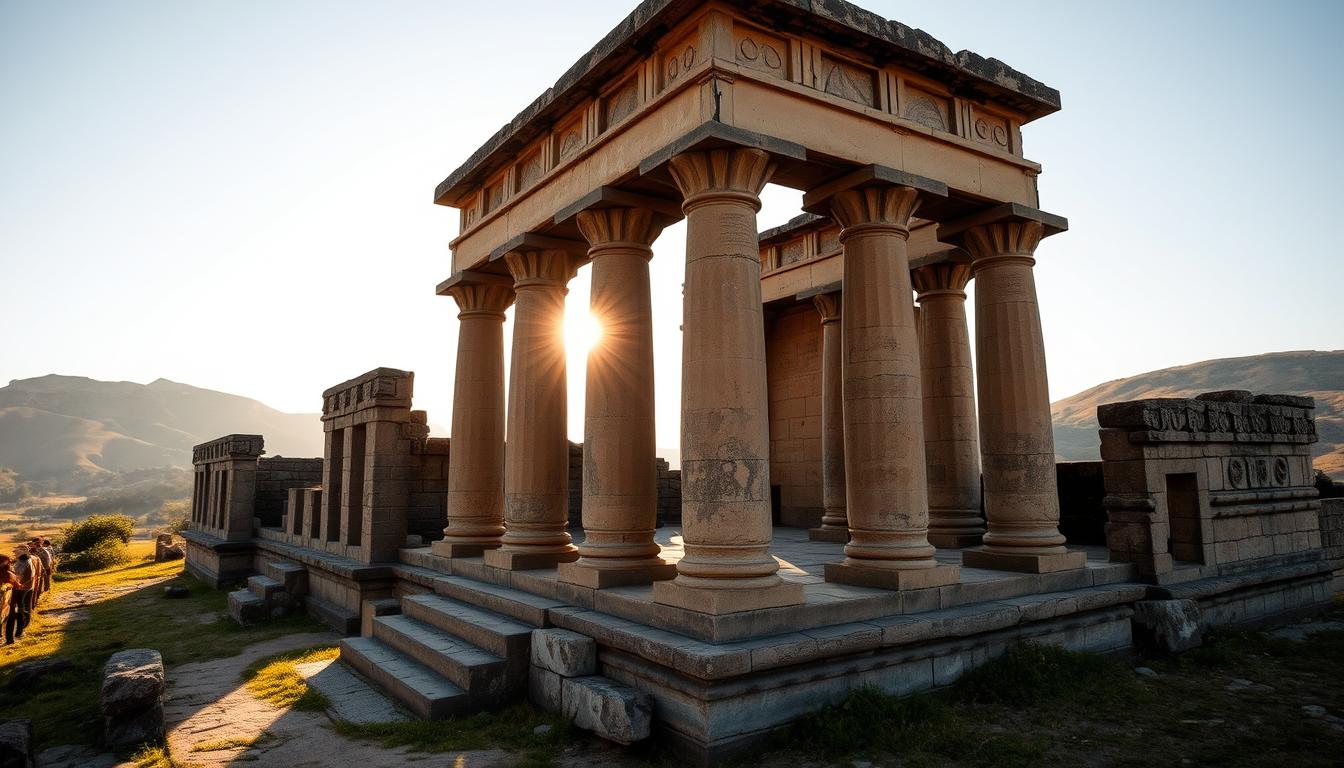
Humans first built structures over 12,000 years ago. Places like the Towers of Tell Qaramel and Göbekli Tepe’s temple show early community efforts. These monuments, from Jerf el-Ahmar to Mureybet, highlight the start of ancient construction.
Göbekli Tepe’s animal-carved pillars and Barnenez’s tomb are ancient wonders. They used materials like limestone and stone. Jericho’s tower and Malta’s temples show early societies’ ability to work together.
Monuments like Sechin Bajo in the Americas and Egypt’s Great Pyramid show construction’s growth. Uruk’s city and Stonehenge’s stones reveal how communities turned materials into lasting symbols.
What Constitutes the Oldest Known Structures?
Archaeologists have strict ancient structure criteria for the world’s oldest buildings. A site must have a clear form, intact features from its original time, and enclosed spaces with doors. This rule excludes standalone monuments like standing stones, even if they are ancient. Carbon dating and other archaeological dating techniques like stratigraphy and dendrochronology help find the exact time they were built.
Göbekli Tepe in Turkey, dating back to 9500 BC, meets these standards. It has massive limestone pillars and ritual spaces. Its circular layouts and carved symbols show advanced prehistoric construction methods. This proves it was a temple, not just a rock arrangement.
The Tower of Jericho, built around 8000 BC, is also considered a structure. It stands 28 feet tall and has staircases. Barnenez in France, from 4500 BC, keeps its megalithic architecture with 23 chambers. But sites like Stonehenge’s standing stones lack enclosed spaces, so they’re seen as monuments, not buildings.
Environmental factors like climate and human activity also affect preservation. Dry areas often keep structures better than wetter ones.
Discoveries like Mehrgarh in Pakistan, with 7500-year-old dwellings, show the power of carbon dating. It reveals tools and homes from early times. UNESCO-recognized Maltese temples, older than Stonehenge, used corbeled roofs, showing early engineering skills. As techniques get better, sites like Tell Qaramel’s 11,000-year-old stone circles may change how we see early architecture. Every new find changes how we understand humanity’s first lasting structures.
The Great Pyramids of Giza: Timeless Wonders
The Giza pyramid complex is a marvel of history. The Great Pyramid of Khufu, built around 2560 BCE, was once 481 feet tall. It was made of 2.3 million limestone blocks, each weighing up to 15 tons.
These stones fit together so well that a knife blade can’t slip between them. Recently, a sealed corridor was found deep inside the pyramid, revealing secrets.

How the pyramids were built is a mystery. Scholars think workers used ramps to move the blocks. But how they lifted stones to 480 feet is unknown.
The ScanPyramids project found a 100-foot void near the Grand Gallery. This discovery changes what we thought about hidden chambers. The 25-ton granite ceiling in the King’s Chamber shows incredible precision.
Behind the pyramids were 100,000 workers. They were fed by bakeries and had animal bones to eat. Despite losing its outer stones, the site’s three pyramids stand tall. The Great Pyramid was the tallest structure on Earth for 3,800 years.
Every block tells a story of a civilization that pushed human limits.
Stonehenge: Mysteries of the Megaliths

In Wiltshire, England, the megalithic stone circle of Stonehenge is a famous ancient British monument. It was built between 3000 BCE and 2000 BCE. The stones, weighing 2.5- to 25-tons, were moved 150 miles from Wales.
This neolithic construction is aligned with the summer solstice sunrise. This prehistoric astronomical alignment is a wonder to experts today.
Every June 21, sunlight hits the Heel Stone, lighting up the altar. This is tied to solstice ceremonies. But, the Stonehenge mystery grows when we think about its unfinished state.
Burial mounds and Durrington Walls suggest a large sacred area. In 2024, it was found that the Altar Stone came from Scotland, not Wales. This makes us question what the builders wanted.
Today, scans show over 50 million data points from damage by visitors. Despite research, many questions remain. Was it a temple, calendar, or burial site? With 1.6 million visitors a year, Stonehenge’s mystery and engineering continue to fascinate.
Göbekli Tepe: A Revolutionary Discovery
The Göbekli Tepe discovery in southeastern Turkey has changed history. This Turkish archaeological site is from 9500 BCE, 6,500 years before the pyramids. Its massive T-shaped pillars, up to 15 meters tall, form a 
Excavations show hunter-gatherers built this ancient religious complex. This challenges the idea that farming was needed for permanent structures. The site has over 200 pillars, some weighing up to 10 tons, showing organized labor before settled societies.
The builders left no pottery or domesticated crops. This suggests rituals were key to their nomadic life. Why was it buried around 8000 BCE? Some think it was due to changing spiritual practices or the environment.
A 2013 protective shelter now guards the stones from weather. Nearby Şanlıurfa Museum displays full-scale replicas. Only 10% of the site is uncovered, but it keeps surprising us.
Its detailed carvings and engineering show early communal efforts. This hunter-gatherer monument challenges our views of ancient societies. It shows humanity’s earliest architectural dreams.
The Ziggurats of Mesopotamia: Gods and Temples
Ancient Mesopotamian temples, like the Ziggurat of Ur, show early human creativity. These stepped pyramid designs were built in cities like Ur and Uruk. Rulers like Ur-Nammu built them to honor gods like Nanna.
They were made from sun-dried bricks. Their terraced layers seemed to reach the sky. This showed the ziggurat architecture’s skill in both engineering and spirituality.

The Ziggurat of Ur was rebuilt in the 1980s. It shows how these structures were both places of worship and administrative centers. Nearby, the Anu ziggurat of Uruk had the White Temple on a platform to avoid floods.
Each Sumerian religious structure showed a city’s faith. Staircases connected the earthly and divine realms.
These monuments in ancient Iraq changed over time. The Sialk ziggurat, from 3000 BCE, was before Ur’s famous one. Later, like Etemenanki in Babylon, they grew to seven tiers, inspiring stories like the Tower of Babel.
Even though they eroded, their bases show their former glory.
Ziggurats were more than just religious sites. They were the heart of urban life. They housed priests, stored grain, and were the site of festivals.
Their ability to survive floods and time shows the builders’ skill. They turned ziggurat architecture into lasting symbols of Mesopotamia’s spiritual and civic heart.
Machu Picchu: Inca Ingenuity and Landscape Harmony
Machu Picchu sits 7,970 feet high, a marvel of Inca stone architecture. Built in the 15th century, it was a project of Emperor Pachacuti. The structure blends perfectly with the Andes Mountains.
The Machu Picchu construction used Inca building techniques like ashlar masonry. This method made the stones fit so tightly, a knife can’t fit between them. The walls, made from andesite, have stood strong through many earthquakes.
At Machu Picchu, terraced fields show the Inca’s agricultural genius. Over 700 of these andenes helped grow crops on steep slopes. Water from 16 springs and canals kept the site alive, showing off advanced engineering.
The sacred mountain architecture also aligned buildings with solstices. This linked astronomy to daily life.
In 1911, Hiram Bingham rediscovered Machu Picchu, hiding from Spanish conquerors. UNESCO named it a World Heritage site in 1983. In 2007, it was named one of the New Seven Wonders. Today, it shows the Inca’s love for nature and their skill in building.
The Pantheon: Ancient Rome’s Architectural Triumph
The historic Roman temple known as the Pantheon is a marvel. It was built under Emperor Hadrian. Its Pantheon dome construction is unmatched in scale and innovation.
The 43.3-meter-wide dome has an open oculus. It once lit rituals with sunlight and rain. This ancient Roman engineering wonder used lightweight volcanic ash concrete at the top. This reduced weight while keeping strength.
The design mixed mathematics and mysticism. The dome’s height matches the rotunda’s diameter, creating a perfect sphere. The building survived thanks to being converted into a church in 609 CE.
Inside, you’ll find Egyptian granite columns and marbles from Tunisia and Asia Minor. These show Rome’s imperial reach. The Pantheon’s classical architecture influence inspires structures like the Jefferson Memorial and Florence’s Santa Maria del Fiore. Even after 1,900 years, it amazes us, showing Rome’s builders’ genius.
Skara Brae: A Glimpse into Neolithic Life
Skara Brae is a hidden gem on Orkney’s coast. It’s Northern Europe’s most intact neolithic village. Dating back to 3100 BCE, it’s older than Stonehenge and the Egyptian pyramids.
Its stone homes are connected by low passages. They show the cleverness of prehistoric domestic architecture. Inside, you’ll find carved stone furniture like beds and dressers, giving us a peek into life 5,000 years ago.
The builders used local stone and midden to keep warm. These stone age dwellings had indoor toilets and drainage. This shows they planned ahead.
After being left around 2500 BCE, sand covered it until a storm in 1850 uncovered it. Later, digs found tools, jewelry, and bones. This suggests they farmed, fished, and traded. But, there were no weapons, hinting at a peaceful society.
Skara Brae’s design shows a focus on community. It’s part of Orkney’s UNESCO World Heritage Site, near the Ring of Brodgar and Maes Howe tomb. Its survival is a testament to how ancient Orkney settlement design adapted to its environment and culture.
The Role of Ancient Structures in Modern Culture
Efforts to conserve ancient monuments ensure they last for future generations. Places like Göbekli Tepe, with a new museum by the Turkish Ministry of Tourism, show the balance between sharing and protecting. Cultural tourism boosts local economies, with sites like Machu Picchu and Rome’s Pantheon attracting millions.
Managing these sites is key to prevent damage from too many visitors. It’s about sharing their stories without harming them. This balance is essential.
Modern architecture draws inspiration from ancient designs. Roman concrete, mixed with volcanic ash, led to strong modern materials. The White House and Union Station in Washington use Roman arches and columns.
These designs show the lasting impact of ancient ideas. Even today’s roads and bridges follow Roman engineering, proving their enduring value.
These sites teach us about our shared history. Schools and documentaries use them to teach engineering and cultural values. Debates on returning artifacts remind us of their importance.
Efforts like 3D scanning and drone mapping help preserve these sites. They allow scientists to study without disrupting the site.
From inspiring modern buildings to boosting tourism and sparking debates, ancient structures are vital. They teach us about resilience, creativity, and the importance of cultural heritage. By protecting them, we honor the past and shape a future that learns from it.