
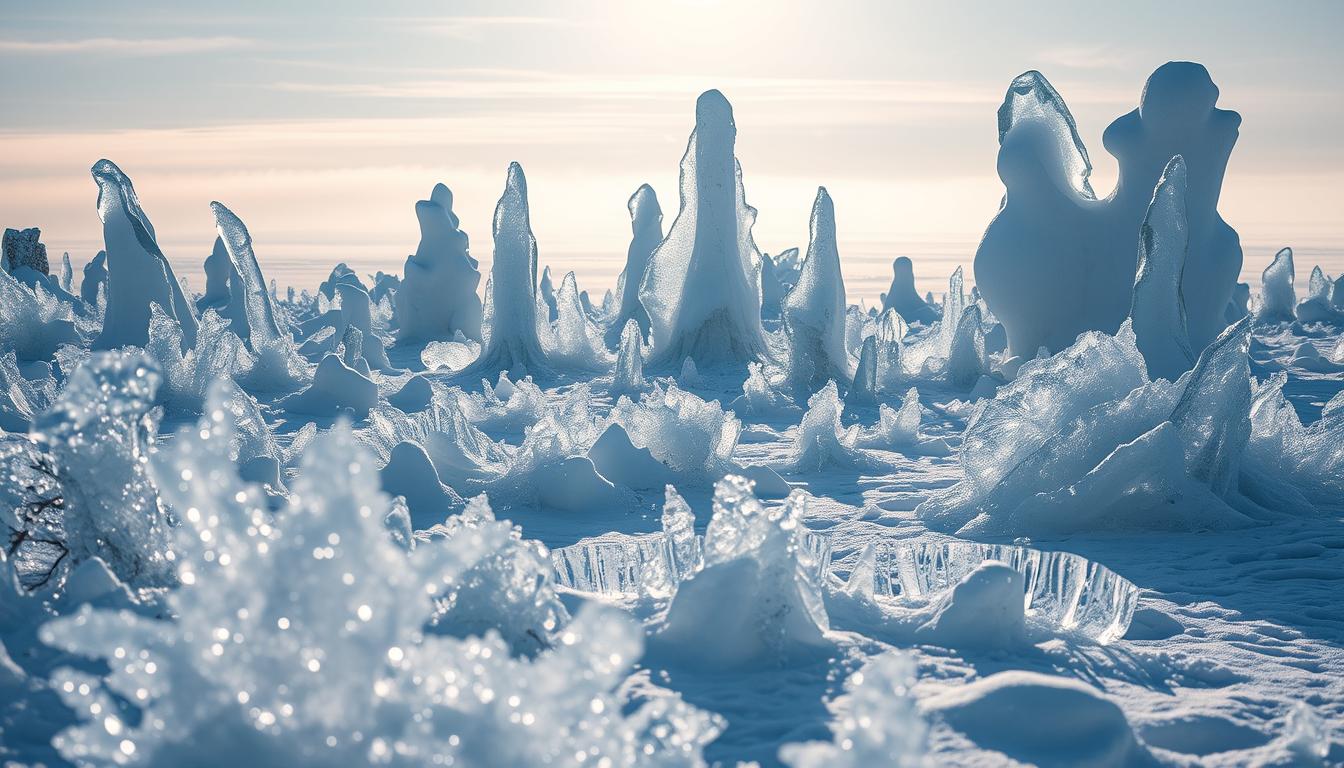
Nature’s cold creativity never stops surprising us. It creates spinning ice circles as big as basketball courts and delicate frost flowers on frozen plants. These strange ice formations are real, made by wind, water, and extreme temperatures.
In 2019, a 100-yard-wide ice disc spun in the Presumpscot River. This shows how natural ice phenomena can feel magical.
Frost flowers can hold a million bacteria, and pancake ice sheets can be as big as cars. These wonders form under exact conditions. From Antarctica’s jagged penitentes to hoar frost covering backyards, natural ice phenomena turn ordinary spots into surreal art.
Let’s explore how Earth’s chilliest tricks create these bizarre but real weird ice structures. They challenge what winter can do.
Introduction to Strange Ice Formations
Nature creates stunning ice sculptures under specific conditions. Water freezes from the top down, leaving a small opening. This opening lets liquid rise and freeze into delicate ice spikes.
These ice formations thrive in places where temperatures are just below freezing. The process starts with water molecules forming into hexagonal crystals. This creates beautiful patterns. Even small changes in temperature or humidity can shape unique structures.
“Five-foot-high frozen spires resembling telephone poles appeared on Lake Erie in 1963.”
Scientists found that ice spikes form best in shallow containers like bird baths. Using distilled water in ice cube trays mimics this. But, impurities in tap water can disrupt the process.
The 9% expansion of water when freezing creates pressure. This pressure forces liquid upward through the last unfrozen hole. This builds upward-growing spikes. Once the top freezes shut, growth stops.
Natural ice phenomena like frazil ice appear in turbulent water. These slushy crystals clump into pancakes in polar seas. Arctic ice grows thicker yearly, piling up over decades.
Even Antarctica’s open ocean churns frazil into thin pancakes instead. And brinicles—icy “fingers”—form underwater, trapping cold brine in hollow tubes.
From backyard ice cubes to Arctic seas, these frost formations show nature’s hidden chemistry. Their beauty hints at complex science shaping our planet’s coldest landscapes.
The Mysteries of Antarctic Ice Formations
Antarctica’s landscapes are full of wonders, like the towering penitentes. These spiky ice structures are found in the high Andes and Antarctica. They form when sunlight turns snow directly into vapor without melting.
Reaching heights over 16 feet, they point toward the sun, creating eerie, blade-like fields. These Antarctic ice formations are named after Spanish religious garb. Their jagged shapes mirror the pointed hoods of Holy Week penitents.

Scientists study these glacial ice features to uncover clues about Earth’s climate history. Antarctica’s blue ice zones, shaped by wind and pressure, reveal layers of frozen data. Researchers endure -70°C temperatures to analyze these icy puzzles.
They discover how they reflect past environmental conditions. Each formation holds secrets about our planet’s ancient climate and its future.
Penitentes grow in high-altitude deserts and cold polar regions, their tips always facing the sun. These structures and other glacial ice features act as natural archives. Their study offers clues to climate shifts, from ancient ice layers to modern melting rates.
As ice formations change, their stories may soon vanish—making every expedition a race against time.
Unique Ice Features Found in Glaciers
Iceland’s ice caves show nature’s artistry, with walls glowing in shades of blue ice phenomena. These glacial ice features form as ancient ice compacts over centuries. They filter out impurities and bend light into vivid hues. Visitors trek to Vatnajökull, where caves like Crystal Cave and Blue Ice Cave shift yearly.
Below the surface, glaciers hide dangers and wonders. Crevasses slice through ice like jagged teeth, while moulins roar with meltwater plunging into depths. Scientists study seracs—towering ice blocks—that shift during glacial surges. In 2013, Russia’s Vavilov Ice Cap surged at 26 meters daily, carving 10km toward the Arctic Sea.
Such shifts shape landscapes but threaten fragile ecosystems. Explorers face risks, from sudden collapses to -40°C temperatures. Yet these sites offer clues about climate change. Iceland’s glaciers, covering 11% of its land, are shrinking, altering ice cave formations.
The Hubbard Glacier’s 1986 surge blocked a fjord, proving glaciers’ dynamic power. Even tiny glacier fleas thrive here, surviving in ice cracks—a reminder of life’s tenacity.
Each year, these icy wonders rewrite their stories. As ice caves fade and reform, their fleeting beauty mirrors Earth’s fragile balance. For adventurers and researchers alike, they’re fleeting time capsules of our planet’s frozen history.
The Fascinating World of Ice Hoar
Hoar frost turns landscapes into winter wonderlands overnight. It forms when water vapor in the air freezes directly onto surfaces. This creates beautiful patterns.
Known as “frost on steroids,” hoar frost’s feathery spikes cling to branches, fences, and even grass. It turns ordinary scenes into magical displays.

Hoar frost needs freezing temperatures, high humidity, and calm air to form. It appears when surfaces like tree limbs are colder than the air. This lets vapor freeze instantly.
Surface hoar—a type of frost formations—lies on snowpack. It creates hidden dangers. These fragile layers weaken snow stability, making avalanches more likely in mountains.
Scientists are amazed by hoar frost’s structure. Each crystal follows a hexagonal pattern, mirroring water’s molecular makeup. The process happens silently, building delicate lattices that vanish with sunlight or wind.
Early risers often spot the best examples before dawn’s warmth melts them. Photographers race to capture these fleeting masterpieces before they disappear.
Cold mornings with clear skies are the best times to see hoar frost’s magic. Look for it near bodies of water, where moisture fuels its growth. While it’s a sight to see, hikers should stay alert in snowy areas—surface hoar’s hidden layers can lurk beneath the surface, posing unseen risks.
Bizarre Ice Forms Seen in Lakes
Ice circles, or ice discs, form where rivers bend, creating rotating strange ice formations. A 100-yard example in Maine’s Presumpscot River spun for days in 2019. Pancake ice floats in lakes as flat, round slabs. These strange ice formations arise when waves mold slush into circles, needing freezing temps and moving water.
Lake Baikal’s massive ice rings, first seen via satellite in 2000, baffle scientists. Some span 4 miles, spinning over underwater canyons. Of 57 recorded, 13 appeared near Nizhneye Izgolovye Cape. Researchers drilled 700 feet deep, finding warmer water in eddies. “The interplay of currents and cold is complex,” said one team.
“The science behind these wonders is not fully understood,” noted experts studying Baikal’s depths.
Pancake ice’s cousin, slush balls, form briefly in Manitoba. These delicate spheres vanish when touched, needing rapid cooling and wind. Even glaciologist Jeff Kavanaugh has never seen them in person. Ice circles need frazil ice buildup—a mix of needle-like crystals—to form. Witnessing these marvels demands perfect timing, as climate shifts may soon alter their fragile balance.
The Intricacies of Frost Flowers
Frost flowers, also called ice ribbons or ice flowers, form when freezing air meets warm soil. They appear as plant sap expands inside stems, splitting them open. This releases water that freezes into beautiful ribbons.
These structures are short-lived, melting by midday as temperatures rise. Each one is unique, lasting only a few hours.
On plants like Verbesinia virginica, frost flowers emerge as stems crack overnight. This happens when air chills below freezing but the ground stays warm. These ice ribbons can grow up to 30 centimeters tall, shining golden in the dawn light.
“These crystalline blooms are nature’s winter art,” wrote Sir John F. W. Herschel in 1833, capturing their ephemeral beauty during Antarctic exploration.
Scientists study ice flowers to learn about life trapped in their icy layers. They find clues about microbial life inside. Research shows these formations depend on soil texture, like clay-rich ground, that helps ice form.
Studies by Vernon Meentemeyer show how freezing sap pushes outward. This shapes each delicate filament.
See frost flowers at dawn after the first autumn freeze. Look for frostweed plants in Texas, where they often appear on tall stems. Their brief time means you must catch them early. Once sunlight warms the scene, these winter wonders disappear like morning mist.
Stunning Ice Formations in Caves
Deep underground, ice caves hide some of Earth’s most breathtaking strange ice formations. These subterranean wonders form when cold air traps moisture. This lets ice build into towering columns and translucent curtains.
In Austria’s Eisriesenwelt, the world’s longest ice cave, visitors explore over 42 kilometers of frozen tunnels. Iceland’s ice caves near Jökulsárlón Glacier Lagoon shift yearly. They offer blue hues from compacted glacial ice absorbing red light.
“The best time to visit is November to March,” says a Vatnajökull National Park guide, “when temperatures keep formations intact.”
These natural ice phenomena also face threats. Rising temperatures cause melting, risking collapses in places like Glacier National Park. Scientists study layers in ice to track climate history.
Local economies rely on tours—like Katla and Langjökull caves, accessible year-round via snowmobile. Even the Perlan Museum’s man-made ice cave offers insights into how real caves form.
Colors from volcanic ash or air bubbles add drama to these fragile ecosystems. While tours adapt with safety checks after recent incidents, preserving these icy gems requires balancing access with conservation. From Alaska to the Alps, each cave tells a story of ancient ice and its uncertain future.
How Climate Change Affects Ice Formations
Climate change and ice interact in ways that reshape Earth’s ice formations. Scientists see thinner glacial ice and changes in Arctic patterns. For example, Arctic Ocean ice forms later in autumn and melts sooner in spring.
In 2022, September ice coverage was 4.87 million square kilometers, down from the 1981–2010 average. This loss harms wildlife and coastal communities.
Rising temperatures change ice cycles. Multiyear ice, once a third of the Arctic, now is just 5%. Glacial ice features like ice ridges and melt ponds are also changing. Thinner ice lets darker ocean water absorb more heat, speeding warming.
This creates a feedback loop that weakens ice stability. It leads to longer stretches of open water.
But some ice patterns are showing up in new ways. Professor Jody Demming talks about frost flowers—delicate ice crystals on young sea ice. These form vast “meadows” where open water freezes.
These blooms, while fascinating, show shifting polar conditions. Also, melt ponds on ice sheets lower reflectivity. They absorb 94% more sunlight than snow-covered ice.

Arctic communities face erosion as ice-free coasts lose their protective barriers. Shipping routes like the Northwest Passage now open more often. This changes ecosystems and human activity.
While these changes bring challenges, they also show nature’s adaptability. Scientists keep tracking these shifts to understand how ice formations evolve with a warming planet.
Adventures in Ice Exploration
Thrill-seekers and nature lovers will love chasing strange ice formations. Iceland’s Vatnajökull glacier, Europe’s largest, has ice caves that glow blue. The Juneau Icefield in Alaska offers 1,500 square miles of frozen wilderness to explore.
Planning a trip? Safety first. Hire guides like Troll Expeditions for glacier hikes or ice cave tours. Always check ice thickness before stepping onto frozen lakes and watch the weather.
The Katla ice cave in Mýrdalsjökull and frost flowers on dead stalks are rare wonders. One explorer said,
“These ice flowers form even though the stalks are dried out… they’re rare and each is uniquely shaped.”
Timing is key: Juneau’s ice caves open in winter, and Iceland’s waterfalls like Hraunfossar are best seen under winter’s ice.
Bring layers, waterproof gear, and sturdy boots. Helicopter tours over the Juneau Icefield or guided treks on Langjökull let you see ice formations up close. Remember, natural ice phenomena like Iceland’s volcanic-tinged Snæfellsjökull glacier or Alaska’s Taku Glacier’s blue ice show Earth’s frozen beauty. Respect the environment by staying on marked paths to protect fragile ecosystems. With the right preparation and curiosity, every journey is a story of discovery.
Documenting Ice Formations Through Photography
Capturing strange ice formations needs patience and the right tools. Use a camera like the Panasonic G9, which works well in cold. Set your aperture to f/7.1 to f/8.0 for sharp details. Choose shutter speeds from 1/400 to 1/1200 seconds to freeze ice in motion.
Adjust your ISO from 200 to 3200 to balance light and noise in dark places. Macro lenses show hidden textures like frost flowers. A polarizing filter helps reduce glare on shiny surfaces.
Keep your batteries warm to make them last longer. For natural ice phenomena, stand 20–30 yards away to show scale. Even smartphones can capture amazing shots by focusing on contrast.

“The Panasonic G9’s 6400 ISO capability saved shots in near-freezing fog,” says photographer Wu, who documented the rapidly receding Pastoruri glacier at 17,000 feet. “Even small cameras can reveal nature’s hidden art.”
Look for ice photography in everyday scenes. Find rime on fences, hexagonal ice plates on ponds, or ice bubbles in frozen lakes. Use wide-angle lenses for big glaciers and close-ups for tiny details. Share your finds to document disappearing natural wonders.
Conclusion: The Ongoing Mystery of Ice
Nature’s ice creations, like hair ice and Antarctica’s ice sheets, show how small changes can make big differences. These strange ice formations remind us that even water has secrets. Scientists study natural ice phenomena like Antarctic ice shelves, which could raise sea levels by over 150 feet.
Projects like ANDRILL’s deep-sea drilling and citizen science efforts let everyone get involved. For example, documenting frost flowers or reporting hair ice sightings helps researchers. This helps them track climate clues hidden in ice formations.
Alfred Wegener’s early work on hair ice helped us understand today’s discoveries, like how Exidiopsis effusa fungi shape its silky threads. But many mysteries remain, like why some glaciers crackle audibly. Questions like these keep our curiosity alive.
Even small changes, like humidity levels creating hair ice’s fuzzy edges, show nature’s precision. Antarctica’s ice alone holds 70% of Earth’s freshwater, yet its ice formations have untold stories. As temperatures change, these frozen wonders remind us that every snowflake, icicle, and ice shelf is a puzzle piece in Earth’s evolving climate.
Whether we marvel at frost flowers or track melting ice sheets, the science—and beauty—of ice is a journey we’re all learning together.