
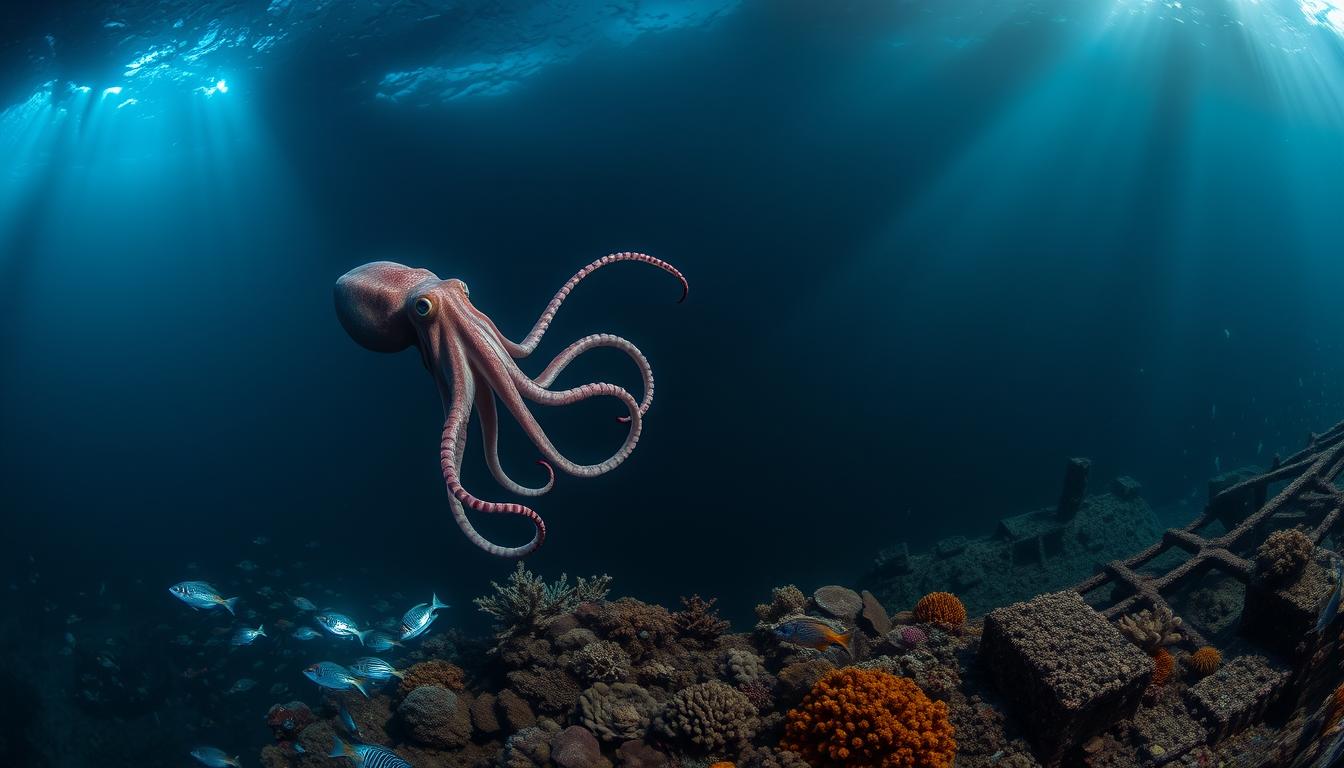
Earth’s ocean covers 71% of our planet and is home to 99.5% of all life. Yet, we’ve explored less than 5% of it. Marine research shows a world full of life beneath the waves.
From the deepest zones to the mesopelagic depths, scientists find species living in extreme conditions. Recently, they discovered over 7,564 unique microbial genomes in the deep sea. About 90% of these were new to science.
Ocean exploration is changing how we see biodiversity. The ocean has 34 phyla, twice as many as on land. These findings show the ocean’s importance as Earth’s largest ecosystem.
Breakthroughs like NCI’s use of deep-sea compounds in cancer trials show the ocean’s medical value. As technology improves, each dive into the ocean depths reveals secrets important for medicine, climate science, and health.
The ocean depths are full of wonders, from glowing species to creatures that help cycle carbon. This article looks at how marine research is uncovering these wonders. It also explains why these discoveries are important for life on land.
The Mysteries of the Mariana Trench
The Mariana Trench is the deepest part of our planet, dropping 10,984 meters into the Pacific Ocean. It’s a place where no sunlight reaches and temperatures are near freezing. At the bottom, called Challenger Deep, the pressure is so high it could crush most submarines.
But amazingly, life exists here. Missions like China’s Fendouzhe have shown us creatures like snailfish and giant amphipods living in these depths.
Studies have found that snailfish have special genes that help them survive the extreme pressure. The Mariana Trench Environment and Ecology Research Project discovered over 200 microorganisms, including huge amphipods up to 13 inches long. Sadly, pollution from plastic bags and microplastics has also been found in these creatures.
Even though we’ve been studying the Mariana Trench for decades, only 5% of it is mapped. It has five isolated habitats that suggest unique ecosystems. Scientists now see these trenches as biodiversity hotspots, not empty spaces. As technology improves, we continue to uncover the secrets of these deep, unexplored areas.
Strange Underwater Ecosystems
Deep sea ecosystems are full of wonders where life thrives without sunlight. Hydrothermal vents, found in 1977, release water over 400°C, supporting life like giant tube worms. These places are home to extremophiles, creatures that can survive pressures 250 times higher than at sea level.
At 2,500 meters, the Tica Vent shows snails, worms, and bacteria living in extreme conditions. This was once thought impossible.

NOAA’s “forest of the weird” in the Pacific revealed glass sponges and coral formations. These are homes to unique species like the “ET sponge.” Microbes here use chemosynthesis instead of photosynthesis.
Over 7,564 new microbial genomes were found, 90% unknown to science. This highlights the marine biodiversity in places like the Nazca Ridge. There, a 2-mile-tall underwater mountain has a coral garden the size of three tennis courts.
Extremophiles’ survival strategies, like pressure-resistant proteins, challenge our understanding of life’s limits. Scientists study these for insights into extraterrestrial life. Even the oceanic crust’s porous structure supports thriving microbial networks, showing life’s resilience.
With only 26% of the seafloor mapped, new discoveries are made. Like 25 new seamounts and 150 undocumented species. These ecosystems not only expand our knowledge of Earth’s biodiversity but also hint at possibilities beyond our planet.
Ancient Shipwrecks and Lost Treasures
Shipwrecks hidden in the ocean’s depths tell tales of empires, wars, and forgotten journeys. Underwater archaeology uncovers these treasures, like the Flor do Mar, a 16th-century Portuguese ship. It carried treasures worth billions today. Chuuk Lagoon, a graveyard of World War II naval vessels, shows how deep sea preservation keeps shipwrecks and artifacts safe in cold, dark waters.

The Spanish San José, known as the “holy grail of shipwrecks,” sank in 1708 with $20 billion in gold. Its 2015 discovery showed the importance of maritime history. The Belitung shipwreck, found off Indonesia, held 60,000 Tang dynasty artifacts. These artifacts prove ancient trade routes between China and the Middle East.
Florida’s 1715 treasure fleet is believed to have $400 million hidden, with coins washing ashore yearly. The Nuestra Señora de Atocha took 16 years to find, yielding $450 million in treasure. Modern scans have uncovered even older sites, like the 1533 Bom Jesus, the oldest shipwreck in sub-Saharan Africa.
Ethical debates surround these finds. While SS Central America’s gold and the San José’s uncut gemstones are fascinating, some sites, like war graves, need respectful study. These discoveries remind us of the importance of deep sea preservation. It lets shipwrecks share their stories for generations.
The Role of Technology in Deep Sea Explorations
Exploring the ocean’s darkest depths needs cutting-edge deep sea technology. Over half of U.S. territory underwater is unmapped. But, innovations like the HOV Fendouzhe now dive to 6,000 meters deep. These underwater vehicles can handle pressures 596 times greater than at sea level, making discoveries in dark places possible.

Remote operated vehicles (ROVs) like Deep Discoverer use robotic arms and 4K cameras to collect samples. Its suction samplers store specimens in six canisters. Probes measure hydrothermal vent temperatures up to 400°C. Autonomous underwater vehicles (AUVs) like Sentry map seafloors with multibeam sonar, showing shipwrecks and hydrocarbon plumes from disasters like the Deepwater Horizon.
“The deep sea is humanity’s final frontier,” says explorer Robert Ballard, who pioneered 120 expeditions to 12,000-foot depths. “Every dive uncovers new life forms.”
Ocean mapping advancements now reveal hidden features. AUVs like Sentry also analyze environmental DNA by filtering seawater. Marine exploration equipment like Alvin’s robotic arms recover artifacts from shipwrecks. With AI and swarm robotics coming, these tools will soon explore depths beyond 6,500 meters, unlocking secrets beneath 98% of the seafloor now accessible. As technology evolves, the mysteries of the abyss grow closer to light.
Bioluminescence: Nature’s Underwater Light Show
In the dark depths of the ocean, bioluminescent creatures light up the night. Deep sea light is more than just a way to survive—it’s a way to communicate. Anglerfish glow to lure prey, while green bomber worms flash light to confuse predators.

Marine bioluminescence works through a chemical reaction. This reaction makes cold light without heat. It helps creatures talk, hunt, and hide. Over 1,500 fish species use this ability, with some seeing red light that others can’t.
Dinoflagellates, tiny plankton, create huge underwater illumination blooms. These can be seen from space. Edie Widder, president of ORCA, has made cameras to capture these wonders.
Her work shows how bioluminescent creatures keep ocean ecosystems alive. Studies found 76% of deep-sea species glow. Even the ocean’s surface has glowing plankton, showing bioluminescence’s wide reach.
Bioluminescent proteins also help in medical imaging. But pollution and overfishing threaten these creatures. Widder says, “Understanding these lights could unlock secrets of life itself.” With most of Earth’s life in oceans, their light is vital.
Unveiling the Secrets of Ocean Currents
Ocean currents research uncovers forces that shape Earth’s climate. Deep water circulation, powered by thermohaline circulation, moves heat and nutrients far. It begins with cold, salty water sinking in polar areas, forming underwater rivers.
Scientists use sensors, satellites, and current tracking tools like underwater gliders to map these currents. These tools help us see how marine water moves. This movement connects distant ecosystems and shapes weather.
Recent studies show thermohaline circulation’s role in global carbon storage. Researchers like Widder use bioluminescent organisms to track carbon. This method lights up paths that were once invisible.
Advanced technology like autonomous vehicles and multi-beam echo sounders gather data once thought impossible. They show how currents support marine life and absorb CO2.
Climate change is a threat to these systems. Warming waters change deep water formation in places like the North Atlantic. This affects fisheries and storms.
Innovations in current tracking offer hope. They allow for real-time monitoring to predict changes. As scientists learn more about marine water movement, they highlight the need to protect these ocean highways.
Plastics and Pollution in Deep Waters
Deep sea pollution is changing life in the ocean’s darkest parts. At the Mariana Trench’s lowest point, Challenger Deep, researchers found a plastic bag tangled among the sediment. This shows how far human impact reaches.
Now, over 2,200 microplastic pieces per liter litter trench floors. These tiny pieces are often mistaken for food by deep-sea squids. They carry toxins that poison entire food chains.
Ocean plastic comes from far away: synthetic clothing fibers, discarded fishing nets, and packaging waste. The Tyrrhenian Sea has microplastic hotspots with two million fragments per square meter. Even deep trenches 11,000 meters down have polyester and PET plastics from East Asia.
These underwater debris trap heavy metals and pesticides. They create marine contamination zones that spread worldwide.
“By 2050, oceans could hold more plastic than fish by weight.”
Environmental impacts grow as cold, dark conditions slow plastic breakdown. ORCA’s pollution maps track toxin movements like weather patterns. They show how 10 million tons of plastic enter oceans yearly.
While surface patches get headlines, 99% of ocean plastic sinks into deep-sea sediments. We need to stop waste at its source. This is the only way to prevent another invisible crisis in the dark blue.
The Importance of Deep Sea Research
Deep sea resources are full of possibilities for new medicines and technologies. Scientists like William Fenical have made big discoveries. For example, they found a compound in skin creams and a drug for glioblastoma in ocean life.
“It makes no sense to exploit the planet’s riches without accountability.”
Keeping these ecosystems safe is key for our planet. Ocean conservation is vital. Yet, deep-sea mining could harm these areas, which took millions of years to form.
Research today helps us manage ocean resources wisely for the future. NOAA and the International Seabed Authority work together. But, we need more funding to keep exploring.
Every new find, from cancer treatments to climate insights, shows why deep sea research is important. It’s not just science—it’s about our survival.
Future Deep Sea Discoveries on the Horizon
Only about 5% of the ocean has been explored. This means there’s a lot more to discover. Projects like NOAA’s FY24 funding and the Nippon Foundation-GEBCO Seabed 2030 Project aim to map the seafloor by 2030.
Expeditions like the Aleutians Uncrewed Ocean Exploration are already finding new ecosystems. They use tools like the Saildrone Surveyor. These discoveries could help us understand climate patterns and biodiversity.
Sustainable research is key. It must balance our curiosity with protecting the ocean. Rising ocean temperatures threaten deep-sea life. Projects like NOAA’s Battle of Midway studies and Gulf of Mexico habitat restoration show we can explore and protect at the same time.
Edie Widder warns against exploiting the deep sea. Europe’s precautionary approach is a good example. It ensures discoveries help science without harming the ocean.
The deep sea holds secrets to solving global challenges. The 2025 Explorer-in-Training program and student-led debris analysis projects are inviting new generations to join. Collaboration between scientists, policymakers, and educators is essential.
The future of the deep sea isn’t just about what we find. It’s about protecting these wonders through marine conservation and innovation. The next chapters of our blue planet’s story await, but only if we explore and preserve together.